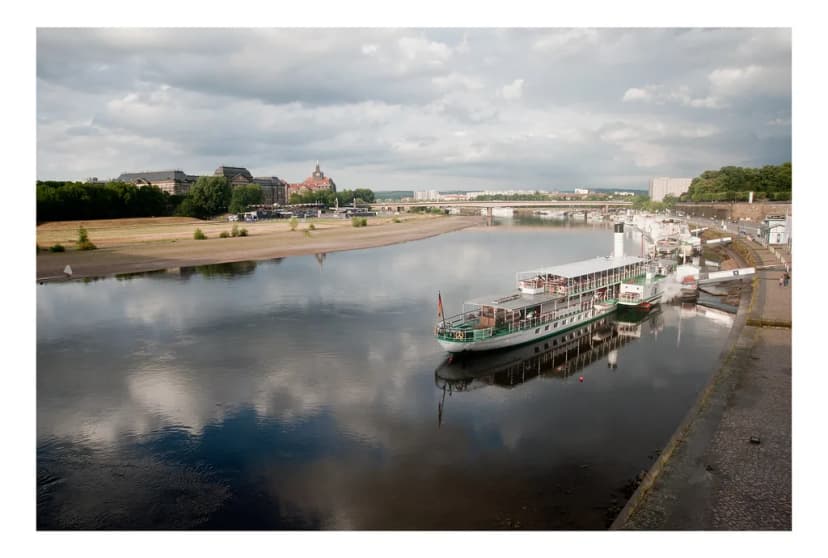
Standing on the Elbe bank with the Frauenkirche dome behind you and the terraces rising on the opposite side, the river explains Dresden faster than any walking route. From the water the city reads as a single composition: the rebuilt baroque skyline, the broad floodplain banks, and the wooded valley slopes that frame them. A boat puts all of that in front of you in one continuous view rather than piece by piece. As a rough suggestion rather than any official timing, allow a half day on the riverfront if you want to combine a short sailing with time on foot afterward.
The first thing to sort out is which product you are actually booking, because two completely different offers share the same search results. One is a local sightseeing loop that returns to Dresden the same day; the other is a multi-day Elbe cruise-tour that uses Dresden as a stop between larger cities and usually brackets the sailing with hotel stays. Comparing their prices line by line before you know which category you want is the most common planning mistake. Decide the category first, then compare at operator level.
What an Elbe River Cruise in Dresden Actually Is
Dresden is a port city on the broad basin of the Elbe, and the city publishes its current Elbe gauge reading alongside its arrival and transport information, so you can check water levels directly from the municipal source before you plan a sailing. The rebuilt baroque centre that defines the view from the deck was reconstructed across the second half of the twentieth century. The Zwinger palace buildings went back up in the 1950s and 1960s, the Semperoper was rebuilt in the 1980s, and the Frauenkirche was reconsecrated in 2005 after a seven-year reconstruction. Knowing that history changes what you are looking at: the skyline is a deliberate reconstruction, not continuous fabric.
Short City Loop or Multi-Day Elbe Cruise-Tour
City sightseeing boats run a compact loop on the Elbe around Dresden and are sold as an activity you do inside a normal sightseeing day. Multi-day Elbe cruise-tours are a different animal: they typically run between Berlin and Prague with Dresden, Meissen and Saxon Switzerland along the way, and they often begin and end with hotel stays in those two capitals. If your trip is a three-night Dresden stay, the loop is the realistic option. If you have ten days and want the river to be the trip, you are shopping in the cruise-tour category. A booking platform listing Dresden river sightseeing cruises confirms that short boat tours on the Elbe are sold as individual activities rather than as part of a multi-day package.
The specialist river-cruise position is that most Elbe products marketed as cruises are in fact cruise-tours, with the sailing sandwiched between city hotel nights. That distinction matters for cost comparison, because the hotel nights, transfers and some meals sit inside the headline figure on one product and outside it on another. Ask each operator to itemise what the quoted price contains before you treat two numbers as comparable. A shorter, cheaper-looking sailing can end up the more expensive holiday once the missing nights are added back.
Suggested durations, clearly labelled as our suggestions rather than official timings: allow one to two hours on the water for a city loop, and treat multi-day itineraries as roughly a week or more depending on the operator's programme. Confirm the exact sailing duration and the day's departure schedule directly with the operator when you book.
Ticket Scope: What a Dresden Boat Ticket Covers
A Dresden boat ticket buys you the sailing and the view; it does not buy you entry to the buildings you are looking at. The Frauenkirche, the Zwinger's museums and the Semperoper are separate admissions with their own tickets, and the collections inside a complex do not automatically share one ticket with each other or with the courtyard. Budget the boat and the interiors as two separate lines. If you want the Green Vault or a performance, treat those as independent bookings that have nothing to do with your cruise reservation.
On multi-day products the inclusion picture is more complicated and more variable, so read the itinerary line by line. Excursions may be bundled on one ship and optional on another, drinks policies differ, and city hotel nights are sometimes inside the fare and sometimes not. Request a current written inclusions summary from the operator before comparing prices. Compare what is inside the fare, not the headline number.
Getting to the riverfront itself is straightforward. Dresden's local transport network includes trams, buses, Elbe ferries and two mountain railway lines, and the Elberadweg cycle path runs along the river bank away from road traffic. Use the city's own arrival and transport pages to plan your approach rather than relying on remembered tram numbers, since routes change with construction. Civil works along the Elbe corridor do occur and can close sections of the riverside path.
What You See From the Water
The signature view is the old city seen from the river: the Frauenkirche dome, the Zwinger's pavilions and the Semperoper grouped behind the terraces. Brühl's Terrace is the raised promenade that gives the embankment its nickname, and from a boat you see it as a long balustraded line rather than as a viewpoint you are standing on. For context on the walkway itself and its position above the water, the Bruhl Terrace Dresden visitor guide is worth reading before or after your sailing.
The bridges are as much of the experience as the buildings. The Blue Wonder, the steel suspension bridge upstream, has a profile unlike anything else on the river, and sailing beneath it is a different perspective from crossing it on foot. The Blue Wonder Bridge Dresden visitor guide covers the structure and its setting if you want to pair a crossing with a river trip.
Beyond the city, the view opens into the Elbe Valley slopes and the floodplain meadows that flank the river, with the Elberadweg cycle route running along the bank. Dresden markets the river corridor as part of its green and recreation infrastructure, and the meadows are genuinely part of the landscape rather than leftover land. Wildlife in the floodplain is a real feature of longer stretches, including beavers, otters and large birds such as cranes and white-tailed eagles in the protected middle reaches of the river.
Upstream to Saxon Switzerland and the Bastei
Sailing upstream toward Saxon Switzerland is a landscape day, not a city day, and it is the reason many travellers choose the Elbe over a more conventional river. Saxon Switzerland is a national park about 19 miles, roughly 30 kilometres, southeast of Dresden, where sandstone has eroded into tower-like formations. The Bastei is the best-known group, a collection of jagged rocks linked by a footbridge. Expect cliffs and forest rather than skyline. For planning a land-based visit to the same area, the Saxon Switzerland from Dresden guide covers the logistics of getting there independently.
The practical consequence is that access to the rocks is not from the boat deck; the dramatic viewpoints sit above the river and are reached on foot from landing points. If seeing the Bastei from the top matters to you, check what the itinerary actually includes beyond the sailing itself. A sailing that passes beneath the formations and a day that puts you on the bridge are different products.
Downstream to Meissen and Porcelain Country
Heading downstream, the river passes through the wine-growing Elbe Valley and reaches Meissen, where porcelain heritage and the Albrechtsburg define the town's identity. The specialist river-cruise assessment places Meissen's porcelain heritage alongside Wittenberg and Dresden as the cultural anchors of the German Elbe. This is a stop where the shore content usually matters more than the sailing, so check whether the itinerary includes time in the town. Some longer itineraries also connect onward to Berlin and Prague, which are separate cities rather than alternatives to Dresden. For a self-planned visit, the Meissen day trip from Dresden guide covers getting there on your own.
Timing: May, June and October Versus Summer Low Water
Water level is the single biggest variable on the Elbe, and the specialist river-cruise position is that late spring and October are the sweet spots, offering greenery or autumn colour along with more stable conditions. The same source identifies July to September as the main low-water risk and spring snowmelt as the high-water risk, when ships can be unable to pass under Dresden's historic bridges. Treat this as an operator and industry assessment of patterns, not as a guarantee about any particular week. Weather in any given year can override the seasonal norm entirely.
The German stretch of the Elbe is unusual among major European rivers in having virtually no lock-and-dam system, which is why it behaves more like a natural, free-flowing waterway than a managed canal. That is also why level changes translate so directly into itinerary changes. Before you commit to a date or a route, look up the current Elbe gauge reading for Dresden; the city publishes it alongside its arrival and transport information.
Ship Types and Why the Elbe Is Different
Because the river is shallow, Elbe vessels are purpose-built rather than borrowed from other routes: smaller ships with specialised drafts, and in some cases paddlewheel technology designed to cope with a sandy bed. The specialist assessment is that this engineering is what allows certain operators to keep sailing when water drops and others to fall back on substitute road transfers. Passenger capacity on the Elbe is correspondingly small, which is why berths on this river are limited compared with the Danube or Rhine. Small ships mean fewer cabins to sell, not a quieter river.
If your priority is reaching a specific far point on the itinerary, the ship class is the thing to interrogate, because a shallow-draft vessel and a paddlewheeler do not have identical reach in low conditions. Ask the operator directly what happens to your itinerary if levels fall, and get the answer for your specific sailing. Do not assume a substitute coach segment is included at no cost or that it will follow the same route.
Practical Planning and Booking
Treat booking as two separate decisions: which category of product you want, and which operator within it. For a Dresden city loop, availability is generally day-based and can usually be arranged close to your visit; for a multi-day cruise-tour, cabins are limited and worth reserving earlier. Request a written inclusions summary before paying anything, and ask specifically about hotel nights, transfers and shore excursions.
Build the rest of your Dresden day around the sailing rather than the other way round, because river timetables shift with conditions. A morning on the water leaves the afternoon free for the old city on foot, and the Albertinum Dresden visitor guide is a reasonable indoor counterpart if the weather turns. An evening sailing has its own appeal, with the illuminated skyline a particular draw, and Dresden at night covers what changes after dark. Keep one flexible slot in your plan in case the operator moves your departure.
Choosing Your Dresden Elbe Cruise
Decide the category first: a city loop that fits inside a Dresden day, or a multi-day cruise-tour in which Dresden is one stop. Once that is settled, the rest of the comparison becomes sensible, because you are no longer weighing a two-hour boat ride against a week-long holiday. Check inclusions in writing rather than comparing headline prices that may bundle completely different things. Then confirm the level of the Elbe and the operator's current schedule before you commit.
Whichever route you pick, keep the water level and the operator's own schedule as your final check, since both can change an itinerary quickly. A flexible plan with one movable slot handles that far better than a tightly packed day. Book the boat for the view, and the buildings for the history, as separate items. Do that and the Elbe becomes the easiest part of your Dresden trip rather than the riskiest.
Frequently Asked Questions
How long is a Dresden Elbe river cruise?
City sightseeing boats work as short loops you fit into a normal sightseeing day, so the water time is a matter of an hour or two rather than a full day. Multi-day Elbe cruise-tours run for roughly a week or more and typically bracket the sailing with hotel stays in larger cities. Operators do not publish a single standard duration for the Dresden stretch, so check the specific itinerary you are considering for its own sailing and port times.
Is a Dresden river cruise the same as a multi-day Elbe cruise?
No, and conflating them is the most common planning error. A Dresden river cruise keeps you in the city and returns you to the same place the same day, while a multi-day Elbe cruise-tour moves you between cities over a longer period, often with hotel nights before and after the sailing. They are different products with different prices, different inclusion rules and different booking horizons. Decide which category you want before comparing anything else.
What can you see from the water in Dresden?
From the deck you get the old city as a single composition: the Frauenkirche dome, the Zwinger and the Semperoper behind the embankment, with Brühl's Terrace running above the water. The bridges are part of the view too, including the Blue Wonder upstream. Beyond the centre the Elbe Valley slopes and the riverbank cycle path open up. The buildings you pass are seen, not entered, so any interior visit is a separate arrangement.
When is the best time of year to cruise the Elbe at Dresden?
The specialist river-cruise assessment points to late spring and October as the most reliable window, when conditions are generally more stable and the valley looks its best. The same source flags July to September as the period when low water is most likely, and spring snowmelt as the moment when high water can stop ships passing under Dresden's bridges. Those are patterns rather than guarantees, so check the current river situation before you travel.
Can low water levels cancel or shorten an Elbe cruise?
They can force changes, and the industry position is that shallow-draft and paddlewheel vessels cope better than standard ships. Where a ship cannot continue, operators have been known to substitute coach transfers for parts of a route, which changes the experience even when the holiday continues. Whether any specific sailing is affected depends on conditions at the time, so ask your operator how they handle low or high water on your particular itinerary rather than relying on general advice.
Are there Elbe cruises to Saxon Switzerland or Meissen?
Yes, both appear as destinations on Elbe itineraries, with Saxon Switzerland roughly 19 miles southeast of Dresden and home to the Bastei rock formations. Meissen is downstream and known for its porcelain heritage and the Albrechtsburg. What differs is how much time ashore each product gives you, since some routes pass the scenery while others put you on land. Check the shore-time detail before assuming a stop means a visit.
Do I need to book a Dresden Elbe river cruise in advance?
Short city loops are usually arranged close to the day you want to sail, while multi-day cruise-tours on the Elbe involve limited berths and reward earlier booking. Exact availability for any operator changes constantly and cannot be assumed from a website listing alone. Contact the operator directly for current departures and cabin or seat availability, and confirm the sailing time you want rather than relying on a general timetable.
Does a Dresden boat ticket include entry to the Frauenkirche or Zwinger?
No. A boat ticket covers the sailing and the view from the water; the Frauenkirche, the Zwinger's museums and the Semperoper are separate admissions with their own arrangements. Museums within a complex do not automatically share one ticket either. Plan the boat and the interiors as separate items in both your schedule and your budget, and check each attraction's own current arrangements before you go.