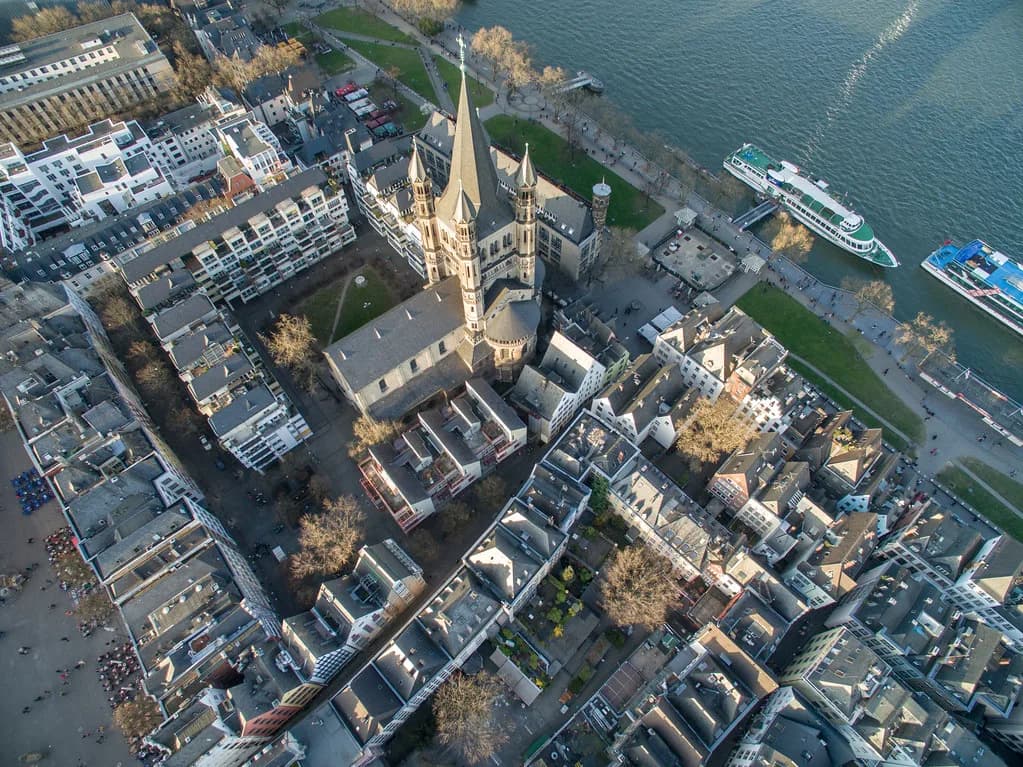
Great St. Martin, written Gross Sankt Martin in German, is a three-aisled pillar basilica with a trikonchos plan: a square chancel flanked by three large semicircular apses. The crossing tower rises 75 metres above a church that measures over 50 metres in length and is flanked by four octagonal turrets. It stands at Martinsstrasse 9 in Cologne's old town, on what was once part of a Rhine island just east of the Roman Praetorium.
The archaeology is the reason to step inside rather than photograph the exterior alone. Excavations in the war-damaged church during the 1970s revealed the remains of an ancient water basin and large storehouses, known as horrea, and the walls of those Roman storehouses had been incorporated into the medieval church building. Parts of the water basin and the surrounding walls of the former square are displayed near the choir of today's crypt. As a suggested duration rather than an official figure, allow roughly 30 to 45 minutes inside, plus time outside for the tower and river frontage.
Why Great St. Martin Matters in Cologne
Cologne's skyline is usually read through the cathedral, but the city's Romanesque churches form a second, older network of landmarks, and Great St. Martin is among the most prominent of them. It belongs to the group commonly called the twelve Romanesque churches of Cologne, alongside buildings such as St. Gereon, St. Aposteln and St. Pantaleon. Together they reflect a period when Cologne was a major religious and pilgrimage centre rather than simply a cathedral city.
The site matters as much as the building. It occupied part of a Rhine island just east of the Roman Praetorium, the administrative centre of Colonia Claudia Ara Agrippinensium, and excavations between 1965 and 1979 showed continuous occupation from the first century onward. That combination of Roman riverside infrastructure, a medieval monastery church and a modern city square is what makes a stop here different from a purely architectural visit.
The Romanesque Architecture Explained
The plan is the first thing to understand. Great St. Martin is a three-aisled pillar basilica with a trikonchos plan: a square chancel flanked by three large semicircular apses that form a cloverleaf shape when seen from the east. The church runs over 50 metres in length, and the apses are crowned with rounded, semi-conical roofs, arcades and columns that read unmistakably as Romanesque work.
Above the crossing rises the tower, 75 metres high and flanked by four octagonal turrets, with the trefoil apses merging visually into its base when viewed from the river side. A dwarf gallery runs along the upper sections, tying the apses and tower together horizontally. That band plus the vertical tower is why the silhouette registers from the Rhine promenade long before you reach the church.
Not everything is of one date. Romanesque design dominates the choir and crossing tower, while Gothic influence appears in the upper nave, particularly in the triforium and clerestory. The 19th and 20th-century restorations added their own layer, so reading the interior is partly an exercise in spotting where medieval fabric ends and revival work begins.
Beneath the Church: Roman Storehouses and the Water Basin
Excavations in the war-damaged church during the 1970s uncovered an ancient water basin and large storehouses, and the walls of the Roman storehouses had been incorporated into the medieval church building. Some of the results are on display: parts of the water basin and the surrounding walls of the former square near the choir of the modern crypt. Remains of pillars and the outer walls of the horrea with their external supporting pillars can also be seen in the walls.
The earliest uncovered structure on the site was an enclosed complex with a large open area measuring about 76 by 71 metres and a sunken water basin nearly 35 metres long and 17 metres wide, a feature described as having no parallels north of the Alps. By the mid-second century the ground was raised and multi-aisled halls were built on three sides, most likely warehouses for goods traded along the Rhine. One of those halls stayed in use long after the Roman period, with signs of repeated renovation and Carolingian-period pottery found on site.
Treat the crypt and the excavation display as one continuous layer rather than two separate sights, since the Roman structures sit directly under the space you walk through above. Access arrangements are set locally and can change, so confirm with the parish or the city's visitor information before assuming the crypt is open on a given day.
Reading the Interior: Brigid Chapel, Baptistery and Surviving Art
Much of the older furnishing was lost in the 20th century, so what remains is a selective group: objects from the 13th to 16th centuries, later donated or purchased pieces, and some works from the 1980s. That mix explains why the interior can feel less uniformly medieval than visitors expect from a Romanesque church.
In the west bay of the south aisle, surviving wall fragments mark the demolished parish church of St. Brigida, which shared part of its south wall with Great St. Martin from the middle of the 12th century. The niche now holds a Baroque wooden statue of Brigida of Kildare with a crozier, and the floor mosaic nearby depicts the biblical seven fat cows — a small, easily missed pairing that rewards a slow look.
The baptistery holds three key works: a crucifixion group from 1509, a burial group and a baptismal font. The crucifixion sculptures — Christ with Mary and John — are associated with the Cologne sculptor Tilman van der Burch, and only three small statuettes survive from the Gothic sandstone arch that once framed the group; the rest of the arch is weathered. Standing close, the anatomy and the side wound are the details to look for.
From Benedictine Abbey to Wartime Ruin
Although the site's Roman past is older, the confirmed founding of Great St. Martin as a collegiate church is credited to Archbishop Bruno of Cologne in the mid-10th century, recorded in the Lorscher Codex. Bruno dedicated it to St. Martin of Tours and gave it relics of St. Eliphius, who became a second patron. In 989 the canonry was converted into a monastery, initially with Irish Benedictine monks, who were later replaced by local German Benedictines.
After completion in the 13th century the building changed comparatively little until the 19th century, with most effort going into the repeatedly damaged crossing tower. A fire destroyed the roof in 1378; a storm in 1434 tore off three of the tower's four gables; and in 1450 to 1460 work on the crossing tower introduced the distinctive bent Gothic roof that shapes the silhouette seen today. A Baroque renovation in the early 18th century brought new painting and furnishings, none of which has survived.
Secularisation followed the French occupation: the monastery was dissolved in 1802, and much of the abbey complex, including the cloister, was demolished in the following decades. War damage in the 1940s was severe, with the tower and nave roofs destroyed in 1942 and the church left in ruins by March 1945, leaving only parts of the eastern triconchos and nave walls intact. Reconstruction began in 1948, the crossing tower was completed in 1965, and the church reopened on 13 January 1985 — a reported sequence rather than an official timeline.
A Working Church, Not Just a Monument
Since 19 April 2009 Great St. Martin has housed a monastic community again, entrusted by the Archbishop of Cologne to the Communities of Jerusalem, a fraternity founded in Paris. The community is small, and the church's public life revolves around daily prayer: Lauds in the morning, Vespers in the evening and regular Mass from Tuesday to Sunday.
For visitors, that means timing matters more than at a museum. If a service is under way, keep voices low, stay to the side aisles rather than walking through the prayer space, and hold off on photography. Interior photography has been permitted on special occasions such as open-monument days, so ask at the entrance before setting up a shot rather than assuming it is always allowed.
Practical Planning: What to Confirm Before You Go
Confirm current opening times with the parish or the city's visitor information rather than trusting a guidebook or an older listing. The church reopened in 1985 after its long reconstruction, but that says nothing about today's door times, which are set locally and can be shortened around services or feast days. Because a working monastery church is not run like a ticketed museum, access to different parts of the building may not be uniform either.
If you find the doors shut when you arrive, use the time on the surrounding streets: the old town lanes around the church, the riverside promenade and the Roman monument network all sit within an easy walk. The Romano-Germanic Museum, in its role as protector of historical monuments, lists the remains beneath Gross Sankt Martin's church among the archaeological monuments it is responsible for, which is a useful reminder that the church is part of a wider in-situ Roman landscape rather than a standalone sight.
Where Great St. Martin Sits in Cologne's Old Town
The church is at Martinsstrasse 9 in the old town, close to the Rhine and within comfortable walking distance of the cathedral. That proximity is the practical advantage: you can pair the two in one afternoon without public transport, and the contrast between the Romanesque apses and the Gothic cathedral is the point of the comparison. If you want the cathedral's own visiting logistics rather than a quick look, the Cologne Cathedral visitor guide covers its ticketing and tower access separately.
The wider cluster of Romanesque churches is scattered across the city rather than lined up in one quarter, so grouping two or three is more realistic than attempting all twelve. St. Gereon, St. Aposteln and St. Pantaleon are commonly named as further examples, and each has its own opening regime — check each separately rather than assuming a shared arrangement. For the surrounding streets, the Cologne Old Town walk sets the church in its lane-by-lane context.
Pairing the Church with Other Cologne Sights
Because the church sits near the river, a straightforward half-day plan works well: cathedral first, then Great St. Martin, then a walk along the Rhine and the old town streets. The Roman-Germanic Museum holds the archaeological context for the site, but its exhibition building has been undergoing a complete refurbishment, so confirm which displays and locations are currently accessible before planning around it.
If you want a longer arc along the river, the Rhine-side landmarks beyond the old town extend the walk, and both the Chocolate Museum and the Rheinseilbahn sit on the southern or opposite stretch of the riverbank. Treat those as separate visits with their own tickets and times rather than assuming one entry covers everything. If you are shaping a wider city stay, the Cologne city guide section collects itineraries by duration so you can slot the church into a plan rather than building a day around it.
Making the Most of Your Visit
Great St. Martin rewards a specific kind of attention rather than a checklist. Look up at the tower and dwarf gallery from the river side, then look down in the crypt for Roman walls the medieval builders reused. The gap between the two — several centuries of rebuilding, demolition and revival — is the real subject of the church. For wider planning, see Cologne landmark visitor guides.
Plan for a short, flexible stop rather than a fixed itinerary slot, and check the day's opening arrangements and service times locally before you set out. If the doors are closed, the old town setting still makes the walk worthwhile — and you can return when the community is welcoming visitors.
Frequently Asked Questions
What makes Great St. Martin different from Cologne Cathedral?
The cathedral is Gothic, vast and defined by its twin spires and long construction history; Great St. Martin is Romanesque, earlier in style, and built around a trefoil plan with a central crossing tower. It also sits directly on Roman remains, so the site layers archaeology and medieval architecture in a way the cathedral does not. Visiting both in one afternoon gives you a comparison of two eras rather than two versions of the same thing.
Is there Roman archaeology beneath Great St. Martin Church?
Yes. Excavations in the war-damaged church during the 1970s uncovered an ancient water basin and large storehouses, and some of the results are displayed near the choir of the modern crypt. Walls of the Roman storehouses were incorporated into the medieval church fabric, so parts of the Roman structure are visible in the building itself. Access arrangements can change, so confirm with the parish or the city's visitor information which areas are currently open.
Can you go inside Great St. Martin Church?
It is a working monastery church cared for by the Communities of Jerusalem, which holds daily prayer from Tuesday to Sunday, so visiting generally happens around those services rather than on a fixed attraction timetable. Opening times and any restrictions are not published as stable figures in the sources available here, so check the city's tourism page or the parish directly on the day. If a service is in progress, keep to the side aisles and follow staff guidance.
How long should you spend at Great St. Martin Church?
As a suggestion rather than an official figure, allow roughly 30 to 45 minutes inside if you want to read the interior, the Brigid Chapel and the crypt display, plus another 10 to 15 minutes outside for the tower and river views. Add more if you are combining it with the cathedral or the old town walk. Because services can interrupt access, build in a little slack rather than treating the stop as fixed.
Which other Romanesque churches in Cologne are worth pairing with a visit?
Great St. Martin belongs to the group commonly called the twelve Romanesque churches of Cologne, which includes St. Gereon, St. Aposteln and St. Pantaleon. They are spread across the city rather than clustered in one district, so two or three in a day is a realistic target. Each has its own opening arrangements, so check them individually instead of assuming a shared schedule.
Sources
- Groß St. Martin: How a Romanesque church reflects a city’s history - Fabrizio Musacchio
- Römisch-Germanisches Museum Köln | BENEATH GROSS SANKT MARTIN'S CHURCH
- Official event website
- Römisch-Germanisches Museum Köln | Archaeological Monuments
- Romano-Germanic Museum, Cologne - Projects - Romano-Germanic Museum, Cologne