Cologne began as Colonia Claudia Ara Agrippinensium and grew into the capital of the Roman province of Germania Inferior. Its Roman remains are not gathered in a single archaeological park: they lie under streets, inside churches and beneath the town hall, which is exactly why a Roman walk here works better as a set of separate stops than as one continuous ruin field.
The clearest fixed reference point is the Cologne Tourist Board's own Roman-history walking tour, which describes a route partly along the old Roman city wall from the former northern city gate to the almost completely preserved Roman tower, a stretch of around one kilometre, and states a tour duration of 120 minutes. Those figures describe that guided tour, not an official length for a self-guided walk, so treat them as a benchmark for the core stretch rather than a rule for your own pace.
The practical split is between remains you can view from the street for nothing and interiors that depend on a ticket, a guided format or simply being open. The Römerturm and the excavated harbour road paving belong to the first group; the Roman-Germanic Museum's collection and the Praetorium belong to the second. Sorting the stops that way before you leave saves a day built around a door that turns out to be shut.
Reading Roman Cologne Through Its Walls
Roman Cologne was ringed by a wall whose course still shapes the Altstadt, and a few stretches survive above ground. The tourism board's described route begins at the former northern gate and runs roughly a kilometre to the Roman tower, so walking that line today means following a defensive circuit rather than a signposted sightseeing corridor. That is why the remains arrive in short bursts between ordinary buildings.
Gates mattered because Cologne was an administrative and customs centre, not only a garrison. The Praetorium, the residence of the Roman governor of Germania Inferior, sat inside the walls near where the town hall stands today. That inner position explains why the governor's palace, the museum quarter and the main shopping streets all sit within a few minutes of one another, and why a Roman walk naturally becomes a walk through the modern centre as well.
One Roman site sits well outside this circuit. The Römergrab Weiden is a burial chamber on the city's outskirts, maintained and opened by a volunteer association in defined guided contexts rather than as a drop-in attraction. If it interests you, check that association's arrangements separately; do not fold it into a walk through the old town.
The Römerturm, Cologne's Best-Preserved Survivor
The Römerturm is described as a roughly two-thousand-year-old Roman watchtower and one of the best-preserved surviving sections of Cologne's ancient city wall. It stands near the Belgian Quarter, away from the cathedral crowds, which is why many visitors never reach it. Look for the distinctive checkerboard pattern of brick and stone, and note that the tower is visible from the street without a ticket.
Because the tower stands in a residential block rather than a fenced archaeological park, treat it as a short stop rather than a destination in itself. Photograph the stonework, then fold it into a longer circuit that continues into the Belgian Quarter. It also pairs naturally with the Old Town walk if you want one continuous day on foot.
There is no published price to quote here because it is not a ticketed monument; you simply walk up to it. Anyone quoting an entrance fee for the Römerturm is quoting the wrong site. If the tower is your main reason for coming, confirm the current situation on the city's Roman heritage pages before a special trip.
The Praetorium and the MiQua Quarter
Beneath the area around Cologne's town hall lie the remains of the Praetorium, the governor's palace, with mosaic floors, columns and structural walls. The site has been bound up with the MiQua development, the archaeological quarter project that also covers the medieval Jewish heritage of the same district. That linkage is why a straightforward Roman visit here is not simply a matter of walking in and looking down.
The practical consequence is that the palace remains should be treated as a site to verify, not a certainty. Traveller accounts describe the Praetorium as effectively closed while the surrounding project is under development, and no source in this research establishes current opening hours or booking arrangements. Check the city's museum channels or the MiQua project before building a morning around it.
If it is open when you visit, the payoff is one of the few places in northern Europe where you can stand inside a Roman provincial governor's residence. If it is not, the walk still works: the tower, the harbour road paving and the excavation site under Groß St. Martin are all independent of it. Plan the fixed-hour and ticketed elements first and let the free outdoor stops absorb any slack.
The Roman-Germanic Museum and Its Temporary Home
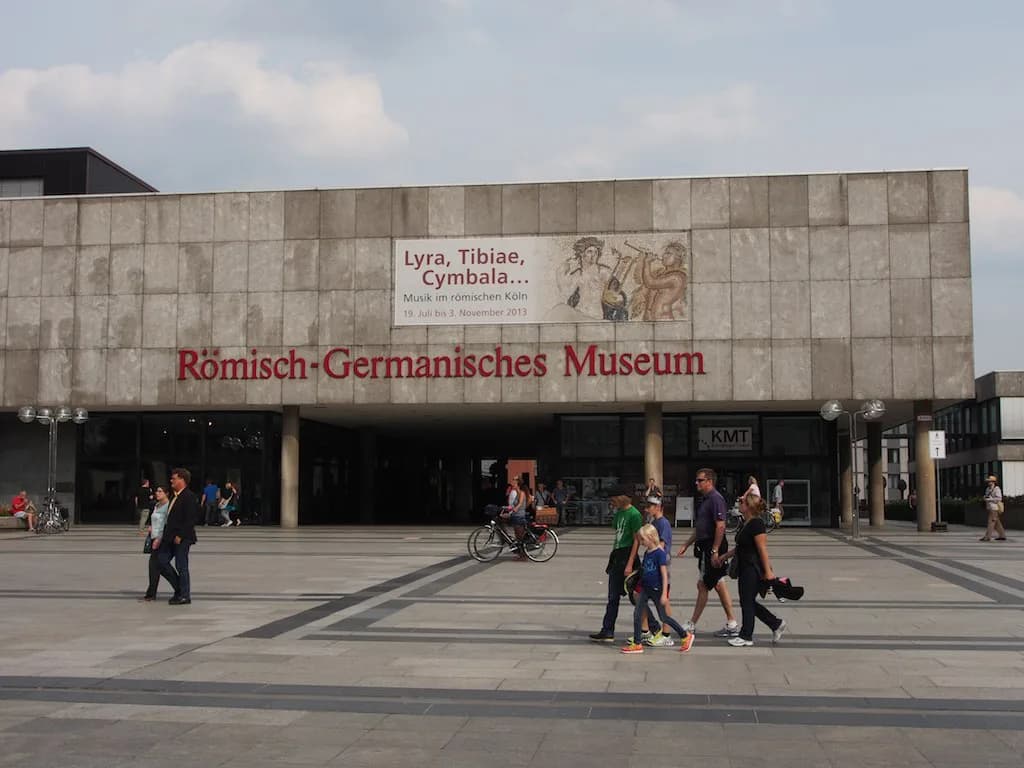
The Roman-Germanic Museum holds one of Germany's finest archaeological collections. Its 1974 exhibition building was constructed above the site of a large Roman villa complex and wrapped around its headline exhibit, the Dionysus mosaic. The architects leading the renovation describe the building as structurally and functionally deficient, with an expanding research collection, and it is undergoing a complete refurbishment.
Exhibitions have been relocated while that work continues, and no source here establishes a reopening date, so do not plan around one. Treat the temporary display as its own stop with its own location, and confirm the current address, hours and admission arrangements directly with the museum or the city. This is the one element of a Roman day where checking ahead is not optional.
A broader caution applies across the city: there is no single Roman ticket covering the tower, the palace, the museum and the churches. Each site is run and priced separately, and some are free while others are not. Budget decisions therefore have to be made site by site rather than by buying one combined pass.
Underground Roman Cologne: Sewers and the Harbour Road
The Roman sewer under the old town is one of the more unusual survivals, a first-century engineering work that occasionally opens for guided tours rather than for general public access. It belongs in the same category as the Weiden tomb: an opportunity to watch for, not a stop to walk into. If a tour is running during your dates, book it; if not, skip it without regret.
More accessible is the excavated section of the Roman harbour road, not far from the museum area and close to the Rhine. You can see original paving stones and foundations from a road that once carried trade along the riverfront. Because it is street-level archaeology, it is quick to view and easy to fold into a walk between the cathedral and the riverside.
These two stops make the point that Roman Cologne runs vertically as well as horizontally. Above ground you get walls and towers; below, you get drains, warehouses and quays serving a Rhine port. With limited time, prioritise the visible street remains and leave the underground layers to whichever guided format happens to be available.
Groß St. Martin and the Layer Beneath the Church
Groß St. Martin is a Romanesque church on what was once part of a Rhine island just east of the Praetorium. Excavations carried out between 1965 and 1979 revealed continuous occupation of the site since the first century, including an enclosed complex about 76 by 71 metres with a sunken water basin nearly 35 metres long and 17 metres wide that has no parallels north of the Alps. Scholars have suggested uses ranging from an athletic field to a swimming pool or a sacred precinct.
By the mid-second century the area had been raised and multi-aisled halls, probably warehouses for Rhine trade, were built on three sides. One of those halls remained in use long after the Roman period, and Carolingian pottery found on site points to activity into the early Middle Ages. That sequence, Roman warehouse to medieval church, is what makes this stop worth the detour.
See the excavation site in context rather than as a standalone attraction: the church itself is a working place of worship under a monastic community with daily prayer services, not a museum. Combine it with the riverside stretch of the walk so the Roman layer, the medieval building above it and the Rhine setting read as one story. This is the stop casual Roman walkers most often skip.
Sequencing the Walk: Two Sensible Loops
One approach, outdoors first, uses daylight and costs nothing: start near the town hall and the cathedral, walk the wall and tower stretch described by the tourism board, cross to Groß St. Martin, then finish along the harbour road remains by the Rhine. This order suits a bright day and lets you abandon the walk at any point without losing money.
The other, museums first, reverses the logic and puts the fixed-hour, weatherproof elements at the front. Start with whichever Roman display is currently accessible, then treat the outdoor remains as a flexible afternoon. If rain is forecast or your group includes anyone who tires quickly, this is the safer sequence because the ticketed stops have fixed schedules you cannot move.
Either way, keep both ends of the day loose. The free street archaeology has no schedule to miss, which makes it the ideal buffer when a museum visit runs long or a site turns out to be shut. Carry a written note of the stops you care about most, because a phone map will not tell you whether a building is a Roman survival or simply old.
How Long to Allow and How the Guided Tour Compares
The Cologne Tourist Board's Roman-history tour runs 120 minutes, a useful benchmark for how much ground the core stretch covers at a guided pace. A self-guided version of the same ground generally stretches longer because you read panels, backtrack and take photographs. As a rough planning suggestion rather than an official figure, set aside a half day for the outdoor circuit plus one interior, and a full day if you add a Roman display and Groß St. Martin.
The tourism board's route is a group tour with private-tour pricing rather than a per-person ticket. It departs from Kardinal-Höffner-Platz, the square beside the cathedral where the tourist information office sits. If you want the structure and the commentary, that is the format to book through the operator rather than through a reseller.
Guided and self-guided versions answer different questions. A guide tells you which lumps of stone are Roman and which are later repairs, which is genuinely hard to work out alone. Walking it yourself gives you control over pace and lets you spend an hour in the excavation site under Groß St. Martin if the mood takes you, which no group schedule permits.
Free Remains, Ticketed Interiors and Nearby Breaks
Free and visible: the Römerturm, the surviving wall stretches and the excavated harbour road paving. Ticketed or guided: whichever Roman collection is currently on display, and any sewer or tomb tour that happens to be running. Because prices and access rules change, get current figures from the museum, the city tourist information or the relevant association when you plan, not from a cached blog post.
Cologne Cathedral is not a Roman site, though it anchors the middle of the walk and its own visiting rules are easy to confuse with the archaeology. Since 1 July 2026 a ticket has been required for tourist visits to the interior, according to the cathedral's own visitor pages, while the North Transept remains accessible free of charge outside service times as a place of prayer, and the tower and treasury are handled separately. Check the cathedral's own pages rather than assuming entry is free.
If you want a non-Roman break mid-walk, the 4711 fragrance house in the Glockengasse is a few minutes from the main axis and runs guided tours, seminars and scent experiences, which makes it a good rain stop between Roman sites. Otherwise, use the Belgian Quarter cafes at the northern end of the route to rest before walking back.
One mental model worth carrying: coverage of the city stresses that Roman traces are scattered throughout the historic centre rather than concentrated in a single zone. The walk is therefore a connect-the-dots exercise, and the dots change as building work, closures and displays move.
Finally, the Praetorium's association with the governor's palace is what lifts this walk above a wall-and-tower stroll. If the palace interior stays inaccessible during your trip, at least read its context before arriving, because the ground beneath the town hall carries more Roman significance per square metre than almost anywhere else in the city.
Plan Your Roman Day in Cologne
Build the day around certainties first: the Römerturm, any open stretch of the city wall and the harbour road paving cost nothing and cannot be cancelled. Then slot in whichever ticketed Roman display is running during your dates, and treat the Praetorium, sewer and Weiden tomb as optional extras to verify close to arrival.
Use the tourism board's roughly one-kilometre northern-gate-to-tower description as your spine, and remember that its stated 120 minutes applies to their guided tour rather than to your own pace. For anything with a door, a fee or a schedule, confirm details with the operator or the city before setting out, since those are the facts most likely to have changed since any guide was written.
Frequently Asked Questions
Where can you see Roman ruins in Cologne without paying?
The Römerturm, the surviving stretches of the Roman city wall and the excavated section of the Roman harbour road are visible from public streets and cost nothing to look at. Groß St. Martin's Roman excavation site is tied to a working church. Ticketed or guided elements, such as the current Roman display and any sewer tours, sit in a separate category, so plan the free stops as your fixed backbone.
How long does a Roman heritage walk in Cologne take?
The Cologne Tourist Board states a duration of 120 minutes for its guided Roman-history tour covering the walk from the former northern gate to the Roman tower, a stretch of around one kilometre. A self-guided version generally takes longer because you read panels, backtrack and stop for photographs. As a suggestion, allow a half day for the outdoor circuit plus one interior, and a full day if you add a museum and the excavation site under Groß St. Martin.
Is the Praetorium in Cologne open to visitors?
The Praetorium is tied to the MiQua archaeological quarter project, and traveller accounts describe the site as effectively closed while that development continues. No reliable source establishes current opening hours or booking arrangements, so check directly with the city's museums or the MiQua project before planning a visit around it. The outdoor Roman stops remain a good fallback if the palace is not accessible.
Is the Roman-Germanic Museum in Cologne still closed?
The 1974 exhibition building is undergoing a complete refurbishment, and the museum has been operating from a temporary location rather than its main home above the Dionysus mosaic. No reopening date is confirmed, so do not plan around one. Check the museum's own channels for the current display location, opening arrangements and any admission requirements before you travel.
Can you see the Roman city wall in Cologne?
Yes, in fragments rather than as a continuous circuit. The Römerturm near the Belgian Quarter is the most substantial surviving piece, and the tourism board describes a route of around one kilometre from the former northern gate to that tower. Expect the remains to appear between ordinary buildings, because the modern street plan sits directly on top of the Roman one.
Are there guided Roman history tours in Cologne?
Yes. The Cologne Tourist Board runs a guided walking tour along the city's Roman history, departing from Kardinal-Höffner-Platz and stating a duration of 120 minutes, with private-tour pricing rather than per-person tickets. Independent operators also offer walking tours of the old town that touch on Roman sites. Book through the operator directly and confirm current departure times, since schedules change seasonally.