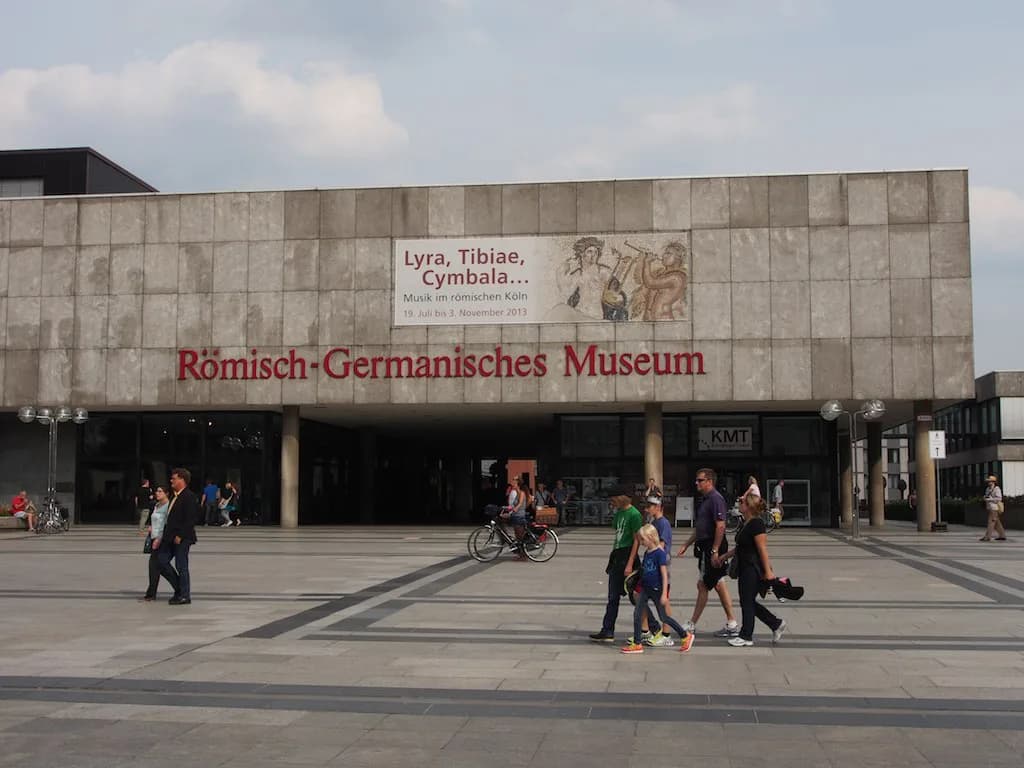
The Roman-Germanic Museum in Cologne is not a conventional gallery that happens to hold Roman objects. Its exhibition building was raised above the site of a large Roman villa complex and shaped around one of its principal finds, the Dionysus mosaic, which stays where it was discovered rather than being moved indoors from elsewhere. That single decision explains most of what makes the museum unusual, and it shapes how you should plan a visit.
The building stands in the immediate urban context of Cologne Cathedral, at Roncalliplatz in the historic centre. Opened in 1974, it was designed as both a freestanding structure visible from all sides and a piece of the surrounding historic cityscape. Being next door to the cathedral is a geographic fact of the setting, not evidence of any shared admission arrangement.
A workable plan treats the visit as one compact stop on the Roncalliplatz plateau: the museum interiors, the cathedral, and the Roman remains visible in the surrounding streets. Because renovation work has affected the building, and because ticket scope and opening arrangements are published by the operator rather than fixed in guidebooks, the museum's own website should be your last check before you set out.
Why the Museum Sits Where It Does
The site carries layers that are unusually easy to read. The exhibition building was constructed above the remains of a large Roman villa complex and integrated into the cathedral bunker built on the same ground in 1941. Those two facts together mean the basement of the museum is not simply storage: it contains historic fabric and bunker architecture that the renovation concept treats as part of the building's identity.
Architecturally, the building is described as a transparent ground floor beneath a clear, box-shaped upper floor that is closed to the outside and punctuated by inner courtyards. Those courtyards act as orientation points and daylight sources, which matters when you are moving between dense displays of stone and glass. Knowing the plan in advance helps you avoid the common mistake of treating the museum as one long corridor.
For context on the city around it, the museum is one stop among many on a historic centre walk. The Cologne hub gathers itineraries and city-level planning, which is useful if you want to slot the museum into a longer day rather than visit it in isolation.
The Dionysus Mosaic: An Exhibit That Never Moved
The Dionysus mosaic is the clearest example of the museum's in-situ approach. It was uncovered on the site, and the building functions as a spatial envelope around its findspot, so the mosaic's relationship to the ground it was made for survives. This is different from seeing a mosaic mounted on a gallery wall, and it is the main reason the architecture takes the form it does.
Practical caution is warranted here. Whether any individual object, including the mosaic, is accessible on a given day depends on exhibition and building conditions that the operator publishes. Treat the mosaic as the reason the building exists rather than a guaranteed sight, and confirm current display arrangements on the official site before you travel.
Reading the Roman Stone Monuments
Beyond the mosaic, the collection's strength lies in large-format stone monuments. These are the pieces that give a deep insight into everyday life in Roman and Germanic Cologne: funerary and civic stonework whose scale and carving carry information that small portable objects cannot. Because they are heavy and architectural, they also explain why the museum needs the kind of floor plates and courtyards it has.
Give the stone galleries real time rather than treating them as the warm-up to the mosaic. A sensible approach, and this is a suggestion rather than an official figure, is to budget roughly two hours for the museum interiors so that inscriptions, reliefs and portrait stones get attention. If you are short on time, decide in advance whether the mosaic or the stone monuments matter more to you and move accordingly.
The Museum's Second Role Across Cologne
In its role as protector of historical monuments, the museum is responsible for more than a hundred archaeological remains in situ across the city, not only for the objects inside its own building. The published list includes the Ubier monument, the Roman city wall, the harbour road and sewer, remains beneath Gross Sankt Martin's Church and beneath St Severin's Church, evidence of Roman farmsteads, a Roman chamber grave in Cologne-Weiden, clarifying basins on Berrenrather Strasse and Divitia-Deutz.
This is drawn from the museum's own listing of archaeological monuments, so it should be read as an inventory rather than an independent audit. For visitors, the practical value is that some of Roman Cologne is visible without a ticket, in churches and public spaces. The remains beneath Gross Sankt Martin are a good example: the church above them rewards a look, and its Roman-era excavation material ties directly back to the city's Roman past.
If that wider Roman layer interests you, plan it as separate stops rather than assuming one ticket covers them. The Roman city wall and the monuments beneath churches are part of the urban fabric, and the museum's own pages are the place to confirm which are accessible and how.
Pairing the Museum with Cologne Cathedral
The compact geography is the real advantage. Roncalliplatz places the museum and the cathedral within sight of each other, so you can combine a Roman collection visit with the city's best-known landmark without a long transfer. A wider cathedral visit, from the Domplatte forecourt to the tower and the interior, is worth planning as its own stop, and our Cologne Cathedral visitor guide sets out how that site works on its own terms. Treat the pairing as a geographic convenience and plan each site separately.
One thing to avoid is assuming a single combined admission covers both. Cologne Cathedral does not charge for general sightseeing, though individual elements such as the tower have their own tickets, and no shared cathedral and museum ticket is published. Check each operator separately for current access, ticket scope and any joint offers.
If you want to extend the walk, the Rhine embankment and the riverfront museums are close by. The Cologne Cable Car crosses the river from the zoo side and can turn a museum morning into a wider loop, though it is a separate attraction with its own arrangements.
Practical Planning: Ticket Scope and Current Access
The museum has been the subject of a general renovation project, and the building fabric had been preserved almost entirely in its original state before that work. Because opening arrangements and access during such projects change, no guidebook or third-party summary should be treated as authoritative. Confirm current status, hours and admission directly with the operator before committing to a travel day.
The same applies to ticket scope: admission rules, reduced categories and any combined offers are published on the museum's pages, and those details are not fixed for the long term. This guide deliberately does not quote entry prices or hours, because stale figures are worse than no figures when you are planning a specific date.
On the day itself, keep the visit flexible. Ask at the entrance what is currently on view in the permanent displays and whether parts of the building are affected by works. That question takes a moment and prevents the frustration of arriving for a specific object that is temporarily off display.
Plan Your Visit
The Roman-Germanic Museum rewards visitors who understand what it is: an in-situ display building on Roncalliplatz, built above a Roman villa complex and around the Dionysus mosaic, holding large stone monuments that illuminate everyday life in Roman Cologne. Its protector role extends far beyond its own walls to more than a hundred archaeological remains across the city.
Before travelling, check the museum's own pages for the current opening arrangements, admission scope and any effect of refurbishment work, and treat the cathedral as a separate site with its own rules. Build the day around a compact Roncalliplatz stop, then walk outward to the churches and riverside sights that carry the Roman layer further into the modern city.
Frequently Asked Questions
Is the Roman-Germanic Museum next to Cologne Cathedral?
Yes. The museum sits at Roncalliplatz in Cologne's historic centre, in the immediate urban context of Cologne Cathedral, and the two are close enough to combine in one walk. That proximity is a matter of geography; it does not mean the two share an admission ticket or an opening schedule. Check each site's own information before your visit.
What is the Dionysus mosaic and why is it in this museum?
The Dionysus mosaic was uncovered on the site and is one of the museum's main exhibits. The exhibition building was designed as a spatial envelope around its findspot, so the mosaic remains where it was found rather than being relocated into a gallery. Because displays can change, confirm what is currently on view with the museum before travelling.
Does one ticket cover both the cathedral and the Roman-Germanic Museum?
The museum and the cathedral are separate institutions, and no shared ticket is published by the museum's own information. Admission scope, any reductions and any joint offers should be checked with each operator directly, especially while building work is under way. Do not assume that one purchase covers both sites.
What else does the Roman-Germanic Museum look after besides its own collection?
In its role as protector of historical monuments, the museum is responsible for more than a hundred archaeological remains in situ across Cologne. Its own listing names the Ubier monument, the Roman city wall, the harbour road and sewer, remains beneath Gross Sankt Martin's Church and beneath St Severin's Church, farmstead evidence, a chamber grave in Cologne-Weiden, clarifying basins on Berrenrather Strasse and Divitia-Deutz. Treat this as the museum's own inventory.
Is the museum currently open while refurbishment work is planned?
The building has been the subject of a general renovation project, and the project description notes that the fabric was in poor condition. That document does not tell you today's access, hours or closures, so it cannot be used as proof of what is open now. Check the operator's current information before you travel.