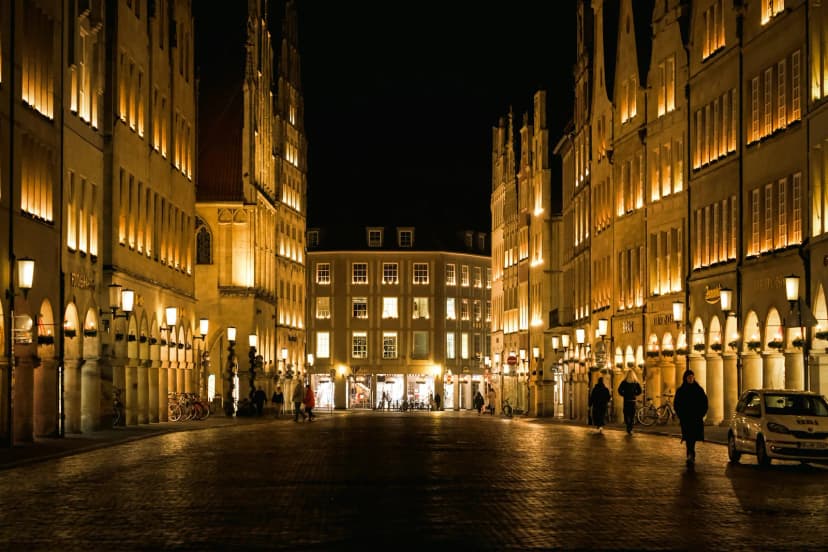
St. Peter's Cathedral, known locally as St. Petri Dom, stands on Bremen's market square between the town hall and the state parliament. A church has occupied this site for over 1,200 years, and both towers rise more than 90 metres. According to Bremen's tourism office, the southern tower is the one open to visitors, and the climb rewards you with a view over the city.
Think of the site as three distinct spaces: the cathedral interior, the Dom-Museum inside the building, and the Lead Cellar where eight mummies lie in open coffins. Bremen's tourism office states that museum admission is free, but nothing suggests a single combined ticket covers all three. That distinction matters when planning how much time and budget to set aside.
Where the Cathedral Sits and Why the Square Matters
The cathedral anchors the eastern side of the market square, facing the town hall and the Roland statue across the cobblestones. Bremen's tourism office describes it as completing the ensemble of historic buildings on the square, and its two towers are visible from well beyond the old town. That position makes it an easy waypoint rather than a detour, since you pass it walking between the town hall and the parliament building.
If you are building a walking route through the old town, treat the cathedral as a fixed point you return to rather than a single stop. The town hall and its Roland statue are steps away, and the whole cluster sits within a compact centre that rewards slow wandering. A good approach is to circle back in the late afternoon when the square empties out and the light on the brick facade improves.
For a wider look at the square itself, the Bremen Marktplatz visitor guide covers the buildings, statues and market life around you, while the cathedral remains the architectural anchor at one end.
Opening Hours: What the Operator Publishes
The cathedral's own site lists cathedral and tower hours for April to December: Monday to Saturday from 10 a.m. to 5 p.m., and Sunday from 11.45 a.m. to 5 p.m. The Lead Cellar follows a narrower window over the same seasonal period, opening Wednesday to Sunday from 11 a.m. to 5 p.m. and closing on Monday and Tuesday. Those are the only months the operator publishes, which means winter visitors should check the official site in the week of travel rather than relying on a printed plan.
The Dom-Museum keeps a different rhythm again, with weekday hours, a shorter Saturday window, and a Sunday afternoon slot. Because these three schedules never align perfectly, it helps to decide before you arrive which one is non-negotiable. If the Lead Cellar is the priority, plan around a Wednesday-to-Sunday visit; if the museum matters more, a weekday morning gives you the longest opening.
The Tower Climb: Height, Stairs and Honest Trade-Offs
Only one of the two towers admits visitors, and Bremen's tourism office identifies it as the southern tower, which stands over 90 metres high. The climb is a stair ascent rather than a lift ride, so it is not a casual stroll. Anyone with knee trouble, a fear of tight spaces, or a stroller will want to weigh that before committing.
Whether the ascent is worth it is a judgement call rather than a fact, but the trade-offs are fairly clear. You trade roughly 20 to 30 minutes of climbing and queuing for a rooftop panorama of the market square and the red-tiled old town, weather permitting. On a clear day that view is the single best reason to climb; in heavy rain or strong wind, the cathedral floor and the museum give you better value for the same time. Prices for the tower are not published on the operator pages, so ask at the entrance or check the official site rather than trusting older blog figures.
If you want to compare this vantage point with other lookouts in the city, the Bremen viewpoints guide sets out alternative options before you commit to the stairs.
What You Actually See from the Top
The reward at the top is a compressed view of everything you have been walking through at ground level. You look down on the market square, across the town hall roof, and over the dense old-town fabric toward the Weser. Because the towers top 90 metres, the perspective flattens the square into a pattern of roofs and cobbles that is hard to read from street level.
Photographers tend to prefer the climb in the late afternoon, when the light rakes across the brickwork and the tourist density on the square drops. Wind at that height is stronger than it feels below, so a light jacket is worth carrying even on a warm day. If the weather turns while you are queuing, you can abandon the climb without losing anything else on your itinerary, since the tower is a self-contained stop.
Inside the Cathedral: What to Notice
The interior was rebuilt around 1500 in a late Gothic style, and the filigree net vaulting overhead is the feature most worth slowing down for. Medieval stonework, tomb monuments, and stained glass fill the nave, and the scale only becomes clear once you are standing under it. The building was badly damaged in the Second World War and restored between 1972 and 1985, which explains the mix of old fabric and careful reconstruction you see today.
A short walk-through takes perhaps 20 minutes if you keep moving, but the details reward a slower pass. Look at the carved stonework at eye level rather than only upward, since much of the medieval craft sits where you can actually inspect it. If you want a structured explanation, the operator runs open cathedral tours on Saturdays at 12.30 p.m. with no reservation required and tickets available at the museum entrance.
The Dom-Museum: Who It Is Really For
The cathedral museum documents the building's 1,200-year history, displays sacred art, and shows excavation finds from seven bishop's tombs. Admission is free according to Bremen's tourism office, which makes it a low-risk stop even if your interest in ecclesiastical archaeology is modest. The museum is the right choice if you want context for what you just walked past in the nave.
It is less compelling for anyone travelling with small children or with only a passing interest in church history. The collections are scholarly rather than interactive, and the rooms are quiet by design. Budget 30 to 45 minutes if you read labels, or skip it entirely if the Lead Cellar is your priority and time is short.
The Lead Cellar and Its Mummies
The Lead Cellar is the cathedral's strangest draw: eight mummies displayed in open coffins, originally buried in the cathedral's east crypt. Bremen's tourism office notes that the reason for the mummification has never been conclusively explained, and that researchers found a bullet in the spine of one male mummy. The distinction between the original east crypt burials and the current display location confuses many guides, so keep them separate in your mind.
The cellar opens Wednesday to Sunday from 11 a.m. to 5 p.m. during the April-to-December season, and is closed on Monday and Tuesday. Free museum admission does not extend to the Lead Cellar, so treat the two as separate stops with separate access. If you want the cellar explained rather than simply viewed, the Friday combined cathedral-and-Lead-Cellar tour at 12.30 p.m. covers both in one visit.
Guided Tours and Group Bookings
The operator runs two regular public formats: an open cathedral tour on Saturdays at 12.30 p.m. requiring no reservation, and a Friday tour that combines the cathedral and the Lead Cellar, also at 12.30 p.m. Tickets for the Saturday tour are sold at the museum entrance. Both are fixed-time commitments, so they work best as the anchor of a morning rather than an add-on at the end of a day.
Separate group tours can be arranged by emailing the cathedral office, which is the route to take if you are travelling with a club, school, or larger party. The operator does not publish tour prices or confirm language options beyond what is listed, so ask directly when you enquire. If your dates are fixed, request the group tour well ahead rather than assuming a slot will exist.
A Suggested Visiting Order and Timing
A sensible order is interior first, then the museum, then the tower, then the Lead Cellar if the day and time align. Starting inside gives you the architectural context that makes the museum's excavation finds legible, and climbing later means you are not pressing through the nave in a hurry. Treat the following as one suggestion rather than a fixed itinerary: roughly 20 minutes in the nave, 30 to 45 in the museum, 30 for the tower including the queue, and 15 to 20 in the cellar.
That puts a full cathedral visit at around 90 minutes to two hours, which fits comfortably into an old-town morning. If the Lead Cellar is closed on the day you visit, drop it and reallocate the time to the tower queue, which is the least predictable element. Anyone with limited mobility should plan for the interior and museum only, since the operator does not publish lift access details for the tower.
Pairing the Cathedral with the Rest of the Square
The market square packs several of Bremen's headline sights into a few dozen metres, so the cathedral rarely stands alone in a visit. The town hall and the Roland statue together form a UNESCO World Heritage listing, and the Town Musicians statue sits beside the town hall as the city's most photographed bronze. Walking the full circuit takes less than ten minutes but rewards an hour if you stop properly.
From the square you can continue toward Böttcherstraße, the Schnoor quarter, or the Weser promenade at Schlachte, all within easy walking distance in the compact centre. A half-day that combines the cathedral with two or three of these gives you a solid grounding in the old town without rushing. For a wider set of routes and day plans, the Bremen City itineraries and city travel guides hub is the place to sketch the rest of your stay. Related guide: Bremen City: Landmark Visitor Guides.
Practical Notes Before You Go
Check the cathedral's official site in the week of your visit, because the operator only publishes hours for April to December and winter schedules are not listed. Confirm the tower, Lead Cellar, and museum windows separately rather than assuming one opening time covers all three. If the tower price matters to your budget, ask at the entrance, since published operator pages do not state one.
Wear shoes you can climb stairs in, carry a light layer for the tower, and treat the market square as your base rather than the cathedral as an isolated stop. The old town is compact and walkable, so the main risk is over-scheduling rather than distance. Give yourself the flexibility to swap the tower for the museum if the weather turns.
Frequently Asked Questions
Is climbing the tower of Bremen Cathedral worth it?
It depends on your tolerance for stairs and your luck with the weather. The southern tower is the one open to visitors and stands over 90 metres high, so the payoff is a rooftop panorama of the market square and the old town. If you have knee trouble, a fear of heights, or a rainy day, the cathedral interior and the free museum give you a better return for the same time.
Is the Dom-Museum in Bremen Cathedral free?
Bremen's tourism office states that admission to the cathedral museum is free. That does not extend to the tower climb or the Lead Cellar, which are separate spaces with their own access arrangements. Treat the three as distinct stops rather than assuming one entry covers everything.
What can you see in the Lead Cellar at Bremen Cathedral?
The Lead Cellar displays eight mummies in open coffins. They were originally buried in the cathedral's east crypt, though the display itself sits in the cellar, and the reason for the mummification has never been conclusively explained. Researchers also found a bullet in the spine of one male mummy.
What are the opening hours of Bremen Cathedral?
The operator publishes cathedral and tower hours for April to December: Monday to Saturday from 10 a.m. to 5 p.m., and Sunday from 11.45 a.m. to 5 p.m. The Lead Cellar opens Wednesday to Sunday from 11 a.m. to 5 p.m. and closes Monday and Tuesday over the same period. Winter hours are not published, so check the official site close to your travel date.
How long should you spend at Bremen Cathedral?
A reasonable suggestion is 90 minutes to two hours if you want the nave, the museum, the tower, and the Lead Cellar. That breaks down roughly as 20 minutes in the nave, 30 to 45 in the museum, 30 for the tower including any queue, and 15 to 20 in the cellar. If any one space is closed, the visit shortens accordingly.
Are there guided tours of Bremen Cathedral and the Lead Cellar?
Yes. The operator runs an open cathedral tour on Saturdays at 12.30 p.m. with no reservation required and tickets sold at the museum entrance, plus a Friday tour that covers both the cathedral and the Lead Cellar, also at 12.30 p.m. Group tours can be arranged by contacting the cathedral office directly.