
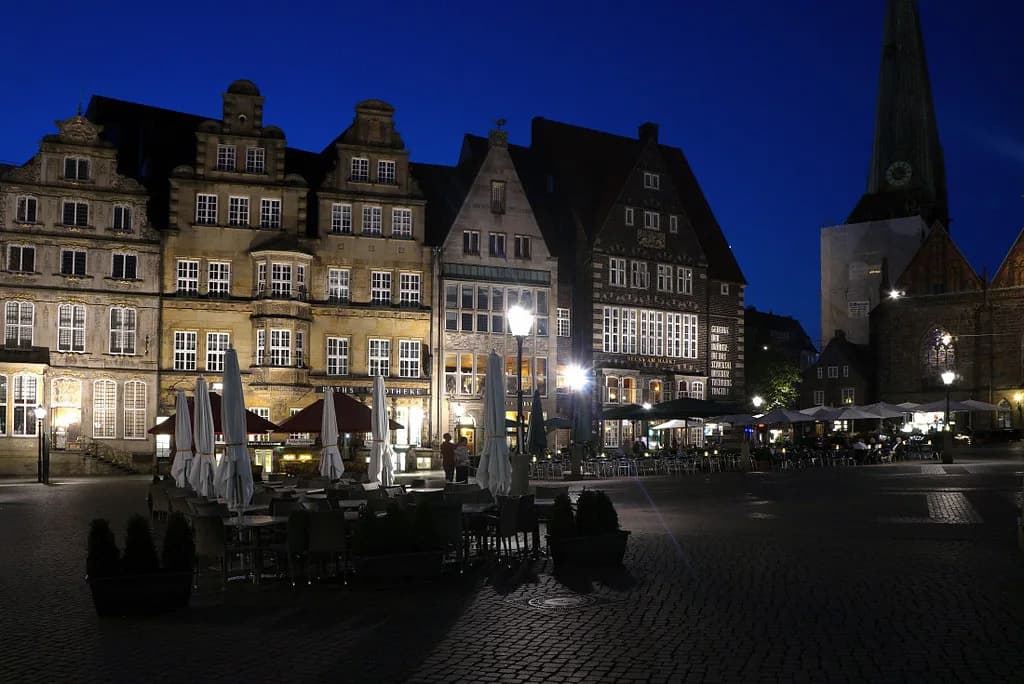
Bremen Marktplatz works best as a base rather than a single stop, because the square itself is small but the surrounding old town packs in a UNESCO-listed Town Hall, the Roland statue, two historic churches, and two lanes worth slowing down for. The square is known locally as the city's gute Stube, or good room, and it has served as a gathering place since Bremen's medieval trading period. It sits in the old town and is reached easily on foot from Bremen Hauptbahnhof, making it a good first orientation point on any Bremen City trip.
One practical detail worth knowing before you arrive: the square and the old-town lanes are open to pedestrians at no charge, while interiors such as the Town Hall, cathedral tower and museums are separate, ticketed spaces. Treat the Marktplatz as your anchor and build a loop outward, and you can decide how much paid content you want. The order below runs from the square to the river so you are always walking downhill toward the Weser.
What Is Bremen Marktplatz?
Bremer Marktplatz is the historic market square at the centre of Bremen's Altstadt, often described as the city's "good room" because it has served as a gathering place since the medieval trading period. It is paved, flat and open, with the Town Hall on its northern side and the cathedral just behind. Because it is a public square rather than a ticketed attraction, you can walk through it at any time without an entry fee. The Bremen tourism pages are the right place to confirm current event details before you travel.
The square connects naturally to three directions: north and east toward Böttcherstraße and the Schlachte, west toward the Schnoor lanes, and south past the cathedral into the shopping streets. That compact layout is why it makes sense to start here and let the old town unfold on foot. The Bremen City itineraries hub is a useful next stop once you have picked your half-day or full-day shape.
The UNESCO Core: Town Hall and Roland Statue
The Town Hall is the building most visitors photograph first, a Gothic structure begun in the early 1400s with a Weser Renaissance facade added later, and it forms part of the UNESCO World Heritage listing along with the Roland statue in front of it. From the square, the facade and its sculptural details are free to admire. If you want to understand the building's history, role and the question of interior access, the Bremen Town Hall visitor guide covers the context.
The Roland statue stands to the west of the Town Hall and dates from 1404, making it one of the oldest civic monuments in northern Germany. It represents the city's market rights and independence, and it is free to view at any time from the square. For the full story of the figure and how to read its details, see the Bremen Roland statue visitor guide before you arrive so you know what you are looking at.
Both monuments are best viewed in the morning or late afternoon, when low light picks out the carved stone and the square is less crowded. There is no fixed opening time for the square itself, so this is a stop you can fit around your arrival or departure. If you want to go inside the Town Hall, that is a separate, ticketed arrangement run by the city, so check current tour availability on the official Bremen tourism pages rather than assuming you can walk in.
Town Musicians Statue and the Roland Tradition
The bronze Town Musicians sculpture, created by Gerhard Marcks in 1953, sits on the west side of the Town Hall and depicts the donkey, dog, cat and rooster from the Brothers Grimm tale stacked on each other. It is free to see and is one of the most photographed spots in the old town. Local tradition says that rubbing the donkey's front legs brings good luck or a return visit, which is why that part of the bronze looks brighter than the rest.
The sculpture works well as a short stop of a few minutes rather than a destination, and it pairs naturally with the Roland statue a few steps away because both tell Bremen's story of civic identity. Note that the figure sits on an open square on cobblestones; if mobility is a concern, plan for uneven ground rather than assuming a smooth, level approach. This is a public space without gates, so you can visit whenever the square is open.
Two Church Stops: St. Petri Cathedral and Our Lady
St. Petri Cathedral, with its twin spires, anchors the south side of the square and combines Romanesque and Gothic work from the medieval period. Entry to the church itself is free, while climbing the tower is a separate, ticketed arrangement that involves a long staircase; confirm current access and any charges on the official pages before you commit. The Bremen Cathedral visitor guide explains what to look for inside.
The Church of Our Lady, or Liebfrauenkirche, sits just a minute or two away and offers a quieter contrast to the cathedral, with modern stained glass that throws coloured light across the interior on sunny days. Together, the two churches let you see very different treatments of religious architecture within a short walk. Both are active places of worship, so check for services and events before planning a visit, and treat any published hours as something to verify locally.
Schnoor: Bremen's Oldest Quarter
The Schnoor quarter, a short walk west of the Marktplatz, is a dense tangle of half-timbered houses, small workshops and narrow lanes. It works best as an unhurried wander rather than a checklist: the point is the texture of the place, the low doorways and the crooked rooflines. The name comes from an old word for rope or string, a nod to the rope-making trade once based there.
Schnoor is free to walk through, but the lanes are gravel and cobblestone, so sturdy shoes make more sense than smooth soles, and it is worth bearing in mind if you are pushing a stroller or using a wheelchair. Shops and cafes keep their own hours, and many close on Sundays, so plan a weekday visit if browsing is part of the plan. Allow roughly an hour on a first pass, more if you stop for coffee.
Böttcherstraße and Its Expressionist Frontage
Böttcherstraße runs from near the Marktplatz toward the river and is known for its 1920s expressionist brick architecture, which makes it a striking contrast to the medieval square. It is a short street, typically no more than a few minutes end to end, so treat it as a compact detour rather than a half-day in itself. Galleries and small museums sit along it, and some of those spaces charge admission while the street itself does not.
The Glockenspiel, or carillon, is the timed feature most visitors wait for, and it is a fixed mechanical display rather than a performance you book. Because published times can change with maintenance and seasons, check the current schedule with the operator or the official city tourism pages on the day you visit rather than relying on an old guide. Plan it as an optional pause, not a reason to rush.
Schlachte and the Weser Promenade
The Schlachte promenade along the Weser is Bremen's old harbour turned riverside walk, with restaurants, beer gardens and historic boats lining the bank. It has two levels, with dining terraces above and a lower path by the water, which makes it easy to find a bench and watch the river. Access to the promenade itself is free, and it is the natural place to end an old-town loop.
Late afternoon or early evening gives the best light on the water, and the riverside is where you can slow down after a morning of looking upward at facades. Look for the historic sandstone lion heads beneath the bridge as a small, easily missed detail. If you want a boat trip, confirm departures and availability at the pier or with the operator, since schedules vary by season.
Markets and Seasonal Events on the Square
The Marktplatz hosts markets and cultural events through the year, most visibly the Christmas market that transforms the square and neighbouring streets into a winter market with stalls and lights. The exact dates, stall layout and opening times change annually and are set by the organisers, so the responsible approach is to check the official Bremen tourism calendar close to your travel dates. That way you are planning around confirmed information rather than an old schedule.
Larger city festivals such as the autumn fair take place at their own venue rather than on the Marktplatz, so if that is your reason for visiting, check the venue and dates separately. Summer tends to favour outdoor exploring, while late November and December bring the strongest market atmosphere but colder, wetter weather. Whenever you come, build in a weather layer and a flexible hour, because North German weather shifts quickly.
Suggested Route and How Long to Allow
A suggested half-day loop is roughly three to four hours: start at the Marktplatz with the Town Hall and Roland statue, cross to the Town Musicians sculpture, look into one or both churches, then walk through Böttcherstraße to the Weser and finish with a riverside stroll. If you add Schnoor and a museum stop, budget a full day and expect it to feel unhurried rather than packed. The suggested durations are planning aids, not official recommendations.
If you have only a few hours between trains, keep to the square, one church and Böttcherstraße, and skip anything that requires a timed entry, since those are the items most likely to overrun. If you have a full day, put Schnoor in the morning when lanes are quieter and finish at the river. For more city-level options across multiple days, the Bremen City itineraries hub is the place to compare shapes.
Practical Tips for the Square and Old Town
Everything described here sits within a compact, walkable area, so you rarely need transport between stops once you reach the old town. The surface is a mix of cobblestones and gravel, which matters for footwear and for anyone using wheels, and the cathedral tower climb is a long staircase rather than a lift. Plan for uneven ground and choose shoes accordingly.
The square is the natural meeting point because it is easy to find, open and central, which makes it a sensible place to split up and regroup. Bring a light rain layer and check the local forecast the day before, since Bremen's maritime climate produces frequent changes. For cross-city context on how this attraction sits within the wider landmark network, see Bremen City: Landmark Visitor Guides.
Plan Your Visit
Bremen Marktplatz rewards visitors who use it as a starting point rather than a finish line. See the Town Hall and Roland statue for free from the square, decide on the day whether interiors or a tower climb are worth it to you, then let the lanes pull you toward Schnoor and the Weser. That approach keeps costs predictable and lets the old town's scale work in your favour.
Before you travel, confirm any ticketed element and the current market or festival schedule on the official city tourism pages, since those details change by season. Pair this square with the dedicated landmark guides for the Town Hall and the Roland statue to go deeper on each. With that groundwork done, a half-day or full-day loop is easy to shape around your own pace.
Frequently Asked Questions
Is Bremen Marktplatz free to visit?
Yes, the square itself is a public space with no entry charge, and you can see the Town Hall facade, the Roland statue and the Town Musicians sculpture from outside at no cost. Paid elements, such as interior tours or tower climbs, are separate and arranged individually, so check current arrangements with the operator or the official city tourism pages before you go.
How long should I spend at Bremen Marktplatz?
A suggested plan is three to four hours for the square, one church and Böttcherstraße, or a full day if you add Schnoor and a museum. These are suggestions rather than official recommendations, and the right length depends on how many paid interiors you choose and how much time you spend in the lanes.
What can I see within walking distance of the Marktplatz?
The Town Hall, Roland statue, Town Musicians sculpture, St. Petri Cathedral and the Church of Our Lady are all within a couple of minutes of the square. A short walk further brings you to Böttcherstraße, the Schnoor quarter and the Schlachte promenade along the Weser, so the whole old-town core is reachable on foot.
Do I need a ticket for the Town Hall or the cathedral?
Viewing the buildings from the square is free, but entering the Town Hall or climbing the cathedral tower is a separate, ticketed matter that can depend on season, staffing and scheduled tours. Confirm the current position on the official pages or with the site itself before planning your day around either one.
When is the Bremen Christmas market on the Marktplatz?
The Christmas market is a seasonal fixture on and around the square, but the dates and layout change each year and are set by the organisers. Rather than relying on an old schedule, check the official Bremen tourism calendar in the weeks before your trip to confirm when it opens and closes.
What is the best time of year to visit the square?
Late spring through early autumn generally gives the mildest weather and long daylight hours for walking the old town and the riverside. Winter brings the strongest market atmosphere but colder, wetter conditions, so pack a waterproof layer whichever season you choose and check the forecast shortly before arrival.


