
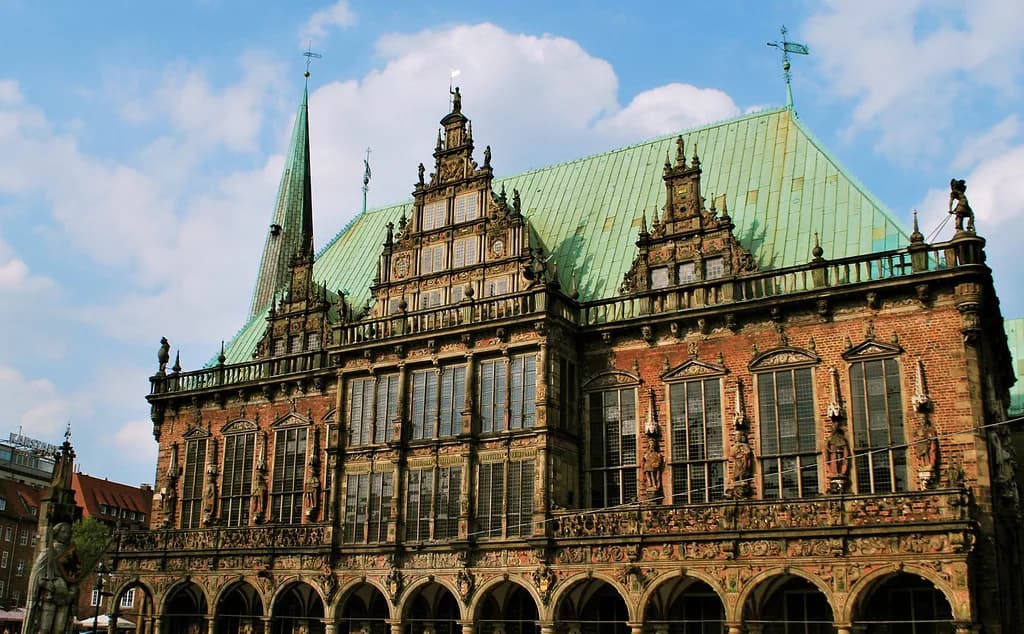
Bremen Town Hall is not a museum. The mayor's own welcome message states that for more than 600 years the building has been where Bremen politics were shaped, and today it houses the Senatskanzlei, the office of the state government. That single fact determines how you visit: the historic rooms are normally seen on a guided tour, while the market square outside is open public space. As a suggested planning figure rather than an official duration, allow roughly 45 to 60 minutes for an interior tour once it begins, plus arrival time.
Tour times, prices and languages are not published as fixed values on the official site, so check directly with the city tourist office before you build a day around a slot. What follows covers the two buildings, the rooms worth knowing about, free versus ticketed access, and how the Town Hall fits into a wider look at Bremen City.
Why Bremen Town Hall Matters: A Working Government Building
The Town Hall is the government headquarters of the state of Bremen and the place where the mayor and the Senate carry out their work. It is not a museum with exhibition rooms and opening hours in the usual sense; it is an active civic building. This distinction matters because state rooms can be taken out of visitor use when official events, ceremonies or government business require them. For wider planning, see St. Peter's Cathedral Bremen.
The official site notes that the Rathaus is flag-decorated on commemorative and public holidays, a visible reminder of its official function. If your visit depends on seeing a particular room, confirm the current situation with the tourist office in advance rather than assuming daily access.
The Two Buildings: Old Town Hall and New Town Hall
Bremen Town Hall is actually two adjacent buildings. Construction of the old building dates to the period 1405 to 1409, while the new building was erected between 1906 and 1913. A single visit therefore spans around five centuries of architecture, from the Gothic gabled front to the ornate early twentieth-century extension beside it.
The Town Hall, together with the statue of Roland on the market place, was declared a UNESCO World Heritage Site in 2004. The official description calls the ensemble a unique testimony to the development of civic autonomy and market rights as they evolved over the centuries in Europe. That is the context worth carrying with you when you stand on the square.
What You Can See Inside: Upper Hall, Golden Chamber and Senate Hall
The official highlights begin with the Upper Hall, built in 1405, described as one of the largest halls of that period. The so-called Golden Chamber was designed in 1905 by the painter Heinrich Vogeler in Art Nouveau style, a sharp contrast to the medieval hall. The Senate Hall is where the senators, the ministers of the Bremen state government, convene each Tuesday, so it is a room in genuine political use.
A virtual tour of the Town Hall is offered through the official site and walks through the building's history and architecture. Note that this virtual tour page is not in English, so you may need a translation tool if you do not read German. It is useful preparation whether or not you manage to join an in-person tour.
How Tours Work: Organised Through the Tourist Office
Guided tours of the Town Hall are offered by the Bremer Touristik-Zentrale, the city's tourist organisation, not by the Town Hall administration itself. The Senatskanzlei's visitor information confirms this arrangement: Gästeführungen are provided by the Bremer Touristik-Zentrale. That tells you exactly where to direct any booking or availability question.
Because no official schedule of tour times, languages or prices is published in the available materials, contact the tourist office directly before you travel. Ask about the specific date you want, whether an English-language option exists, and whether advance reservation is needed. Third-party listings of tour times can become outdated, so treat them as leads to verify rather than confirmed arrangements.
Free Grounds Versus Paid Interiors
The market square and its monuments are public space. You can see the Town Hall's exterior, the Roland statue and the surrounding old town without paying anything or booking ahead. The interiors, by contrast, are the part that requires a guided tour, which in turn means the tour organiser sets any applicable charges.
If you only have a short stop, the square itself delivers the UNESCO ensemble, the architecture and the civic setting at no cost. Save the interior for a visit where you can commit to a fixed tour slot, since walking in and expecting entry is not how this building operates. Where a fee applies, confirm the current amount with the tourist office rather than budgeting from an old figure.
The Roland Statue and the Market Square Setting
The Roland statue stands on the market place in front of the Town Hall and is inscribed together with the building as one World Heritage listing. It represents the civic freedoms and market rights highlighted in the UNESCO citation, which is why the two are always discussed as a single ensemble. A few minutes considering its symbolism before you arrive makes the square more rewarding than a quick photo stop.
The square is also the natural starting point for the old town. St. Peter's Cathedral faces the Town Hall across the open space, so you can pair the two sights in one loop. Planning a wider Bremen city break around the market square is more efficient than treating each monument as a separate outing.
How Long to Allow: A Suggested Time Budget
As a suggestion rather than an official figure, allow around 45 to 60 minutes for an interior tour once it starts, plus time to arrive early and assemble with your group. The official materials do not publish a visit duration, so adjust this estimate once you know your slot. If you are only seeing the square and exterior, 15 to 20 minutes is usually enough.
For a half day in the old town, combine the Town Hall with the cathedral, the Roland statue and the Town Musicians sculpture, treating the interior tour as the fixed appointment around which everything else flexes. For a full day, add the surrounding streets, the riverfront and a museum. Building the day around one fixed tour time is the simplest way to avoid rushing the rest.
Fitting the Town Hall Into Your Bremen Itinerary
With one day, start at the market square in the morning when the light falls well on the facade, then take a tour if one runs on your date. Use the remaining hours for the cathedral, the Schnoor quarter and the riverfront rather than trying to cover the whole city. That structure keeps the UNESCO ensemble central without turning the day into a checklist.
Over a weekend, pair the Town Hall with a wider look at Bremen's civic and maritime history, keeping one slot free for a tour on whichever day it is offered. Give yourself a buffer around the tour so a delayed start does not derail the rest of the plan. Two days also lets you return to the square in different light.
Practical Tips: Language, Timing and Booking
Ask the tourist office directly about the language of the tour you are booking, since the official materials do not guarantee an English-language schedule. If your dates are fixed and a tour is essential, contact them well ahead and confirm what you have reserved. This avoids arriving at the square and discovering the day's arrangements do not match your expectations.
Remember that the building is in official use, so state rooms can be withdrawn from tours at short notice for government business or ceremonies. Build flexibility into your plan and keep a backup such as the cathedral or the market square itself. If the interior is closed, the UNESCO ensemble is still fully visible from outside.
Plan Your Visit
Bremen Town Hall rewards a little preparation more than most city sights, because access depends on an organised tour rather than spontaneous entry. Treat the market square and the Roland statue as the free, always-available part of the visit, and the interior as the part you schedule. Confirm current arrangements with the Bremer Touristik-Zentrale before you travel, since prices, times and languages are not published as fixed values.
With the two buildings, the three main interior rooms and the surrounding old town understood in advance, you can slot the Town Hall into a half day or a full day without over-planning. Use the city guides to build the rest of your Bremen itinerary around it, and keep your tour slot as the fixed point. That way the UNESCO site anchors your visit instead of consuming it.
Frequently Asked Questions
Can you visit inside Bremen Town Hall?
Yes, but not by walking in off the street. The Town Hall is an active government building rather than a museum, and the interior is normally seen on a guided tour arranged through the city's tourist office. Availability depends on the building's official calendar, so confirm the current arrangements before you plan a day around a visit.
How do you book a tour of Bremen Town Hall?
Tours are organised by the Bremer Touristik-Zentrale, the city tourist office, rather than by the Town Hall administration. Contact the tourist office directly to ask about dates, languages and whether advance reservation is needed. No official schedule of tour times is published, so a direct enquiry is the only reliable way to confirm details for your travel dates.
Is Bremen Town Hall free to visit?
The market square, the exterior and the Roland statue are public space and cost nothing to see. The interiors are visited on a guided tour, which may carry a charge set by the tour organiser. Because current prices are not published in the official visitor information, ask the tourist office for the present amount rather than relying on an older figure.
What can you see inside Bremen Town Hall?
The highlights are the Upper Hall, built in 1405 and one of the largest halls of its period, the Golden Chamber designed in 1905 by Heinrich Vogeler in Art Nouveau style, and the Senate Hall where Bremen's senators meet each Tuesday. A virtual tour on the official site shows these spaces if you want to prepare beforehand.
Is Bremen Town Hall a museum?
No. The building is the seat of Bremen's government and has been the centre of the city's political life for more than 600 years, as the mayor's own welcome message explains. That is precisely why access is by guided tour rather than open admission, and why state rooms can be unavailable when official business takes place.
What is the difference between the Old and New Town Hall?
They are two adjacent buildings rather than two separate attractions. The Old Town Hall was built between 1405 and 1409, while the New Town Hall was added between 1906 and 1913. Seeing both in one visit gives you a compressed timeline of five centuries of civic architecture in a single stop on the market square.
When did Bremen Town Hall become a UNESCO World Heritage Site?
The Town Hall and the Roland statue on the market square were inscribed together in 2004. The listing recognises the ensemble as a testimony to the development of civic autonomy and market rights in Europe. Because the statue is part of the same inscription, it makes sense to see both on the same visit.


