Four animals who never reach Bremen in the Brothers Grimm tale ended up giving the city its best-known landmark. The bronze group of donkey, dog, cat and rooster stands in the old town, a short walk from the town hall, and can be viewed at any time. It takes only a couple of minutes to see, but it sits inside one of the densest clusters of historic sights in northern Germany. For wider planning, see Bremen City city travel guides.
This guide covers where the statue is, what Gerhard Marcks made in 1953, why the donkey's front legs shine, and how to photograph a small sculpture that is often surrounded. It also suggests a half-day walking order through the Market Square and the lanes beyond it, with the statue treated as one stop inside a wider Bremen itinerary. For wider planning, see Bremen City landmark visitor guides.
Where the Bremen Town Musicians Statue Stands
The statue occupies the left, western side of Bremen's town hall, in the heart of the old town. Bremen's tourism pages describe the position exactly that way and add a reliable approach: follow Schoppensteel street from the Church of Our Lady towards Domshof and the bronze is impossible to miss. That route crosses one of the busiest pedestrian corridors in the city, so the stop folds naturally into a walk rather than a detour.
On the ground, the statue is small enough that first-time visitors sometimes walk past it while looking for something grander. Look for the stacked silhouette against the town hall wall, not a monument on a plinth in the middle of the square. If you arrive from the central station, the old town is a straightforward walk, and the city's main tourism site is the safest place to confirm current information before you set out.
What You Are Actually Looking At: Marcks' 1953 Bronze
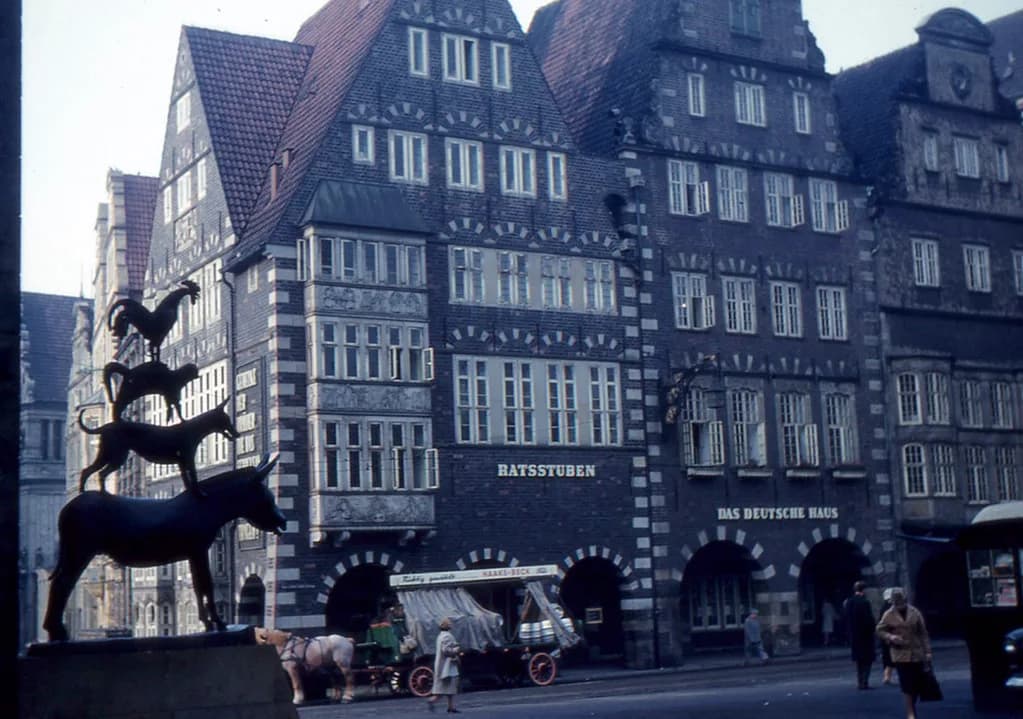
The sculpture was created by Gerhard Marcks in 1953 and stands as a tribute to the popular fairytale, according to Bremen's tourism pages. The animals are stacked in the order the story made famous: rooster on top, then cat, then dog, with the donkey bearing the weight at the base. It is a compact composition, which is a large part of its charm in such a monumental setting.
The source material presents the statue as the city's most well-known landmark and as a deliberate piece of civic pride rather than a fairytale-themed novelty. Knowing that helps you read the placement: the animals sit beside the town hall, not in a dedicated park. Treat the sculpture as a short, dense piece of public art and give it a closer look than a quick snapshot allows, then continue to the town hall itself if you want to understand the setting.
The Grimm Tale Behind the Four Animals
In the Brothers Grimm story, a donkey, a dog, a cat and a rooster set off for Bremen in search of a better life. They never actually arrive, and their story ends in a robbers' cottage on the road, which is why the statue reads as an aspiration rather than a homecoming. Bremen's tourism pages connect the tale to the city's self-image as a welcoming Hanseatic port with a long tradition of drawing people from elsewhere.
That theme is useful if you are travelling with children, because the story gives the photo stop a narrative. The animals are also presented as part of a wider civic identity, not only a children's book illustration. If you want the full tale before you go, the tourism pages point readers towards the fairytale text itself, which is a better preparation than any plaque summary.
Free Access: Sculpture Versus Ticketed Interiors
The bronze itself is a public sculpture in the old town, and no source in the current set gives an admission fee for seeing it. Trip.com's listing records free admission for the attraction, though that page is user-generated and should be treated as a secondary reference. The town hall next to it is a different matter: it is a working civic building with its own visitor arrangements, and those change independently of the statue.
Older visitor posts online still quote town hall opening hours and tour prices, but those figures come from third-party pages and were not verified for this guide. The correct move is to check the official tourism website for current access, tour times and any closures before you plan around the building. Treat the square as the free, always-available part of the visit and everything indoors as something to confirm.
The Good-Luck Ritual and the Polished Legs
The donkey's front legs are noticeably shiny, and Bremen's tourism pages explain why: touching them is meant to bring good luck. The same source adds a local joke that separates newcomers from residents, warning against rubbing just one leg with one hand. The line goes that doing so is simply one donkey shaking the hand of another.
Some travel posts suggest touching the donkey's nose instead, but that is not the ritual described by the city's own tourism pages. If you join in, use both hands on both front legs, as the saying implies, and keep the moment brief. The bronze is small, so a long pose blocks the view for everyone waiting behind you.
Photo Etiquette at a Small, Busy Landmark
The statue sits on a pedestrian route rather than in a fenced enclosure, so photographers and leg-touchers compete for the same narrow space. The cleanest frames come from slightly to the side of the approach, which lets you show the stacked rooster, cat, dog and donkey without standing in the walking line. If someone is touching the legs, wait rather than shooting through them.
Trip.com's attraction page records a typical visiting window of 15 to 30 minutes and an address at Schoppensteel 1, which can help you gauge how much time to set aside. It is a user-generated page rather than an official source, so use it for orientation and not as a rule.
What Else Is in the Same Square
The statue shares its immediate surroundings with the town hall and the Roland statue, both of which you can walk past without buying anything. Stepping from the animals to the Roland figure takes seconds, and the pair together explain Bremen's civic identity better than either does alone. For wider planning, see Bremen Marktplatz Visitor Guide.
Bremen's tourism pages list the cathedral and the Church of Our Lady within the same old-town cluster, so the statue works best as one stop in a circuit rather than a destination in itself. Note that published heights for the Roland statue vary between sources, so avoid treating any single figure as definitive.
Other Town Musicians Depictions Around Bremen
Bremen's tourism pages note that besides the bronze at the town hall there are many other depictions of the animals across the city. That is worth knowing if you want more than a single photograph, since shop signs, sculptures and themed details recur in the old lanes. The source frames these as a way to discover the landmark in an entirely new way.
The same pages also mention a stage version of the tale and guided city walks, which can be a good option if you prefer context delivered in person. Details of performances, languages and departure points are not fixed in the sources consulted for this guide, so confirm them through the official tourism website before booking anything. Treat any listing you find elsewhere as provisional.
Nearby Old-Town Sights to Combine With the Stop
Bremen's tourism pages list the Schnoor Quarter, Böttcherstrasse and the old quarter along the Schlachte embankment as related sights. Schnoor is the oldest district, with narrow lanes and small houses; Böttcherstrasse is a short, expressive brick alley. Each is a few minutes from the market area on foot.
Because the statue and the square cost nothing to walk through, they pair well with a low-cost day. Free things to do in Bremen covers further options if you want to keep spending down while still seeing the historic core. Save the paid interiors for the places whose current access and pricing you have checked directly.
A Suggested Half-Day Walking Order
Start at the statue on the western side of the town hall, then turn to the town hall facade and the Roland figure before crossing towards the cathedral. From there, walk into Boettcherstrasse and finish in the Schnoor Quarter, which rewards slow wandering more than checklist sightseeing. Allow roughly half a day for the full loop; that is a suggestion, not an official duration, and the statue itself takes only a few minutes.
If you have less time, the minimum version is the statue, the town hall exterior and the square, which can be done in a short walk from the station side of the old town. If you have longer, add the Schlachte embankment for a riverside finish. Keep the order flexible and let crowds at the statue decide whether you start or end there.
Practical Realities for a Street-Level Bronze
The statue is an outdoor sculpture in a public square, and no source in this set publishes opening hours for it or rules on accessibility at the site. Assume cobbled, uneven ground in the old town and plan footwear accordingly, especially in wet weather. For anything specific, from step-free routes to guided access, ask the official tourism service rather than relying on old forum posts.
Trip.com's attraction page lists user-generated details including a suggested sightseeing time and a phone number, but such pages are not authoritative for schedules or requirements. Use them only as a rough sense of what other travellers did. Check the official Bremen tourism site close to your travel date for anything that could affect your visit.
Why the Statue Rewards More Than a Quick Photo
The Bremen Town Musicians statue is a two-minute stop that only makes sense inside a longer walk. Its free public setting, its 1953 Marcks bronze and its polished donkey legs are all best appreciated with the town hall, the Roland figure and the old lanes as context. Keep expectations modest and let the square do the rest of the work.
Before you travel, confirm current town hall access and any guided tours through the official Bremen tourism channels, since those details sit outside what the statue's own sources cover. Then build the visit around the free outdoor sights and add paid interiors only where you have verified them.
Frequently Asked Questions
Where is the Bremen Town Musicians statue located?
It stands on the left, western side of Bremen's town hall in the old town. Bremen's tourism pages suggest following Schoppensteel street from the Church of Our Lady towards Domshof, where the bronze is hard to miss.
Is it free to see the Bremen Town Musicians statue?
The statue is an outdoor sculpture in a public square, so there is no admission charge for viewing it. Indoors at the town hall is a separate matter with its own visitor arrangements, so check the official Bremen tourism website for current access and tour information rather than assuming one ticket covers everything.
Why do people touch the donkey's legs on the statue?
Bremen's tourism pages say touching the donkey's front legs is meant to bring good luck, which is why they look polished. The same source jokes that rubbing just one leg with one hand marks you as a newcomer, so the local habit is both hands on both front legs. Some travel posts mention the nose instead, but that is not the documented ritual.
How long do you need at the statue?
The statue itself takes only a few minutes. A suggested half-day covers the statue, the town hall exterior, the Roland figure, Boettcherstrasse and the Schnoor Quarter at an unhurried pace. Treat any duration as a planning suggestion rather than an official figure, and adjust for how busy the square is.
What else can you see near the statue in Bremen's old town?
The town hall and the Roland statue are steps away, and Bremen's tourism pages list the cathedral, the Church of Our Lady, Boettcherstrasse, the Schnoor Quarter and the Schlachte embankment as sights in the same old-town cluster.
Are there other Bremen Town Musicians statues in the city?
Bremen's tourism pages note that besides the bronze at the town hall there are many other depictions of the animals around the city. A stage version of the tale and guided city walks are also mentioned, but details of performances, languages and departure points should be confirmed through the official tourism website before you book.