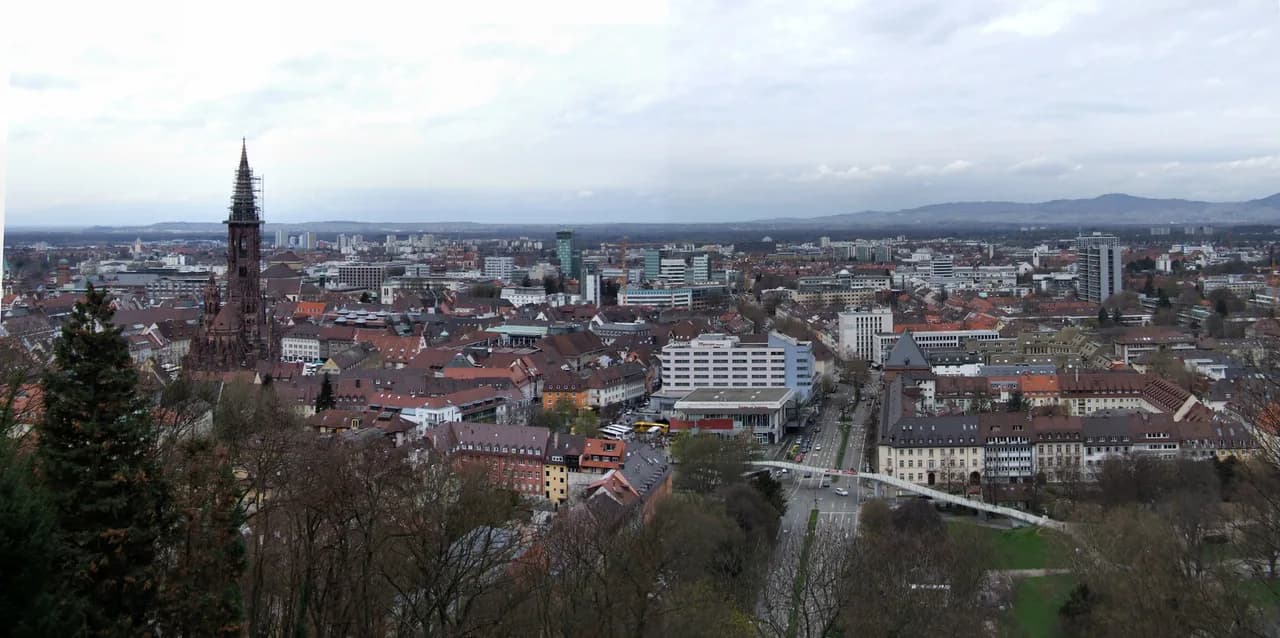
Freiburg Minster, the Freiburger Münster or Münster Unserer Lieben Frau, stands on Münsterplatz in the old town. It is at once the parish church of the Dompfarrei and the cathedral of the Archdiocese of Freiburg, so a visit means entering a working church rather than a museum hall, and the official site describes it as a national cultural monument.
Construction began around 1200 in Romanesque style under the last duke of Zähringen and continued from 1230 in Gothic style, partly on the foundations of an earlier church that had stood there since Freiburg's beginnings around 1120. That layered history explains why the building reads as several phases rather than one uniform design.
As a suggestion rather than an official figure, allow around sixty to ninety minutes for a focused look at the nave, choir, and named highlights, and longer if you climb the tower or linger over the windows. Decide in advance which parts matter most, because the church, the tower, and the surrounding square can each absorb more time than you expect.
Why Freiburg Minster Is the City's Anchor Sight
The Minster is dedicated to Unserer Lieben Frau and serves simultaneously as parish church and cathedral, which gives it the rhythm of worship, concerts, and quiet hours rather than a fixed exhibition schedule. The official site calls it a national cultural monument and notes that it belongs to the small group of Gothic great churches completed in the Middle Ages and largely spared by wars.
Its tower has long carried the epithet of the fairest on earth, a reputation that is part of how the building has been described for generations rather than a modern slogan. For visitors that means the exterior deserves as much attention as the interior: walk the square first, look up, and then decide how much time to spend indoors.
Because the Minster remains an active place of worship and hosts events, the interior can be affected by services, funerals, and concerts. Check the Minster's own calendar before you turn up, and treat any published opening times as the starting point for your plan rather than a guarantee.
Orientation on Münsterplatz and in the Old Town
The Minster sits on Münsterplatz, with the Historical Merchants' Hall on the south side of the square. Its dominant red facade makes an easy landmark if you approach from Kaiser-Joseph-Straße or from the market stalls that fill the square on most mornings.
The square sits between the Martinstor and Schwabentor, the two surviving medieval gates of the old town. A natural route is to enter through one gate, cross the Altstadt, spend time at the Minster, and leave through the other, turning a church visit into part of a larger walk.
If you want to build a day around the city rather than a single building, the Freiburg: Itineraries and City Travel Guides hub collects route ideas that put the Minster in context. Skim it before fixing your schedule, especially if you are combining the church with the market or nearby collections such as the Museum für Neue Kunst Freiburg or the Archäologisches Museum Colombischlössle.
Plan Before You Arrive: Entry Arrangements and Hours
Do not rely on third-party listings for opening hours or admission arrangements, because interior access can shift with services, concerts, and seasonal patterns. The operator publishes current information on the official Freiburg Minster site, and the city maintains its own page; check one of those and note the date you checked it.
The operator does not publish a simple, permanent statement that the nave is always free and the tower always paid, so treat those as separate questions and confirm how entry currently works on the official pages. The same applies to any treasury, crypt, or chapel space: do not assume one ticket covers everything in the complex.
Because services take priority, build flexibility into your plan. If you arrive and find the church in use, use the time to walk the square, study the exterior, or visit the c-punkt Münsterforum before returning later in the day.
Inside the Nave and Choir: What to See
The official highlights list is a useful checklist for the interior. It names the high altar, the ring of chapels, the triumphal cross, the Holy Sepulchre, and the Lambertus bust, so you can pace your visit around specific works rather than drifting.
The ring of chapels around the choir rewards slow looking, because each chapel has its own character and function within the church's liturgical life. If the choir area is in use, respect any barriers or guidance and return when it is open to visitors.
The Lambertus bust and the Holy Sepulchre are easy to miss if you only walk the central aisle. Ask at the visitor centre or use the digital guide so you know roughly where to look before you start moving through the building.
The Stained Glass to Look For
The Minster's windows are a highlight in their own right, and the official site lists them individually. Look for the Wurzel-Jesse, Barmherzigkeits, Konstanzer, and Märtyrer windows, which carry major narrative and regional themes, alongside the Tulenhaupt window.
Guild and donor windows add a social dimension: the Schumacher, Küfer, Bäcker, and Schneider windows reflect the trades that helped fund the building. The Passions, Anna, and Edith-Stein windows round out the set, so a short glass-focused walk can easily fill half an hour.
Light changes through the day, so if stained glass is your priority, plan to look more than once during your visit. Morning and late afternoon often give different readings of the same window, especially in the choir and chapel ring.
Music and Bells: Organs and Bell Ringing
The Minster has four organs, and the official description notes that they can be played individually or together. The operator also runs an organ recital series, with Orgelmusik zur Marktzeit each Saturday at 11.30 from mid-April until Christmas, so you can plan around a short half-hour of music rather than guessing at times.
Nineteen bells give the tower an unusually wide range of possible sound. Bell ringing is tied to the liturgical schedule, so if hearing them matters to you, check the calendar and plan around a service or a scheduled ringing rather than arriving at random.
Music is one reason the Minster feels alive rather than preserved. If you attend a concert or recital, remember that you are in a church first, and follow whatever etiquette the organisers publish for that event.
The Tower Climb as a Decision, Not a Default
The tower climb is a separate offering from visiting the nave, presented on the Minster's own site under its own heading. Whether it suits you depends on time, fitness, weather, and how you feel about heights, so treat it as a decision to make on the day rather than an automatic part of the visit.
The operator does not publish step counts, a lift, or detailed access arrangements on its main pages, so check the official site or ask at the c-punkt Münsterforum before committing. If stairs are a concern for anyone in your group, the virtual tour and the digital guide to the choir and chapel ring offer an alternative way to explore the upper spaces.
How Long to Allow
As a suggestion rather than an official figure, allow around sixty to ninety minutes for a focused visit to the nave and choir, including time to find the named artworks and windows. Add extra time if you want to sit quietly, attend a service, or listen to music.
If you also plan to climb the tower, add further time for queuing, the climb itself, and the view, and check current arrangements on the official pages. Families with small children and travellers with limited mobility may prefer to split the visit across two shorter stops.
For a half-day, pair the Minster with the market on Münsterplatz and a short old-town walk. The Freiburg: Landmark Visitor Guides collection is a good place to see how the Minster fits alongside other city landmarks before you lock in your route.
Digital and Virtual Options
The Minster offers a virtual tour and a digital guide to the choir and chapel ring. These are useful if you want a preview before you arrive, or if the tower climb is not for you and you would rather explore the upper spaces digitally.
Using the digital guide alongside a physical visit can help you identify what you are looking at without reading long panels inside the church. It is also a sensible option for anyone on a tight schedule who wants to prioritise a few specific works.
The c-punkt Münsterforum Visitor Centre
The c-punkt Münsterforum functions as a visitor centre as well as an information, pastoral care, and counselling point. It is a reasonable first stop if you want orientation, current information, or a quiet word before entering the church.
Because details such as opening times and available services can change, treat the visitor centre as the place to confirm current practicalities rather than relying on older descriptions. It also connects to the wider work of the Münsterbauverein and related foundations that maintain the building.
Practical Etiquette for an Active Church
The Minster is a place of worship first, so dress and behaviour should reflect that, and avoid visiting during services unless you are attending as a worshipper. The official site shows a daily timetable of services and events, which makes it easy to pick a quieter window.
The official site carries its own notice about video surveillance, so read that notice rather than relying on second-hand descriptions. Follow any signage inside the building, and respect barriers or restricted areas even if they look temporary.
If you are unsure whether photography or movement is appropriate in a given area, ask at the visitor centre. A short question avoids awkwardness and helps keep the church available for both worship and visitors.
Scheduled Tours and Events
Guided tours and events appear on the Minster's own calendar, which is the reliable place to confirm times. The official site shows regular Münsterführungen, described as covering the Minster inside and out, alongside services and concerts, so you can build a visit around a guided introduction.
Third-party listings can be out of date, so use them for ideas only and verify the details with the official source. If a tour is central to your plan, check the calendar on the day as well as in advance, since schedules can shift.
What to Skip or Save for Next Time
Families with small children may find a short look inside plus time on Münsterplatz more enjoyable than a long interior visit, especially if the tower climb is not practical for the group. Travellers short on time can focus on the exterior, the nave, and one or two named highlights.
Art-focused visitors may want to return for the windows and chapels in different light, or follow the Old Town walking route through the Altstadt to see the Minster in its urban setting. If the church is busy or closed for a service, the Alte Wache and the surrounding Münsterplatz area give you a natural fallback without leaving the old town.
Plan Your Visit
Freiburg Minster rewards a visit that separates its parts: the active church interior, the tower climb as an optional decision, and the surrounding square and old town. Check the official Minster site and the city page for current opening and admission information before you go, and note the date you checked.
A suggested window of about sixty to ninety minutes covers the nave, choir, and named highlights comfortably, with more time if you climb or linger over the windows. Use the digital guide and visitor centre to orient yourself, and let the service calendar shape when you go rather than the other way around.
Frequently Asked Questions
Is Freiburg Minster free to enter?
The operator does not publish a permanent statement that the nave or choir is always free or always ticketed, and interior access can also be affected by services and events. Check the official Freiburg Minster site and the city page for current information before you visit, and treat the tower as a separate question from the nave.
Do you have to pay to climb the tower of Freiburg Minster?
The tower climb is a separate offering from visiting the nave, but current admission and any booking arrangements should be confirmed with the operator rather than assumed. Check the official Minster site before you plan to climb, and note the date you checked it.
How long should I allow for a visit to Freiburg Minster?
As a suggestion rather than an official figure, allow around sixty to ninety minutes for a focused look at the nave, choir, and named highlights. Add extra time if you plan to climb the tower, attend a service or recital, or revisit the windows in different light.
What should I see inside Freiburg Minster?
The official highlights list names the high altar, the ring of chapels, the triumphal cross, the Holy Sepulchre, and the Lambertus bust. The windows are a major draw in their own right, including the Wurzel-Jesse, Barmherzigkeits, Konstanzer, Märtyrer, Tulenhaupt, guild, Passions, Anna, and Edith-Stein windows.
Can you visit during a service?
The Minster is an active place of worship, so services take priority over visitor access. The official site shows a daily timetable of services and events, so check it and plan around quieter windows rather than arriving during worship, and follow any guidance given inside the church.
Are there guided tours of Freiburg Minster?
Guided tours appear on the Minster's own calendar alongside services and events, and the official site lists Münsterführungen described as covering the building inside and out. Schedules can shift, so check the calendar close to your visit if a tour is central to your plan.
Is the tower climb suitable for children or anyone with a fear of heights?
That depends on your group, since the operator does not publish detailed step counts or accessibility arrangements on its main pages. Treat the climb as a judgement call based on time, fitness, weather, and comfort with heights, and check the official pages or ask at the c-punkt Münsterforum before deciding.