Vierzehnheiligen Basilica is the most rewarding half-day excursion from Bamberg that most visitors never plan for. The Baroque pilgrimage church stands above Bad Staffelstein in the Gottesgarten am Obermain, a landscape of river valley, limestone hills and monastery views that begins roughly where the city's UNESCO-listed old town ends. It is a working pilgrimage site, not a museum with a single turnstile, which is why the access question is more interesting than it first appears.
If your only Bamberg reference points are the cathedral and the old town, use the landmark guides for the destination overview before deciding how to spend a spare morning. The city rewards a slow visit, but it also sits within easy reach of countryside that Upper Franconia treats as its own backyard, and a short rail hop gets you into that landscape without a car. This guide avoids fixed hours and prices because the organiser publishes those directly, and instead explains what to check and in what order.
Why Vierzehnheiligen is the classic half-day excursion from Bamberg
Bamberg itself keeps drawing people back, and the tourism office frames both the city and the surrounding Bamberger Land as places where you can walk, cycle and slow down rather than simply tick off monuments. That framing is a useful clue: the strongest day trips from the city are the ones that trade density for landscape. Vierzehnheiligen fits that brief better than most, because a single building carries the artistic weight of a museum and the outdoor context supplies the rest.
The basilica is not in Bamberg at all. It sits above Bad Staffelstein, and parking, rail and even the final approach are separate decisions rather than one seamless transfer. Treating it as a half-day excursion, roughly four to five hours door to door including travel and an unhurried look around, is a reasonable personal suggestion rather than an official timetable. If you have a full day, you can layer in a second site or a ridge walk without rushing.
Where the basilica sits: Bad Staffelstein, the Gottesgarten and the Obermain valley
The basilica belongs to the Gottesgarten am Obermain, a tourism landscape spread across the upper Main valley between Bad Staffelstein, Lichtenfels and the hills to the east. The basilica's own published address places it in Bad Staffelstein, so the geography is easy to fix: you are heading north-east along the Main, not deep into the Franconian forest. That matters when you check connections, because a train toward Lichtenfels and a train toward Hof can look similar on a departure board.
Kloster Banz, another former monastery on a hill opposite, is part of the same visual composition from several viewpoints, which is exactly why the two are so often mentioned together. A cycling description of the area registers the basilica, the Banz view and the Staffelberg summit as successive highlights of one loop starting and ending at Bad Staffelstein station. Read that as evidence of proximity, not as proof that the two sites share opening times or a single entry arrangement.
Getting there from Bamberg without a car: railway logic and the last stretch uphill
The realistic car-free plan is to take the railway from Bamberg towards Bad Staffelstein and cover the remaining distance on foot, by local bus or by bike. Nobody can responsibly give you a departure minute without checking a live timetable, so look up connection options on the day before you travel and again in the morning. Bad Staffelstein has its own station, and the basilica is signed from the area, but the village approach and the final climb are not the same thing.
Budget time for the upper section. A published cycle route through this landscape records a demanding, noticeably steep climb up to the pilgrimage basilica, especially near the top, where riders describe pushing hard in the final metres. A cyclist's gradient warning translates into a slow, breathy walk for a pedestrian arriving in ordinary shoes. If you are unsure of your pace, plan the uphill first and leave the more flexible part of the day for the descent.
Before committing to public transport, cross-check the day's options with the city's visitor information, which also covers how to reach the wider Bamberger Land and how to move around once you are there. Advance tickets and travel passes for the region are usually cheaper and simpler than buying singles on the day, but confirm current conditions yourself. If you are travelling on a Sunday or public holiday, check twice, because rural services thin out even in a well-connected valley.
Opening logic: grounds, church interior and pilgrimage services
Vierzehnheiligen is a consecrated pilgrimage church, and the practical consequence is that there is no single opening time to memorise. The basilica's own website separates the basilica, the current service schedule and the opening times into different sections, which tells you that casual visiting and liturgical use run on different clocks. Check the opening times page for the interior and the service order for the day you intend to travel. Distinguish three things: the outdoor grounds and forecourt, the church interior, and the times when the interior is reserved for worship.
The organiser also publishes an events and dates section, where recurring devotions, concerts and one-off gatherings appear. Rosary devotions, evening prayers and diocesan events are normal life here rather than exceptions, and they can restrict how freely you wander mid-service. If your visit coincides with a pilgrimage group arriving, expect the nave to be busier and the atmosphere more focused on ceremony than on sightseeing. Adjust your expectations rather than the building.
Whether any part of the visit carries a charge is a question the official site answers for itself, and it can change. Check there before you travel rather than relying on older trip reports or on any statement that the church and the neighbouring monastery complex share one arrangement. Because the packet does not settle admission details, the responsible move is to read the organiser's own information and plan as if only the published facts apply.
What you actually see inside: the Gnadenaltar and the fourteen holy helpers
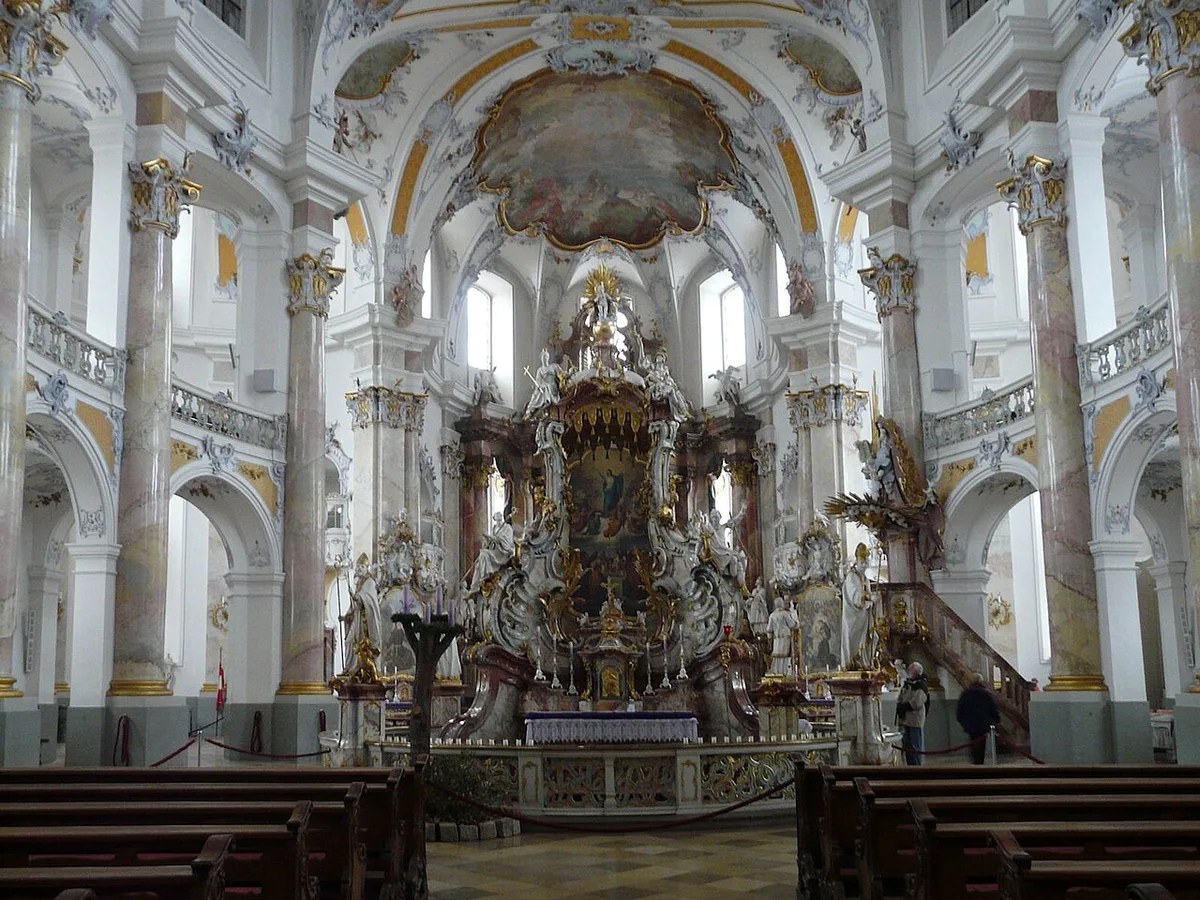
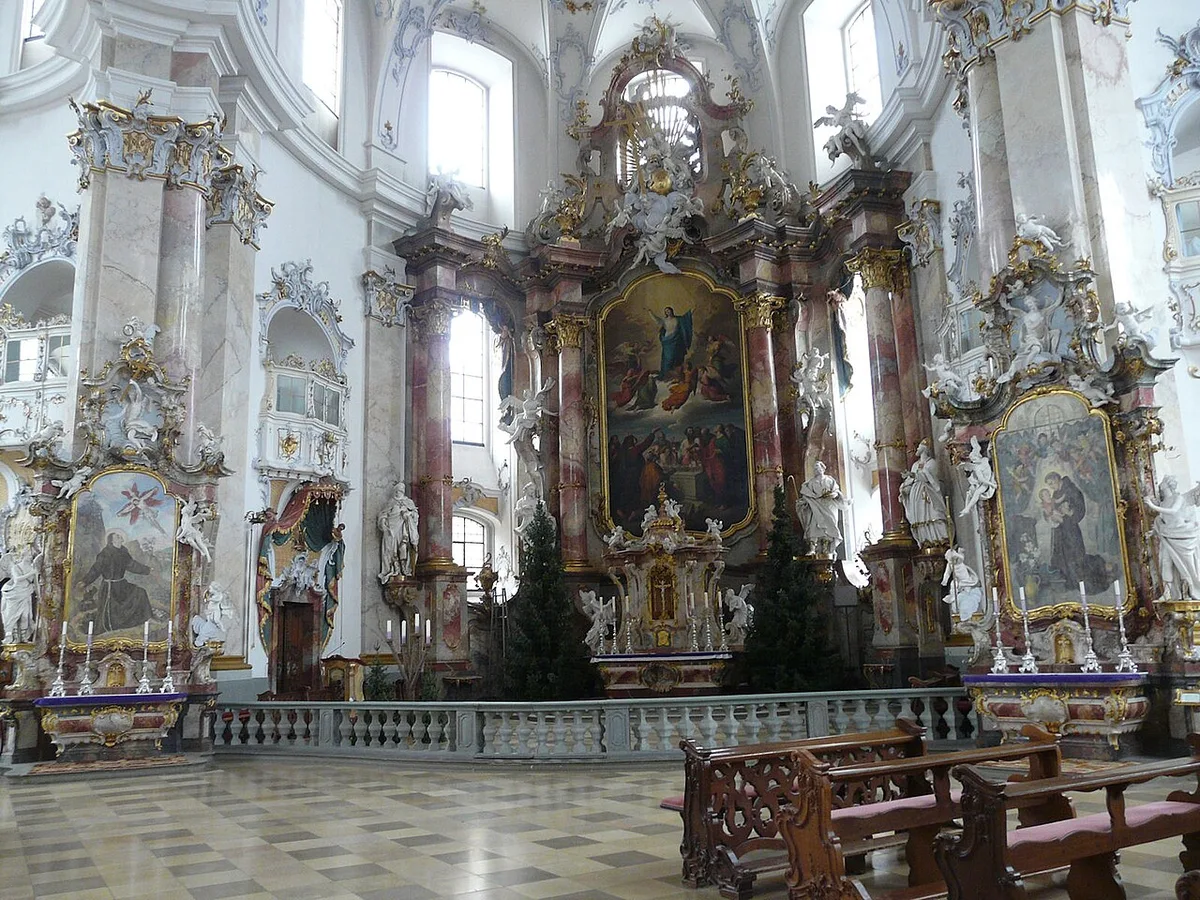
The centrepiece is the Gnadenaltar, the altar of grace, built over the spot where the fourteenth-century vision of the Christ Child and the Fourteen Holy Helpers is said to have occurred. Balthasar Neumann's design turns that devotional focus into a theatrical Rococo canopy of light, gilding and sculpture, and the church interior is genuinely one of the high points of Franconian Baroque. If you know the Bamberg Cathedral visitor guide well, you will notice the contrast immediately: Romanesque weight in the city, airborne Rococo in the countryside.
Each of the Fourteen Holy Helpers carries its own tradition, and the basilica's site devotes a separate page to figures such as Saint Christopher, Saint Barbara and Saint Vitus. The nave layout rewards a slow circuit rather than a photograph from the entrance, because the altar's structure only makes sense once you have walked around it. Even a fifteen-minute look becomes thirty if you read the saints' attributes, so decide in advance how much detail you want.
Practical etiquette matters in a church of this importance. Keep voices low, avoid blocking the central aisle while a service is under way, and dress as you would for any active place of worship in Bavaria. If you are travelling with children, brief them before you enter, because the ornament invites touching. These are common-sense behaviours rather than site-specific rules, and you can confirm anything unusual on the organiser's information pages.
Checking current Mass times, devotions and events before you go
The single most useful pre-trip action is to open the official site's service and dates sections the day before you travel. They publish a current order of services, a half-year overview and a regularly updated events list, which is more reliable than any third-party summary. You do not need to memorise the schedule; you simply need to know whether the hours you planned to look around clash with a Mass, a rosary or a musical evening prayer.
If a pilgrimage group is booked for the same day, the site will reflect it in the dates list and the church will feel busier. Consider shifting your arrival an hour earlier or later if your schedule allows, and treat a full nave as a sign of the building doing its actual job rather than a problem. Check the site again on the morning of your visit, because special services can be added at short notice.
A word about the Franciscan monastery and the education houses on site
Vierzehnheiligen is more than a church building. The official site lists a monastery with a Franciscan community, an information centre, education houses and a separate congregation of Franciscan sisters, all on and around the pilgrimage site. That structure explains why the place feels inhabited rather than curated, and why you may see people going about religious and educational work while you are visiting.
For the traveller, the practical implication is that the complex has several doors and several functions rather than one visitor entrance. Do not assume that a programme for the education houses also governs access to the basilica, or the reverse. If you want to understand the whole site, read the monastery and information-centre pages on the official website before you go, and treat any door marked for a specific group as closed to casual visitors.
Pairing Vierzehnheiligen with Kloster Banz: what the combination really involves
Kloster Banz is a separate site on the opposite ridge, and the two often share a single panorama. The basilica's website links to the monastery as a neighbouring institution, which is useful context but not a joint ticket announcement. Treat Banz as its own visit with its own timetable, its own entry conditions and its own approach route. Check its organisational pages independently rather than assuming anything carries over from the basilica.
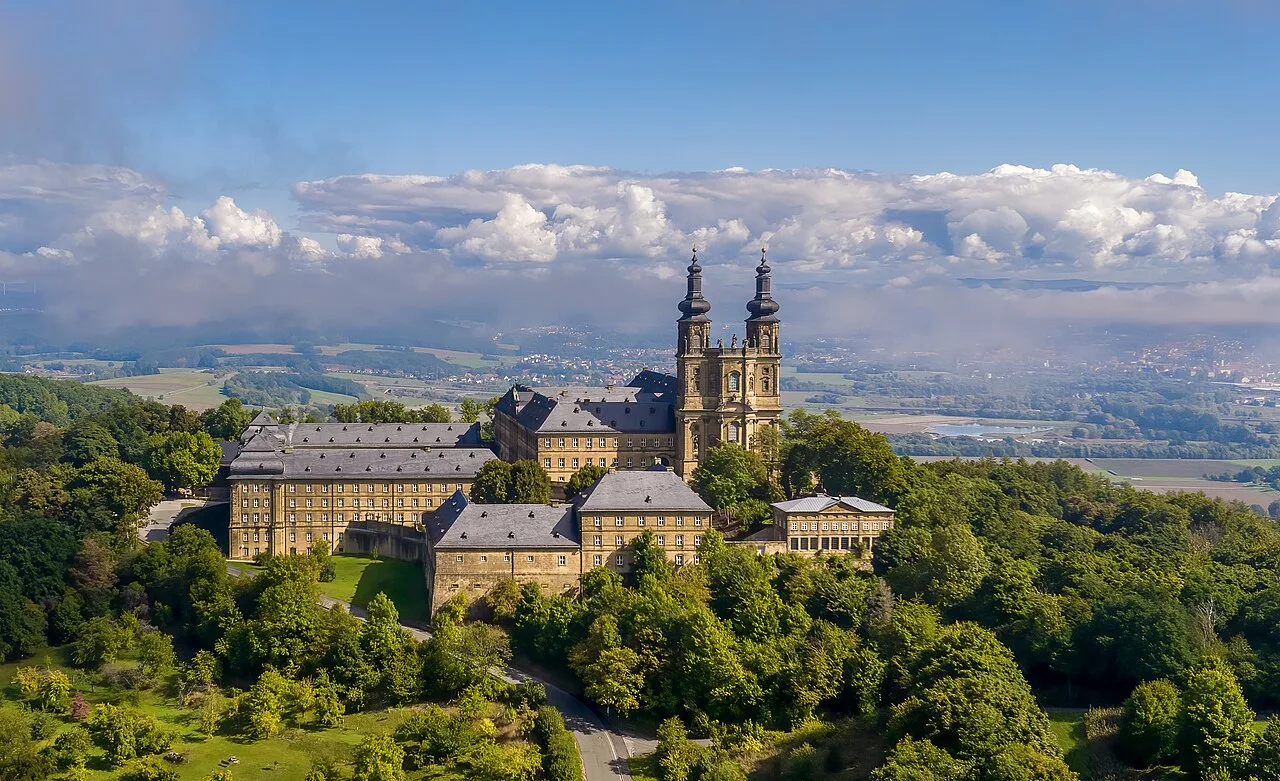
Combined, the two make a long half-day or a comfortable full day, depending on how much walking and how many interior visits you want. The main trade-off is transport: stringing two hilltop sites together by public transport is rarely elegant, while a car or a bike makes the connection much simpler. If you are car-free, study the local bus and rail options for the Banz side before you commit, and accept that one of the two may end up being a viewpoint stop rather than a full interior visit.
Doing it by bike: the Staffelstein loop, Staffelberg and the Scheffel viewpoint
The most rewarding way to see the whole Gottesgarten in one go is on two wheels. A published loop from Bad Staffelstein station runs about twenty kilometres with roughly 330 metres of climbing, rated moderate and estimated at under two hours for a reasonably fit rider, and it strings together the old town, the Staffelberg ascent, the summit panorama, the basilica and a Banz viewpoint. Use those figures as a planning baseline and add time for stops, because the route description assumes continuous riding.
The route's own notes are surprisingly honest about the final climb to the basilica, describing the upper section as genuinely steep, and about the Staffelbergklause segment, where the last metres are hard work. The Viktor von Scheffel viewpoint, roughly two-thirds of the way round, opens onto the basilica, the monastery and the wider valley and is described as a good place for a break. The start and end point at Bad Staffelstein station is noted as reachable by public transport, which is the detail that makes the whole plan car-free.
If you would rather keep it simple, you can ride only the flat valley sections and walk the last stretch to the basilica, or skip the Staffelberg summit and save your legs. The route crosses a protected natural park area, so stay on marked paths and follow local signage. Rental availability and opening conditions at Bad Staffelstein change with the season, so confirm locally rather than trusting an out-of-date listing.
Suggested half-day structure: arrival, visit, viewpoint, return
Here is a non-official structure you can adapt rather than follow. Aim to arrive in Bad Staffelstein mid-morning, walk or ride up to the basilica while you still have energy, and give the interior a full hour if the schedule allows. That sequencing puts the climb behind you and leaves the afternoon free for either Banz or the valley.
After the basilica, walk to one of the nearby viewpoints for the reciprocal view of Banz and the Staffelberg, then descend at a relaxed pace and catch a return connection. Build in a buffer of at least thirty minutes before your train, because rural connections are sparse and a missed one can cost an hour. If the weather turns, cut the viewpoint and prioritise the return leg.
Keep the day flexible. If the service schedule means the church is busy when you arrive, swap the interior and the outdoor walk around, since the grounds and viewpoints do not depend on the liturgy. That single swap is often the difference between a frustrating visit and a memorable one.
What to skip if you only have a morning
A morning is enough for the basilica and a viewpoint, and not much more. Skip the Staffelberg summit, skip the second site, and treat Kloster Banz as something to admire from the Scheffel viewpoint rather than to visit. Ride or take a bus to the village if you can, because the uphill walk eats the time you have.
Prioritise the interior first, since it is the reason you came and the only element with a schedule that can close around you. Photograph the exterior and the valley view on the way out, when the light on the Obermain is usually better anyway. Then head straight back to the station rather than lingering over a detour.
Practical constraints: weather, terrain, pilgrimage crowds and quiet hours
The upper Main valley is exposed, and the walk up to the basilica is on open ground for much of its length. Rain, wind and summer heat all land harder on that final climb than they do in Bamberg's lanes, so pack accordingly. Good shoes matter more than anything else on this trip, and a light waterproof earns its place even on a promising forecast.
Crowds follow the pilgrimage calendar rather than the tourist one. Large groups tend to arrive by coach and concentrate around services and feast days, so an early or late slot usually feels calmer. Quiet hours in a working church are not a marketing concept here; they are part of the building's purpose, and respecting them improves the visit for everyone.
For the wider trip, use the Bamberg tourism site to check seasonal information, transport notes and what else is on in the region during your dates, and compare it against the basilica's own event list. Building the day around a city itinerary and cross-checking the countryside timetable in parallel is the most reliable approach. If the two sources disagree, trust the organiser of the specific site you are visiting.
Plan Your Visit
Vierzehnheiligen works as a half-day excursion from Bamberg because it asks something slightly different of you than the city does. You trade dense streets for a valley view, a cathedral for a pilgrimage church, and a fixed opening time for a schedule you need to check yourself. The reward is one of the finest Rococo interiors in Germany, framed by a landscape that gives it meaning.
Before you go, set three things: a live connection to Bad Staffelstein, the current service and event list from the basilica's own pages, and a realistic decision about whether Kloster Banz gets a proper visit or a viewpoint. Everything else, from shoes to timing, follows from those three. If you keep the plan loose enough to swap the interior and the walk, weather and worship alike will not derail the day.
Frequently Asked Questions
Is Vierzehnheiligen Basilica worth visiting from Bamberg?
Yes, if you have a spare half-day and an interest in Baroque architecture or pilgrimage culture. The Gnadenaltar alone justifies the trip, and the valley setting above Bad Staffelstein gives the visit a different character from anything inside Bamberg's old town. It is also easy to combine with a viewpoint or a short cycle loop.
Can you combine Vierzehnheiligen with Kloster Banz in one trip?
You can, but treat them as two separate visits with separate timetables and entry arrangements rather than one combined attraction. The two sit on opposite sides of the valley and appear together in the same panorama, which is why they are so often paired. Their internal policies are published independently, so check each organiser's own information before you go.
What should you check before travelling to Vierzehnheiligen from Bamberg?
Check three things on the day: live rail connections to Bad Staffelstein, the basilica's current opening and service information, and the weather for the exposed climb. The organiser publishes opening times and a service order, and the city's tourism office covers transport and regional tourist information. Do not rely on older trip reports for scheduled details.