

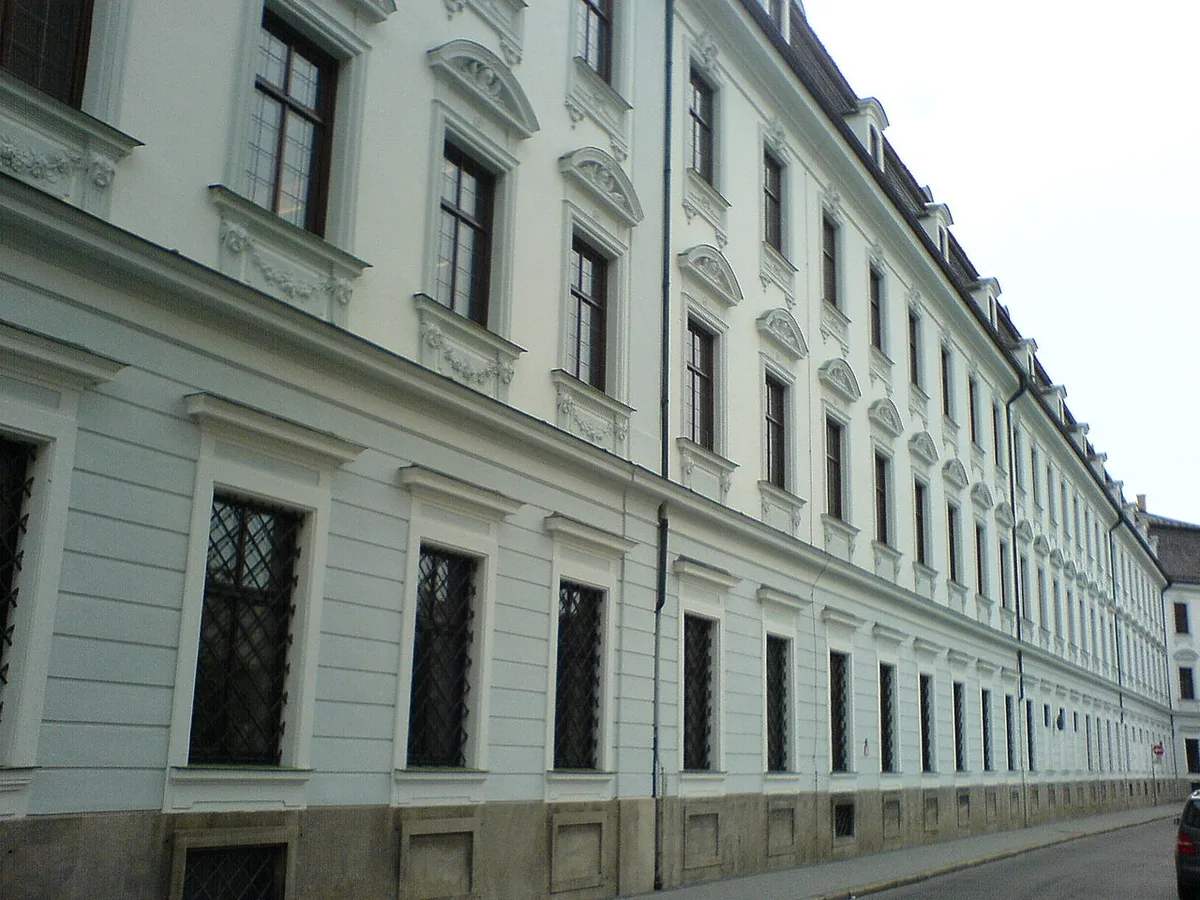
The Schaezlerpalais is Augsburg's most significant and best-preserved private residential and commercial building of the 18th century, standing directly beside the Herkulesbrunnen on Maximilianstrasse. Banker Benedikt Adam Liebert von Liebenhofen bought the older patrician house on the site in 1764, had it demolished, and commissioned the present palace, completed in 1770. That history is why the building reads as a wealthy merchant's townhouse rather than a royal residence, and why so much of its interior decoration survived.
Confusingly for first-time visitors, the Schaezlerpalais and the Rathaus Golden Hall are separate buildings with separate admissions. The palace sits on Maximilianstrasse, while the Renaissance Rathaus with its Golden Hall is a different stop elsewhere in the old town. Treat them as two distinct visits and budget time for each rather than assuming one ticket covers both.
What the Schaezlerpalais Is and Where It Sits
The building at Maximilianstrasse 46 holds the Deutsche Barockgalerie and an enfilade, a Baroque sequence of rooms, stretching more than 100 metres before ending in the famous Rococo Festsaal on the first upper floor. The second floor presents paintings of the Karl and Magdalene Haberstock Foundation alongside temporary exhibitions staged several times a year. The palace sits in the middle of Augsburg's old town, so it slots naturally into a walk along Maximilianstrasse rather than requiring a separate trip.
Augsburg Tourism lists the Schaezler-Palace among the city's famous sights, alongside the Fuggerei, the Renaissance city hall, the cathedral and the Maximilianstrasse. The tourist office publishes downloadable international brochures with a sight map for the city centre, so you can orient yourself before setting out.
The Rococo Festsaal: What You Are Actually Looking At
The Festsaal is the heart of the palace, and a large proportion of its surfaces is still original, which is what makes it a rare document of South German Rococo. Gregorio Guglielmi painted the expansive ceiling fresco in 1767, an allegory of trade linking the continents and dominated by Europe. Its light palette gives the illusion of an opening to the sky, reinforced by the room's many windows. The ceiling painting is set into the stucco decoration of the brothers Franz-Xaver and Simpert Feichtmayr, while Placidus Verhelst carved the mirrors, walls and furniture.
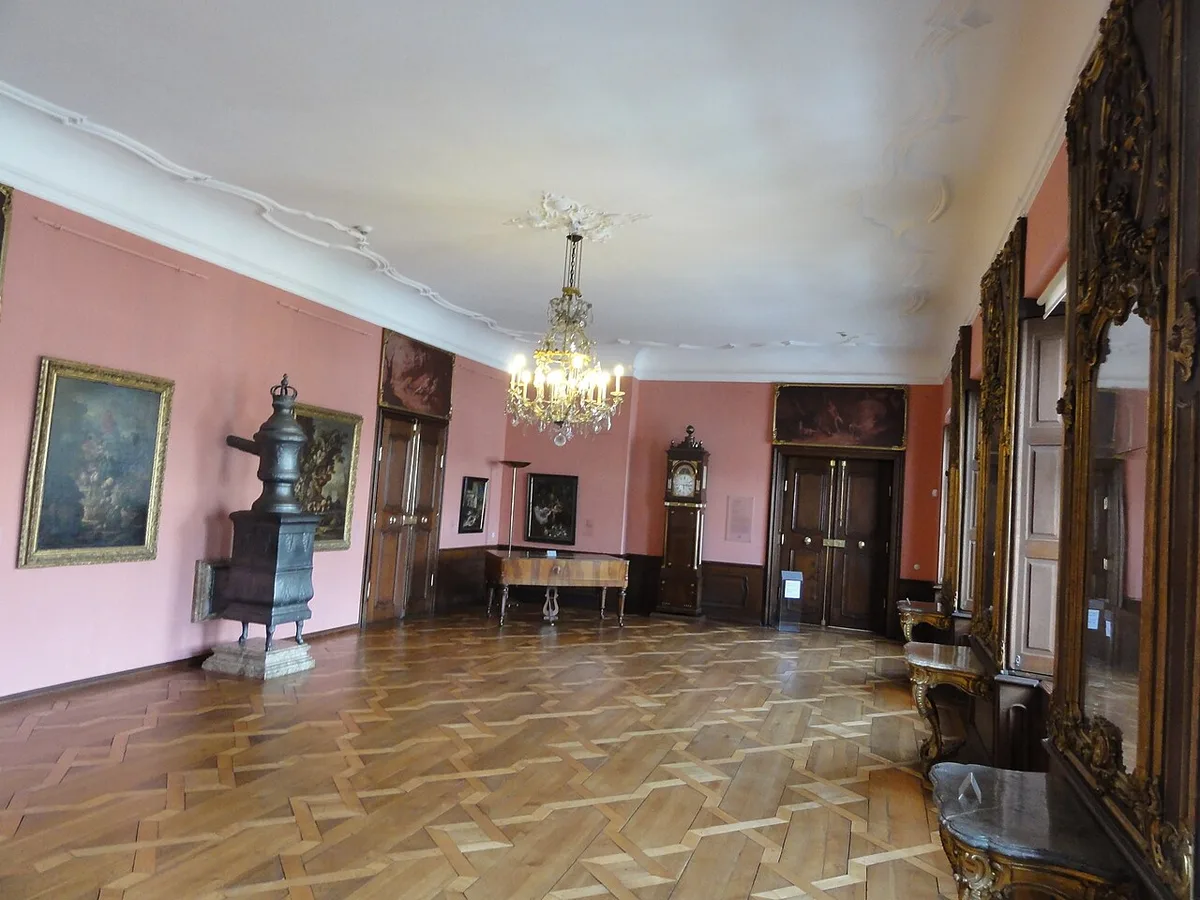
The world allegory continues around the room: four supraportes above the doors show flora and fauna of the continents, and the mirror crests on the long sides carry the signs of the zodiac. Look low as well as high, because the original parquet floor, panelling and door leaves survive. The operator notes these original surfaces are what make the hall a unique document of South German Rococo. Further visitor details appear in Schaezlerpalais | Kunstsammlungen und Museen Augsburg.
The hall was inaugurated in 1770 by Archduchess Maria Antonia of Habsburg-Lorraine, who stopped in Augsburg on her journey to Versailles for her wedding to the future Louis XVI of France. That date gives you a useful anchor for the room's decoration: almost everything you see belongs to the first few years of the building's life. The palace remained in the Schaezler family until their descendants donated it to the city of Augsburg in 1958.
Ballroom Etiquette: Rules That Affect Your Visit
The museum association publishes binding visitor regulations, and several rules matter specifically in the Rococo ballroom. Touching the exhibits is not permitted, and the rules explicitly extend this to the historical furniture in the ballroom. Balloons are strictly forbidden in the exhibition rooms, including the ballroom. Children under ten, groups of children and school classes must be accompanied by at least one responsible supervisor.
Private photography is welcome without flash and without a tripod, and selfie sticks are prohibited. Eating, drinking and smoking are not allowed in the showrooms, with the Schaezlerpalais garden stated as the exception. Large bags, backpacks, umbrellas and wet rainwear belong in the wardrobes, where a board indicates the maximum permitted bag size.
Wedding photography in the ballroom and garden is possible by prior arrangement with the office and requires registration, and a fee is paid at the museum cash desk. Scattering rice or confetti anywhere in the Schaezlerpalais, garden included, is not permitted, and wedding ceremonies themselves are not possible in the building or on its grounds. Assistance animals such as guide dogs are allowed with prior notification to the visitor service.
Deutsche Barockgalerie and the 100-Metre Enfilade
The Deutsche Barockgalerie occupies the first floor and presents roughly one hundred masterworks from the city of Augsburg's collections and various lenders. Although divided into thematic groups, it is conceived as a continuous whole showcasing the strengths of 17th- and 18th-century painting. Augsburg was a style-setting centre in this period, and German Rococo was once called the Augsburg taste.
The selection concentrates on painters active in Augsburg, including Josef Heintz, Matthäus Gundelach, Johann König, Johann Georg Bergmüller, Johann Evangelist Holzer and Matthäus Günther. Works by Johann Heinrich Schönfeld and the early Augsburg academy circle convey High Baroque painting, while Bergmüller and his pupils trace the move towards Rococo. The sequence closes with later names such as Anton Graff, Anton Raphael Mengs and Heinrich Friedrich Füger.
Moving through the enfilade, you also pass the surviving furnishings of the three rooms facing Maximilianstrasse, including supraportes by Joseph Christ showing episodes from Ovid's Metamorphoses. Each of the 67 paintings was held in a single colour, echoing the lost silk wall coverings, and the walls were repainted in those tones in 2005, during the operator's 2004-06 refurbishment of the building complex. A restoration initiative from 2015 gave all the first-floor paintings decorative frames.
Steiner-Kabinett: Free-Access Hinterglas Paintings via the Cafe
On the ground floor, the Steiner-Kabinett shows part of the Steiner collection, an extensive group of 18th-century Hinterglas or reverse-glass paintings. In the 18th century Augsburg was one of the centres of this technique, which was widespread across Europe and produced mainly small-format works. Subjects were largely religious, but allegories, landscapes, town views and mythological scenes also appear, often based on printed sources.
Under the title Der Blick dahinter - Allegorien, selected reverse-glass paintings hang in the redesigned Steiner-Kabinett, and the page notes free access through the museum cafe. That free access makes this the easiest collection to see if your time or budget is tight, but remember it is a small cabinet rather than a full gallery. The cafe and Liebertzimmer adjoin it and invite you to linger.
Stiftung Haberstock and the Second-Floor Special Exhibitions
On the second floor, the Karl and Magdalene Haberstock Foundation presents around 40 masterpieces of European painting alongside works by Paolo Veronese, Giovanni Battista Tiepolo, Anthony van Dyck, Jacob Ruisdael and Lucas Cranach the Elder. The city received the estate of the Augsburg-born art dealer Karl Haberstock and his wife Magdalene in 1983, including their library and valuable archival material. Temporary exhibitions on wide-ranging themes are staged here several times a year.
The Haberstock rooms are also a place of provenance research rather than a straightforward picture hang. After the American historian Jonathan Petropoulos criticised the city's handling of the foundation in 2000, the Kunstsammlungen began a scholarly reappraisal of the dealer's estate, which includes sales to Nazi figures and work as a buyer for the planned Linzer Museum. Results were published in 2008, and the project is described as pioneering for provenance research in German museums.
The Free Rococo Garden and the Schaezler Bees
The Rococo garden on the south side of the palace was reconstructed in 2005 following historical findings and garden-archaeological research. It is laid out as a nearly square four-field parterre with a central fountain, framed by box hedges, asymmetric winding paths, lawns and small trees, today cornelian cherries. The operator states that the garden is open daily and generally available to everyone free of charge as a place to relax, including people who are not visiting the museum.
Building and garden still form an architectural unit, with the hall range, its ground-floor arcade and the garden aligned on the same axis. Since spring 2013 the former chicken house in the garden has housed a bee colony that reaches up to 60,000 bees in summer, and the operator states the honey yield at 50 to 70 kilograms per colony, roughly double that of the countryside; the honey is sold in the museum shops of the Schaezlerpalais and the Maximilianmuseum.
If the garden is your main reason for stopping, note the operator's visitor regulations state that receptions there were not possible at the time of writing because of the pandemic, the elevator construction site and the sculptures in the garden; consider confirming current arrangements with the visitor service. Garden conduct still matters: do not tear down plants, branches, flowers or fruit, and leave the space clean after your stay. Non-museum visitors may use the garden, so it works well as a quiet pause in the middle of an old-town walk.
What the Ticket Covers, and the Closed Katharinenkirche
The operator's Schaezlerpalais page states that its ticket gives access to the Staatsgalerie Alte Meister in the Katharinenkirche, a branch gallery of the Pinakotheken. The same page carries the status note that the gallery is closed for technical reasons until further notice as of 07/2025, so do not plan around it. Check the current position before you travel rather than assuming the branch has reopened.
Admission to the museums is only permitted with a valid admission ticket, which must be shown to supervisory staff on request, and tickets are non-transferable and not replaced if lost. The visitor regulations do not list admission prices and instead direct readers to the ticket offices, the website and the quarterly programme. That is where you check current prices and any combined offers rather than relying on older figures. For wider planning, see Perlachturm Augsburg.
The free-access Steiner-Kabinett through the cafe and the free Rococo garden are the exceptions to ticketed entry, and the ticket scope is what separates the interior collections from those spaces. The Rathaus Golden Hall is a separate attraction with its own admission arrangements, so a Schaezlerpalais ticket should not be understood as covering it. If you want both, plan them as two stops on the same old-town walk.
Suggested Duration and Timing Your Stop
Allow roughly one to two hours for the interior collections if you want to read labels and look properly at the Festsaal, and treat that as a suggestion rather than an official figure. Add time for the garden, which is free and open daily, and for the cafe if you want a break between floors. The building is compact, so the main variable is how long you spend in the Baroque gallery and the ballroom.
Maximilianstrasse makes the palace easy to combine with other central sights, and Augsburg Tourism publishes downloadable city-centre brochures that include a sight map, so you can orient yourself before you go. Augsburg's UNESCO water management system and its canals are a separate theme worth an afternoon of their own. If you are building a full day, pair the palace with the Rathaus and Perlachturm, then walk the Lech canals.
The Perlachturm next to the Rathaus offers a contrasting experience: a tower climb rather than an interior collection. It is worth checking the current access and hours before you go, since renovation work can affect tower openings. Pairing a viewpoint stop with the Schaezlerpalais gives you both the city roofline and the palace interiors.
Practical Visitor Information and Getting There
The visitor service of the Kunstsammlungen and Museen Augsburg answers questions about exhibitions, opening hours and visits from Monday to Friday, 9 a.m. to 12 p.m., on +49 (0) 821-324 41 12 or by email. The visitor service is also the place to book art and culture mediation offers. For orientation once you arrive, the palace is at Maximilianstrasse 46, 86150 Augsburg.
The rules on bags are enforced at the wardrobes, where a board states the maximum permitted bag size, and some houses provide lockers for the duration of your stay. Children under ten, groups of children and school classes must be accompanied by a responsible supervisor. No liability is accepted for the wardrobe, so keep valuables with you.
Augsburg is served by train and by long-distance buses, and the main station sits within walking distance of the central squares. The tourist office at Rathausplatz keeps opening hours for its information desk that run from April to October and differ in winter, so check before relying on it. For any visit, confirm current hours and admission at the operator's ticket office rather than an old blog post.
How the Schaezlerpalais Fits Into an Augsburg Day
The Schaezlerpalais works best as one deliberate stop rather than a quick photo call, because the reward is in reading the ballroom's original surfaces and walking the long enfilade slowly. Give the interior a suggested one to two hours, then use the free garden as your break before continuing. The palace is in the middle of the old town, so it naturally fits between Maximilianstrasse, the Rathaus and the Fuggerei.
For families, the Augsburg Zoo is a different kind of stop that needs its own half day and its own planning. If you are staying longer, our Augsburg guides cover itineraries, the water system and other landmarks so you can group sights by theme or by walking distance. Always confirm prices and hours at the operator's ticket office the week you travel.
Frequently Asked Questions
Is the Schaezlerpalais Rococo garden free to visit?
Yes. The operator states that the garden of the Schaezlerpalais is open daily and generally available to everyone free of charge as a place to relax, including people who are not visiting the museum. Conduct rules still apply: do not tear down plants, branches, flowers or fruit, and leave the garden clean after your stay. Note that the visitor regulations state receptions in the garden were not possible at the time of writing because of the pandemic, the elevator construction site and the sculptures there.
Is the Schaezlerpalais the same as the Rathaus Golden Hall?
No. They are two different buildings in Augsburg with separate admissions and should be planned as separate visits. The Schaezlerpalais stands beside the Herkulesbrunnen on Maximilianstrasse, while the Rathaus with its Golden Hall is elsewhere in the old town. A Schaezlerpalais ticket should not be assumed to cover the Rathaus or the Golden Hall.
How long do you need at the Schaezlerpalais?
Allow roughly one to two hours for the interiors if you want to read labels and look properly at the Rococo Festsaal; treat that figure as a suggestion, not an official duration. Add extra time for the free garden and the cafe between floors. The main variables are how long you spend in the Deutsche Barockgalerie and whether a temporary exhibition is on the second floor.
What can you see in the Rococo Festsaal?
The Festsaal is the heart of the palace, and a large share of its surfaces is still original. Gregorio Guglielmi painted the ceiling fresco in 1767, an allegory of trade linking the continents, set into stucco by the brothers Franz-Xaver and Simpert Feichtmayr. Placidus Verhelst carved the mirrors, walls and furniture, and the original parquet floor, panelling and door leaves also survive.
Can you take photos inside the Schaezlerpalais?
Private photography is permitted without a flash and without a tripod, but selfie sticks are prohibited. The visitor regulations ask visitors not to publish private recordings on publicly accessible media for legal reasons. Commercial, scientific or similar photography requires written approval from the press office.
Do you need the same ticket for the Deutsche Barockgalerie and the Steiner-Kabinett?
Not necessarily. The Deutsche Barockgalerie is on the first floor and forms part of the ticketed museum, while the Steiner-Kabinett on the ground floor is described as having free access through the museum cafe. The operator's visitor regulations say access to the museums requires a valid admission ticket, so check the current arrangements at the ticket office rather than assuming one ticket covers everything.
Is the Staatsgalerie in der Katharinenkirche still included with a Schaezlerpalais ticket?
The operator's page states that the Schaezlerpalais ticket gives access to the Staatsgalerie Alte Meister in the Katharinenkirche, a branch gallery of the Pinakotheken. The same page carries the status note that the gallery is closed for technical reasons until further notice as of 07/2025. Treat it as closed and confirm the current position before planning around it.


