
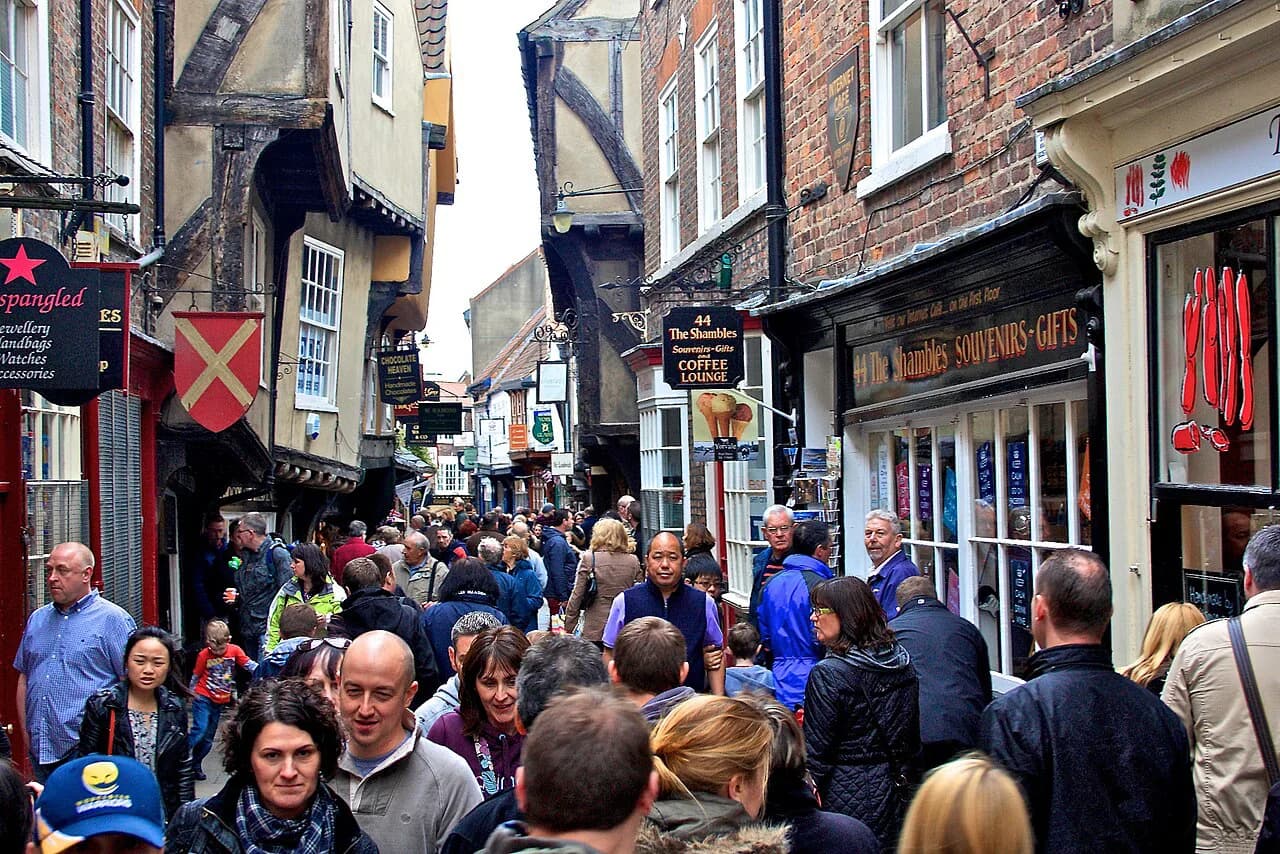
Last updated September 2026, this guide to hidden gems in York skips the queues at the Shambles and the Minster's ticket line. York's medieval walled center is compact enough to reach nearly every entry on this list within a 20-minute walk from the railway station. Three worth prioritizing first: Holy Trinity Church on Goodramgate, the Roman Baths pub on St Sampson's Square, and the free, self-guided York Cat Trail.
18 Hidden Gems in York: From Roman Culverts to Secret Pubs
Every entry below sits inside or just beyond York's city walls, and most are a short walk from York railway station or the Minster. This list moves from underground Roman remains to snickelways, quiet green spaces, and a handful of restaurants locals actually book. For smaller ticketed collections that didn't make this cut, a dedicated guide to York's lesser-known museums covers additional stops.
- The Minster Culvert
- The Undercroft beneath York Minster still holds a Roman-era culvert with water flowing through it today.
- The same underground passage also passes Roman-era barrack remains, visible on the same ticketed tour.
- Nearby, the Minster's Chapter House is worth combining with the same visit for its carved medieval stonework.
- Bar Convent's Hidden Chapel
- Founded in 1686 just beyond Micklegate Bar, Bar Convent still operates today as a working religious community.
- Its 1769 chapel was built with eight separate exits so the sisters could disperse quickly if authorities raided the building.
- An on-site exhibition covers the religious tension Catholic communities faced in 17th-century England.
- St. Leonard's Hospital Crypt
- Beside the Museum Gardens and the city library, a vaulted crypt is what remains of St. Leonard's Hospital, once among the largest medieval hospitals in the north of England.
- The hospital was rebuilt on this site after a fire destroyed its predecessor, St. Peter's Hospital, in 1137.
- The crypt sits close enough to the Museum Gardens to combine both stops in one short walk.
- Micklegate's Film-Set Streets
- Crossing the river toward Micklegate leads past cafes and Georgian houses that have doubled for London in period dramas, including the Bronte adaptation To Walk Invisible.
- A five-minute walk south from Skeldergate Bridge reaches the quieter residential streets of Bishophill and Clementhorpe.
- Continuing past Micklegate Bar reaches Bar Convent without doubling back through the busier shopping streets.
- Coffee Yard to Stonegate
- This snickelway threads directly through the footprint of Barley Hall, a medieval house museum, with an entrance tucked under a Thai restaurant on Stonegate.
- This route is one stop covered in the full York snickelways guide.
- The passage exits onto Stonegate itself, a shopping street with roots reaching back roughly 1,900 years to Roman Eboracum.
- Mad Alice Lane
- Diagonally opposite the Poundland on Petergate, this narrow passage runs down to Swinegate and carries one of the city's darker local legends.
- A walking tour built around the same name still runs through the city's ghost-story circuit today.
- The lane doubles as a quick shortcut between the Shambles and the bars further south on Swinegate.
- Whip-Ma-Whop-Ma-Gate
- First recorded in 1505, this short street connecting Colliergate and Pavement carries one of the longest names on one of the shortest streets in England.
- Remnants of the medieval St. Crux church sit on the same site, a two-minute detour from the Shambles.
- Holgate Windmill
- York's last surviving windmill still grinds stone-ground flour and is staffed entirely by volunteers, so check current opening days before visiting.
- It sits slightly outside the walled center, making it an easy add-on to a longer walk or cycle route.
- Informational displays inside explain the milling process to visitors.
- The York Cat Trail
- This free, self-guided route leads past roughly 20 cat statues fixed to walls, rooftops, and doorways across the center.
- Leaflets are available at York Glass on the Shambles or the Cat Trail Gallery on Low Petergate.
- A downloadable brochure is also available for anyone who wants to plan the route before arriving.
- The Plague Stone and Tyburn
- The Plague Stone, dating to 1604, once marked where York residents left food and payment for those forced outside the city walls during outbreaks.
- Across the road at Knavesmire, the Tyburn gallows operated from 1379 until the last hanging in 1801.
- Its most notorious prisoner was the highwayman Dick Turpin, hanged there in 1739.
- York's Original 1839 Railway Station
- Before the current station opened, York's first railway terminus operated inside the city walls starting in 1839.
- Combining this stop with a stretch of the nearby city walls keeps the diversion to a few minutes.
- Dean's Park
- Tucked beside the Minster, this small park gives one of the few clear views of the cathedral's north side without a ticket.
- It's a common resting point on the two-hour loop of the city walls.
- Dean's Park is one of several stops covered in the York quiet parks guide.
- St. Olave's Church and the Museum Gardens
- First mentioned in a document from 1055 and rebuilt in the 1400s, St. Olave's Church carries a dedication to the patron saint of Norway.
- Next door, the Museum Gardens hold the Roman Multangular Tower, the ruins of St. Mary's Abbey, and the Yorkshire Museum.
- The gardens and museum are managed by the York Museums Trust, with paths far calmer than the Shambles.
- The Cholera Burial Grounds
- Across the street from the train station, a small burial ground marks the 1832 cholera outbreak that killed at least 185 people in York.
- About 20 gravestones remain on the site today, easy to miss on the walk from the platform into town.
- SOPHie at Skeldergate Bridge
- Set in a riverside turret near Clifford's Tower, this cafe-restaurant serves coffee and cake by day and cocktails by evening, with outdoor seating on the Ouse.
- It operated for years as Dyls before rebranding, so confirm the current name and hours before booking a table.
- Its outdoor tables face the Ouse directly, a quieter river view than the crowded stretch near Lendal Bridge.
- Trinacria on Bishopthorpe Road
- A 10 to 15-minute walk south of the center, this Sicilian restaurant is known locally for its arancini and gelato.
- The walk down Bishopthorpe Road doubles as a look at a residential stretch most Shambles-bound visitors never see.
- Spark: York
- Built from repurposed shipping containers on Piccadilly, this open-air food court covers everything from street food stalls to covered seating for wet days.
- A private room is also available to hire, with a 2023 published rate of £120 for a Saturday evening slot plus speaker hire.
- Street food vendors rotate regularly, so the exact lineup varies from one visit to the next.
- The House of Trembling Madness
- The original Stonegate location is tucked into the eaves above a beer shop, with medieval beams overhead and a deep list of craft beer.
- A second, larger site on Lendal adds light bites alongside the same beer menu.
- Both locations count among the stops in the fuller York quieter pubs guide.

Local Logistics: Flooding, Traffic, and Parking in York
York sits where the River Ouse meets the smaller River Foss, so flooding is a real seasonal risk, not a rumor. Roman and medieval builders set the historic core on ground that slopes up from the Ouse. News crews chasing dramatic flood photos usually head to low-lying spots like St George's Field car park. Just 50 meters upslope from those shots, the vast majority of the city remains open and walkable. Road access is a separate constraint: most of the walled center closes to private cars after 10am. That funnels traffic onto the ring road well before mid-morning. For live conditions, official flood warnings are the most reliable way to check before finalizing plans.
The medieval core slopes upward from the river, so even when low-lying areas flood, major attractions like the Minster, Bar Convent, and Merchant Adventurers' Hall remain accessible just 50 meters upslope.
- City Council Car Parks
- These sit closest to the walls but can cost £10 or more per day, often with a further 10-minute walk into the historic core.
- Park & Ride
- Sites around the ring road charge only for the return bus fare, and under-16s travel free, which usually makes this the cheaper option for families.
- The 20-Minute Wall Shortcut
- With only 20 minutes to spare, walking the stretch of wall from Bootham Bar to Monkgate covers the section directly behind the Minster.
Which Hidden Corner of York Fits Your Trip
Some of these stops suit a rushed layover between trains, and others reward a full afternoon. Families with young children tend to do best with the free National Railway Museum, the York Cat Trail, and Dean's Park. All three stay manageable with strollers and short attention spans. History-focused visitors typically spend the most time at Bar Convent, St. Leonard's Hospital Crypt, and the 14th-century Merchant Adventurers' Hall. Its chapel wall still marks past flood levels from the River Foss. Anyone tracking costs can stick to the free tier: the Cat Trail, Dean's Park, and the Museum Gardens' outdoor areas. The full two-hour loop of the city walls is free too. Small groups planning a private gathering can also look at Spark's private room or Brew York's Hoptail Lounge. As of 2023, Brew York listed a rate of £150 for up to 60 guests. The table below breaks down time, cost, and accessibility for the stops that come up most in trip planning.
| Hidden Gem | Time Needed | Cost | Accessibility |
|---|---|---|---|
| York Cat Trail | 1-2 hours | Free | Flat, stroller-friendly |
| Dean's Park | 15-20 minutes | Free | Flat, level paths |
| Bar Convent | 45-60 minutes | Paid entry (check current rate) | A few stairs to the chapel |
| St. Leonard's Hospital Crypt | 10-15 minutes | Free to view | A few uneven steps |
| Holgate Windmill | 30-45 minutes | Small entry charge | Stairs inside the mill |
| SOPHie at Skeldergate Bridge | 45-90 minutes | À la carte pricing | Flat, riverside access |
| Full City Walls Loop | About 2 hours | Free | Some steep, unfenced drops |
Common Mistakes When Chasing York's Quiet Corners
A few avoidable habits turn a quiet-corners trip into a frustrating one. Building in slack for wandering matters more than following a fixed itinerary. Travelers extending the trip north can apply the same local-first approach with Edinburgh's quiet closes and courtyards. Heading south instead, London's overlooked courtyards and markets follow a similar logic.
A 7am to 8am arrival catches the Shambles quiet and avoids the 10am closure that siphons traffic onto the ring road, combining two major timing constraints into a single trip benefit.
- Driving Into the Center After 10am
- Most of the walled core closes to private traffic after 10am, so arriving later usually means circling for a space near the ring road instead.
- Expecting an Empty Shambles
- The Shambles gets busy from mid-morning onward, and arriving closer to opening, around 7am to 8am, is the more reliable way to see it quiet.
- Skipping the Snickelways
- Sticking to the main shopping streets misses the snickelway shortcuts that connect Stonegate, Swinegate, and the Shambles in a fraction of the time.
Merchant Adventurers’ Hall: York’s Medieval Guildhouse
Merchant Adventurers’ Hall is one of York’s strongest alternatives to the better-known Minster museums. It stands on Fossgate, a short walk from the Shambles, yet many visitors pass without looking inside. The timber-framed Great Hall was completed in 1357 for the city’s merchant guild.
The building also reveals how trade and welfare overlapped in medieval York. The undercroft served as an almshouse, while the first floor accommodated a chapel and hospital. Exhibits explain the Merchant Adventurers’ Company and its continuing role in the city.
- Allow 45 to 60 minutes for the hall and displays.
- Expect uneven floors, stairs, and historic surfaces.
- Check official opening times and admission details before travelling.
Pair it with a walk through Fossgate and Walmgate for a quieter historic route east of the central shopping streets.
Explore hidden gems in other cities
Frequently Asked Questions
Is York worth visiting if it's flooding?
Most of York stays open even when the River Ouse rises, since the medieval core sits on ground that slopes up from the riverbanks. News coverage often focuses on low-lying spots like St George's Field car park, which floods first. Away from the riverside paths themselves, the rest of the walled center is rarely affected. A flood alert alone is not a reason to cancel a visit.
What are the best free hidden gems in York for kids?
York's Cat Trail costs nothing and sends families hunting for roughly 20 statues scattered across the center. Dean's Park and the Museum Gardens both offer flat, open lawns suited to strollers and younger children. Near the station, the National Railway Museum is also free to enter and large enough for a full morning.
How long does it take to walk the York city walls?
Walking the full loop of the city walls takes about two hours at an easy pace. Going clockwise is generally the better route for views along the way. Some stretches have steep drops without fencing, so keep a close watch on children, and dogs aren't permitted.
Where can I find the cat statues in York?
Cat Trail leaflets are available at York Glass on the Shambles and at the Cat Trail Gallery on Low Petergate. About 20 statues are worked into rooftops, walls, and doorways across the center. Following the full route on foot usually takes an hour or two, depending on pace.
Is parking near York's city center expensive?
City center car parks can run £10 or more per day, and some still leave a 10-minute walk into the historic core. Park & Ride sites around the ring road only charge for the return bus fare, with under-16s traveling free. For solo travelers or couples, that combination is usually cheaper than parking right in the center.
Explore More Hidden Gems in York
From alleyway walks to quiet riverside parks, work through York's lesser-known corners by theme.


