

Last updated November 2026: the best Cotswolds day trip from Bath is a loop of Castle Combe, Bibury and Lacock, with lunch in Malmesbury or Tetbury. By car it covers roughly 90 miles and three hours or a little more at the wheel, which leaves four to five hours on foot in the villages. Without a car, Lacock is the one stop you can reach easily by train and bus, and a small-group tour is the simplest way to see Castle Combe and Bibury.
Featured image: Colin Park, CC BY-SA 2.0, via Wikimedia Commons.
Cotswolds Day Trip from Bath at a Glance
Bath sits at the southern tip of the Cotswolds, so the nearest villages are closer than most visitors expect. Castle Combe is about 15 miles from the city centre and Lacock about 14. Bibury is the stretch: a little over 40 miles away by the direct route, on the far side of Cirencester. Strictly, Lacock lies a few miles outside the protected Cotswolds landscape, but it is almost always paired with the stone villages and fits neatly on the way home.
The order matters more than the list. Castle Combe is small and fills up early, so it goes first. Bibury is the furthest point and the busiest with coach groups, so arrive before lunch. Lacock is run by the National Trust and opens at 10am, which makes it the natural afternoon stop on the drive back to Bath.
| Leg | Approx. distance | Approx. drive | Time on foot |
|---|---|---|---|
| Bath to Castle Combe | 15 miles | 35-45 minutes | About 1 hour |
| Castle Combe to Bibury | 31 miles | 50-60 minutes | About 1 hour |
| Bibury to Malmesbury (or Tetbury) | 20 miles (18 to Tetbury) | 35-40 minutes | About 1 hour for lunch |
| Malmesbury to Lacock | 14 miles | 25-35 minutes | About 2 hours |
| Lacock to Bath | 13 miles | 30-40 minutes | - |
Distances are rounded from road routing, and drive times include a margin for lanes and parking.
Castle Combe: First Stop, Before the Crowds
Castle Combe is the closest of the classic villages to Bath and the one most worth reaching early. Upper Castle Combe sits on the B4039, and the old village lies below it in the narrow valley of the By Brook. No new houses have been built in its historic centre since about 1600, which is why it photographs the way it does.
Walk down to the 14th-century market cross, where the three main streets meet, then carry on along The Street to the bridge over the By Brook. That bridge view, looking back at the cottages, is the shot on every postcard. St Andrew's Church, a few steps from the cross, is worth five minutes inside. An hour covers the village; add two or three for a circular walk along the brook.
Don't try to drive into the lower village. There is almost nowhere to park and the lanes are too narrow to turn in, and the parish council points visitors to the pay-and-display car park on Dunns Lane in Upper Castle Combe instead. From there it is a short, steep walk down, about 10 minutes, and harder on the way back up. Wiltshire Council sets the tariff, which has changed in recent years, so check the machine on arrival. On summer weekends the car park can fill by late morning; arriving before 9:30am avoids that and the tour minibuses.
Bibury and Arlington Row
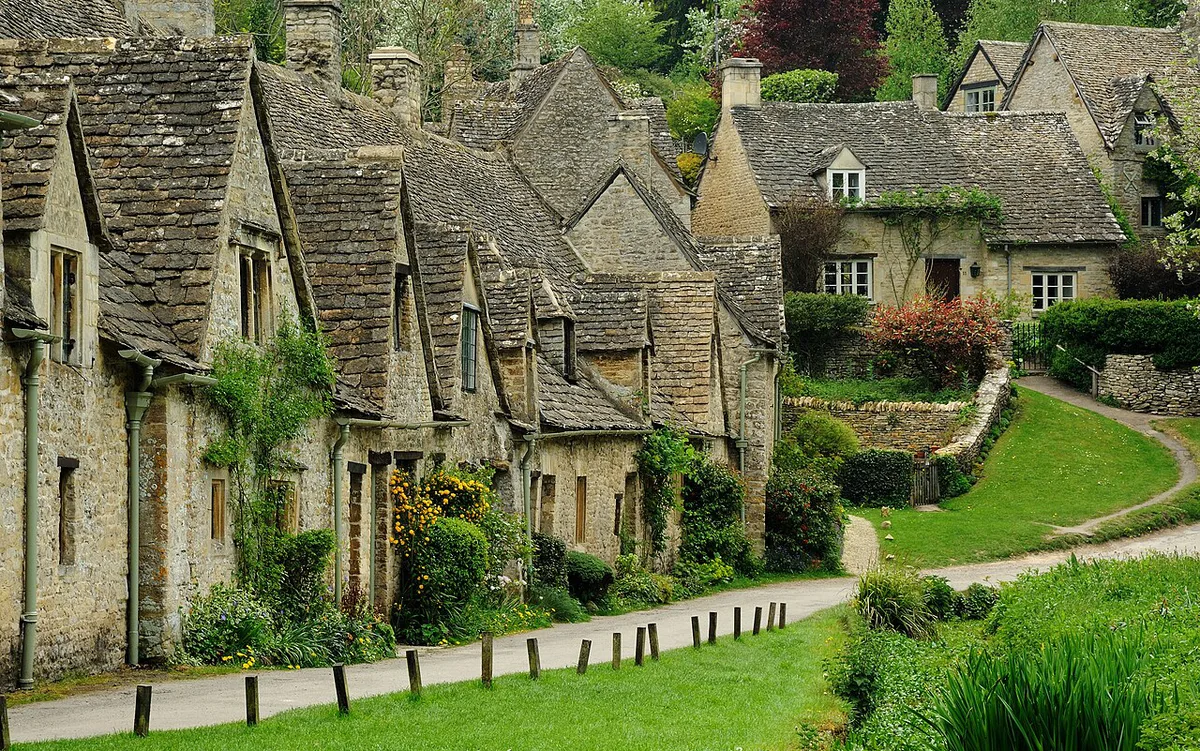
Bibury is the long leg of the day and the reason to start early. It sits on the River Coln, about 6 miles northeast of Cirencester, and William Morris called it the most beautiful village in England. Its fame rests on Arlington Row. The National Trust, which owns it, dates the building to around 1380, when it was a monastic wool store. It was converted into weavers' cottages in the 17th century. Most of the cottages are private homes today, so this is a look-from-the-lane visit, not a house tour. Keep to the path and out of the gardens. Opposite the row is Rack Isle, the water meadow where wool was once hung to dry. It is now a wildfowl reserve and the best spot for a photograph of the whole terrace. An hour is plenty.
Parking is the hard part. Bibury has a small car park opposite the trout farm and limited roadside spaces in the village. Gloucestershire County Council closed the coach bays in the village centre in 2025 and has consulted on pay-and-display parking along The Street and longer yellow lines. Its Bibury traffic management page carries the current status and any road closures, so check it the day before. If every space is taken, don't circle the village. Move on to lunch and come back later in the afternoon, when the coaches have gone.
Lunch in Malmesbury or Tetbury
Bibury has few places to eat and they fill quickly. Eat instead in one of two market towns on the way back south, both with independent cafés, pubs and more parking than the villages.
Malmesbury is the better choice if you like history. Its hilltop abbey was founded around 676, King Æthelstan was buried there in 941, and the surviving Norman church has a south porch with some of the finest Romanesque carving in England. It is also on the most direct line from Bibury to Lacock, about 20 miles from the first and 14 from the second.
Tetbury suits shoppers. Long Street is lined with antique dealers, and the pillared Market House of 1655 still holds markets. It is a few miles shorter from Bibury but a little further from Lacock, so the total drive is about the same either way. Pick one: fitting both in is the easiest way to end up rushing Lacock.
Lacock: Abbey and Village
Lacock is the most complete stop of the day, because the abbey and almost the entire village are owned by the National Trust. The streets of timber-framed and stone houses, the 14th-century tithe barn and St Cyriac's Church are all free to walk around. Allow two hours if you want the village and the abbey.
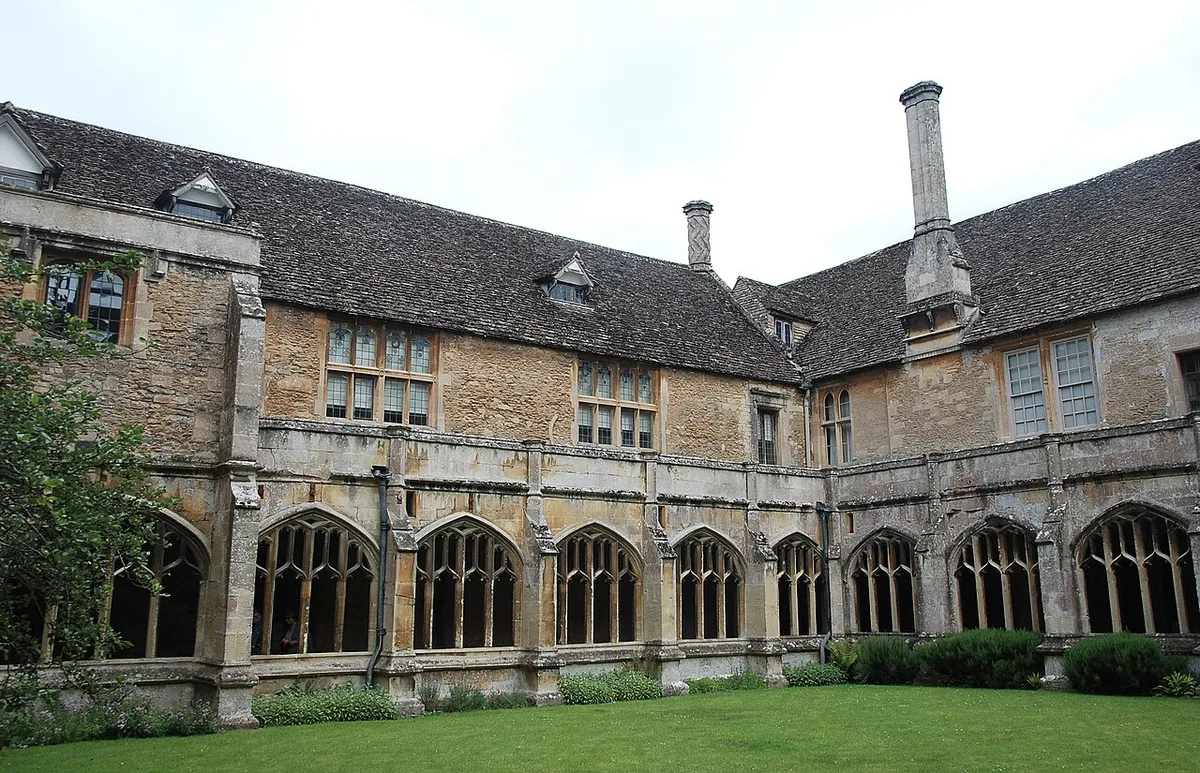
The abbey was founded in 1232 and later became home to Henry Fox Talbot, the photography pioneer. The Fox Talbot Museum by the entrance covers his work. The medieval cloisters are the part most visitors come for, and they are a long-standing film and TV location. Opening times change through the year. On the National Trust's Lacock page in November 2026, the abbey grounds and Fox Talbot Museum were open 10am to 4pm and the cloisters 10:15am to 3:45pm. The abbey rooms close for winter cleaning from 1 November to 1 March, with the Great Hall reopening for Christmas from 28 November.
For the winter season, when the abbey rooms are closed, a non-member adult ticket is £14.00 (£15.40 with Gift Aid), a child (5-17) £7.00 and a family £35.00. Christmas prices from 28 November to 1 January are higher: £16.00 for an adult without Gift Aid. Buy tickets on the day at visitor reception; National Trust members get in free.
Park in the Trust's Hither Way car park, under 400 metres from visitor reception. Non-members pay £5.00 for the day through machines or the JustPark app, and members park free after registering. In November the car park is open 10am to 4pm, or until dusk if that is earlier. That closing time is why Lacock comes last but not late: arrive after 3pm in November and you get the village, not the abbey.
Driving the Loop: Lanes, Timing and Fuel
A car is the only way to see all three villages in one day at your own pace. The main roads are easy. The A46 runs north out of Bath, the A429 and A433 cover most of the distance around Malmesbury and Tetbury, and the A350 takes you south to Lacock. The slow part is the last mile into each village. The lanes around Castle Combe and Bibury are hedged and often only one car wide, with passing places or field gateways instead of a second lane. When you meet oncoming traffic, pull into the nearest gap on your side, or reverse to one if it is closer. Drivers used to the right-hand side of the road should leave extra time for that. If you want more than one day behind the wheel, a longer Cotswolds driving route adds the northern villages such as Bourton-on-the-Water and Stow-on-the-Wold.
Fill up in Bath before you leave or in Cirencester or Malmesbury on the way round, since the villages themselves have no fuel. A smaller hire car is easier on the lanes and in the tight village car parks. On a winter day, plan to be off the narrow lanes before dark, which in late November means mid-afternoon. Bath's own traffic is often the slowest part of the day, so leave by 8:30am. If you are only in the city for two days, my weekend in Bath itinerary shows where a village day fits without losing the Roman Baths.
Lacock's car park closes with the abbey grounds, at 4pm in winter. Keep Lacock as the last stop and leave Malmesbury or Tetbury by about 1:30pm.
Without a Car: Train, Bus or a Small-Group Tour
Public transport works for Lacock and not for much else. Take a direct train from Bath Spa to Chippenham, then Faresaver's X34 bus towards Melksham, which the National Trust lists as the service that stops near the village. The X34 runs Monday to Saturday, so check the timetable before planning a Sunday trip. The Trust puts Melksham station about 3 miles from Lacock and Chippenham about 3½ miles. Castle Combe and Bibury have no practical bus link from Bath for a day visit.
A small-group tour is the easiest car-free way to see Castle Combe and Bibury. Visit Bath lists a full-day village tour that leaves central Bath at 8:25am, takes up to 16 guests and stops at Castle Combe, Bourton-on-the-Water, Stow-on-the-Wold and Bibury with Arlington Row. Other operators run similar routes; read the stop list before booking, and choose a private driver-guide if Lacock is a must.
When to Go and How to Shape the Day
Weekdays are calmer than weekends at every stop, and mornings beat afternoons for light and parking. Summer brings the heaviest crowds, especially in Bibury and Castle Combe, where a full car park can cost you half an hour. Spring and early autumn give long enough days with fewer coaches. In winter the villages are quiet, but daylight is short and Lacock's abbey rooms are closed until March. December adds Christmas openings at Lacock and makes a good pairing with an evening at the Bath Christmas Market once you are back.
A realistic day looks like this: leave Bath at 8:30am, Castle Combe 9:15 to 10:15, Bibury 11:15 to 12:15, lunch in Malmesbury 12:50 to 1:50, Lacock 2:20 to 4:00, and back in Bath by 5pm. For a slower day, drop Bibury and walk from Castle Combe instead. For dinner back in the city, my best restaurants in Bath guide is sorted by area. For a car-free half day that still gets you into green countryside, the Two Tunnels Greenway starts a short walk from Bath Spa station. More ideas for quieter corners of the city itself are in my guide to Bath's hidden gems. The Cotswolds National Landscape board also publishes guidance on visiting the protected area responsibly.
Frequently Asked Questions
Can you do a Cotswolds day trip from Bath without a car?
Partly. Lacock is reachable by train from Bath Spa to Chippenham, then the Faresaver X34 bus, which runs Monday to Saturday. Castle Combe and Bibury have no practical bus link from Bath, so a small-group tour from the city is the easiest way to see them without driving.
Is it worth driving to Bibury from Bath in one day?
Yes, if you start early and combine it with Castle Combe and Lacock. Bibury is a little over 40 miles from Bath, the furthest point of the loop, so aim to arrive before lunch, when parking is easier and coach groups are fewer.
How much does it cost to visit Lacock Abbey?
In the winter season, when the abbey rooms are closed, a non-member adult ticket is £14.00, or £15.40 with Gift Aid, with higher Christmas prices from 28 November to 1 January. Parking costs non-members £5.00 a day. National Trust members enter and park free.


