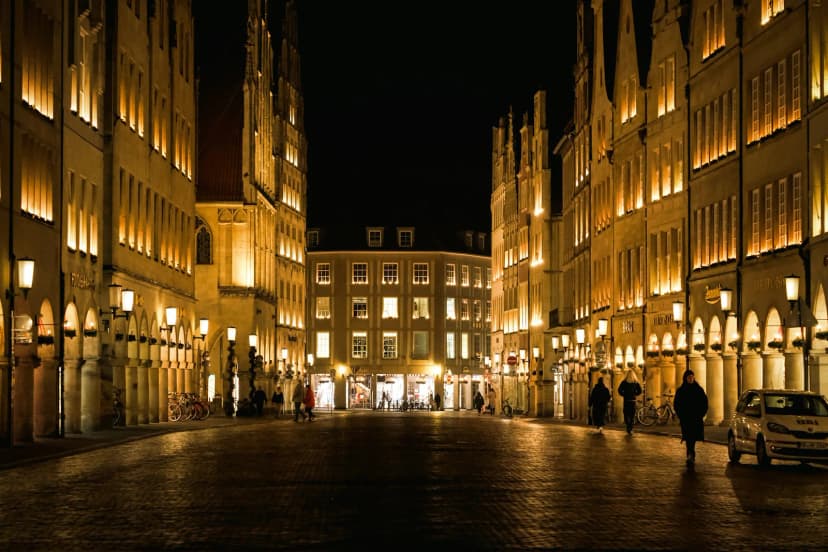
A rainy day in Trier is less of a problem than it sounds, because the historic centre is unusually compact for a city with this much Roman fabric. Most of what you came for sits within one pedestrian corridor running from the Porta Nigra up Simeonstrasse to the Hauptmarkt and then into the cathedral quarter. That means you can move between shelter, coffee and the next indoor sight without ever committing to a long wet walk.
The real planning question is not whether things stay open in the rain, but which stops give you genuine cover and which ones you would enjoy far more in dry weather. The Imperial Baths have narrow underground passages that work well in wet conditions, while the Amphitheater and the Roman Bridge are essentially outdoor experiences. Porta Nigra sits between the two: impressive from the pavement, and a short interior visit if you decide it is worth it.
This guide treats Trier as a series of separate decisions rather than one giant attraction. Churches in the cathedral quarter are distinct buildings with different entry arrangements, the museums are individually ticketed, and the seasonal wine stall on the Hauptmarkt is not a winter rain plan. For a broader look at how the city fits together across a longer stay, the Trier: Itineraries and City Travel Guides page puts these same stops into multi-day context.
Why Trier Works When It Rains
Trier's old town is laid out for walking, and the main sights cluster tightly enough that a rainy day becomes a series of hops rather than a hike. From the Porta Nigra you can head straight up Simeonstrasse, the pedestrian shopping street, and reach the Hauptmarkt without leaving cover for long. Beyond the market square, side streets lead into the cathedral quarter, where the Dom, the Liebfrauenkirche and the Konstantin-Basilika stand within a few minutes of each other.
That density matters more than any single indoor attraction, because it lets you break a wet day into short blocks instead of one long museum session. It also means you rarely need a bus or taxi inside the centre; public transport becomes useful mainly for reaching the station, outlying districts or the amphitheater side of town. The city's official portal is the sensible place to confirm current bus and rail arrangements rather than relying on a printed plan.
One useful frame for the day: treat the Porta Nigra to cathedral-quarter stretch as your spine, and treat everything else as a detour you take when the rain eases. That way a downpour costs you a stop, not the afternoon.
Porta Nigra: Free to Look At, Optional to Enter
The Porta Nigra is the natural starting point and the one Roman monument every visitor photographs, rain or shine. What often gets lost is the distinction between the building as a piece of cityscape and the building as an interior visit. The monumental dark gate is free to admire from the square, and that alone justifies the stop even if you never go through the turnstile.
If you want the interior, treat it as a short sheltered stop rather than a half-day commitment. Climbing through the gate's levels gives you city views and a sense of its layered history, from Roman gateway to medieval church foundation. The tourist office publishes a Roman-costumed guided experience, The Secret of the Porta Nigra, which runs on Saturdays and adds extra dates in the warmer months at 13:00, lasting about 60 minutes and meeting at the Tourist Information beside the gate; it is a ticketed event rather than a free walk-up, and the organiser notes the route covers areas that are difficult or impossible for visitors with limited mobility.
Because the gate's interior arrangements and any tour availability can change with the season, confirm current details with the operator before you build your day around it. The same applies to any discount pass: the tourist office notes that holders of a Solidarkarte or Trier Card receive an additional discount when buying at the Tourist Information office, but the exact amounts vary by site.
The Cathedral Quarter: Three Buildings, Three Sets of Rules
Visitors often talk about "the cathedral" as though it were one attraction, but the quarter around it is really a cluster of separate buildings with separate entry arrangements. Trier Cathedral, the Dom St. Peter, is the enormous Romanesque core and the city's most important church. Next to it stands the Liebfrauenkirche, the Church of Our Lady, which shares a wall with the cathedral but is architecturally its opposite: an early Gothic building with sharply detailed carving rather than the cathedral's massive, layered bulk.
A short walk away, the Konstantin-Basilika is a third distinct building, the surviving Roman throne hall that now serves as a Protestant church. Its vast single-room interior and visible brickwork make it a genuine rainy-day stop, since the point of the visit is the space itself rather than a collection. Confirm current visiting windows locally, because services and seasonal arrangements affect when tourists can enter.
The practical implication is that you should not assume one ticket covers the quarter. Churches generally operate as places of worship first, and the cathedral treasury is a separately managed collection with its own arrangements. Because published prices and hours for the treasury change, verify them with the operator rather than relying on older trip reports. The wider Trier: Landmark Visitor Guides hub is a reasonable place to check how these buildings are covered individually before you plan the order.
Behaviour matters here too. These are active churches, so keep voices low, avoid blocking aisles during services, and step outside if a tour group arrives.
Museum am Dom and the Cathedral Treasury: Choosing One Indoor Detour
If you only have time for one indoor block near the cathedral, the choice usually comes down to the Museum am Dom and the cathedral treasury. The Museum am Dom, sitting just around the corner from the church, focuses on the cathedral itself and its art: restored crucifixes, sculpture, vestments and unusual Roman ceiling paintings that survive from the site's long history. It is a small museum, which is exactly its appeal on a wet afternoon.
The cathedral treasury is the other option, and it answers a different question. Where the Museum am Dom explains the building and its artistic life, the treasury is about sacred objects accumulated over centuries. Neither is a substitute for the other, so pick based on whether you want context about the church as a place or proximity to goldsmith work and reliquary objects.
Because admission and opening arrangements for the treasury are set independently and can change, check with the cathedral's own information point rather than trusting a blog post. If your interest leans generally toward which of Trier's collections deserves your limited hours, a comparison of the best museums in Trier worth visiting is a faster decision aid than reading each site's page separately.
The Toy Museum Option for Families
The Spielzeugmuseum is the obvious pick when you are travelling with children and the weather has closed down outdoor plans. It trades on nostalgia and play rather than grand architecture, which makes it a useful counterweight to the Roman and religious sights that dominate the centre. The catch is verification: the museum's own opening arrangements are the only reliable guide, and you should check them the same day rather than assuming a standard weekly pattern.
Think of it as a one-block substitute, not a whole rainy day. Pair it with a nearby cafe stop so the children get a break between museum time and the walk back to the centre. If you are building a family-focused trip around that kind of pacing, Trier with kids covers the wider logistics of shorter legs, snack stops and indoor fallbacks.
One honest caveat: because the toy museum's hours are not something you should take on trust from secondary sources, keep a second indoor option in reserve in case it is closed when you arrive.
Roman Sites in Wet Weather: Kaiserthermen and the Underground Passages
The Kaiserthermen, or Imperial Baths, is the Roman site that handles rain best, because its most memorable section is genuinely covered. The surviving walls stand around 19 metres high, and narrow underground service corridors let you walk beneath the complex rather than around it. Wet ground above matters far less when the payoff is a dim passage below.
Third-party listing data puts general adult admission at about 6.97 US dollars with daily hours of 9:00 to 18:00, but that figure comes from an aggregator rather than the operator and should be treated as unverified against the official site before you rely on it. The same listing advises bringing a light for the long tunnels and suggests roughly an hour on site, while noting that many visitors spend far less. Treat that duration as a suggestion, not an official timing.
Accessibility inside the tunnels and tower interiors is not something to assume, and no source reviewed here guarantees step-free movement through those passages. If that matters to you, ask at the entrance or check with the operator in advance. For the wider Roman picture, there is no single ticket covering every monument, so plan each site as its own decision.
When to Skip the Amphitheater and Roman Bridge in the Rain
The Amphitheater is the clearest candidate to postpone when it is pouring. It sits outside the compact centre, roughly 1.2 miles on foot from the Porta Nigra, and its appeal is largely spatial: the arena, the tiered seating, the sense of scale. Rain flattens that experience and makes the walk less pleasant, and the cellar below, while covered, is entered by stone steps that get slick.
The Roemerbruecke, the Roman bridge over the Moselle, is similarly better saved. Parts of the existing pillars date back to antiquity and it remains in daily use, but the pleasure is the view from the crossing and the riverside path beneath it. That is a dry-weather walk, particularly the tree-lined route along the water.
Substitute indoors instead. Karl Marx House, a short step from the Porta Nigra, turns the city's other famous association into a substantial museum visit, and it is a natural swap when the forecast rules out the arena. Pair it with the neighbouring cluster of shops and cafes so you are not walking far between stops. If you want these pieces sequenced across more than one day, a 2 days in Trier itinerary handles the ordering problem for you.
Eating and Warming Up: What the Hauptmarkt Offers, and When
The Hauptmarkt is Trier's living room, and even in bad weather it earns a stop for the architecture alone: the Marktkreuz erected in 958 is described by the tourist office as the oldest market cross in Germany, and the Petrusbrunnen fountain carries allegorical figures and monkeys that reward a slow look. From the market cross steps you can see both the Porta Nigra and the cathedral with a small turn of the head, which makes it a natural midpoint on a wet walk.
The wine stall is the part people ask about, and the seasonality matters. Trier's tourist office states that from the end of March to early November the Hauptmarkt wine stall is a meeting place for locals and visitors, with a different regional winery presenting each week, split between Monday to Thursday and Friday to Sunday slots. In other words, it is a spring-to-autumn institution, not a November-to-March rain plan, and the weekly winery rotation is not something to plan around in advance.
For the colder months, use the market's surrounding cafes, bakeries and the shopping streets for shelter instead. Trier's municipal site is the better place to confirm what is running on a given day when the weather pushes events indoors.
Linking the Stops on Foot, and When to Take a Bus
Inside the centre, walking logic is simple: Porta Nigra, Simeonstrasse, Hauptmarkt, cathedral quarter, then the palace gardens and the Imperial Baths to the east. That chain keeps you in pedestrian and semi-covered territory for most of the day and avoids any need for public transport. Specific bus line numbers between central attractions vary and are best confirmed locally, since route numbering and seasonal timetables are not something to copy from an older guide.
The bigger distances are the exception. Trier Hauptbahnhof sits west of the historic core and is the practical arrival point if you are coming by train, with a straightforward walk down into town. The tourist office operates a route planner from the Porta Nigra with bus and train connections, useful for checking a specific journey rather than guessing.
If mobility is a concern, the accessible city tour page is the sensible starting point for what the city itself publishes about step-free routes. Note that the Roman-costumed Porta Nigra tour explicitly covers areas that are difficult or impossible for visitors with limited motor capacity, so it is not the accessible option.
Sample Running Orders for a Wet Day
Two-hour essentials: start at the Porta Nigra for the exterior, walk Simeonstrasse to the Hauptmarkt, look at the market cross and fountain, then walk into the cathedral quarter for the Dom and, if it is open, the Konstantin-Basilika. That loop stays short, keeps you moving between sheltered pockets, and needs no transport. Allow extra time for queuing at any church entrance.
Half-day with one museum: same spine, but commit to either the Museum am Dom or the cathedral treasury, then add the Kaiserthermen for the underground passages. This is the version that best uses indoor cover, because the baths' tunnels are the one Roman experience improved rather than spoiled by rain.
Full day with more sitting: spread the cathedral quarter, one museum, a long lunch near the Hauptmarkt, Karl Marx House and a slower pass through the palace gardens between showers. The palace garden and Electoral Palace exterior are free to walk, and the viewing of the garden costs nothing, so they work as low-commitment filler when the rain eases. If you need these durations fitted into a larger trip, the Trier hub on Eurolandmarks keeps the itinerary pages in one place.
Rain-Day Kit and Indoor Etiquette
Trier's answer to wet weather is layers, because indoor stops are warm and church interiors can be cold, and the Porta Nigra tour notes that its rooms are cool. A compact umbrella handles the short hops, but on the underground sections at the Kaiserthermen a small torch is genuinely useful, and gripping soles matter on stone stairs.
Etiquette in the cathedral quarter is straightforward but worth stating: these are working churches. Keep voices down, take bags off your shoulder on narrow stairs, don't photograph during services, and treat donation boxes as donations rather than admission. If a service is beginning, leave quietly and come back later.
For practical logistics, Trier's tourist information lists restrooms, drinking water and shade as separate service categories, which is the quickest way to find facilities rather than hunting mid-downpour. Public toilets in the centre are limited, so use them when you pass one.
Finally, keep the day flexible. A rainy plan in Trier works precisely because you can drop the Amphitheater without losing the trip; the city's core is dense enough that reordering costs you very little.
Plan Your Visit
Trier survives rain better than most historic cities, because the Roman gate, the market square, the churches and the museums all sit within one walkable corridor. Build the day around that spine, treat the Porta Nigra as a look rather than a half-day, and treat the Imperial Baths as the one Roman site that actually rewards wet weather.
Verify anything volatile before you commit: museum and treasury hours, any admission figures, and tour availability should come from the operator rather than from older trip reports. The Kaiserthermen admission and hours circulating on aggregator sites are a reasonable planning starting point but carry no operator confirmation.
Above all, separate free from ticketed in your own head. The churches, the market square, the palace garden and the exterior of the Porta Nigra cost nothing to experience, and on a rainy day those free anchors are what keep the day moving while you decide what deserves a ticket.
Frequently Asked Questions
What can you do in Trier when it rains?
Focus on the compact corridor between the Porta Nigra, Simeonstrasse, the Hauptmarkt and the cathedral quarter, since those stops sit minutes apart and let you move between shelter and short indoor visits. Add one museum, and use the Kaiserthermen underground passages as the Roman site that works least badly in wet conditions. Save the Amphitheater and the Roman Bridge for a dry spell.
Is the Porta Nigra worth visiting in bad weather?
The exterior is free to see from the square and is impressive in any weather, so the stop is worth it even in heavy rain. Whether you pay to go inside is a separate, shorter decision. If you want the costumed tour, check dates and ticket details with Trier's tourist office, since the schedule is seasonal and the route is not suitable throughout for visitors with limited mobility.
Are Trier's churches free to enter?
The cathedral quarter contains several distinct buildings, and entry arrangements differ between them rather than sharing one ticket. Treat them as working churches, expect donation boxes rather than fixed admission, and check separately for any managed collection such as the cathedral treasury, whose own hours and pricing are set independently.
How long do you need indoors in Trier on a wet day?
As a suggestion rather than an official timing, a two-hour loop covers the Porta Nigra exterior, the market square and the cathedral quarter on foot. A half-day version adds one museum and the Kaiserthermen passages. Third-party listings suggest around an hour at the Imperial Baths, though many visitors finish faster.
Is the Hauptmarkt wine stall open in winter?
No. Trier's tourist office states the wine stall runs from the end of March to early November, with a different regional winery presenting each week. Outside that window you should plan on the surrounding cafes, bakeries and market-hall-style stops for shelter instead. Do not treat the stall as a November-to-March rain plan.
Do you need a car to reach the Roman sites in the rain?
No. The central Roman and cathedral sights are walkable, and the Imperial Baths sit just beyond the palace garden, still within the pedestrian-zone logic. The Amphitheater is the outlier at roughly 1.2 miles from the Porta Nigra, which is why it is the stop most worth postponing in poor weather. For specific bus or train connections, check locally rather than relying on an old itinerary.
Is a rainy day in Trier still worth it?
Yes, provided you accept that the day will be reordered rather than cancelled. Trier's advantage is density: the free outdoor anchors such as the market square, the church exteriors and the palace garden stay open to view, and they sit close enough that you can retreat indoors whenever the weather turns. The trip only fails if you insist on the amphitheater and the riverside on a wet day.
Sources
- Accessible City Tour through Trier - Trier for All - Tourist-Information Trier
- Kaiserthermen, Trier, Germany - Reviews, Ratings, Tips and Why You Should Go – Wanderlog
- Stadt Trier
- Main Market (Hauptmarkt) - Places of Interest - Tourist-Information Trier
- The Secret of the Porta Nigra - Guided Tours - Tourist-Information Trier