
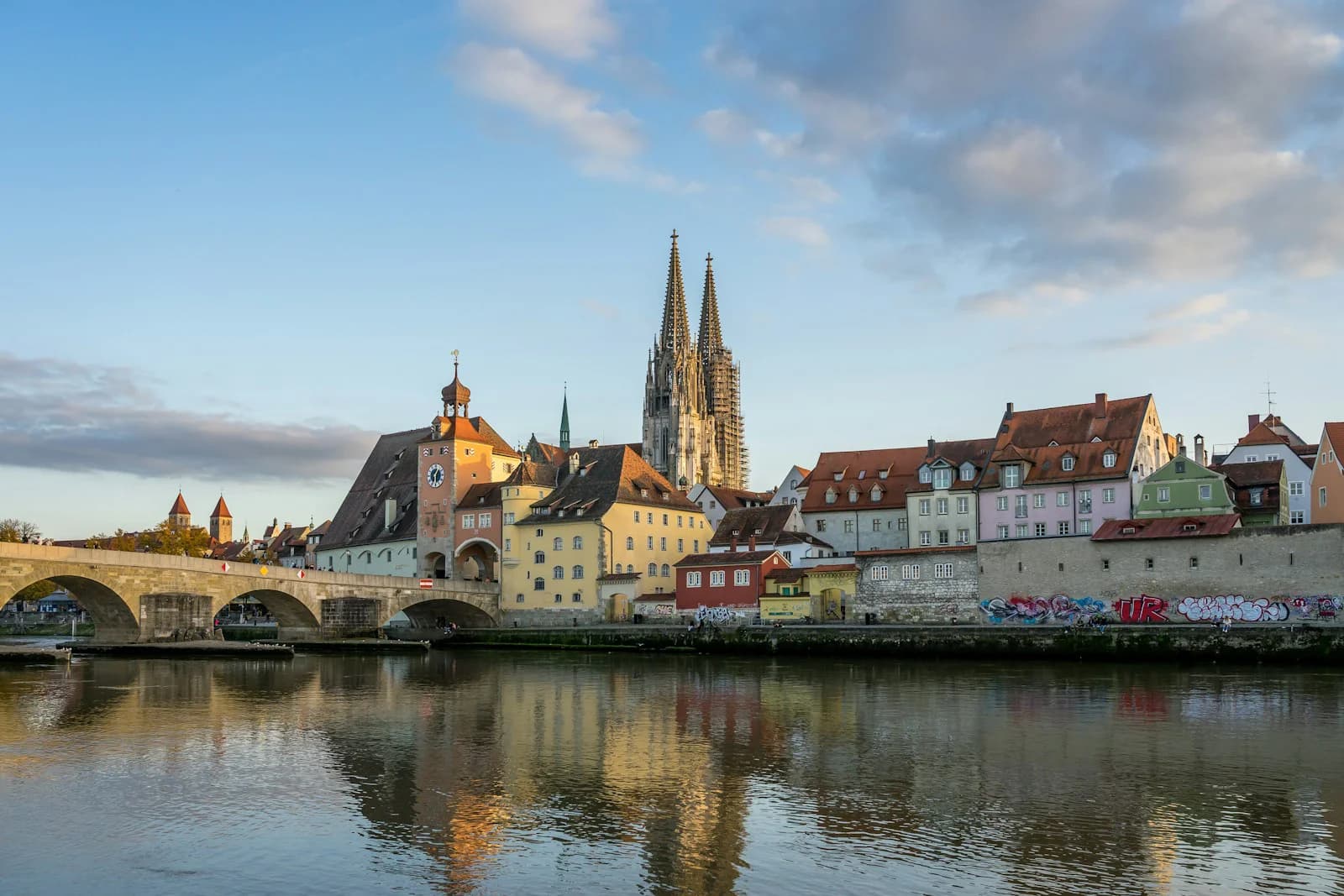
The old town of Regensburg along the Danube, between the cathedral and Bismarckplatz, was designated a World Heritage Site in 2006 and covers less than one square kilometre, according to Bavaria's official tourism site. That compact scale is the main reason families can move between cathedral squares, the Stone Bridge and the river islands without a full-day route. The city's own tourism office confirms the old town holds UNESCO status, alongside a second title added for the Danube limes in 2021. As a suggested editorial pace, not an official timing, allow most of a day for one museum or tower visit plus river time. For city-level planning use Regensburg city travel guides; for individual sights use Regensburg landmark visitor guides.
The Danube acts as a built-in pressure valve: quays, the Wöhrdinsel and the district of Stadtamhof give children open space within minutes of the medieval lanes. Treat paid interiors as one or two anchors and keep the rest of the day flexible for weather and flagging energy levels.
Why Regensburg Works for Families
Regensburg holds two World Heritage titles: the medieval old town, listed in 2006, and the Danube limes, added in 2021, according to the city's tourist office. That second title relates to Roman remains such as the Porta Praetoria near the Gothic cathedral, which Bavaria's official tourism site describes as the surviving feature of the former legion camp of Castra Regina, a stone's throw from St. Peter's Cathedral. It gives children something concrete to examine rather than another facade. Because the centre is small, one or two highlights before lunch is usually enough.
Families with one full day can compare a one day in Regensburg itinerary against a slower two-day plan. The trade-off is straightforward: fewer stops with more playground and river time usually beats trying to cover every sight. Decide which two or three anchors matter, then let the gaps fill themselves.
Parents watching the budget can build the day around free things to do in Regensburg and add a single paid visit. That way a rainy morning does not wreck either the spending plan or the mood.
Pacing the Day: Old Town in the Morning, River in the Afternoon
The centre sits on a peninsula between Danube arms, which makes orientation easier than the street pattern suggests. Bavaria's official tourism site describes the old town as a maze of streets, alleyways, junctions, forks and cul-de-sacs, and that is precisely what children tend to enjoy. Splitting the day into a morning old-town leg and an afternoon water-and-island leg keeps walking distances short and gives children a clear reward to aim for.
Musicians, bubble magicians and jugglers sometimes appear around the Neupfarrkirche on warm summer evenings, according to Bavaria's official tourism site. Because that kind of programme is informal, treat it as a bonus rather than a plan. The city's tourist office publishes an events calendar, so check it shortly before travelling if a specific performance matters to your family.
Weather decides a lot here, so keep one indoor option in reserve and one outdoor option ready to swap in. Two or three short legs with seated breaks between them will beat any attempt to see everything at once.
Kid-Friendly Museums and Indoor Options
The Museum of Bavarian History opened in 2018 near the Iron Bridge and uses multimedia displays, often with a light touch, to explain how Bavaria's regions and identity developed, according to Bavaria's official tourism site. It is the strongest single indoor pick for families because the presentation is visual rather than object-heavy. Admission, opening hours and current family programming are not published in the sources used here, so confirm them with the museum before committing a morning. For more indoor planning, see Regensburg on a rainy day.
A local city magazine collects further leads, including a children's museum, children's theatre and rainy-day ideas, but these are editorial recommendations rather than venue-published details. Treat them as starting points for research, not as confirmed opening times. Before travelling, check each venue's own page for current hours, ticket terms and whether a programme suits your children's ages.
Do not assume that neighbouring collections share one ticket; museums in a complex or district often run separate admissions and separate hours. Budget attention rather than money: one substantial museum plus a short church or tower visit is usually enough for children in a single day.
River, Island and Bridge: Outdoor Time That Costs Nothing
Bavaria's official tourism site describes the Steinerne Brücke as a magnificent medieval monument around 300 metres long, spanning the Danube with rounded stone arches, which makes it a satisfying there-and-back walk rather than an endurance test. The same source notes that on mild summer evenings locals and tourists sit on the quays below. Cross to Stadtamhof for a quieter return leg instead of retracing the same crowded line.
Bavaria's official tourism site describes Stadtamhof as a small island in the Danube with gardens, fruit trees and a slower rhythm than the old town opposite; the same source says the Wöhrdinsel connects to it by several narrow bridges and offers cycle paths, poplar-shaded avenues and secluded bays. These are outdoor, largely free spaces, but nothing here is supervised, so keep children within reach near the water.
At Grieser Spitz, where the Regen meets the Danube, the Bavarian tourism feature reports youths jumping into the water and residents of Stadtamhof heading to or from a swim on warm summer mornings. Nothing in the available sources confirms that swimming is officially sanctioned, supervised or of verified water quality, so treat it as something you may observe rather than a plan you promise children. If river time is the goal, ask the tourist office about current conditions and choose shallower, busier spots with clear sightlines.
Half-Day and Full-Day Excursions Beyond the Old Town
In the north of the city, the children's and youth farm is a fenced area of roughly 4,000 square metres in the Konradsiedlung district and has existed since 2003, according to a local city magazine report. That report frames it as a local project rather than a tourist attraction, and its opening arrangements are not confirmed by the sources used here. Verify visiting times before building a morning around it.
The Altmühltal offers two bigger day trips: a dinosaur park near Denkendorf and the Schulerloch stalactite cave, both described by the same local magazine. A local blog notes the Dinosaur Museum in Denkendorf sits roughly an hour's drive from Regensburg through the Altmühltal valley, with tickets sold at the entrance, but confirm current opening times and terms before setting out. These are half- or full-day commitments in their own right, not add-ons to an afternoon in the old town. Choose one and accept that the city sights will wait. See day trips from Regensburg for more options.
Families comparing German city breaks may want a broader frame: Berlin with kids and Dresden with kids show how other destinations balance museums with open space. Regensburg's advantage is scale, so an excursion remains a choice rather than a necessity.
Practical Tips: Strollers, Food Breaks and What to Verify
Cobblestones are the main practical obstacle in the old town, so a stroller with sturdy wheels or a carrier works better than a lightweight buggy. The peninsula is small, which means you can return to a base or a cafe quickly instead of pushing on. Plan two or three short legs with a seated break between them.
Beer gardens and cafes give children space while adults eat, and Bavaria's official tourism feature mentions the Spitalgarten near the Stone Bridge as a spot enjoyed by cyclists and visitors. Food and drink prices vary, so check current menus on site or on the venue's own page rather than relying on any figure you read elsewhere.
Museum hours, children's theatre programmes, farm visiting times and any river conditions are exactly the details that change, and the sources used here are city-level or editorial rather than venue pages. Check the official Regensburg tourism site and each venue's own page before travelling. If a detail cannot be confirmed, leave that stop out rather than gamble a family afternoon on it.
Plan Your Family Day in Regensburg
Regensburg works for families because the distances are short and the river is always close. Bavarian tourism describes the Steinerne Brücke as a must for visitors and notes that locals and tourists sit on the quays on mild summer evenings, while Stadtamhof and the Wöhrdinsel stay quieter than the old town lanes. Anchor the day with one museum or one climb, then let the Stone Bridge, Stadtamhof and the Wöhrdinsel absorb the rest of the time. Two or three short legs with real breaks in between will beat any attempt to see everything.
Before you go, confirm the few things that matter: museum opening hours and admission terms, any children's theatre programme, the farm's visiting arrangements and current river conditions. Use the official Regensburg tourism site and the venue's own site as the final word. Everything else can stay flexible, which is exactly how a good day with children tends to unfold.
Frequently Asked Questions
Is Regensburg good for kids?
Yes, mainly because the old town is compact and the Danube islands give children space to run. The old town between the cathedral and Bismarckplatz covers less than one square kilometre and was designated a World Heritage Site in 2006, according to Bavaria's official tourism site, so you can plan short walking legs instead of a marathon day. Outdoor time on the quays, the Wöhrdinsel and the Stone Bridge is free and easy to reach, while the Museum of Bavarian History offers a modern indoor option when it rains.
Is there a children's museum in Regensburg?
A local city magazine lists a children's museum among its museum recommendations for families, alongside children's theatre and rainy-day ideas. Those listings are editorial leads rather than venue-published details, so check the individual museum's own page for current opening hours, admission terms and whether the programme suits your children's ages before you travel.
Can you swim in the Danube in Regensburg?
You may see people swimming near Grieser Spitz and Stadtamhof residents heading to the river on warm mornings, according to Bavaria's official tourism feature, but nothing in the available sources confirms that swimming is officially sanctioned, supervised or of verified water quality. Treat river time as watching and paddling with close supervision unless a current, authoritative source says otherwise. Ask the tourist office about conditions on the day.
How much time should we allow in Regensburg with children?
As a suggested pace, a day is enough for one museum or tower, a walk through the old town, the Stone Bridge and some river or island time. Families who want an Altmühltal day trip such as the dinosaur park or Schulerloch cave should add a separate day rather than squeezing it into the same afternoon. The compact centre means you can leave and return without long transfers.
What can families do in Regensburg on a rainy day?
The Museum of Bavarian History is the most substantial indoor option, with multimedia displays that hold children's attention better than traditional object cases. A local magazine also flags a children's museum and children's theatre, but those are editorial recommendations, so verify current hours and programmes with each venue. Keep one indoor plan in reserve and swap it in when the forecast changes.
Where can kids run around in Regensburg?
The quays along the Danube, the Wöhrdinsel with its cycle paths and meadows, and the quieter streets and gardens of Stadtamhof all give children room to move close to the old town. The Steinerne Brücke crossing is roughly 300 metres each way and makes a manageable loop. In the north of the city, a children's and youth farm offers a fenced outdoor area, though its visiting arrangements should be checked before you go.


