
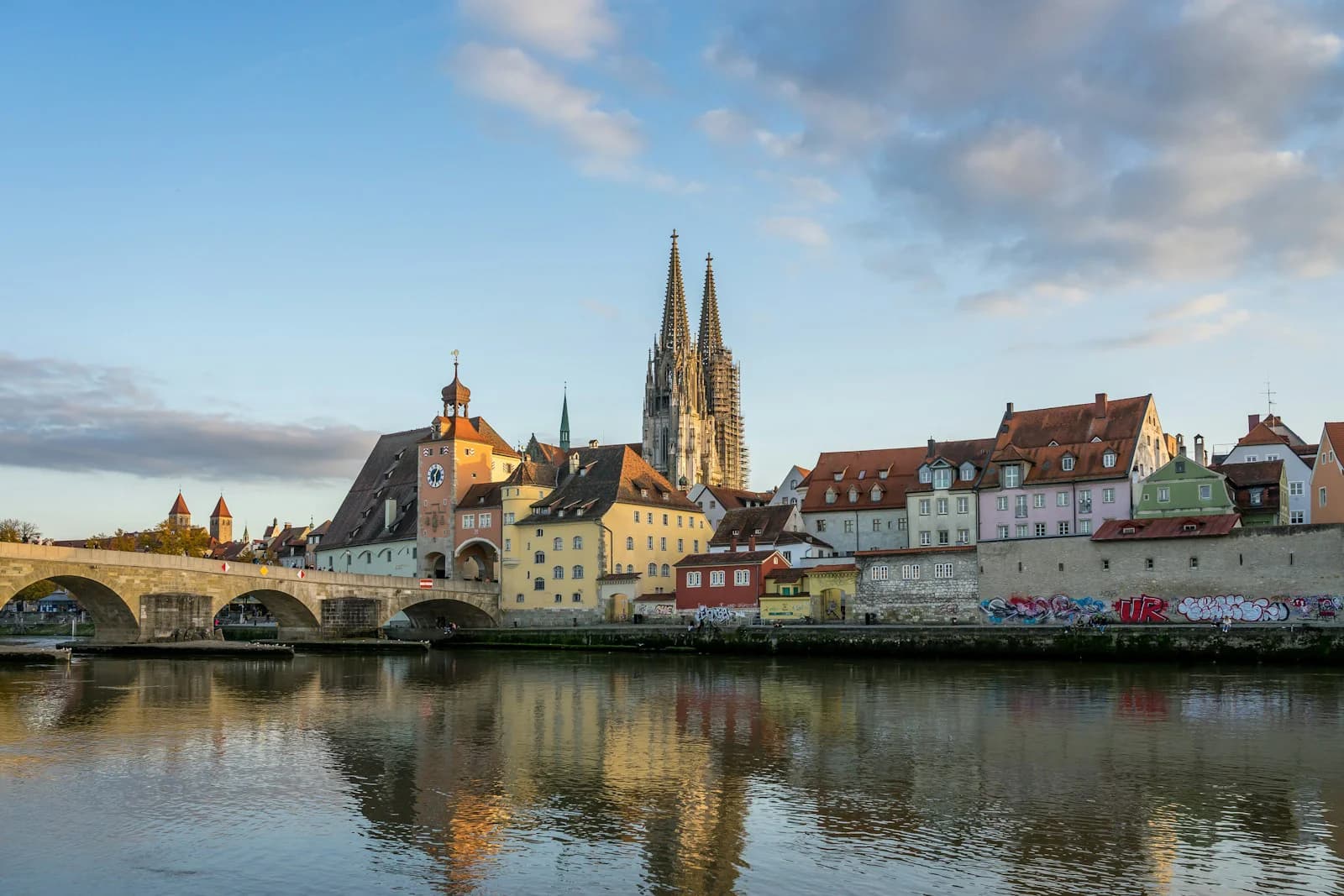
Regensburg's headline sights are mostly public space, which makes it an unusually good value city for a walker. The city tourism office describes it as Germany's best-preserved medieval city and notes that it holds two World Heritage titles: one since 2006 for the Old Town and Stadtamhof, and a second since 2021 for the Danube Limes.
That matters for budgeting. The squares, lanes, Stone Bridge, Roman gate fragment and riverbanks are open to walk through, while interiors, tower climbs and museums generally sit behind a ticket desk. Plan the free layer first and treat everything else as optional.
This route assumes you are on foot and have at least half a day, which is a suggestion rather than an official timing. Before setting out, stop at the Tourist Information at Rathausplatz 4 to pick up a map and ask which interiors are open or cost nothing on the day you are there, since those conditions change.
Start at the Tourist Information on Rathausplatz
The Tourist Information office sits at Rathausplatz 4, in the heart of the Old Town and beside the Old Town Hall. According to the city tourism operator, it opens Monday to Saturday from 9.30 am to 6 pm and Sunday and public holidays from 9.30 am to 4 pm.
Treat this as a ten-minute briefing rather than a destination. Ask specifically about church interiors, tower climbs and any current closures, because staff can confirm what is open that day in a way no printed guide can. A free city map also saves you from repeatedly checking a phone in the middle of a cobbled lane.
The Old Town Hall itself is one of the highlights the tourism office lists, and it is worth reading the facade before you move on. The building hosted the Perpetual Imperial Diet, and its historic rooms and the former interrogation chamber below are a separate, ticketed visit rather than something you wander into.
The Cathedral of Light: What You Can See From Outside
St. Peter's Cathedral is the visual anchor of the Old Town, and its twin Gothic spires are visible from most squares and riverside points. The city tourism office promotes it as the cathedral of light and lists it first among its highlights, which tells you how central it is to any first walk.
The exterior costs nothing and is genuinely the main event for a short visit: the west facade, the spires and the surrounding lanes reward a slow circuit. Whether the interior is free to enter, and at which times, is a separate question that the operator does not settle on its published pages, so confirm it at the Tourist Information rather than assuming.
If you want to build a deeper day around individual monuments, it helps to plan one or two paid interiors rather than trying to enter everything. Otherwise you end up queuing instead of walking, and the free fabric of the city is what makes Regensburg memorable in the first place.
Two World Heritage Titles, Two Banks
Regensburg's World Heritage listing is deliberately double-sided. The tourism operator explains that the Old Town and Stadtamhof were inscribed together in 2006, and that the Danube Limes followed in 2021 as a second, separate title recognising the Roman frontier.
For a walker this is practical rather than academic. It means the north bank and the Stadtamhof peninsula belong to the same story, and crossing the river is not a side trip to be fitted in later. Plan the route so the bridge crossing happens once, in the middle of your walk, with the Old Town on one side and the riverbank on the other.
Regensburg also marks the northernmost point of the Danube, another detail the tourism office highlights. That geography explains why the river feels so wide and central here, and why riverside paths make such a good free alternative when the lanes get crowded.
Squares as Waypoints: Haidplatz to Bismarckplatz
Haidplatz is described by the tourism office as one of the most beautiful and oldest squares in Regensburg, and it works well as the first proper pause on a walking route. It has long been a gathering place for markets and events, so it is a good spot to sit, orient yourself and decide which lane to take next.
Neupfarrplatz sits a short walk away and carries the Dani Karavan installation, which the tourism office lists as a highlight. The square is a reminder that Regensburg's layers run deep: this was the site of the medieval Jewish quarter, and the artwork marks that history above ground while much of it lies beneath.
Bismarckplatz, once the seat of envoys, is the third useful waypoint and today serves as a place to linger. Use these three squares as a spine and let the lanes between them do the work; that way you are always walking toward something rather than doubling back through the same street.
Medieval Lanes, Patrician Towers and the East Gate
The tourism office singles out Wahlenstraße and Bachgasse for strolling through medieval alleys, and these are the streets where the free experience of Regensburg is at its best. Because Regensburg survived the Second World War largely intact, the lanes still carry the proportions they were built with, which is why simply walking them feels like the attraction.
Look upward for the patrician towers, the tall stone structures medieval families built to outdo one another in height. A widely read travel account identifies the Goldener Turm at Wahlenstraße 14 and a pink tower at Watmarkt 4, but treat specific house numbers as a starting point and confirm on the ground rather than hunting a single address.
At the eastern edge of the Old Town stands the Ostentor, which the tourism office calls one of the most beautiful Gothic city gates in Germany. It is free to walk through and free to photograph, and it gives a clear sense of where the medieval city stopped and the open ground began.
Roman Regensburg Without a Ticket
Porta Praetoria, the surviving north gate of the Roman fortress Castra Regina, sits in the Old Town and is one of the oldest structures you can see in the city. A travel write-up describes the surrounding Roman remains as effectively a free open-air museum you can wander through, which makes this the cheapest way to touch Regensburg's deepest history.
The Roman layer connects directly to the 2021 World Heritage title for the Danube Limes. If the archaeology interests you, the World Heritage visitor centre in the city documents two thousand years of history as one of the operator's listed highlights, though it is a ticketed indoor visit rather than a free one.
Set expectations accordingly: the stones themselves are modest to look at without context. Read the panels, or take a few minutes at the Tourist Information first, and the fragment of wall becomes far more legible than it appears on a quick pass.
The Stone Bridge and the Danube Riverbank
The Stone Bridge is described by the tourism office as a miracle of the Middle Ages, and crossing it on foot is free and unmissable. For centuries it was the only river crossing between the Old Town and Stadtamhof, and its arches still frame the best views back toward the cathedral towers.
Riverbank paths run along both sides, and a travel account notes people gathering on the banks in warm weather with the smell of charcoal in the air. These paths are free, flat and easy, and they offer a break from cobbles when your feet need one.
Watch for cyclists, because the riverside routes are shared and riders move quickly through the pedestrian areas. Keep to one side, cross only at the marked points, and the walk stays pleasant for everyone.
Stadtamhof on Foot and the Tower-View Question
Stadtamhof, once a separate medieval village, is now part of the same World Heritage inscription, and it is a small, walkable district in its own right. Highlights on this side include the rococo church and monastery complex of St. Mang and the hospital church of St. Katharina, both noted in travel accounts of the area.
The Andreasstadel, a former salt warehouse, now holds artists' studios, galleries and a cafe. Wandering the building and the surrounding streets costs nothing, though anything you buy inside is a normal commercial transaction rather than a sightseeing fee.
Tower climbs are the one thing here that is often assumed to be free and usually is not. A travel account describes climbing the bell tower at the Lutheran Trinity Church for its view and explicitly mentions a small fee, so treat any climb as a paid extra to confirm locally rather than a free viewpoint.
If a view is the priority, ask at the Tourist Information which towers are currently open and what they charge. Conditions change, and the answer you get on the day is worth more than any list.
Practical Notes for a Free Day in Regensburg
Regensburg is genuinely walkable, and the free route described here fits comfortably into a half day at a relaxed pace, which is a suggestion rather than an official duration. If you want to add interiors, a riverbank loop and the Stadtamhof wander, allow a full day and still expect to leave things out.
Weather decides more than any guidebook here, because almost everything on this route is outdoors. Rain makes cobbles slippery and turns the riverbank paths muddy, so keep a flexible plan with one indoor stop held in reserve for the wettest hour.
Do not build your day around free food or drink. Regensburg's bakeries and beer gardens are part of the experience but they are paid stops, and current prices are best checked on site rather than taken from older write-ups.
The Walhalla memorial lies outside the city and is a separate outing, not a walk from the Old Town. A travel account recommends cycling there along the Danube and warns that bicycles can sell out, but treat any transport or rental detail as something to verify directly before you commit a day to it.
Plan Your Free Regensburg Walk
The core of Regensburg costs nothing: the squares, the lanes, the Stone Bridge, the Roman gate and the Danube banks are all open to anyone on foot. Build your day around those, and treat interiors, towers and museums as optional extras you decide on only after checking what is open.
Start at Rathausplatz 4, take the map, ask the two or three questions that matter for your dates, and then walk north and east through the lanes toward the bridge. If you have more time, a two or three day stay lets you add the paid interiors and a separate trip out to the Walhalla without cramming.
Frequently Asked Questions
What can you see for free in Regensburg?
The Old Town lanes, Haidplatz, Neupfarrplatz and Bismarckplatz, the Ostentor gate, the Porta Praetoria Roman gate, the Stone Bridge and the Danube riverbank paths are all open public spaces. St. Peter's Cathedral is free to view from the outside. Interiors, tower climbs and museums may require a ticket, so confirm current conditions at the Tourist Information on Rathausplatz 4 before you plan around them.
Do you need tickets for Regensburg Cathedral or the Stone Bridge?
The Stone Bridge is a public crossing and there is no ticket to walk across it. For the cathedral, the exterior is freely visible, but whether the interior is open and under what conditions is not something the city tourism pages settle, so ask at the Tourist Information rather than assuming. Tower climbs elsewhere in the city, such as the Trinity Church bell tower, are described as carrying a small fee.
How long does a free walking route through Regensburg take?
A relaxed half day covers the Old Town squares, the medieval lanes, the Roman gate and a crossing of the Stone Bridge. Adding a riverbank loop and time in Stadtamhof pushes it toward a full day. These are suggestions rather than official timings, and how long you spend depends on how often you stop and how much you detour.
Is Regensburg walkable without a car?
Yes. The free sights described here sit within the compact Old Town and the adjacent Stadtamhof district, and the Stone Bridge connects them on foot. A car is more of a hindrance than a help inside the historic centre. For anything outside the city, such as the Walhalla memorial, check current transport options and availability yourself before setting out.


