
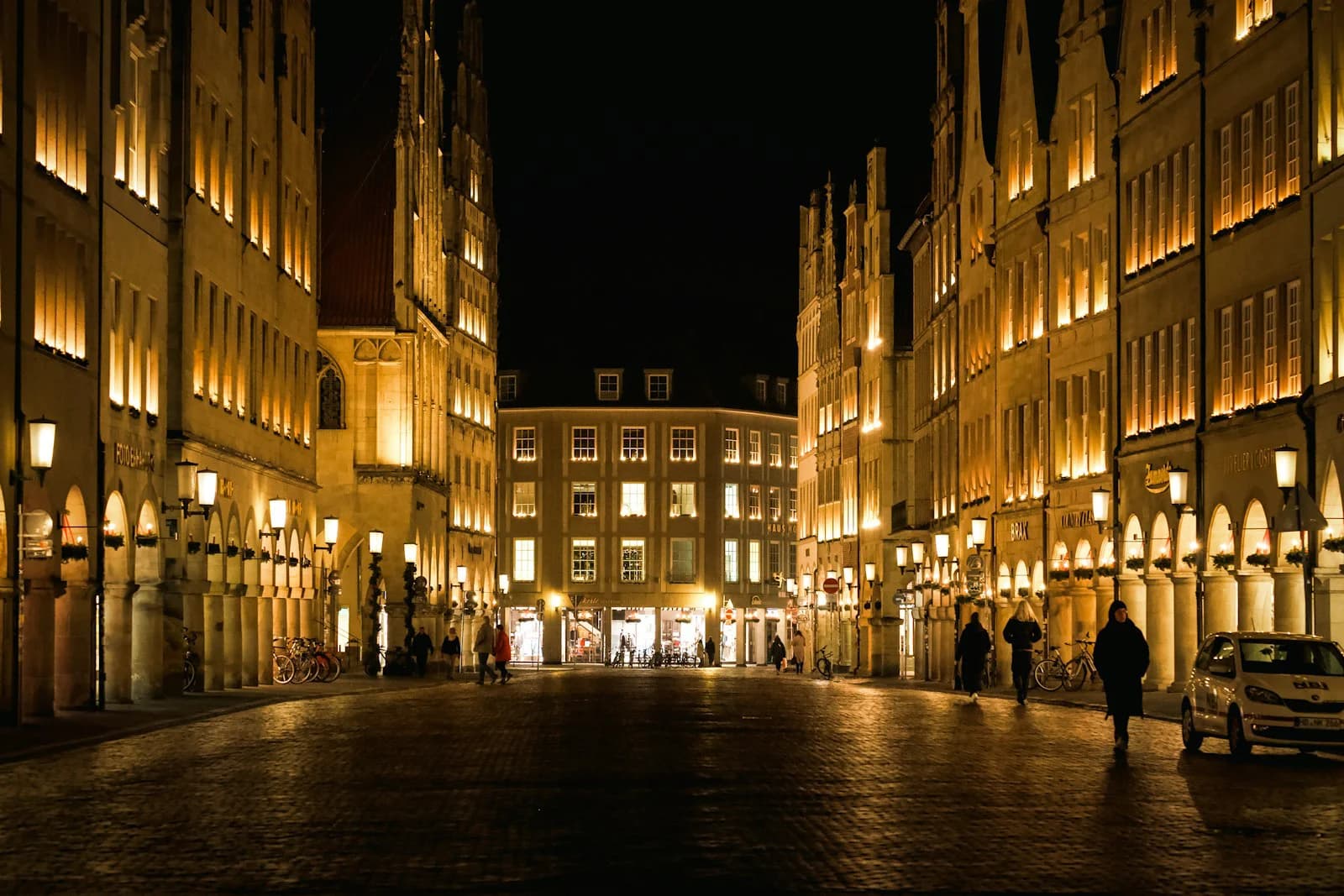
Münster does not have one famous sunset platform, and that is the first thing to accept when you plan an evening here. Tourismus NRW lists the Aasee in Münster among its North Rhine-Westphalia sunset spots, describing boats on the water, geese in the shore willows and the Giant Pool Balls by Claes Oldenburg throwing long evening shadows. That makes the lake the default answer, but the evening really works as a pairing: the open water for the light, the car-free Promenade for getting there and back.
Most visitors should default to the Aasee's western shore, where the water sits between you and the setting sun. The Promenade is the second half of the plan, not a rival viewpoint, and it is where the two areas link into one outing. Allow roughly an hour and a half to two hours for the whole loop at an easy pace, and treat that as a suggested planning estimate rather than an official figure.
Quick Answer: The Aasee Is the Spot to Default To
If you only have one evening, go to the Aasee. It is the only Münster location in the regional tourism authority's round-up of sunset places, and the description is specific: boats crossing the surface, geese calling from the shore willows, and the Giant Pool Balls casting long shadows in the low light. That combination of open water and a western horizon is what you cannot replicate inside the old town, where buildings block the final degrees of sun.
Set expectations about what you are buying: this is a public lakeshore, not a ticketed attraction with a viewing deck. There is no need to reserve anything or arrive at a gate, which also means there is no guaranteed clear view or seating. If you want the full picture of how the lake fits into a longer stay, the wider Münster: Itineraries and City Travel Guides surface is the place to start.
Near Shore or Far Shore: The Decision That Shapes Your Evening
The Aasee gives you a genuine either-or. Stand on the far side and you get water and the city silhouette in one frame, because you are looking back across the lake with the sun behind you or beside you. Stand on the near side, the side you most likely arrive from, and access is easier and the walk home after dark is shorter, but your frame is flatter.
Photographers should treat this as a composition choice rather than a quality ranking. The far shore buys you reflections and depth; the near shore buys you convenience and a faster exit when the light dies. Photo-specific stops such as the arcaded Prinzipalmarkt and the cathedral square are covered in our guide to the Best photo spots in Münster, which is useful if you want to build a morning or afternoon route before the evening one.
Reading the Sky Before You Commit
Sunset forecasts compress a lot of weather into one number, and understanding the scale changes how you use it. Sunsethue explains its quality score as an estimate of how visually striking the sunset is likely to be, based on conditions around sunset time, and it grades anything below 20 percent as poor because of excessive cloud. The middle bands, 20 to 40 percent and 40 to 60 percent, describe fair and good evenings, while scores of 60 percent and above are described as rare but the most visually stunning.
The counter-intuitive part is that a completely clear sky is not automatically the best sky. The same source explains that its score depends on light being reflected from visible clouds, so broken cloud can produce colour that a cloudless evening will not. Treat a modest score as a judgement call rather than a verdict, and remember that a flat, cloudless evening is a pleasant walk even when the colour never arrives.
Check on the day, not days ahead. Sunsethue advises looking at the forecast on the day of the sunset, ideally a few hours beforehand, so the latest weather data is used, and it warns that forecasts can be wrong because weather prediction is inherently uncertain. That practical habit matters more than any single score you might read now.
Orientation: What a Direction Value Actually Tells You
A direction value in degrees is the most useful number on a forecast page, because it tells you which slice of the horizon to claim. For illustration, one Münster forecast snapshot showed sunset in the west at 259 degrees, with cloud cover noted separately; that is a single-day reading, so it is a teaching example rather than a time to plan around. What generalises is the logic: a value near due west tells you the open western shore of the Aasee is where you want to be.
Use the value to pick your side of the water and to avoid wasting the best light walking in the wrong direction. Because the sun's precise direction shifts through the year, a spot that works beautifully in one month may put the light slightly to your left or right in another. Recheck the direction on the day rather than assuming last trip's angle holds.
Timing Without a Fixed Clock
Copying a specific clock time from an article is the most common way to miss a good sunset. The time changes daily and across the year, and the only reliable source is a forecast or almanac checked on the day itself. What you can plan in advance is your margin: be in position well before the expected moment so you are not still crossing the park when the colour starts.
Stay after the horizon moment. Sunsethue notes that depending on conditions and your location, colours may last up to 30 minutes after the stated sunset time, which is exactly the window most people waste by leaving early. Budget that extra half hour into your evening and you will see the afterglow far more often than if you treat the listed minute as the finale.
Temperature is the quiet practical factor, especially from October onward, because a lakeshore evening is cooler than a sheltered old-town street. A layer that seems unnecessary at the start of the walk often becomes the difference between lingering and leaving. For an evening that continues after dark, see Things to do in Münster at night for what stays lively once the light is gone.
The Promenade: A Car-Free Ring for Getting There
The Promenade is the ring of greenery that wraps the old centre, and it is described as car-free and lined on both sides with trees that shelter it from sun and rain. It is heavily used by people walking dogs, students heading to the university, runners and cyclists, which tells you what kind of space it is: a working everyday route, not a quiet lookout. That is precisely why it makes a good approach to the water rather than a destination for the sun itself.
Keep the two surfaces distinct in your head. The Promenade is shade, movement and a way to cross the city without traffic; the Aasee beyond it is open sky and a west-facing view. Starting on the ring and finishing at the water gives you a gradual transition from enclosed streets to open horizon, which is easier on the eye than arriving straight from the station.
For the full picture of that ring and the lake path it connects to, including how the two fit together on foot or by bike, Walking the Aasee Promenade in Münster covers the same ground in more detail. Read it before you go if you want the walk to be the main event rather than the means to an end.
A Suggested Self-Guided Walk Linking Ring and Lake
Here is a simple plan: begin on the Promenade near the old town, follow the ring in the direction of the lake, then continue to the Aasee shore and position yourself facing the western sky. The walk in stays in shade and traffic-free, and the last stretch opens onto water, which means you arrive already oriented rather than hunting for a sightline. Treat this as a suggestion you can reverse or shorten, not a fixed route.
Plan on roughly an hour and a half to two hours for the outing including time standing still, with the walking portion comfortably inside an hour at an unhurried pace. That figure is our suggested planning estimate, not an official distance or duration. If you want to see how this evening slots into a longer break, the 3 Days in Münster itinerary shows where a lake evening fits between a museum day and an old-town day.
Choose your turnaround point by light rather than by stamina. If the sky is promising, stay on the far shore and accept the longer walk back; if it is flat, turn earlier and put the extra time into the old town instead. Deciding this when you arrive, with the actual sky in front of you, beats committing to a route on a forecast from the previous day.
Where the Giant Pool Balls Fit
The Claes Oldenburg sculpture is a waypoint, not the reason to go. Tourismus NRW mentions the Giant Pool Balls as part of the evening atmosphere at the Aasee, casting long shadows in the low light, which makes them a good visual anchor as you walk past. They are not described as a sunset viewpoint, and treating them as one is the most common framing mistake in write-ups of this area.
Use them as a photo stop on the way to your chosen shore, especially if you arrive early and need somewhere to stand with a strong composition. Long shadows only appear when the sun is genuinely low, so they are a sign the light is doing something interesting rather than a guarantee of colour. If the lake reflections are the priority, keep moving and come back another day.
What to Do When the Sky Stays Flat
Some evenings simply will not deliver, particularly when the forecast is banded as poor because of heavy cloud. The sensible response is to shift the outing rather than chase colour you were never going to get: enjoy the lakeside walk itself, then move into the old town while it is still light. A quiet grey evening at the water is a good walk even when it is a poor photograph.
If you want a fallback that is genuinely indoors, note that many Münster sights publish their own seasonal hours, and those change through the year. Rather than trusting a third-party listing, check the venue's own page or the city's visitor information on the day. We deliberately do not quote opening times or entry conditions here, because they vary and are better confirmed at the source.
One honest constraint applies to every spot in this guide: none of the available sources verifies seating, lighting or accessibility conditions at the Aasee or along the Promenade. Check on arrival, and if you need a specific setup, look at the ground with your own eyes before the light matters. For the wider set of landmark guides and practical basics, Münster: Landmark Visitor Guides is a useful next stop.
Plan Your Visit
Treat the Aasee as the core of the evening and the Promenade as the way in. Check the forecast on the day, note the direction value rather than a memorised clock time, arrive early, and stay up to half an hour past the moment the sun disappears. That combination gives you the best odds without requiring you to be lucky.
Decide near shore or far shore when you see the sky, not before, and treat the Giant Pool Balls as a stop along the walk rather than the destination. If the evening flops, the walk itself still works, and you can save the big-sky evening for another trip. Arrive with a plan, a layer and a fallback, and Münster's lakeside will do the rest.
Frequently Asked Questions
What is the best place to watch the sunset in Münster?
The Aasee is the spot to default to. It is the only Münster location named in the regional tourism authority's round-up of sunset places in North Rhine-Westphalia, and it is described there as having boats on the water, geese in the shore willows and the Giant Pool Balls casting long evening shadows. The open water and unobstructed western horizon are what make it work; the car-free Promenade is best used as the approach and exit rather than as the viewpoint itself.
What time does the sun set in Münster?
There is no fixed answer worth memorising, because the time changes daily and shifts noticeably through the year. Check a sunset forecast or almanac for Münster on the day you plan to go, and use the listed time to decide when to be in position rather than as a precise deadline. Arrive early, and stay after the listed moment, since colours often continue for a while after the sun has dropped below the horizon.
How early should I arrive for sunset at the Aasee?
Aim to be where you want to stand well before the expected sunset time, so you are not still crossing the park or choosing a spot while the light is at its best. If you are walking in via the Promenade, allow extra margin for the shaded ring before the shore opens up. Staying roughly half an hour past the listed moment is worthwhile on evenings with broken cloud, when the afterglow is often the strongest part of the show.
Is a sunset forecast for Münster reliable?
A forecast is an estimate, not a guarantee. Sunsethue describes its quality score as an estimate of how visually striking the sunset is likely to be, based on conditions around sunset time, and it warns that forecasts can be wrong because weather prediction is inherently uncertain. It advises checking on the day itself, ideally a few hours beforehand, and notes that colour depends on light being reflected from visible clouds, so a partly cloudy sky can outperform a cloudless one.
Can you watch the sunset from the Promenade in Münster?
The Promenade is described as a car-free, tree-lined ring around the old centre, heavily used by walkers, runners and cyclists. All that greenery is shade, which is exactly what you want on the approach but not what you want at the moment of sunset. Use it to reach the water in comfort, then step out to the open Aasee shore for the view itself.


