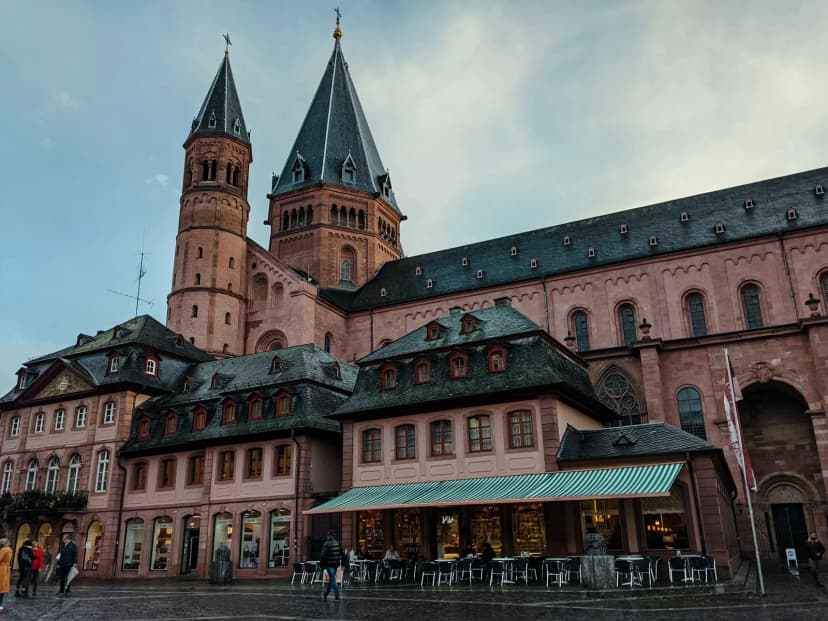
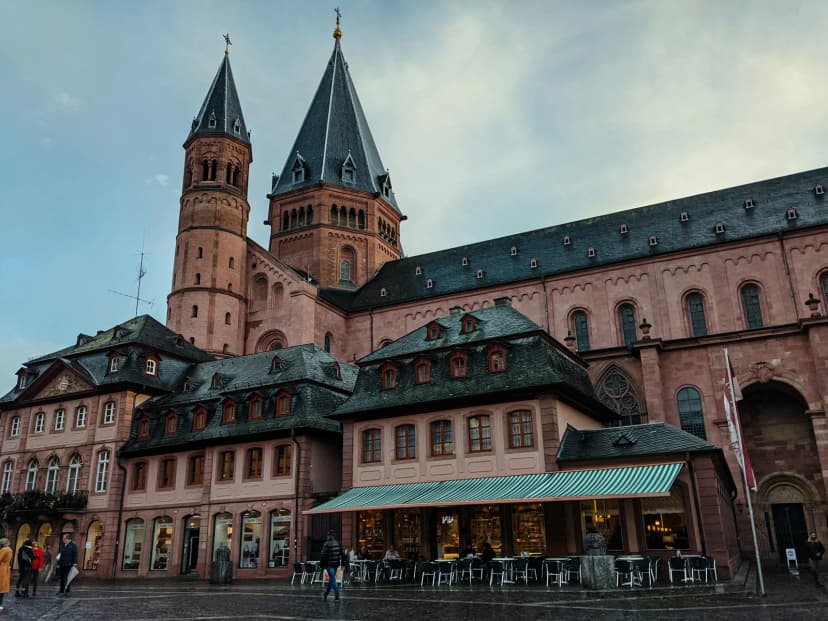
Most visitors arrive in Mainz expecting the printing museum beside the cathedral square, and it is not there. The Gutenberg Museum left its Liebfrauenplatz home when the Schellbau building closed in early October 2024, and since the end of November 2024 it has presented the interim exhibition Gutenberg Museum MOVED at the Natural History Museum Mainz, Reichklarastraße 1, in the restored rooms of the former Clarissan convent. The main telephone line is +49 6131 12-2644 / 3411.
That relocation shapes itineraries. The Bishopric Cathedral and Diocesan Museum is addressed at Domstraße 3, immediately by the cathedral, so it is reached on foot from the cathedral square and from the interim printing museum. Its telephone number is 06131 253 344 and its general email is info@dommuseum-mainz.de.
This comparison treats the two as separate institutions with separate collections and operations. It sorts them by subject, time budget and travelling party, then sets out what to verify before you travel, because the printing museum remains in a temporary exhibition phase rather than a finished new building.
The One-Minute Verdict on Each Museum
Choose the Gutenberg Museum if you want Johannes Gutenberg, the invention of printing with movable metal type, and the wider history of media and communication. The interim show presents a modern concept that combines classical content with contemporary methods of communication, and relates the history of printing to current social questions.
Choose the Cathedral and Diocesan Museum if your interest lies in the cathedral, the diocese and church art. Its exhibition list includes the Mainzer Domschatz and a show on the power of the archbishops of Mainz from Bonifatius to the Naumburger Meister, so it rewards curiosity about how the church shaped the city over centuries. Further visitor details appear in Bischöfliches Dom- und Diözesanmuseum Mainz.
The honest trade-off is fame against proximity. The printing museum carries the international reputation and now sits a short walk from the cathedral quarter; the cathedral museum is smaller but adjoins the building whose history it explains, which changes what a half-day looks like.
Where the Gutenberg Museum Actually Is Now
The interim venue is at Reichklarastraße 1, 55116 Mainz. Separate contact points exist for the Druckladen print shop, also at Reichklarastraße 1, and for the Gutenberg-Carré administration and Gutenberg Library at Ernst-Ludwig-Platz 2.
Treat the exhibition as a display of key objects during an ongoing rebuild and modernisation, not the finished permanent museum. The museum's site points to its press area for current information and planning-team concepts while no completion date is published there.
Practical consequence: do not navigate to Liebfrauenplatz expecting a museum entrance. Use the Reichklarastraße address, and if you are meeting someone, agree on the Natural History Museum building rather than the old square.
What the Interim Exhibition Puts in Front of You
At the centre is Johannes Gutenberg, described on the city's tourism page as Mainz's most famous son, whose invention of printing with movable metal type over 550 years ago triggered a media revolution whose influence is still felt. The exhibition illuminates his life, his inventions and their historical impact, and teaches the basics of printing.
Interactive elements are pitched at younger visitors. One example is a selfie station that allows them to photograph themselves against the backdrop of a historical printing workshop and take the image digitally or as a print.
The upper floors convey the history of printing, with two Gutenberg workshops demonstrating how printing was done in Gutenberg's time, while the printing shop remains a central space for educational projects with practical experiences in printing techniques. As a rough suggestion rather than an official figure, allow around two hours if you read panels and try the interactive stations, and more if someone in your group works through the print shop.
The Gutenberg Bible Question
Two copies of the 42-line Gutenberg Bible are displayed so they can be compared directly in a walk-in treasure chamber. This is a viewing experience in a secured display setting; there is no handling of the volumes, and any expectation of turning pages should be dropped before you arrive.
Because the Bible is one highlight inside a multi-floor exhibition rather than the whole museum, give it real time. If the Bible is your reason for visiting Mainz, plan the rest of the exhibition around that room rather than the reverse.
What the Cathedral and Diocesan Museum Covers
The Bishopric Cathedral and Diocesan Museum is a museum of the cathedral, the diocese and church art, addressed at Domstraße 3, 55116 Mainz, with its own telephone line 06131 253 344, fax 06131 253 349 and email info@dommuseum-mainz.de. Its programme has included the Mainzer Domschatz and exhibitions on the power of the archbishops of Mainz from Bonifatius to the Naumburger Meister.
Its exhibition list also moves into art-historical territory beyond strictly liturgical objects, with shows on manuscript material and on the visual culture of Christian art. That spread means the museum is not simply an appendix to the cathedral next door.
The building's position is the practical argument in its favour. Being immediately adjacent to the cathedral makes a combined visit to the church interior and the museum straightforward, and it lets you look at objects and then walk a few steps to the structure, setting or tradition they came from.
Why a Small Museum Rewards a Structured Visit
The museum runs a museum pedagogy and outreach programme spanning children, teenagers and adults, individual visitors and groups, with the aim of getting to know the cathedral and the museum and discovering a piece of Mainz history and identity. That breadth is unusual for a museum of its size and is the reason a guided format can outperform unstructured wandering. Further visitor details appear in Bischöfliches Dom- und Diözesanmuseum Mainz.
Formats advertised on its programme include an English-language guided tour described as a sixty-minute experience, a thematic tour for children aged three to seven, adult tours, and a recurring Kunst und Kreppel event. Do not read those listings as a fixed weekly timetable: dates and times change, so check the museum's calendar for the days you will be in Mainz and confirm whether a tour runs in your language.
If a sixty-minute format suits you, the museum can be fitted into a morning alongside the cathedral itself. If you prefer to read at your own pace, ask at the desk about current offerings and whether group bookings affect access at your chosen time, since programme pages are published closer to the date.
Choosing by Interest: Printing or Church History
The cleanest split is subject matter. If you are drawn to how ideas spread, mechanical invention and the prehistory of modern media, the printing museum is the obvious stop; if you are drawn to ecclesiastical art, treasury objects and the political role of the archbishops, the cathedral museum answers better.
There is an overlap worth naming: both museums are, at bottom, about the circulation of texts and images in a religious and civic world. Someone with a deep interest in early printed books and manuscript culture can justify both, using the cathedral museum for the devotional and art-historical context that the printing story leaves out.
For a general-interest visitor with no strong preference, the printing museum is the more internationally distinctive experience and the cathedral museum the more locally rooted one. Decide which of those two you would rather carry home.
Choosing by Time Budget
With half a day, do one museum properly and walk the cathedral quarter rather than splitting yourself. With a full day, pair one museum with the cathedral interior, a stroll through the old town, and a pause for food, which suits the city better than two dense collection visits back to back.
If you have only a couple of hours and it is raining, the printing museum absorbs time easily because the exhibition runs across floors with interactive stops. The cathedral museum works better as a short, focused visit, particularly if you join a guided format rather than trying to absorb everything independently. For wider planning, see the rainy-day guide to Mainz.
Choosing by Travelling Party
With children, the printing museum has the stronger hand thanks to the selfie station, the reconstructed workshops and the printing-technique activities. The cathedral museum counters with child-specific formats, including a thematic tour for ages three to seven, which is worth checking when the rest of your group wants a slower adult visit. For more family ideas, see the Mainz with kids guide.
For non-German speakers, the cathedral museum advertises an English-language guided tour, but you should confirm that a session falls on your travel date rather than assuming one runs daily. At the printing museum, the objects speak largely for themselves and the workshops are visual, though exhibition texts in translation are worth asking about at the desk.
Mixed-interest groups often do best by splitting for ninety minutes and regrouping at the cathedral. Nobody has to sit through a subject they do not care about, and both parties come back with something to say.
Practical Planning That Does Not Depend on Guessing
Admission prices and opening times are the volatile part of this comparison, and the safest method is to check each operator directly rather than trusting a third-party listing. Mainz Tourismus publishes an opening-hours block for the Gutenberg Museum, while the museum's own site is the authority for closures and special notices; re-check it in the week you travel.
The museum has posted dated closures on its own site, including a morning shutdown for an internal training session and a maintenance period in late November. Those notices are specific to given dates, so they are not a general rule; the point is that dated interruptions get published, which makes a same-week check more useful here than at a settled institution.
For the Dommuseum, the site's information and service area covers opening times and admission, with telephone advice available on a limited weekly slot and email enquiries accepted. Use those channels for ticket scope questions, including whether any combination with the cathedral is offered, and do not assume a single ticket covers both museums.
Doing Both Well Without Rushing
The two museums sit close enough in the old town that a combined day is realistic if you accept a shorter stay in each. A sensible shape is the printing museum first while you are fresh, a break for lunch, then the cathedral museum in the afternoon when a guided format or a single treasury room feels achievable.
Between them, use the cathedral itself as the hinge rather than a filler. Stepping into the building after seeing objects connected to its history, or before seeing them, makes both visits clearer and costs nothing extra beyond your time.
How to Decide in One Minute
If you want one museum in Mainz and you care about printing, media or Gutenberg, take the Gutenberg Museum at Reichklarastraße 1 and budget around two hours as a suggestion. If you want cathedral history, treasury objects and church art in the place where that history happened, take the Cathedral and Diocesan Museum on Domstraße.
Whichever you pick, verify opening times, admission and any dated closures with the operator before you set out, because the printing museum is still in an interim phase. That one check removes almost every avoidable problem from this decision.
Frequently Asked Questions
Is the Gutenberg Museum at Liebfrauenplatz?
No. The previous Liebfrauenplatz building, the so-called Schellbau, closed in early October 2024 to make way for a new building, and since late November 2024 the interim exhibition Gutenberg Museum MOVED has been hosted at the Natural History Museum Mainz, Reichklarastraße 1. Navigate to that address rather than the old square, and check the museum's own site before travelling because the site remains in a transitional phase.
Does one ticket cover both museums?
There is no evidence of a combined ticket, and the two are separate institutions with separate operations, so plan on paying and booking separately. Ask each museum directly about its own admission scope, and use the cathedral museum's email or telephone advice line for anything about its tickets and tours, since its information and service pages are the authority for its own arrangements.
Which museum is better for children or non-German speakers?
For children, the printing museum's interactive stations, reconstructed workshops and printing activities usually land better, while the cathedral museum runs its own formats for young visitors, including a thematic tour for ages three to seven. For non-German speakers, the cathedral museum advertises an English-language guided tour, but you should confirm that a session falls on your date rather than assuming a daily schedule.
Can you see the Gutenberg Bible in Mainz?
Yes. Two copies of the 42-line Gutenberg Bible are displayed so they can be compared directly in a walk-in treasure chamber at the interim exhibition. It is a display setting, not a handling experience, and because the volumes are one highlight among several floors of material, allow time to look properly rather than treating the room as a quick photo stop.
How long should each museum take?
As a suggestion rather than an official figure, allow around two hours for the printing museum if you read panels and use the interactive stations, and more if you work through the print shop. The cathedral museum suits a shorter, focused visit, and its advertised sixty-minute guided format shows how a structured hour can work; confirm current tour dates on its calendar before building a day around one.