Leipzig's historic centre is small enough to cross in a single loop, which is why a walking route beats any other way of seeing it. The Ring, the boulevard that follows the line of the demolished city walls, wraps the old town in a recognisable circle, so you can reorient without a printed map: if you are walking a green strip with trams beyond it, you have reached the edge.
This route works because most of what makes the centre memorable is public space. The market square, the passages and courtyards, the church exteriors and the Ring promenade cost nothing and carry the character of the city. Interiors are a separate decision, taken stop by stop and paid for individually, not bundled into a single old-town ticket.
Expect a dense sequence of stops rather than a long march. One published city-centre tour visits around thirty locations across roughly four kilometres in about ninety minutes, which shows how tightly packed the centre is.
Why the Old Town Works Best on Foot
Distances between the station, the market, the churches and Augustusplatz are short enough that walking is faster than waiting for a connection. The centre sits inside the Ring, and every major sight on this route lies within that circle or immediately on its edge. You will spend your time looking at buildings rather than at timetables.
The trade-off is concentration: on a busy Saturday the market, Grimmaische Strasse and the passages fill up, and progress slows. Start earlier or reverse the direction so you meet the crowds at the market rather than fighting through them.
Treat the arcades and courtyards as connective tissue, not attractions. They are working buildings with shops, offices and residents, and passing through is normally the point. If a courtyard gate is shut, that is routine building management, not a closure to plan around.
Route at a Glance: Start, Finish and a Route Estimate
Start at the west hall of Leipzig Hauptbahnhof and finish at Augustusplatz. That gives you a clean line from the station into the old town and out again towards the opera, the Gewandhaus and the university, with tram and S-Bahn options at both ends.
As an editorial estimate, allow about three hours for the full loop at a relaxed pace with photo stops, and two hours if you walk briskly and skip interiors. These figures are suggestions from this guide, not an official duration published by the city or any operator; your own pace, queue tolerance and museum choices will move them more than any map does.
If you want a shorter version, cut the Neues Rathaus detour and the university courts and return to the market from the Thomaskirche side. The centre is compact enough that any shortcut still leaves you a few minutes from a familiar landmark.
Leg 1: From Hauptbahnhof to Nikolaistraße and the Brühl
Leave the station by the west portal, cross the Ring and the tram tracks, and walk straight into Nikolaistraße. Early twentieth-century commercial buildings line the street almost immediately, and the scale drops from station concourse to shopping street within a hundred metres.
Turn right into the Brühl, once known as the world street of furs, where the trade in pelts made the street's merchants wealthy until the 1930s. Much of that older architecture was lost in the war, and the Höfe am Brühl complex restored the street line with a varied facade that echoes the smaller buildings that stood there. A plaque on the complex marks the site where Richard Wagner was born in 1813.
At the far end, the curved metal-clad building known locally as the Blechbüchse closes the view and puts you at the Richard-Wagner-Platz on the northwest corner of the Ring. From here, Hainstraße leads south towards the market.
Leg 2: Hainstraße, Kretschmanns Hof and the Courtyard System
Hainstraße is the quietest of the three main shopping streets that end at the market, and it is where the courtyard system becomes obvious. Jägerhofpassage and Kretschmanns Hof open off it within a few steps of each other, and both are walk-through routes rather than destinations.
In Kretschmanns Hof you cross one court, turn left at the far end and pass into a second before emerging on Katharinenstraße. That second court rewards the small detour, and the manoeuvre teaches you how the system works: passages and courts are linked, and you can move across a whole block without returning to the street.
On Katharinenstraße you will find the Museum der bildenden Künste, a glass and concrete cube holding one of Germany's significant civic art collections. Its exhibitions are ticketed, so decide at the door whether the stop fits your day rather than assuming it is part of the walk.
Leg 3: The Market and the Altes Rathaus
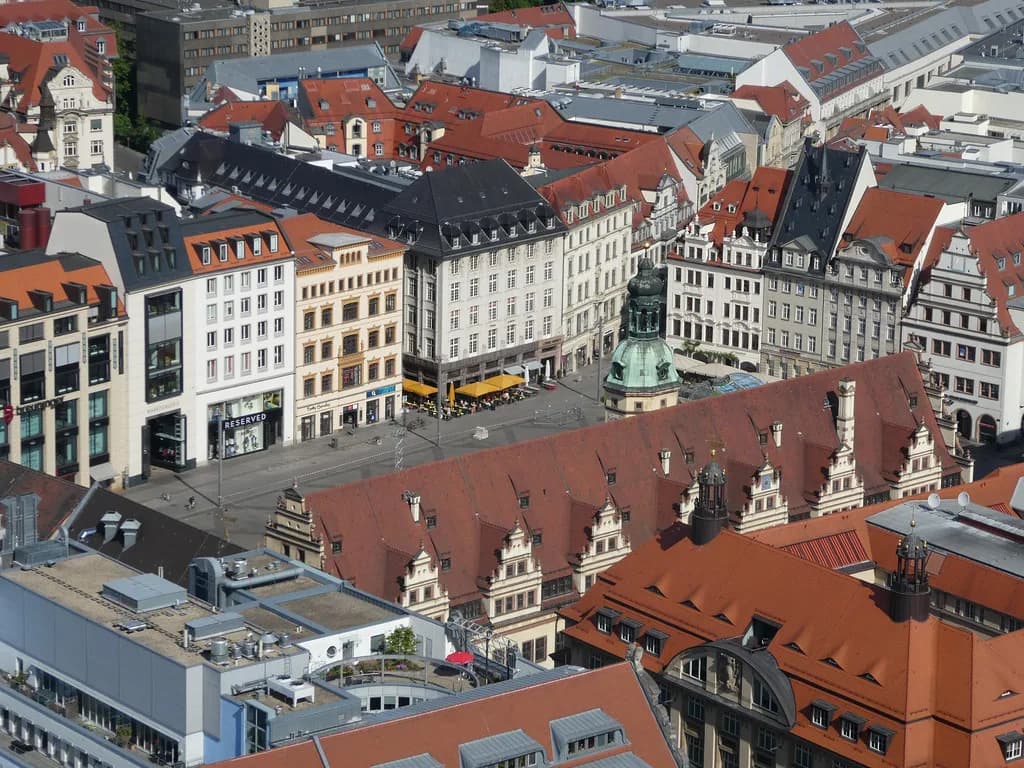
The market square is the orientation point of the whole route. The Altes Rathaus, built from 1557 and one of Germany's outstanding Renaissance town halls, runs along one side, and the reconstructed Alte Waage sits on the northeast corner; the square itself costs nothing and is where locals meet on a sunny afternoon.
Read the square rather than rushing through it. The building inscription on the town hall runs to considerable length, the proportions of the north side show what the merchant city looked like before the war, and the underground trade-fair hall that once lay beneath the square has been replaced by a City-Tunnel station, with original Art Deco stairways still visible at the southern entrance.
In the northeast corner, two passages leave the market for Barfußgäßchen: one through the König-Albert-Haus with two small Art Deco and Jugendstil courts, and Barthels Hof, a baroque courtyard passage described as the oldest surviving passageway in the city. Both are free to walk through.
Leg 4: Mädlerpassage, Naschmarkt and Auerbachs Keller
Mädlerpassage, built in 1813 for a suitcase manufacturer, connects Grimmaische Strasse with the Neumarkt and is the most elaborately designed shopping passage in Leipzig. It links to other passages including the Messehofpassage and Königshauspassage, so you can thread several blocks without stepping outside.
Inside the passage, stairs lead down to Auerbachs Keller, the historic restaurant that Goethe made famous through Faust, and a Goethe statue stands outside on the Naschmarkt side. Dining there is a separate booking decision from the walk itself, and the restaurant fills up around conventional meal times.
Opposite the passage, the Naschmarkt is a small square behind the old town hall with the baroque Alte Börse, the former stock exchange that operated until 1886. It is a good place to pause and let the passage crowds move on. For more detail on the arcade's history and layout, the Mädlerpassage Leipzig visitor guide covers the building in its own right.
Leg 5: Barfußgäßchen and the Coffee House Corner
Barfußgäßchen is where the route slows down. The narrow pub street hides the market from view, and a small square opens ahead with Gründerzeit architecture on several sides. This is the natural halfway break before the western churches.
To the right stands Zum Arabischen Coffe Baum, one of Europe's oldest coffee houses, which today combines a restaurant with a small museum. It is a place to sit rather than to tour, and it works best as a pause before the Thomaskirche leg.
A few metres further on you reach the Dittrichring, the western side of the Ring. The Ring was laid out as a promenade when the fortifications came down, which is why a line of green space still runs along it today and why the boundary of the old town feels like a park edge rather than a traffic barrier.
Nikolaikirche and the 1989 Story
The Nikolaikirche deserves more than a photograph because of what happened around it. Monday prayers held here became the gathering point for the peaceful demonstrations that grew through 1989, and the church's role in that movement is the reason the peace column now stands on the Nikolaikirchhof on the north side.
The interior is a surprise to many visitors because its design departs sharply from what the restrained exterior suggests, and looking inside is worth the few minutes if the doors are open and no service is in progress. Services and concerts take priority over sightseeing, so check the notice at the door before entering. The St. Nicholas Church Leipzig visitor guide covers the building's history and architecture in more depth.
The municipal administration has marked sites connected to the fall of the East German regime with information panels around the centre, which lets you build a second, history-focused layer onto the same walk without extra distance.
Leg 6: Thomaskirche, the Bach Monument and the Museum Decision
Walk around the corner onto the Thomaskirchhof and you reach the Thomaskirche, where Johann Sebastian Bach worked as cantor for decades and where he is buried. The Bach monument stands on the south side of the church, and the building's role in the city's musical life is the reason this stop anchors the western end of the route.
The Bach-Museum occupies the Bosehaus next to the church and is a separate ticketed interior. Decide on the day rather than in advance: if you have already spent time inside the Nikolaikirche and want to keep walking, skipping it is a reasonable call, and current prices, hours and any free-entry arrangements should be checked directly with the museum, because third-party listings go stale quickly.
If your timing aligns with a motet or service, hearing the Thomanerchor in the church is a different experience from a museum visit, and it costs nothing beyond your attention. Check the church's own notices for what is happening during your stay.
Leg 7: Burgplatz and the Neues Rathaus Detour
Burgstraße leads south to Burgplatz, where the Neues Rathaus faces you across the square. Built between 1899 and 1905, it is one of the largest town halls in the world, and its tower is the highest in Germany, reusing the old tower of the Pleissenburg castle that guarded the southwest corner of the city for centuries.
How much of the detour is worth it depends on what you want. The walk around the building takes you under the bridge linking the town hall with the Stadthaus and gives you the portal facades and the adjoining federal administrative court from the Ring. That is exterior sightseeing, and interior access is not something to count on.
If you are short of time, take Markgrafenstraße southeast and rejoin the route rather than circling the building. The trade-off is a shorter walk against losing the view of the facades from the far side.
Leg 8: Petersstraße, Grimmaische Straße and the University Courts
Petersstraße and Grimmaische Straße are the two remaining shopping streets back towards the market, and they are the least uniform in architecture. Petersstraße mixes historic merchant houses with the Petersbogen passage on the left and a partly historic, partly modern department store block on the right, so the walk back is a study in how the city rebuilt.
On Grimmaische Straße, the Mädlerpassage front, the Königshaus and the Messehaus am Markt sit side by side, and the Zeitgeschichtliches Forum occupies part of the same block at Grimmaische Straße 6. That location makes it the easiest museum stop to fold into the walk without adding distance.
Cross the Städtisches Kaufhaus through its inner courts to the Neumarkt, then enter the university campus through the gap between the modern buildings. If the inner court is closed, walk around the south side past the Moritzbastei, the last surviving piece of the city fortifications, which today houses a large student club. Treat all of this as conditional access: the interiors are not guaranteed.
Free Squares and Passages Versus Ticketed Interiors
Be precise about what is free. The market, the Naschmarkt, the Ring promenade, the church exteriors and the arcades and courtyards you walk through cost nothing. Museum collections, church towers and any guided interior visit are separate, individually ticketed, and never covered by a single old-town pass.
The Zeitgeschichtliches Forum on Grimmaische Straße is the significant exception on this route: it documents division and everyday life in the GDR and the road to reunification, and admission to the museum and its exhibitions is free. It opens Tuesday to Sunday, and the permanent exhibition is accompanied by changing shows of its own.
The Museum in der Runden Ecke at Dittrichring 24 is a different proposition: a memorial in the former Stasi district administration, run by a citizens' committee, with exhibitions in original rooms and a modest admission charge, so check the site for current times and tour arrangements before going.
Two Modern-History Stops Near the Route
Both the Zeitgeschichtliches Forum and the Runden Ecke sit close to the walking line but demand more time than a glance. The Forum rewards a focused hour in the permanent exhibition; the Runden Ecke is emotionally heavier and works better as a deliberate stop than as something squeezed between two churches.
The Runden Ecke also runs city walks on the trail of the peaceful revolution and grounds tours of the former Stasi site, offered on a weekly schedule with meeting points at the Nikolaikirche and at the memorial itself. These are bookable extras rather than part of the free display of the old town, and the operator's site lists the current times and arrangements.
If your interest is the GDR period rather than music, start with the Forum because it is free and central, then decide whether the Runden Ecke justifies a second museum slot on the same day.
Suggested Durations and Route Variations
A short loop — station to market, one passage, Nikolaikirche and straight back — fits comfortably into an hour and a half of walking. It skips the western churches and the Rathaus but still delivers the market, the arcades and the civic centre.
The full route with the Thomaskirche and Burgplatz legs is the roughly three-hour version described above, and that figure is an editorial estimate, not an official or timed route. A half day allows for one ticketed interior plus a proper pause at a coffee house without rushing the rest.
If you have a full day in the city rather than a few hours, the one day in Leipzig itinerary adds the areas outside the Ring, and the 3 days in Leipzig itinerary spreads the museums and the southern parks across separate mornings so that the old town walk stays a walk rather than a queue.
Self-Guided Versus Guided
A guided old-town tour compresses the same ground into a fixed slot and adds interpretation you would otherwise read off a panel. One advertised option runs for two hours from Burgplatz and covers the Neues Rathaus, the Nikolaikirche, Barthels Hof, the Coffe Baum, the Altes Rathaus, Mädlerpassage, the Thomaskirche and the university, which shows how much can be packed into a short format.
The self-guided version wins on flexibility: you can linger in a courtyard, change direction when a square gets busy, or abandon the western leg when it starts to rain. The guided version wins when you want the 1989 story told properly at the Nikolaikirche and the merchant history explained at the market rather than pieced together from plaques.
A practical compromise is to walk the route yourself and join one short thematic walk on the revolution or music. That keeps the freedom of the loop while giving the one subject you care about the depth it deserves.
Practical Decisions: Sundays, Services and Surfaces
Sunday changes the texture of the walk. Shops in the arcades mostly close, some passages and courtyards are shut with them, and the centre feels quieter but less permeable. Church services take priority over visitor access, so plan the Nikolaikirche and Thomaskirche for a time when nothing is scheduled.
The walking itself is easy by city standards. You are on paved streets and squares the whole way, with kerbs, tram tracks around the Ring and cobbled stretches in the older lanes, so comfortable shoes matter more than distance. If accessibility affects your planning, note that different stops have different entrances and constraints, and check each site's own visitor information rather than relying on a general description.
Bicycle and tram traffic around the Ring is worth watching at crossings, and trams pass directly in front of the station and along the Ring. Look twice at the tracks and use the marked crossings; the centre is compact enough that a few seconds of caution costs you nothing.
Plan Your Visit
Walk it in one direction, start at the station and finish at Augustusplatz, and treat the arcades as streets rather than sights. Decide on interiors as you arrive at each one instead of pre-booking a chain of museums, and leave the Thomaskirche and Burgplatz legs as the parts you can cut if the day runs short.
Use the free, official city sources for anything that can change between seasons — the Stadt Leipzig portal for city-wide notices and the operator pages for individual memorials and museums. That way the walk stays current even when a particular courtyard gate or exhibition is closed. The Leipzig: Landmark Visitor Guides hub lists the individual buildings in more detail.
Take the route in whatever shape suits the day, and check back on the Leipzig: Itineraries and City Travel Guides page when you want to build the rest of your time around it.
Frequently Asked Questions
How long does a Leipzig old town walk take?
As an editorial estimate, allow about three hours for the full loop at a relaxed pace with photo stops, or around two hours if you walk briskly and skip interiors. These are suggestions from this guide, not an official duration published by the city or any tour operator. Your pace, the crowds in the passages and how many ticketed interiors you enter will shift the total more than the distance does.
Where should I start a self-guided walk through Leipzig's old town?
Start at the west hall of Leipzig Hauptbahnhof. The station sits on the northeast edge of the Ring, so you cross the tram tracks and walk straight into Nikolaistraße and the Brühl without needing any transport first. Finishing at Augustusplatz gives you tram, S-Bahn and coach connections at the other end, and the station is a convenient fallback if you finish early and want to leave.
Are Leipzig's arcades and courtyards free to walk through?
Yes. The arcades and courtyards on this route, including Mädlerpassage, Kretschmanns Hof, Barthels Hof and the Städtisches Kaufhaus courts, function as public through-routes between streets, and walking through them costs nothing. They are also working buildings, so individual gates can be closed for ordinary operational reasons, and interiors such as the Museum der bildenden Künste or the Bach-Museum are separately ticketed rather than covered by one shared old-town ticket.
Is the Leipzig old town walkable in one day?
The historic centre is compact enough that the route itself takes a few hours rather than a full day. The full day gets used up when you add ticketed interiors such as the Bildermuseum, the Bach-Museum or the two modern-history museums on Grimmaische Straße and Dittrichring. If you only have a single day, pick one interior and keep the rest of the time for the streets and squares.
What is the difference between the old town walk and the Notenspuren music trail?
The old town walk covers the civic and religious centre: the market and Altes Rathaus, the arcades, the two main churches, the university courts and the Ring. The Notenspuren trail instead follows the city's musical history through the places connected with Bach, Mendelssohn and the Schumanns, and uses information panels that play short musical excerpts when you press a button. Both cross the same streets, but the Notenspuren walk is a themed route of its own rather than a variant of this loop.
Sources
- The Three Hours in Leipzig Walk - PANORAMASTREETLINE
- The historical old town of Leipzig
- 2-Hour Leipzig Old Town Walking Tour with Local History - tourHQ
- Urban walks in Leipzig: discover beautiful cities and villages
- Museum in der "Runden Ecke" mit dem Museum im Stasi-Bunker. Bürgerkomitee Leipzig e.V.: Startseite
- Startseite leipzig.de - Stadt Leipzig
- Zeitgeschichtliches Forum Leipzig