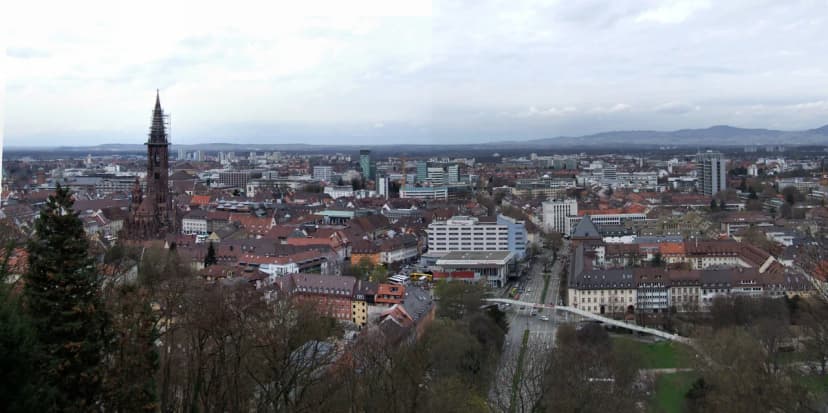
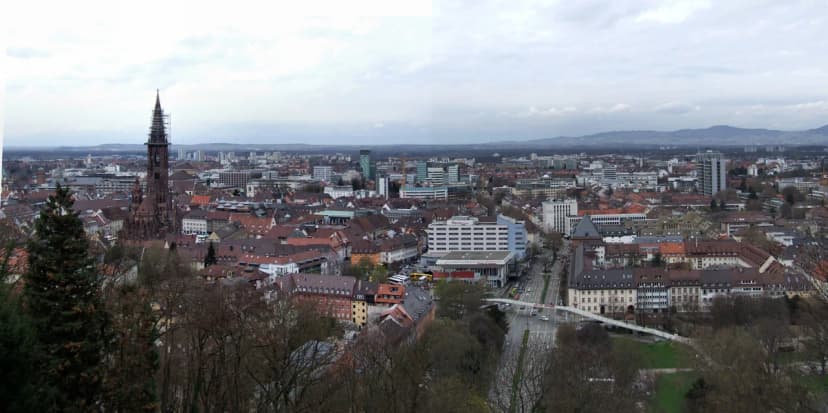
The Wiehre begins almost the moment the old town ends, running south along the Dreisam from the ring of streets below the Minster. It is a lived-in villa quarter rather than a landmark district, so the walk itself, not a ticketed sight, is the point. This route is an editorial suggestion, not an official itinerary, and the duration below is our estimate.
For a concrete anchor before you set out: the Holbeinpferd, the concrete foal at the corner of Günterstal and Holbein streets, was created in 1936 by the sculptor Werner Gürtner and measures 1.90 metres in both length and height, weighing nearly one tonne. Count on roughly half a day on foot if you keep a relaxed pace, linger at the river and stop once; adding the climb to the Lorettoberg ridge and its chapel ensemble pushes you toward the longer end of that window.
Why the Wiehre Is Worth Half a Day
The Wiehre sits directly south of the old town, separated from it by the Dreisam and the wide ring of streets around the Altstadt. Because it is mainly housing, with schools, churches and corner shops, it rewards slow walking and looking rather than queuing. If you have already covered the cathedral and the market, this is the natural next half day.
Freiburg's official tourism portal frames the city as a place where a walk out of the Altstadt reaches the Black Forest within minutes, and the Wiehre is the first green step in that direction. It also gathers the city's outdoor recommendations, which are useful if you want to extend the day beyond the district.
Route Shape at a Glance
The shape is simple: start in the old town, cross south over the Dreisam, work through the Wiehre to the corner of Günterstal and Holbein streets, follow river-side paths, and decide at the end whether to climb to the Lorettoberg. Three anchors hold it together: the Holbeinpferd, the Wiehre churches, and the ridge with its chapel ensemble.
The Lorettoberg is a ridge in the southwest of the Wiehre; at its highest point it is wooded and 384.5 metres above sea level, and it borders the Vauban district to the west and Günterstal to the south. Its chapel is one of many replicas of the Santa Casa of Loreto, and the ensemble includes the Brüderhaus, the Stations of the Cross that originally led up from Loretto Strasse, and the Hilda Tower built in 1886 and named after Hilda of Nassau.
Treat this as a suggested line on a map rather than a signposted trail. Keep a city map or offline guide handy, and expect to improvise at junctions where streets bend or the river splits your options.
From the Old Town Into the Wiehre
Orient yourself by the two surviving medieval gates and the ring road rather than by tram numbers, which are not needed for a walk of this length. Cross south from the Altstadt, and the street character changes quickly: shopfronts give way to front gardens, low walls and taller trees. If you want to see the old town properly before leaving it, a dedicated Freiburg Old Town walking route keeps the two halves of the day from blurring together.
The Dreisam is your handrail. Walking roughly upstream along its banks keeps you oriented as you head south and east into the district, and it gives you an easy way back if you lose interest in the streets.
Reading Wiehre Villa Architecture on Foot
Look at setbacks, garden walls and the way houses turn their shoulders to the street rather than at any single famous address. The district reads as nineteenth- and early twentieth-century residential Freiburg, with generous plots, mature planting and a mix of restrained and decorative facades. Because the character is cumulative, the walk works better as a slow sequence of streets than as a checklist.
Walk quietly and respect that these are homes, not exhibits. If you want a broader sense of what else the city holds beyond its headline sights, it sits comfortably alongside the other hidden gems in Freiburg and the neighbouring Stühlinger quarter.
Church Stops in the Wiehre
The Christuskirche is the district's Protestant landmark, built between 1889 and 1891 to designs by the architect Ludwig Diemer and inaugurated on 31 May 1891. It belongs to the parish of Freiburg Ost within the Evangelical Church in Baden. Whether you can step inside depends on services and current practice, so check locally rather than assuming a visiting window.
On Annaplatz, on Kirchstrasse, the small baroque Sankt Cyriak und Perpetua, known as the Annakirchle, offers a gentler contrast and a natural pause between the villa streets. Interior access is not something to count on, so treat both churches as exterior stops unless you have confirmed otherwise.
The Holbeinpferd as a Mid-Walk Marker
The Holbeinpferd is the colloquial name of a concrete foal sculpture at the corner of Günterstal and Holbein streets in the Wiehre. It was created in 1936 by the sculptor Werner Gürtner, measures 1.90 metres in both length and height, and weighs nearly one tonne. It is a useful, memorable midpoint precisely because it is small and street-level rather than monumental.
Use it as a decision point. From here you can drift toward the river and the green edge of the district, turn back toward the old town, or set your sights on the Lorettoberg.
Dreisam-Side Paths and the Green Edge
The Dreisam marks the boundary between the dense old town and the greener south, and paths along it let you swap pavement for tree cover for a stretch. Above the Wiehre, on the Sternwald side, the Wasserschlössle is an elevated water tank with a castle-like front, partly set into the mountainside and operated by the city's water supplier. It is an architectural curiosity rather than a visitor attraction, and it is glimpsed on the walk rather than entered.
Do not plan around an unbroken, barrier-free riverside route. Surfaces, gradients and seasonal state of the banks vary, and there is no single continuous promenade to rely on, so be prepared to divert onto streets and rejoin the water later.
Optional Extension: Climbing to the Lorettoberg
The climb to the Lorettoberg is the one part of the route that costs you real effort and time, so decide deliberately. It suits the end of the walk, when you can either descend back through the Wiehre or carry on toward Günterstal without doubling back. If your half day is already two-thirds gone, save the ridge for another visit.
On the ridge you get the chapel ensemble, the Hilda Tower and the wooded high point rather than a manicured viewpoint. Expect a residential climb followed by woodland, and treat the chapel as a religious site first, checking locally for any current access restrictions.
Cafes and Wine Bars as a Flexible Pause
Rather than fixing a cafe stop in the Wiehre, treat refreshment as a city-wide decision. Freiburg has a strong cafe and Baden wine culture, and the tourist office lists wine bars and wine shops largely in and around the Altstadt rather than in the district itself. Keep the pause optional so a busy or closed venue does not derail the route. Names, hours, prices and menus change often enough that staying flexible works better than planning around one address.
Five Baden classics the tourist office singles out are Chasselas, Pinot Blanc, Pinot Gris, Müller-Thurgau and Pinot Noir, and the House of Baden Wines at the Alte Wache on Münsterplatz is presented as a place to taste and buy regional bottles. If you want the evening to continue after the walk, an evening in Freiburg pairs naturally with a late stop back in the old town.
When the Weather Turns
If rain makes the ridge unappealing, pivot to a museum interior instead of shortening the walk. The Museum Natur und Mensch on Gerberau is the practical example: published opening hours are Wednesday to Sunday 10 am to 5 pm and Tuesday 10 am to 7 pm, with admission of 5 euros, reduced 3 euros, and free entry for those under 27. These figures are published by the museums service and can change, so confirm before you set out.
Freiburg's municipal museums are separate houses rather than one complex, so hours and prices are set individually for the Augustinermuseum, Museum für Neue Kunst, Archäologisches Museum Colombischlössle, Museum Natur und Mensch and Dokumentationszentrum Nationalsozialismus. Check each museum's own page for the day you plan to visit instead of assuming a shared ticket.
Half-Day Versus Full-Day
A half day covers the old town exit, the villa streets, the Holbeinpferd and a stretch of the Dreisam comfortably, with one pause. Adding the Lorettoberg climb or a museum turns it into a full day; adding both is better split across two visits. If you start after lunch, do the district first and the river last, so you are not climbing in fading light.
Reorder freely. The anchor points do not depend on each other, and the route reads just as well from the Wiehre back toward the Altstadt. If you want a greener, park-focused variation of the same district, the Freiburg Green City walk covers that ground.
Optional Add-Ons Beyond the Wiehre
The Schauinslandbahn is a separate outing, not part of the walk, and it deserves its own half day. The tourist office and operator-published details describe a cableway that spans 3,600 metres and overcomes a 746 metre elevation difference, opened in 1930 as the first passenger circulating-ropeway of its kind, with the lower station behind Günterstal. Fares and timetables change seasonally, so check the operator's own page for the day you plan to ride.
If trains and day trips appeal beyond the city, the region around Freiburg is well served, but treat those as separate plans. Build the Wiehre walk first and add the mountain only if you have a spare half day.
Practical Pacing, Footwear and Layering
Wear shoes with some grip and take a light layer, because river banks, woodland on the ridge and shaded streets behave differently from the sunlit Altstadt. Carry water if you intend to climb. A paper or offline map matters more than a live connection, since signage along the suggested line is not guaranteed.
Set a turnaround time before you leave, especially if the Lorettoberg is optional. Half days disappear quickly when you stop to look at facades, and the walk is more enjoyable if you are not hurrying back through the old town at the end.
Plan Your Visit
The Wiehre works as a half day because it asks nothing of you except walking and looking: no tickets, no fixed stops and no single must-see. Use the Holbeinpferd as your midpoint, the churches as your pauses and the Lorettoberg as your optional reward, and let the river guide you back.
Before you go, check the Freiburg tourist office pages for current city information and any temporary changes. If you want the old town and the district as one continuous day, pair this route with the old town walk and start early.
Frequently Asked Questions
How long does a Wiehre district walk in Freiburg take?
Plan on about half a day on foot at a relaxed pace, including one pause. That covers the old town exit, the villa streets, the Holbeinpferd and a stretch of the Dreisam. Adding the climb to the Lorettoberg pushes you toward the longer end of that window, and the duration is an editorial estimate rather than an official figure.
Is the Lorettoberg climb worth adding to a Wiehre walk?
It is worth adding if you still have energy and daylight, because the ridge gives you the chapel ensemble, the Hilda Tower and a wooded high point rather than another street. It is a genuine climb, so skip it if your half day is nearly over or the weather is poor.
What is the Holbeinpferd and where do you find it?
The Holbeinpferd is a concrete foal sculpture at the corner of Günterstal and Holbein streets in the Wiehre. It was created in 1936 by the sculptor Werner Gürtner and stands about 1.90 metres tall and long. It makes a natural midpoint and decision point for the walk.
Can you walk from Freiburg's old town to the Wiehre without a tram?
Yes. The Wiehre begins immediately south of the old town, so the walk is continuous on foot and needs no tram leg. This article deliberately avoids tram line numbers and journey times, since those are better confirmed on the regional transport operator's own pages.
What can you do in the Wiehre if it rains?
Swap the outdoor stretch for a museum interior, for example the Museum Natur und Mensch on Gerberau, which combines natural history and non-European ethnology under one roof. Hours and admission are published on the museums service site and can change, so confirm before you go, and remember that Freiburg's museums are separate houses rather than one shared ticket.