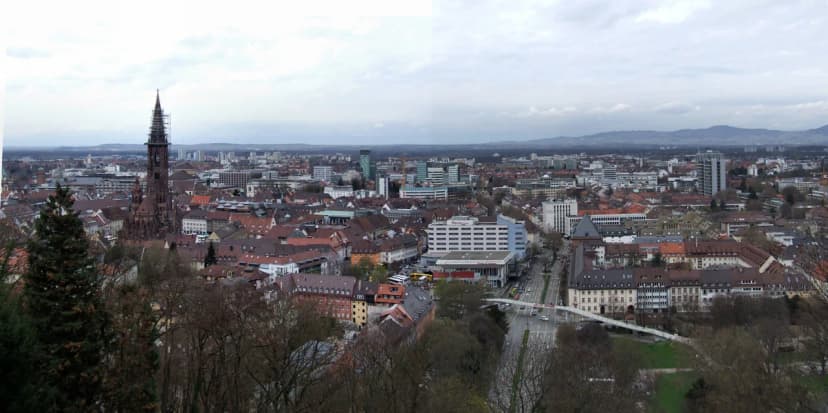
Freiburg's old town is small enough that an evening rarely needs a taxi: the Minster, Rathausplatz, Martinstor and Schwabentor sit within a short wander of each other. A good first anchor is the Alte Wache on Münsterplatz, which the city tourism portal describes as the House of Baden Wines, offering around 100 regional wines and supported by the City of Freiburg together with 23 winegrowers' cooperatives and 11 regional wineries. Treat the route and the stops below as suggestions rather than official itineraries, and confirm any venue's current hours on the day you go.
Freiburg is a university city between the Rhine plain and the Black Forest, and the tourism portal frames the centre as somewhere you can walk from the Altstadt into the forest quickly. That geography shapes an evening: most of what you want is flat, central and close together, while the surrounding hills are best left for daylight. A short loop plus one wine stop is usually more satisfying than trying to cover the whole city.
One planning detail worth knowing before you set out: Freiburg's municipal museums keep their late evenings on different weekdays. The Museum für Neue Kunst closes at its usual time on most days but runs until 7 pm on Thursdays, while the Museum Natur und Mensch runs until 7 pm on Tuesdays, according to their own pages. That spread means a wet evening often has a late-opening option, but only if you pick the right building for that night.
Why Freiburg Works Well for an Evening on Foot
The Altstadt is compact, and the landmarks most visitors want to see at night are close together: Münsterplatz with the Minster and the red Historical Merchants' Hall, Rathausplatz with the Church of St. Martin, and the two surviving medieval gates, Martinstor on Kaiser-Joseph-Straße and Schwabentor. Because they sit in the centre, you can walk between them in one continuous loop rather than treating each as a separate trip. The city's own sightseeing pages list the old town and the Minster as the top-level things to see, which matches how the centre is laid out.
The trade-off is that the busiest squares are busiest in the early evening, when day-trippers and shoppers are still around. Starting slightly later tends to make the same route feel calmer. Freiburg is also a university city, so the streets around the centre stay lively after dinner, though the specific venues change from year to year and no single street should be treated as 'the' nightlife district.
If you want a higher angle on the city before or after your walk, the Schlossberg above the centre is the closest option, and the sunset guide for Freiburg covers the practical side of timing a visit around the fading light. Keep in mind that no nightly illumination programme for the old town is published, so any glowing facade you see is ordinary street lighting rather than a scheduled display.
A Suggested 60-90 Minute Old-Town Loop
This is an editorial suggestion, not an official route. Start at Münsterplatz, where the Minster and the Historical Merchants' Hall face each other across the square, then drift south and east through the lanes toward Rathausplatz and the Church of St. Martin. From there, continue to Martinstor, the older of the two preserved gates, and finish at Schwabentor, the more recent one. The two gates frame the old town at opposite ends, so walking between them covers the core without doubling back.
A relaxed pace with a stop or two for photos usually lands somewhere between one and one and a half hours; that figure is a suggested duration for planning, not a published or measured time. If you prefer a more detailed sequence of streets, a dedicated Freiburg old-town walking route is a better companion than memorising turns from a short guide. The loop works in either direction, so you can end near whichever gate suits your onward plans.
Photographers often get their best results in the blue hour, when the sky still holds colour and the street lights have come on. That window is short in autumn, so it pays to time the loop around it if pictures matter. The Freiburg photography guide covers framing and locations in more depth, and a phone is enough for most of the squares because the buildings are close and the light is fairly even.
Baden Wine in the Evening: The Alte Wache on Münsterplatz
The Alte Wache was built in 1733 as part of the city's military reinforcement and today operates as the House of Baden Wines on the south side of Münsterplatz. The city tourism portal describes it as a showcase for around 100 regional wines, supported by the City of Freiburg along with 23 winegrowers' cooperatives and 11 wineries from the region. Wine tastings are organised there regularly, according to the same page, which is the detail worth relying on rather than any remembered price list.
Tasting and buying are two different activities in the building, and both are possible. An older 2020 city-magazine report described a ground-floor counter for buying and a curved staircase leading to an upper floor where higher-value wines were tasted; the renovation details and mid-range bottle prices in that article are years old and should not be treated as current. Check the venue directly, or the tourism portal's wine page, for today's selection and terms.
Because the Alte Wache sits directly on Münsterplatz, it is easy to fold into the walk described above rather than treating it as a separate outing. If you only have time for one stop, decide in advance whether you want a glass and a snack or a guided comparison, because the two take different amounts of time. The venue-specific Freiburg Alte Wache guide covers the building itself in more detail.
Other Wine Bars and the Autumn Straußwirtschaft Tradition
Beyond the Alte Wache, the city's wine page names several other places to drink in the evening, including Agora Wine Shop & Vinotheque, which describes itself as a shop and vinotheque for European wines with cakes, coffee and small snacks, and Enoteca and Trotte Weinbar, both listed as restaurants and wine bars. Choosing between them is largely about whether you want food with the wine, an Italian-leaning menu, or a focused tasting. Hours are set by each venue, so check the one you plan to visit.
Autumn brings the Straußwirtschaft tradition: seasonal wine taverns where, as the tourism portal puts it, onion tart and other Baden specialities are served alongside Neuen Süßen and house wines. These are time-limited by custom and by each producer's own calendar, so they are not a year-round fixture you can count on in mid-winter. If you are visiting in autumn, ask locally or check the portal for what is open when you are there.
Wine festivals and tastings appear on the city's events calendar through the year, with a wine festival on Münsterplatz among the recurring entries. Because dates shift annually, use the portal's calendar rather than a date remembered from a previous year. A quick check the week you travel is usually enough, and it avoids turning up to a square that has already been cleared.
What to Order First from a Baden Wine List
If you want to start with the local classic, ask for Gutedel, also known as Chasselas. The tourism portal calls it the 'Viertele wine' par excellence and a natural choice with dinner, grown almost exclusively in the Markgräflerland, and describes it as fresh, fruity and usually dry with a mineral, light character. It is the easiest way to taste what the region considers its everyday white.
Pinot Blanc and Pinot Gris are the other reliable whites, with Pinot Gris described by the portal as an all-rounder that works with almost any dish. Müller-Thurgau is the light, aromatic option when you want something easy, vinified semi-dry and dry. For red, ask for Pinot Noir: the portal notes its vines have been in Baden for over a thousand years and describes oak-aged versions as increasingly popular, fuller in body and suited to meat and game.
One practical tip from the local vocabulary: many places pour by the glass, and the traditional measure is the Viertele, a quarter-litre. Ask what is open by the glass before committing to a bottle, especially if you are moving on to a second stop. Staff at a vinotheque are usually happy to steer you toward a style if you describe what you normally drink.
Rain Backup: Which Museum Is Open Late Tonight
Two of Freiburg's municipal museums publish late evening hours, and they are on different weeknights. The Museum für Neue Kunst opens Tuesday to Sunday from 10 am to 5 pm, with a late finish at 7 pm on Thursdays; the Museum Natur und Mensch opens Wednesday to Sunday from 10 am to 5 pm, with its late evening on Tuesdays, also until 7 pm. Those hours come from the museums' own pages and are the numbers to plan around.
Admission is charged separately at each house, and the two pages quote different figures, so do not assume a single ticket covers both. The Museum für Neue Kunst lists admission at 7 euros, reduced 5 euros, with free entry for those under 27. The Museum Natur und Mensch lists 5 euros, reduced 3 euros, also with free entry for those under 27. These are the museums' own published prices at the time of writing; confirm on the day of your visit.
If you are choosing between them on a wet evening, the Museum Natur und Mensch combines natural history and non-European ethnology under one roof and includes interactive stations such as a bird song clock, a crawling tunnel and magic drums, which suits families. The Museum für Neue Kunst focuses on 20th and 21st century art, has a museum garden that functions as a shared meeting and planting space, and has a café. Check each calendar on the day, since temporary exhibitions change what is on view.
One Museum Ticket Is Not Every Museum Ticket
Freiburg's five municipal museums sit under one umbrella organisation, but that does not mean one admission covers all of them. Each house publishes its own hours and its own admission figures, and the individual pages confirm they differ, so treat every museum as a separate decision and check its own page before you go. A combined ticket, if one exists for a particular offer, would need to be confirmed on the museums' own site rather than assumed. Further visitor details appear in Startseite | Freiburg Museen.
The spread of late hours is wider than the two houses above: the Augustinermuseum runs until 7 pm on Fridays, the Archäologisches Museum Colombischlössle has its late evening on Wednesdays, and the Dokumentationszentrum Nationalsozialismus also runs to 7 pm on Tuesdays, according to the museums' central pages. That means you can often find a late opening on any given weeknight, but you have to pick the right building for that day.
One practical move is to decide which single museum you actually want, then confirm its current hours and admission on its own page or through the free Museen Freiburg app, which gathers audio tours, images, videos, digital reconstructions and maps for several houses. The app is a useful navigation aid in the rain, but it does not replace checking the day's opening hours on the museum's own page.
Getting Around After Dark
Freiburg's tram and bus network reaches the centre and the surrounding districts, and the tourism portal treats public transport as a normal way to move between the station, the Altstadt and the outer areas. Think of tram and bus use as a convenience for the first and last legs of an evening rather than a fixed itinerary, and confirm the current network map and service times with the operator on the day. There is no need to memorise line numbers in advance.
Because the old town is compact, most of an evening walk happens on foot, and the useful transport question is usually the return leg. If you are staying outside the centre, identify your nearest stop before you go out rather than after, and note the times of the last services. A screenshot of the route back saves guesswork when you are tired.
One framing point: nothing about using public transport in the evening here should be read as a safety guarantee, and Freiburg does not publish a nightly illumination programme for the old town. Keep to lit, ordinary streets and use the transport network as you would in any European city. For specific accessibility information, the operator and the tourism portal are the places to check rather than a general guide.
If You Want Altitude, the Schauinslandbahn Is a Daytime Option
The Schauinslandbahn is not an evening activity. Its published operating hours run from 9 am to 5 pm daily, and its lower station sits outside central Freiburg behind Günterstal. The cable car climbs 746 metres over 3,600 metres and reaches the summit area in about 20 minutes, which makes it a strong daytime excursion rather than part of a night out. Plan it for a morning or early afternoon if you want the view.
Access from the city is by tram and bus rather than on foot from the centre, and the tourism portal describes the lower station behind Günterstal as reachable by bus and tram from central Freiburg, while a separate sight-listing source notes the connection runs via a bus link to the terminus of a tram line at Günterstal. Because published network details change, confirm the current connection with the operator before you commit. Build in time for the return before the last ascent.
Round-trip adult tickets, family, group and regional-discount rates are listed on the cable car's own page, so the cost depends on which category you fall into and whether you hold a valid regional transport card. Because those figures and conditions can change, confirm on the operator's site before you travel rather than relying on a remembered total. If your main interest is a viewpoint close to the city, the Schlossberg is the simpler substitute on an evening.
Staying Comfortable Late: Practical Notes
Daylight changes quickly in autumn, and by late October the walk back from a wine bar is likely to be in full darkness, so a layer and a small torch or phone light help on the older, uneven lanes. Cobblestones around the Minster and the gates are charming but slick after rain. Flat shoes with grip are a better choice than anything with a smooth sole.
Cafés and wine bars in the Altstadt often close earlier than the bars, so if you want a quiet drink rather than a late night, plan your stop for the earlier part of the evening. The city's culinary pages list venue types so you can match the mood to the hour. Booking ahead is rarely required for a casual glass, but larger groups should check with the venue.
Keep an offline copy of your route and your accommodation address, since phone batteries drain faster in cold weather. If you are relying on public transport for the return leg, note the last services before you set out, because the network's late timetable is occasionally revised. A little planning turns a good evening into an easy one.
Combining a Walk and a Wine Stop Without Over-Scheduling
The most comfortable version of a Freiburg evening is one walk, one wine stop, and an optional museum if the weather turns. Trying to cover both museums and both gates in a single night usually means hurrying through everything. Pick two anchors and let the rest be spontaneous, especially if you are visiting in the short daylight of autumn or winter.
A workable sequence is: start at Münsterplatz while there is still daylight, loop to the gates, then settle in at the Alte Wache or another wine bar for the middle of the evening. If rain sets in, swap the second half of the walk for whichever museum is open late that day. That structure keeps travel time low and leaves room for a slow drink.
If you are comparing Freiburg with other German cities for a night out, it helps to know that Freiburg's appeal is compactness and wine rather than big-club energy. Munich and Berlin offer a different scale of nightlife, which is worth weighing if you are choosing between destinations. For a single evening in the Breisgau, a walk plus a Baden wine stop is the honest highlight, and the city's own 72-hour suggestions show how much of the centre is covered on foot. For wider planning, see 10 Best Things to Do in Munich at Night (2026). For wider planning, see 9 Best Things to Do in Berlin at Night (2026).
Plan Your Visit
Freiburg's evening offer is best treated as a short, flexible plan: an old-town loop anchored by the Minster and the two gates, a wine stop at a place that genuinely represents Baden producers, and a museum as your rain insurance. Because hours and events move, the final check belongs with the venue or the city tourism portal on the day you go. That way you spend your evening walking and drinking rather than standing outside a closed door.
Keep expectations realistic about what an evening can hold: two or three stops is plenty, and the compact centre means you are never far from your next option. If you want more structure, a self-guided old-town route or a broader set of Freiburg landmark guides can fill in the detail. Otherwise, let the light and the weather decide.
Frequently Asked Questions
Is Freiburg old town easy to walk in the evening?
Yes, the Altstadt is compact, and the main squares and gates sit within a short walk of each other, so an evening loop is realistic without transport. The surfaces are largely cobbled, which can be slippery after rain, so flat shoes with grip are a sensible choice. Freiburg does not publish a nightly illumination programme for the old town, so plan around the light you have rather than an advertised display.
Where can I try Baden wine in Freiburg in the evening?
The Alte Wache on Münsterplatz is the House of Baden Wines and is described by the city tourism portal as offering around 100 regional wines, supported by 23 winegrowers' cooperatives and 11 wineries from the region, with wine tastings organised regularly. Other named options on the same page include Agora Wine Shop & Vinotheque, Enoteca and Trotte Weinbar. Because individual venues set their own evening hours, check the one you plan to visit on the day.
Which Freiburg museums offer late evening opening?
The Museum für Neue Kunst stays open until 7 pm on Thursdays, and the Museum Natur und Mensch stays open until 7 pm on Tuesdays, according to their own pages. The museums' central pages also list the Augustinermuseum until 7 pm on Fridays, the Archäologisches Museum Colombischlössle until 7 pm on Wednesdays, and the Dokumentationszentrum Nationalsozialismus until 7 pm on Tuesdays. Each house has its own admission, so check the one you choose.