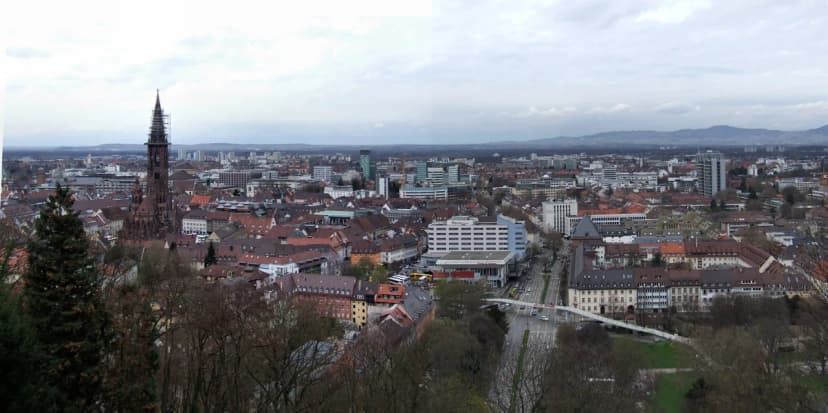
Freiburg's tram and bus network is run by VAG, the city transport operator, and it is the reason you can base yourself in the centre and still reach the Black Forest edge and the main station without a car. A practical detail worth knowing before you plan anything: the city tourism portal lists the Schauinslandbahn as open 09:00 to 17:00 on every day of the week, and the operator's own site says the cable car can run only in suitable weather, switching off early in strong wind or thunderstorms. That is a published schedule and an operational caveat rather than a promise, so check the live status on the operator's site before you leave the city.
What the VAG network actually covers
VAG describes five Stadtbahn lines as the backbone of the network, running on a 7.5-minute interval in the core, with 26 bus lines timetabled to connect at the most important interchange points and out into the surrounding area. The operator says around 81.6 million passengers use its trams and buses each year, which for a city of roughly 230,000 people shows how much the network carries. The practical takeaway is that you rarely need a taxi inside the city, but you do need to understand which lines serve the core and which buses head for the hills. For wider planning, see Freiburg Day Trips by Train.
The tourism portal describes the walk from the old town into the Black Forest as taking only minutes on foot, which is a useful reminder that the network and the landscape meet close to the centre. That is why a tram or bus ride is often the first leg of a hike rather than a replacement for one. If you are planning a full day around the city, pair the network with a route that keeps you on foot in the Altstadt and only uses vehicles for the longer hops. Further visitor details appear in Freiburg entdecken | das offizielle Tourismusportal | visit.freiburg.de.
Which ticket fits your trip
VAG's ticket list is short and worth reading before you buy anything at a machine. As shown on the operator's site when checked on 12 October 2026, the Deutschland-Ticket is a nationwide personal monthly pass at 63.00 €, the Deutschland-Ticket JugendBW is 45.00 € for people up to 27, a single Einzelfahrschein starts at 2.70 €, the Regiokarte Abo monthly subscription starts at 70.90 €, and the Tageskarte Solo+ day ticket starts at 6.91 € and covers one adult plus up to four children. Treat those figures as a snapshot rather than fixed, because fare tables change and the operator publishes the current list. Only state a price from the operator's own page, and re-check the VAG site before you travel.
The decision is usually simple: a day ticket suits two or three separate rides and a group of children, a single is for one spontaneous trip, and a monthly subscription only makes sense if you are staying long enough to justify it. The Deutschland-Ticket is the flexible option for a longer stay because it is valid nationwide, not just inside Freiburg, so it also covers regional legs. If you are here for a weekend, the day ticket is usually the cleaner choice than buying singles for each leg. The same VAG page groups its ticket and subscription bestsellers together, which is the quickest place to compare what is actually on sale. For wider planning, see Freiburg landmark visitor guides.
Where to buy and how to validate
VAG runs an online shop and an AboCenter for subscriptions, and both are listed on the operator's homepage alongside the ticket pages. Buying a subscription through the VAG AboCenter matters later if you want the reduced Schauinslandbahn rate, because the tourism portal says that discount applies only to RegioKarte, Deutschland-Ticket and semester subscriptions taken out through that channel, not to passes bought elsewhere in the RVF. If you are only in town briefly, a ticket machine or the online shop is the practical route.
Validation rules are the classic mistake for visitors: a ticket that is not stamped or activated when required can be treated as invalid, so check the machine or the app instruction at the moment of purchase rather than assuming. On-board purchase options exist on some services, but they are not a guarantee on every line at every hour. Keep the ticket with you for the whole journey, including any interchange, because inspectors can ask to see it mid-route.
Reading the network like a local
The five Stadtbahn lines form the spine, and the buses are timed to meet them at key interchange points so that a tram-to-bus change is a connection rather than a wait. That design is why it helps to think in terms of the nearest tram stop to your destination and the bus that feeds it, instead of trying to memorise the whole map. The operator's own description makes clear that bus lines are scheduled to connect at the most important transfer points, which is where you should plan your changes. Further visitor details appear in VAG Freiburg.
Use the live disruption notices on the VAG homepage before a longer trip, because track works and stop changes are posted there and can affect a specific line for weeks. The operator's news feed shows that kind of change in real time, which is more reliable than a printed leaflet. Build a small buffer into any connection that matters, especially if you are heading for a cable car with a fixed last descent.
Case study: reaching the Schauinslandbahn from central Freiburg
The tourism portal states plainly that the Schauinsland can be reached from the Freiburg centre with bus and tram in about 20 minutes, and that the cable car then takes 20 minutes from the valley station behind Günterstal to the summit. The same page records the line as 3,600 metres long with a 746-metre height difference and notes it opened in 1930 as the first passenger cable car in the world using the circulating principle. That combination of a short city leg and a short mountain leg is what makes Schauinsland an easy half-day rather than a full expedition.
The operator's site confirms the 20-minute ride to a summit it lists at 1,284 metres, while the tourism portal gives 1,248 metres, so do not treat either figure as beyond dispute. What both agree on is that the cable car is the comfortable way up and that the valley station sits behind Günterstal, reachable by tram and bus from the centre. If you are travelling with a bike, note that the cable car publishes a separate bicycle fare rather than assuming it is included. Further visitor details appear in Schauinslandbahn - Mit Deutschlands längster Umlaufseilbahn auf 1284m.
Fares on the mountain side
The tourism portal lists Schauinslandbahn fares as an adult round trip at 15.00 €, an adult single at 12.00 €, a child aged 6 to 14 round trip at 10.00 €, and a child single at 8.00 €. It also lists a family rate of 12.50 € round trip for one adult with one to four children aged 6 to 14, and a reduced 11.00 € round trip for RVF RegioKarte, Deutschland-Ticket and RVF SemesterTicket holders, with the explicit condition that the pass was taken out through the VAG AboCenter. These are published rates, not permanent promises, so confirm them on the operator's page on the day.
The family tariff is a genuine decision rather than a headline, and the published table is worth reading line by line before you queue. The trade-off is that the discounted holder rate does not apply to passes bought outside the RVF, which is a common source of confusion at the ticket window. Check which of your passes qualifies before you buy, because the condition is specific to the channel the subscription was taken out through.
Weather, operations and the honest caveats
The operator states that the cable car can run only in suitable weather, suspends operations early in strong wind or thunderstorms, and also stops for technical faults, with the current status posted at the top of its site each day. The tourism portal lists a 09:00 to 17:00 operating window, but that is a published schedule rather than a promise for any given day. Check the live status shortly before you leave the city, because a cancelled cable car turns a short mountain leg into a different trip entirely. Further visitor details appear in Schauinslandbahn - Mit Deutschlands längster Umlaufseilbahn auf 1284m.
If the cable car is down, hiking routes from the valley remain and the summit can still be reached on foot, but the height difference of 746 metres makes that a serious walk rather than a substitute ride. Plan the descent as carefully as the ascent, because the last scheduled descent is the constraint that matters most. A wet or windy day is the moment to switch to a city plan instead of forcing the mountain.
Connecting to the wider region and the city plan
The tourism portal describes Kaiserstuhl and Tuniberg as one S-Bahn ride from Freiburg and says Basel is about an hour away by train, which places both within an easy day of the city. That makes the main station a natural hub for longer legs, and it is worth checking which regional services stop there before you build a day around a connection. For a fuller menu of train-based options, use a Freiburg day trips by train plan rather than improvising at the platform.
If you only have a day, keep the transport simple and concentrate on the centre, because the old town is compact and the tram is best used to link the station, the Altstadt and one outlying stop. A One day in Freiburg itinerary works well with a day ticket and two or three tram rides, rather than trying to cover the region and the city at once. Combining the tram network with a walking route keeps the cost and the connections predictable.
Practical mistakes to avoid
The most common error is buying a ticket and forgetting to validate it where validation is required, which can turn a valid fare into a fine. The second is assuming the cable car will run on a fixed timetable, when the operator is explicit that weather and technical issues can suspend it. The third is leaving the mountain return too late, because the last scheduled descent is the real deadline of the day.
A quieter mistake is over-planning the network: with five tram lines on a 7.5-minute core interval and 26 connecting bus lines, you rarely need to memorise more than the nearest stop and the direction you want. Keep a screenshot of the current disruption notice from the operator before you set out, and treat any printed map as a starting point rather than the final word. That way a single closed stop does not derail the day.
Plan Your Visit
Freiburg rewards a simple transport plan: use the tram for the centre and the station, use the bus connection for Günterstal and the cable car valley station, and keep the mountain day flexible because the cable car can stop for wind or weather. Buy the ticket that matches your group and length of stay rather than the most expensive one, and check the operator's page for current fares before you commit. The network is compact enough that you can plan it in ten minutes and then stop thinking about it. For related planning, see Europa-Park Day Trip from Freiburg: Plan Your Visit.
Frequently Asked Questions
How much does a tram ticket cost in Freiburg?
VAG publishes the current fare list on its own site, including singles, day tickets, the Deutschland-Ticket and the Regiokarte subscription. Fares change, so check the operator's page at the time you travel rather than relying on an older figure. If you are staying for several days, compare the day ticket with the subscription options before buying.
Is the Deutschland-Ticket valid on Freiburg trams and buses?
The Deutschland-Ticket is sold by VAG as a nationwide monthly pass, and the operator promotes it for use on buses and trains across Germany. It is therefore valid on the Freiburg network as part of its nationwide scope, but always confirm the current validity conditions on the VAG site. It also unlocks a reduced Schauinslandbahn rate only if the subscription was taken out through the VAG AboCenter.
How do I get from central Freiburg to the Schauinslandbahn without a car?
Take tram and bus from the centre to the valley station behind Günterstal, then ride the cable car up. The tourism portal describes the city-to-mountain connection as a short trip and the cable car ride as about 20 minutes, but confirm the operating status before you set out because the cable car can stop for weather or technical issues.
Can I take a bike on a Freiburg tram?
VAG has announced a trial of bicycle carriage on trams, which means the rule is still under test rather than a settled, permanent policy. Do not rely on taking a bike on board until the operator confirms the current conditions. For the mountain, the cable car publishes a separate bicycle fare, so check that too.
How many days should I spend in Freiburg?
Two days cover the old town, the Freiburger Münster and a first look at the surrounding hills, while three days give you room for a mountain day and a regional trip. The city is compact, so the limiting factor is usually how much time you want outside the centre rather than how much there is to see inside it.