Schauinsland is the mountain Freiburg residents treat as their own back garden, and the usual question is not whether to go but how to get up. The Schauinslandbahn cable car does the climbing for you, while a network of trails and the historic Schauinslandstraße gives walkers and cyclists a slower, harder option. Deciding between them mostly comes down to your time budget, your group and how much effort you want to spend on the ascent.
The practical detail that shapes most trips is the gondola itself: the valley station sits behind Günterstal, and the ride to the summit takes around 20 minutes. From there, the Eugen-Keidel-Turm, the short summit loop and the Museums-Bergwerk sit within a compact area, so you can combine several of them without a long transfer. If you walk up instead, that same summit day starts several hours earlier.
The two ways up and who each one suits
Take the cable car if you want the summit views, the tower and the mine in a single unhurried half-day, or if anyone in your group cannot manage a long climb. Hike or ride if the ascent is the point, if you want the forest sections of the Schauinslandstraße and the mountain trails, or if you are travelling on a budget and prefer not to pay for transport. Both approaches land you in the same summit area, so the view does not depend on your choice.
A middle path works well for many visitors: ride up, then walk the easy summit circuit and possibly down a section of trail, or bring a bike up and start a descent from the top. The cable car also carries bicycles for a separate single-journey fare, which makes this combination straightforward if you check the current rules before travelling.
Where Schauinsland sits relative to Freiburg
Schauinsland rises immediately southeast of Freiburg, and the valley station has a Horben address on Bohrerstraße behind Günterstal. The mountain is close enough that residents treat it as a spontaneous afternoon out, which is why the cable car and the trails are busy on clear weekends. Because the summit still lies within the city boundary, Freiburg counts as Germany's highest-lying major city.
The height figure depends on which page you read. The cable car operator and the city's Schauinslandbahn page give 1,284 metres, while the city's house-mountain page and the general tourism portal use 1,248 metres. Treat the difference as a matter of measurement conventions rather than one source being wrong, and quote whichever figure your route description uses.
The Schauinslandbahn: length, climb and ride time
The Schauinslandbahn covers 3,600 metres of cable length and overcomes 746 metres of height difference between the valley station and the top. It opened in 1930 as the first passenger cable car in the world built on the circulating principle, and it was extensively modernised up to 2013. That modernisation is also why the operator now describes the cabins as equipped for wheelchair users.
The operator states that the journey takes about 20 minutes, which is the only travel time you should rely on when planning the day. As the gondola climbs, the view opens over the Rhine plain and the vineyard slopes of Tuniberg and Kaiserstuhl, reaching as far as the Vosges on the western side. Plan your outward leg for daylight and check the last descent before you settle into a long lunch at the top.
Cable car fares and which tickets matter for your group
The fares published on the city tourism portal list 15.00 euros for an adult return and 12.00 euros for a single, with children aged 6 to 14 at 10.00 euros return and 8.00 euros single. Family tickets, group rates from ten people, annual passes and combined cable car plus meal tickets are also listed there, and several of the combination offers state that a reservation is required. Confirm the current figures with the operator or on the ticket page before you travel, since prices and conditions can change.
Holders of an RVF regional card, a Deutschland-Ticket taken out through the VAG subscription centre, or an RVF semester ticket are listed at reduced rates, as are Schwarzwald and KONUS guest card holders, seniors from 63, FreiburgPass holders and visitors with a disability certificate above the stated threshold. If you carry one of these cards, ask at the ticket desk rather than buying the standard fare. Bicycles travel on a separate single-journey ticket, and dogs have their own tariff.
Operating status and hours you must check before leaving
The single biggest planning risk on Schauinsland is weather, not queues. The operator states plainly that the cable car can only run in suitable conditions and that strong wind or thunderstorms cause services to be suspended promptly, with technical faults also putting it out of action. The company advises checking the live operating status banner at the top of its site shortly before setting out, and that status is updated daily.
The city tourism listing for the cable car shows a daily window of 09:00 to 17:00 for each day of the week, which is the value retrieved from that source and not a guarantee for the date you travel. Seasonal timetables, maintenance periods and weather shutdowns can all shorten or cancel that window, so treat the listing as a planning starting point. Because the mountain can be clear in the valley and shut in cloud at the top, check the webcam alongside the status before committing to the trip.
What you see from the top
From the summit the outlook runs to the Feldberg and the wider High Black Forest, and on clear days it stretches well into the Alps. From the gondola during the climb, the panorama takes in the Rhine plain, the vineyard slopes of Tuniberg and Kaiserstuhl, and the Vosges beyond the river. Those two views are different enough that it is worth looking out on both the way up and the way down.
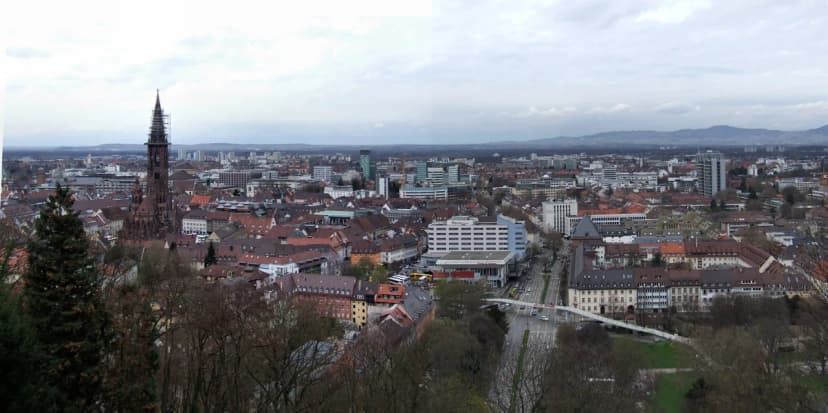
If you are collecting viewpoints around the city, this one sits at the opposite end of the scale from the tower of the minster, and the pair makes a sensible contrast between a rooftop view and a mountain panorama. A clear, stable high-pressure day gives the longest sightlines, while hazy summer afternoons still deliver the closer Black Forest ridges.
The Eugen-Keidel-Turm and the free summit loop
The Eugen-Keidel-Turm, also called the Schauinslandturm, is listed as freely accessible at any time, so there is no ticket and no opening window to work around. From the top station, the easy summit circuit that takes in the tower and the old pasture beeches towards the Engländerdenkmal runs for just under an hour. That makes it the natural first walk for anyone arriving by cable car with limited time.
The city describes the summit loop as a paved, step-free path, but adds that it includes significant gradients in many places. Read that carefully if you are planning around a wheelchair, a pushchair or limited stamina: step-free does not mean flat. Allow more time than the walking distance suggests, especially on the climb back to the top station.
Going into the mountain: the Museums-Bergwerk
Schauinsland was mined for silver, lead and zinc for around 800 years, and the Museums-Bergwerk near the summit is described as the largest mining museum of its kind in the region. Guided tours take visitors into part of a gallery system around 100 kilometres long, and the medieval silver trade is presented as a source of Freiburg's prosperity. Treat the mine as a separate stop with its own timing rather than an add-on to the summit loop.
The city listing shows the Museums-Bergwerk opening on Wednesday at 11:00, which is a single retrieved data point rather than a full timetable, and tour departure times are not published in these sources. Check the mine's own current opening days and tour slots before you build a day around it, and confirm whether underground visits need to be booked. Because it sits close to the top station, it pairs easily with the tower and the summit loop on the same visit.
Hiking and cycling alternatives
Two sourced options frame the walking choice: the easy summit round trip of just under an hour, and a longer mountain-forest route of roughly 8 kilometres with about 790 metres of elevation gain, which can be walked upwards from the valley or downwards from the summit. The longer version is a genuine half-day of climbing rather than a stroll, and it suits fit walkers who want the forest rather than the gondola view.
Cyclists have a classic in the Schauinslandstraße, opened in 1896, with a roughly 65-kilometre loop around the mountain from Freiburg; many riders take an e-bike or bring a bike up by cable car and start high. If you want a gentler second day in the city, the Schlossberg Freiburg and its own cable car give a much shorter climb with a different view back over the old town.
Coming down differently: the downhill roller route
Europe's longest downhill scooter route is described as running about 8 kilometres from the top station back to the valley in roughly an hour, with the scooters rented on site. That is an appealing way to avoid a repeat cable car descent, but it depends on the operation being open and on the weather being suitable. Do not build a day around it without confirming availability and the season with the operator on the day.
If the scooter route is not running, the cable car down, a walk, or a bike descent remain the practical alternatives. Guided herb walks and a puzzle-style outdoor game are also offered on the mountain according to the city, and both need advance scheduling rather than turning up. Check what is running that week on the operator's activities page before you commit the afternoon.
Accessibility: who should choose the cable car
The cable car is described as equipped for wheelchair users, and the operator publishes information about its accessibility measures. That makes the gondola the sensible choice for visitors who cannot manage a long forest ascent. The summit loop is step-free and paved but has significant gradients, so the accessible route at the top still demands some effort.
No source here promises accessibility inside the Museums-Bergwerk or guarantees conditions on the summit trails beyond those general notes, so ask the mine directly if underground access matters to you. For visitors with a disability certificate above the stated threshold, the fare table lists a reduced rate including a companion where the pass carries the relevant marking. Bring the documentation with you rather than assuming it can be verified at the counter.
Suggested half-day and full-day shapes
For a half-day, ride up, walk the short summit circuit past the tower and the old beeches, look at the panorama from the viewing points, and take a coffee or meal at the top station before descending. That is a relaxed shape that leaves the afternoon free in the city, and it works even for groups with mixed energy levels because the walking is optional and short. Treat the timings as a suggestion rather than a schedule.
For a full day, ride up in the morning, add the Museums-Bergwerk tour, eat at the summit, and return by a different method, whether that is the cable car, a bike descent or part of the mountain-forest trail. If you are hiking up instead, start early and keep the summit stops realistic: the mine and the tower together already consume a substantial part of the day. A Freiburg itinerary can absorb this as a single dedicated excursion rather than a filler between city sights.
Practical decisions: weather, wind, crowds and what to bring
Because wind and thunderstorms stop the cable car, build a wet-weather alternative into your plan and decide the morning of the trip, not the night before. Layers matter at the summit even when Freiburg is warm, and the mountain weather can differ sharply from the valley. Footwear with grip is worth the space if you intend to walk any part of the ridge or the summit loop.
Clear weekends and holiday periods bring crowds to the top station and the terrace, so arriving near opening gives you quieter paths and easier restaurant seating. If the cable car is shut, the city still offers indoor options, including the Museum für Neue Kunst Freiburg for contemporary art and the Alte Wache Freiburg on Münsterplatz for a different side of the day.
Plan Your Visit
The decision is simple once you name your priority: the cable car if you want the summit experience with the least effort, a trail or the Schauinslandstraße if the climb is the point, and the scooter route only as a bonus that depends on the day. Whichever you pick, check the live operating status before leaving, because weather is the one factor that can cancel the whole plan.
Confirm current fares and opening times with the operator rather than relying on any published table, and ask specifically about combination tickets, group rates and concession cards if they apply to you. Build the day around one or two summit stops rather than trying to fit everything in, and keep an indoor Freiburg option in reserve. That way a shutdown becomes an inconvenience rather than a lost day.
Frequently Asked Questions
Should I take the Schauinslandbahn or hike up Schauinsland?
Take the cable car if you want the summit, the tower and possibly the mining museum in a relaxed visit, or if anyone in your group cannot manage a long climb. Hike if the ascent itself is the goal or you want to keep transport costs down, accepting that the mountain-forest route involves several hours of climbing. Both options finish in the same summit area, so the views are the same once you are up.
How long does the Schauinsland cable car take?
The operator gives the ride from the valley station behind Günterstal to the summit as roughly 20 minutes. That is the only journey time you should rely on for the cable car itself; travel to the valley station from central Freiburg should be planned with a live timetable check on the day. Add waiting time on busy weekends and holidays.
How much does the Schauinslandbahn cost?
The fares published by the city tourism portal list standard adult and child return and single tickets, plus family, group, annual and combination options. Reduced rates apply to holders of certain regional and guest cards, and some combination tickets require a reservation. Because prices and conditions change, confirm the current fare with the operator or on the ticket page before travelling.
Is the Eugen-Keidel-Turm free to visit?
The Eugen-Keidel-Turm, also known as the Schauinslandturm, is listed as freely accessible at any time, with no ticket and no opening window to plan around. The tower sits within reach of the top station on the short summit circuit. The paved summit loop is step-free but has significant gradients in places, so allow more time than the distance suggests.
Can you visit the Museums-Bergwerk Schauinsland on the same trip?
Yes, the mining museum sits near the summit and can be combined with the tower and the summit loop. It has its own opening arrangements and guided tours, and the sources available here show only a partial picture of its timetable, so check current days and tour times with the museum directly. Treat it as a separate stop rather than something you squeeze into a short summit walk.
Is the Schauinslandbahn wheelchair accessible?
The cable car is described by the operator as equipped for wheelchair users and publishes accessibility information. The paved summit loop is step-free, but the city notes significant gradients at many points, so it is not effortless. Accessibility inside the Museums-Bergwerk and conditions on other summit trails are not covered by these sources, so ask the operators directly if that matters to you.
How long do you need on Schauinsland?
A half-day is enough for the cable car, the short summit circuit with the tower and the panorama, plus a break at the top station. A full day makes sense if you add the Museums-Bergwerk, a guided activity or a descent on foot or by bike. If you hike up from the valley, plan for several hours on the ascent alone and start early.
Is Schauinsland worth it if the weather is uncertain?
The cable car only runs in suitable conditions, and strong wind or thunderstorms cause services to be suspended promptly, so an uncertain forecast is a real risk rather than a minor inconvenience. Check the live operating status and the webcam shortly before you leave. If the mountain is closed, keep a city alternative in reserve rather than waiting at the valley station.