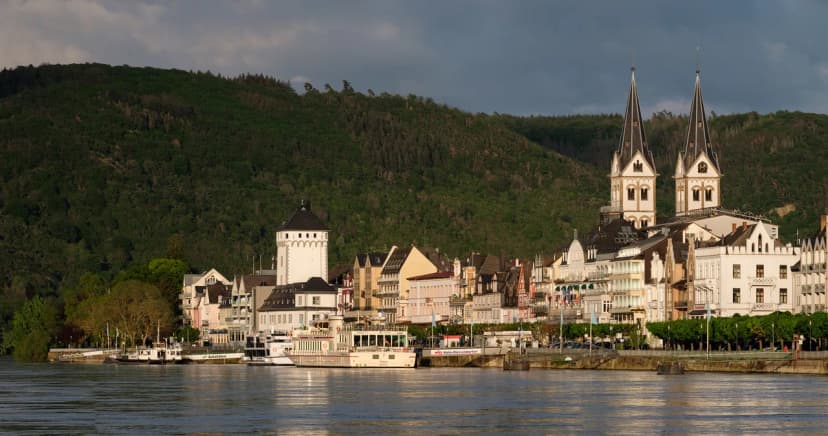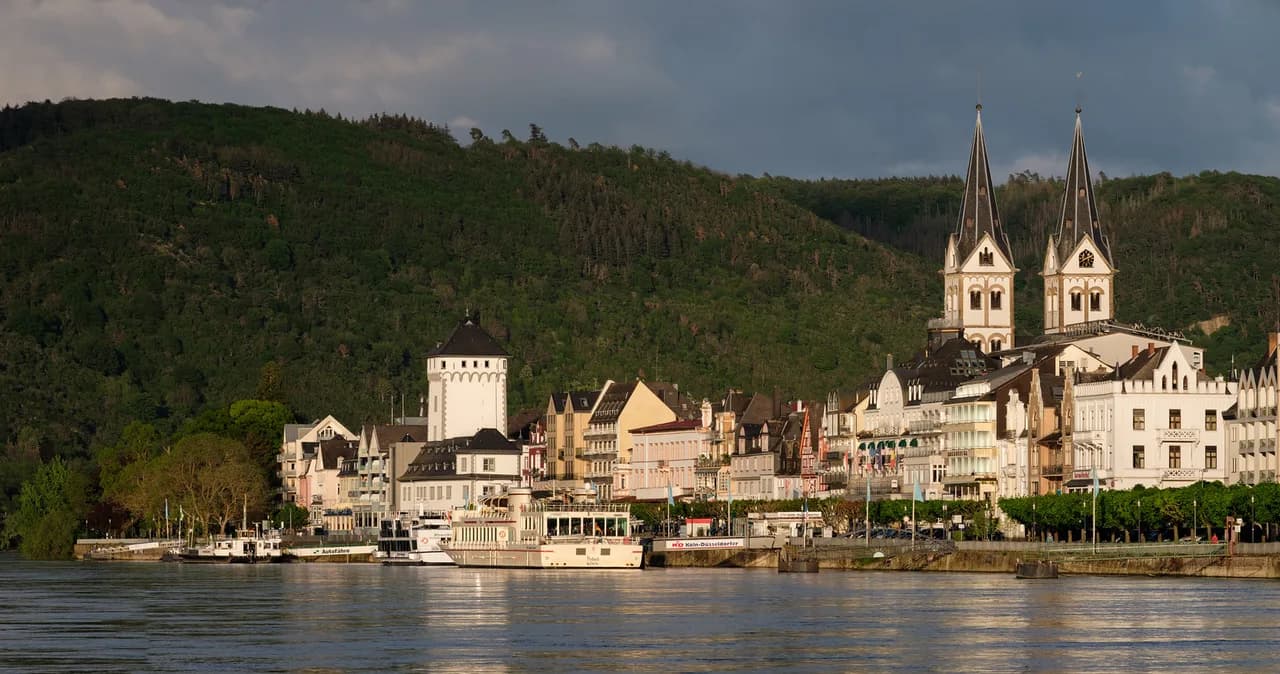
The Rhine Valley works as a day trip from Frankfurt mainly because the region sits inside the same regional transport network as the city, and it rewards travellers who pick one stretch of river rather than trying to sweep the whole gorge. As a planning assumption, allow roughly an hour for the journey to the nearer riverside towns, and a little longer toward Braubach; that figure is an editorial estimate, not an official timetable, so confirm your own connection before you fix the day.
Rail is the backbone of the trip. Regional services run down both banks of the Rhine, and the Rheingau and Mittelrhein towns are connected by the same network that serves Frankfurt, which is why the valley is realistically reachable on a single travel day without a car. Because schedules, platform changes and construction vary by date, treat every travel time in this guide as planning arithmetic and confirm your own connections before you commit to a fixed itinerary.
Why the Rhine Valley Is the Default Day Trip from Frankfurt
Frankfurt sits on the Main in the middle of the Rhine-Main region, which puts vineyard slopes, medieval towns and castle ruins within a comfortable one-direction journey by regional train. The Rhine Valley is the obvious pick precisely because it compresses scenery, food and history into a single corridor rather than scattering them across a long drive. If you are still weighing alternatives, the wider set of day trips from Frankfurt by train includes towns on the Main and the Neckar as well as the Rhine.
The assumption worth challenging is that the valley is one place. It is a corridor of small towns strung along both banks, and the character of the day changes completely depending on whether you stop at Rüdesheim, continue down the gorge to Bacharach, or head north to Braubach. Treat the trip as choosing one anchor town plus one optional second stop, not as a checklist.
Your home base deserves a day of its own. The Frankfurt am Main guide makes a useful complement, since a morning in the old town or on the Mainufer pairs well with an early afternoon departure toward the river.
The Four Routing Decisions That Shape Your Day
First, choose the town cluster: the Rheingau around Rüdesheim and Assmannshausen, the gorge around Bacharach and Oberwesel, or the northern stretch around Braubach and Koblenz. Second, decide whether the boat is a short scenic hop between two towns or the main event, because a long cruise consumes hours you cannot spend on land. Third, fix your rail pass point, meaning the station where you leave the train and join the water, and the one where you rejoin the railway. Fourth, set a return time and work backward from it rather than forward from breakfast.
Rail users should plan with the Rhein-Main-Verkehrsverbund's own tools instead of memorised timetables. The RMV journey planner and travel information pages show current connections, platform details and service notices for the whole network, including the riverside corridors.
One practical constraint worth knowing before you lock a date is that the right-bank rail corridor between Wiesbaden and Koblenz has been undergoing major modernisation work, with passenger restrictions in that section during construction periods. RMV publishes this corridor work as normal operational information, so a two-minute check of current disruptions belongs in your planning rather than in your emergency fund of luck.
Option A: Rüdesheim as a Compact Boat-and-Vineyard Base
Rüdesheim is the easiest first stop to visualise because it sits on the Rhine at the mouth of the Rheingau, with the river on one side and vineyard slopes rising on the other. It gives you a compact town to walk, wine to drink and a choice of ways to get onto the water without committing to a full-day cruise. A one-hour planning figure for the trip from Frankfurt is a reasonable working estimate, but verify your actual connection on the day you travel.
The classic pairing here is a short boat hop across the river to Bingen, which turns a river crossing into the scenic element of the day rather than a separate excursion. Because boat operators publish their own seasonal timetables, pier locations and fare structures, check the operator's own site for your date instead of relying on any figure quoted in a blog post from a previous season.
If you prefer to stay on land, the vineyard terraces above town give you the valley view without a ticket, while the cable car and the town's museums are separately operated and separately ticketed. That distinction matters across the whole valley: free public ground, paid interiors, and two attractions in the same town are rarely covered by one ticket.
Option B: Bacharach for the Rhine Gorge, Castles and Quieter Streets
Bacharach sits in the steep, terraced section of the gorge where castles appear on the ridges and the river narrows, which is the landscape most people picture when they picture the Rhine. The town itself is small enough to walk in an hour, with half-timbered streets, a fortified church and vineyard paths climbing behind the roofs. Swapping Rüdesheim for Bacharach buys you scenery and quiet at the cost of a longer approach and fewer non-wine attractions.
This is the stretch where a boat segment earns its place, because the gorge is best understood from the water rather than from a station platform. The trade-off is scheduling: a cruise in this section runs to the operator's own seasonal timetable, so a boat-and-rail combination works only if you anchor the day around the departure you can actually catch. Confirm departures and boarding points with the operator before you plan the rest of the day around them.
Castles along the gorge vary enormously in what is inside them. Some are ruins you can view from the outside for nothing, some charge for a guided interior, and some are hotels or private property. Check each castle's own visitor information for the day you plan to visit rather than assuming a general admission model applies.
Option C: Braubach and Marksburg for Castle Interiors
If seeing the inside of a castle matters more to you than a long river cruise, Braubach is the more targeted choice. The town sits on the right bank and its main draw is Marksburg, a hilltop castle visited on guided tours rather than at will. Braubach itself is small, with a walkable old town and river frontage, and a travel figure of roughly one to one-and-a-half hours from Frankfurt makes it a plausible half-day or full-day target.
The practical risk here is timing rather than distance. Castle interiors operate to their own tour schedules and last-admission rules, and a missed final tour is the most common way to waste an approach. Check Marksburg's published tour times for your date before you travel, and build in margin for the climb from the station to the castle.
Braubach also works as a quieter counterpoint to the busier Rheingau towns, and it can be paired with a short river segment rather than a long cruise. If you have a second day in the region, the broader Frankfurt three day itinerary: with day trip options is a sensible place to see how a Rhine or Mainz day slots into a longer city stay.
Guided Tour Versus DIY Rail: What You Actually Buy
A guided Rhine Valley tour from Frankfurt typically bundles rail or coach transport, a cruise through the gorge, and often lunch or a wine tasting, which removes almost all of the logistics from your day. What it removes alongside the logistics is choice: the towns you see, the time you spend in each, and the option to abandon the plan when a terrace looks better than the next pier. Operator inclusions and pricing change by season and by provider, so compare what a specific tour actually lists rather than a quoted figure from someone else's trip.
Going independently costs you more planning time and returns flexibility. You choose your anchor town, you decide at the station whether the boat is worth it that day, and you can cut the trip short if the weather turns. The trade is real: DIY means you carry the responsibility for connections, tickets and disruption notices yourself.
The independent route is well documented for the wider region. The Mainz day trip from Frankfurt is a useful rehearsal, since it uses the same network and the same style of planning for a far shorter hop.
How to Read RMV Services and Disruption Notices Before You Commit
Treat the journey planner as the first step, not the last. Enter your actual stations and date, then read the service notices attached to the route, because engineering work along the Rhine corridors can replace a direct train with a bus segment or add a change that a printed timetable would never show. Build your day around the connection you can genuinely make, not the one you remember from a previous trip.
Ticket products and their prices are the other moving target. Network-wide subscription tickets and day passes have their own eligibility rules and change over time, so read the current terms on the network's own ticket pages rather than trusting a figure quoted in a blog post or in this article.
Frankfurt's official tourism site is the better place to confirm what is running in the city itself, including seasonal markets and city tours, if your trip has days either side of the Rhine excursion.
Splitting the Day: Rail One Way, Boat the Other
The pattern that consistently works is to take the train to the far end of your chosen stretch and come back by boat, or the reverse, so you cover the river once instead of twice. Doubling back is the specific failure mode to avoid: a return cruise through the same water burns the hours you wanted for a town, a terrace or a castle interior, and it leaves you watching scenery you have already seen.
A one-way split also solves the boarding problem. You commit to one departure point that suits the rail line and one arrival point that suits your return journey, which means a delayed boat or a missed connection costs you an hour rather than the whole afternoon. Check that both your chosen piers appear in the operator's current timetable before you build the day around them.
Giving the Day Realistic Dimensions
Use the frequently cited one-hour travel figure as a planning assumption rather than a schedule, and then add the time you actually spend standing on platforms, changing trains and walking into town. Blog-based estimates for the region describe trips of roughly one hour from Frankfurt to the Rhine Valley and roughly one to one-and-a-half hours to Braubach, and those figures are useful for sketching a day but are not verified current timings.
On the ground, one anchor town plus one river segment fills a comfortable full day. Two towns plus a cruise plus a castle interior does not fit, and attempting it produces the classic Rhine day: a rushed lunch, a missed tour and a train home in the dark. If your heart is set on both Bacharach and Braubach, split them across two days or accept that you will see one of them properly and the other from a window.
Suggested Shapes for Half a Day, a Full Day and a Slow Full Day
Half day: choose one town only, ideally Rüdesheim or Braubach, travel out early, walk the old town, take a single short river crossing or a viewpoint walk, and return. This shape suits a late arrival from the airport or an evening commitment in Frankfurt, and it removes boat timetables from the equation almost entirely.
Full day: train to Bacharach or Rüdesheim in the morning, one boat segment through the gorge at midday, and a second short town stop before the return train. This is the shape most first-time visitors want, and it works only if the boat departure you need is confirmed for the day you travel.
Slow full day: one town, one castle interior, a long lunch and a single late-afternoon cruise. Choose Braubach with Marksburg if you want interiors, or the Rheingau if you want vineyards and wine. The point of this version is depth, not coverage, and it is the shape that best tolerates a delayed train.
When to Skip the Boat Entirely
Skip the boat when your available window is short, when the cruise season does not match your dates, or when the departure point forces a rail detour that eats the savings in time. Skip it too if your priority is a castle interior, since a guided tour and a cruise usually compete for the same middle hours of the day. In each case the town, the vineyards and the riverbank views remain available on foot at no ticketed cost.
Skip it as well if you are travelling with a tight return connection at Frankfurt, because river services are weather-dependent and less forgiving than trains. The Rhine bridges at Rüdesheim and the riverside paths give you the valley's best angles without committing to a scheduled sailing.
Common Mistakes on a Rhine Valley Day Trip
The first mistake is treating the valley as a single destination and trying to sample it end to end. The second is arriving at midday, which pushes the boat and the castle tour into each other. The third is assuming a castle, cable car or museum will be open and available on arrival; these are separately operated and separately ticketed, so check each one's own published information for your date.
The fourth is ignoring disruption notices until you are on a platform, and the fifth is booking a fixed itinerary before checking whether a route segment is under construction. Both are avoidable with a single pre-departure look at the network's current information and your route's notices.
If you want a wider menu of options before committing to the Rhine, look at the Frankfurt day trips overview, which sets the valley beside the region's other realistic single-day targets.
What to Combine If You Have a Second Day
With two days, pair the Rhine with a shorter, lower-effort outing rather than with a second long rail journey. Mainz sits on the same network and is a compact, walkable alternative that leaves you back in Frankfurt with energy for the evening. If you are building a longer stay, a two-day Frankfurt plan keeps the city content intact while the Rhine fills one full day.
Landmark-focused travellers may prefer to spend the second day in the city itself. The Frankfurt am Main: Landmark Visitor Guides hub collects the individual attraction pages, which is the right level of detail when you want opening information and tickets for one specific place rather than a regional overview.
If your second day is instead the start of a longer city stay, the Frankfurt two day itinerary: museums, old town and Mainufer is a practical frame for keeping the Rhine day separate from the city days.
Plan Your Visit
The Rhine Valley day trip from Frankfurt works when you make one firm decision, choose a town cluster and a boat segment, and let everything else follow from that. Pick Rüdesheim for an easy boat-and-vineyard day, Bacharach for gorge scenery, or Braubach if you would rather stand inside a castle than sail past one. Whichever you choose, set a return time and work backward from it.
Before you travel, check your own connections, ticket terms and current service notices with the operator or network, since schedules, construction and fares are the parts of this trip that change fastest. If you want a calmer first outing or a second day in the region, a Mainz day trip from Frankfurt uses the same planning habits over a much shorter distance.
Frequently Asked Questions
How far is the Rhine Valley from Frankfurt?
Blog-based planning figures put the Rhine Valley roughly an hour from Frankfurt by regional train, with Braubach around one to one-and-a-half hours, but these are visitor estimates rather than verified schedules. Use them to sketch the day, then enter your actual stations and date in the RMV journey planner to see real connections, changes and travel times for your trip.
Can you do the Rhine Valley as a day trip from Frankfurt?
Yes, provided you choose one stretch of river rather than trying to cover the whole valley. One anchor town plus one boat segment fits comfortably into a full day; two towns plus a cruise plus a castle interior does not. Set a return time first, then place the boat departure and the castle tour inside the hours that remain.
Should you take the train or a boat from Frankfurt to the Rhine Valley?
Take the train out and consider the boat for one direction only, so you cover the river once instead of doubling back. Rail is faster and more frequent; river services run to their own seasonal timetables and boarding points. Confirm the operator's current timetable before you build the day around a particular sailing.
Is a guided Rhine Valley tour better than going independently?
A guided tour removes transport, cruise and lunch logistics from your day, which suits first-time visitors and anyone short on planning time. Independent travel returns flexibility over which towns you see, how long you stay and whether you take the boat at all, at the cost of managing connections and tickets yourself. Compare what a specific tour actually includes rather than relying on a quoted figure from an older trip report.
Which Rhine town is best for a first visit?
Rüdesheim is the simplest introduction, with a compact town, vineyards and short river crossings. Bacharach delivers the steep gorge scenery that most people associate with the Rhine. Braubach suits travellers who want to tour a castle interior rather than view one from the water. All three are reachable by regional rail within the same network as Frankfurt.
Can you visit the Rhine Valley without a car?
Yes. Regional trains serve both banks of the Rhine and connect the riverside towns to Frankfurt, with the network's own journey planner covering connections, service notices and disruption information. Boats and castle interiors are separately operated, so check each provider's current timetable or tour times for your date before you commit to a fixed plan.
Is the Rhine Valley worth it if you only have a layover in Frankfurt?
A conventional Rhine day needs more hours than a layover allows once you account for the return to the airport and security. If your window is short, keep the excursion inside the city and use the Main riverbank, the old town and the skyline instead. Save the Rhine for a trip with a full day free and a confirmed morning departure.