As of mid-2026, a full-price ticket to the Archaeological Park of Herculaneum costs €16, with a reduced €2 rate for visitors aged 18–25 from the EU and participating non-EU countries. The park opens at 8:30 a.m. year-round: it stays open until 7:30 p.m. (last entry 6:00 p.m.) from March 16 through October 14, then closes earlier — 5:00 p.m., last entry 3:30 p.m. — for the rest of the year. The only closed days are January 1 and December 25.
Herculaneum sits in the modern town of Ercolano, a short train ride from Naples, and is smaller and easier to see in a half-day than Pompeii — though in places its preservation is even better. This guide covers what a 2026 ticket actually buys, when to go, how long to plan, how to get there from Naples, and the mistakes that trip up first-time visitors.
What Is Herculaneum?
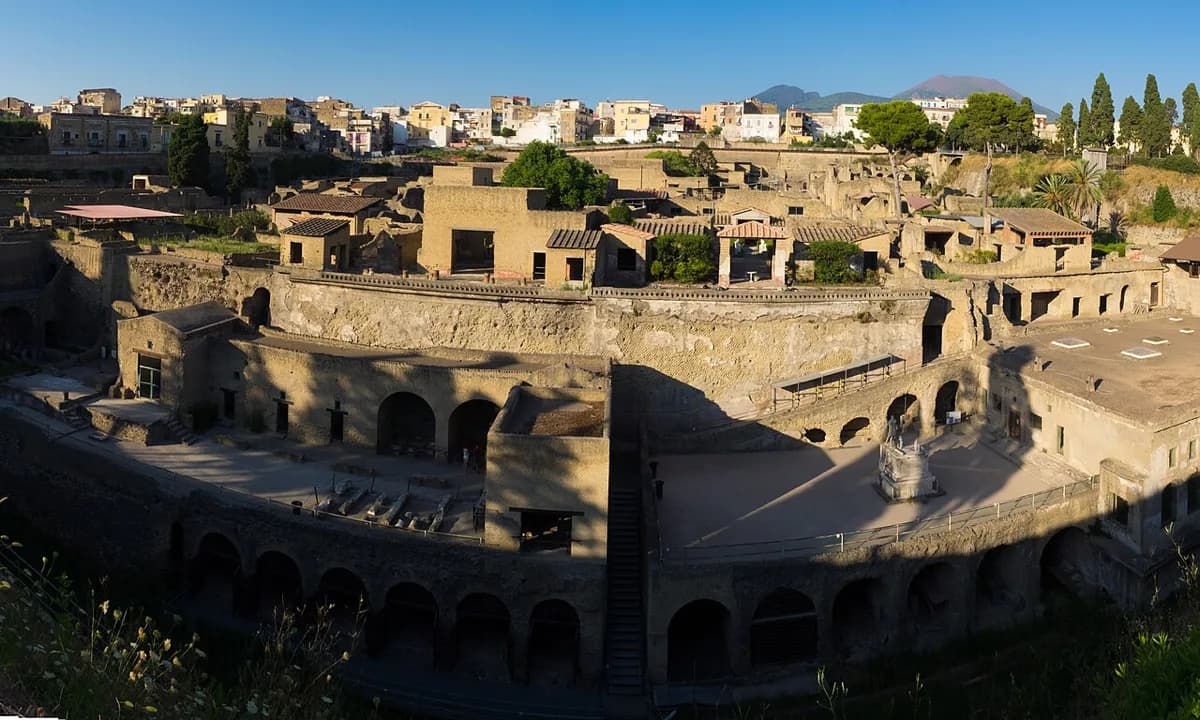
Herculaneum was a prosperous Roman seaside town buried by the same 79 AD eruption of Mount Vesuvius that destroyed Pompeii. The two sites share an origin story but not a burial method: Pompeii was blanketed under a slow, gradual fall of ash and pumice, while Herculaneum was engulfed by fast-moving pyroclastic surges that sealed the town in volcanic material within hours. That sealing effect carbonized rather than incinerated organic material — wooden beams, doors, furniture, even food — leaving a level of domestic preservation that's rare anywhere else in the Roman world.
The town is considerably smaller than Pompeii, which is part of what makes a visit manageable in a couple of hours rather than a full day. Highlights include multi-story houses with intact upper floors, the Villa of the Papyri (the model for the Getty Villa in Los Angeles), and the Antiquarium and Boat Pavilion, where roughly 300 skeletons were found in vaulted boathouses along the ancient shoreline — residents who appear to have sheltered there as the eruption unfolded. The Villa of the Papyri and the Ancient Theatre are currently closed for restoration work, with no reopening date announced as of mid-2026 — check the official site before your visit if either is a priority.
Herculaneum Tickets & Prices 2026
Standard adult admission is €16, with a €2 reduced rate for those aged 18–25 from the EU and participating non-EU countries. Entry is free for EU citizens under 18 and for visitors covered by standard Italian state-museum exemptions (disability access and an accompanying companion, for instance) — the official site lists the full eligibility categories. A combined ticket that adds the "From the Egg to Apples" exhibition costs €19 full price or €4 reduced.
Admission is free on the first Sunday of every month — no advance reservation needed, just collect your ticket at the office on the day — plus on April 25, June 2, and November 4. Tickets can be booked online through the park's official ticketing partner, CoopCulture, or purchased at the entrance. The Campania Artecard, a regional sightseeing pass, also covers entry; details and current bundle pricing are on the official Artecard site rather than at the park itself.
Many of the finest objects recovered from Herculaneum — bronze statues, carbonized papyrus scrolls from the Villa of the Papyri's library, and detailed wall frescoes — aren't at the park itself but on display at the Naples National Archaeological Museum. If the artifacts matter as much to you as the ruins, budget time for both on the same trip.
Opening Hours & Best Time to Visit
From March 16 to October 14, the park is open 8:30 a.m. to 7:30 p.m., with last entry at 6:00 p.m. From October 15 to March 15, hours shrink to 8:30 a.m.–5:00 p.m., with last entry at 3:30 p.m. The park closes only on January 1 and December 25.
Arrive right at the 8:30 a.m. opening for the calmest visit — the site is noticeably quieter in the first hour. Peak crowding runs from about 10:30 a.m. to 2:00 p.m., when coach tour groups from Naples and the Amalfi Coast arrive in waves. Counterintuitively, the free first Sunday of the month is not a good time to aim for a peaceful visit — local turnout rises sharply, and lines can be longer than on a paid weekday.
How Long to Plan for Your Visit
Most visitors need 2 to 3 hours to see the main streets, the decorated houses, the baths, and the Boat Pavilion along the ancient shoreline without rushing. A highlights-only visit — a handful of the best-preserved houses plus the shoreline — can be done in about 90 minutes if time is tight. Add extra time if you're pairing the visit with a trip to the Naples National Archaeological Museum to see the objects recovered from the site, since that alone is worth another 1.5 to 2 hours.
How to Get to Herculaneum
From central Naples, the easiest route is the Circumvesuviana or Campania Express train on the Naples–Sorrento line to the Ercolano Scavi station — a ride of around 18 minutes. From the station, it's a walk downhill to the park entrance on Corso Resina; allow roughly 10 to 15 minutes, more if you're carrying luggage or the day is hot, since there's little shade along the route. A taxi or rideshare direct to the park entrance is a reasonable alternative if you're traveling during the midday heat or prefer not to navigate the station.
Herculaneum works well as a standalone half-day trip or as one stop on a fuller day exploring the Bay of Naples. If you're mapping out which sites to combine and in what order, our guide to day trips from Naples lays out sensible pairings and routing.
Visit Tips: Queues, Booking & Mistakes
Herculaneum rarely sees the queues that build up at Pompeii's main gate, so advance booking is more about convenience than necessity — though booking online through CoopCulture still guarantees your ticket and skips the ticket-office line at busy times, particularly in summer. Bring water and wear proper walking shoes; the ancient streets are uneven, and much of the site has little shade.
The most common mistake is turning back before reaching the ancient shoreline. Many visitors treat the main streets and houses as the whole visit and skip the walk down to the Boat Pavilion — arguably the emotional core of the site, where the boathouse skeletons are displayed close to where they were found. Give yourself the extra 15–20 minutes to see it. If you're building a single day around Naples' ancient sites, our one-day Naples itinerary shows how to sequence a museum visit against a half-day out at Herculaneum without feeling rushed.
Nearby Attractions
Herculaneum is most often paired with Pompeii — larger and more famous, but Herculaneum's compact scale and superior preservation make the two genuinely complementary rather than repetitive if you have time for both. Back in Naples, the National Archaeological Museum houses the finest objects recovered from the site, and the Sansevero Chapel and its Veiled Christ is a short, worthwhile detour if you're spending the rest of the day in the historic center.
For the wider set of sights across the city, see our Naples attractions hub.
Frequently Asked Questions
How much are Herculaneum tickets in 2026?
Full-price admission is €16, with a €2 reduced rate for 18–25 year-olds from the EU and participating non-EU countries. A combined ticket that adds the "From the Egg to Apples" exhibition is €19 full price or €4 reduced. Entry is free on the first Sunday of every month, plus April 25, June 2, and November 4.
Is Herculaneum better than Pompeii?
Neither replaces the other. Pompeii is far larger and gives a stronger sense of a full Roman city, while Herculaneum is smaller but better preserved in places, with intact upper floors, carbonized wood, and the boathouse skeletons at the ancient shoreline. If you only have time for one, Pompeii offers more scale; Herculaneum rewards a slower, closer look and fits more easily into a half-day.
How long does it take to visit Herculaneum?
Plan for 2 to 3 hours to see the main streets, houses, baths, and the Boat Pavilion without rushing. A highlights-only visit can be done in about 90 minutes. Add time if you're also visiting the Naples National Archaeological Museum, where many of the site's finest artifacts are displayed.
Can I visit Herculaneum and Pompeii in the same day?
Yes, though it makes for a long day. Herculaneum takes 2 to 3 hours and Pompeii typically needs 3 to 4 hours, plus train time between them on the Circumvesuviana line. Visiting Herculaneum in the morning and Pompeii in the afternoon is the more common order, since Herculaneum is the quicker of the two stops.
Is Herculaneum ever free to visit?
Yes. Admission is free on the first Sunday of every month, without needing to book in advance — just collect your ticket at the office on the day. It's also free on April 25, June 2, and November 4. Note that the free first Sunday draws heavier local crowds, so it isn't the best choice if you're hoping for a quiet visit.
Herculaneum earns its place on a Naples itinerary on preservation alone — carbonized wood, intact upper floors, and the boathouse skeletons at the ancient shoreline aren't things you see at most Roman sites, including Pompeii. At €16 for a 2- to 3-hour visit, it's also one of the better-value stops in the Bay of Naples.
Go early, budget the extra 15 minutes to reach the shoreline instead of turning back at the main streets, and check the official site before you travel in case the Villa of the Papyri restoration has wrapped up. Whether you pair it with Pompeii, the Naples National Archaeological Museum, or treat it as a standalone half-day, Herculaneum holds up as one of the more efficient uses of a few hours near Naples in 2026.
For the latest official information, see the official Herculaneum ticket page and the Archaeological Park of Herculaneum official site.