
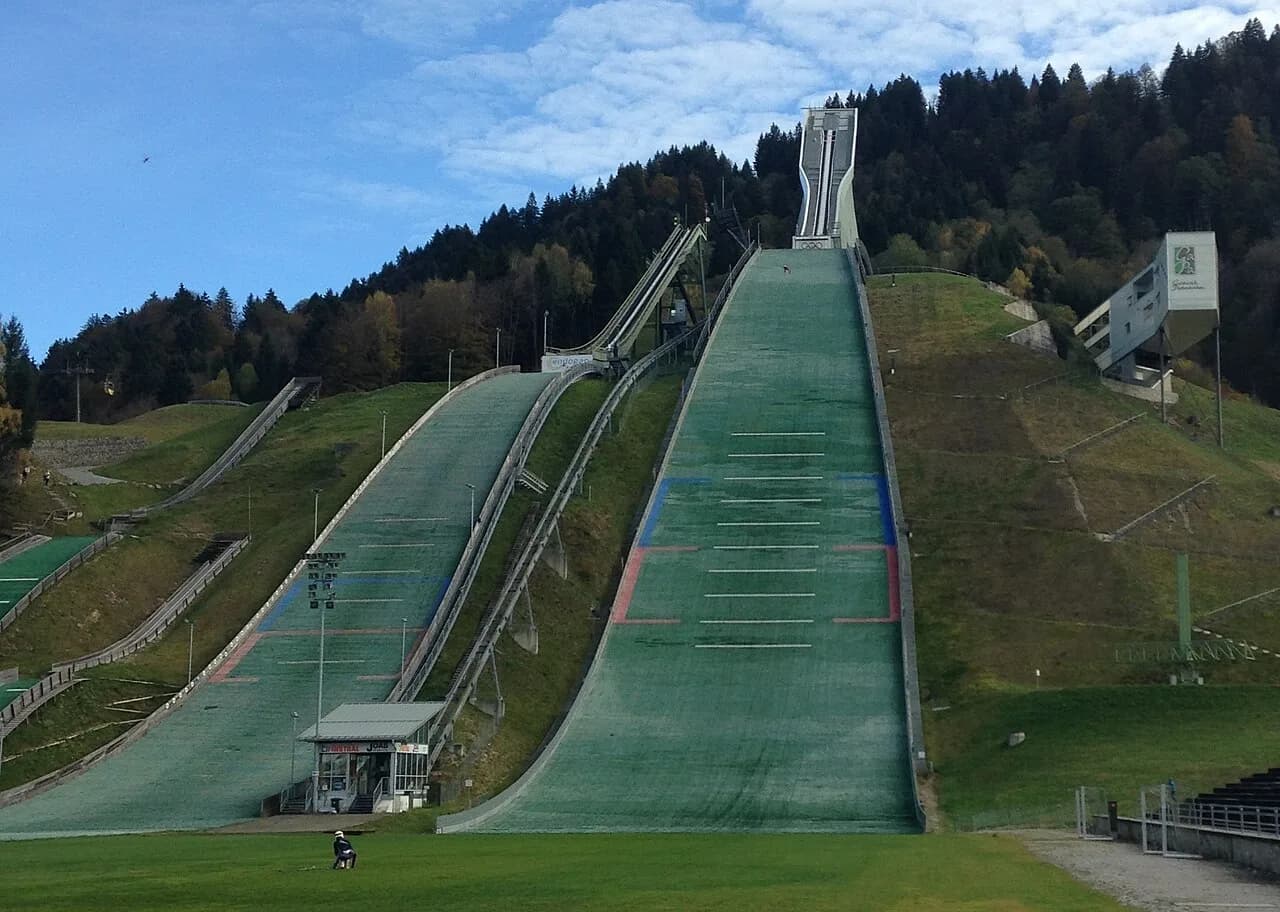
The Olympia-Skisprungschanze in Garmisch-Partenkirchen is the ski jumping complex built for the 1936 Winter Olympics and still in use as a jumping venue. The Ski Jumping Hill Archive lists five jumps for the location, including the Große Olympiaschanze with hill size 142 and a calculation point of 145.5 metres, so the site is really a cluster of hills above the valley floor rather than a single towering structure.
As a suggested stop rather than an official timing, the stadium bowl and the view up to the take-off tower are worth about twenty to thirty minutes if you are passing through on the way to the Partnachklamm. The gorge walk lies in the same valley corner beyond the Olympic stadium, so the two stops fit naturally into one outing. Before setting out, check the GaPa Tourismus livecam at the Olympiaschanze for current conditions.
What the Olympia-Skisprungschanze Actually Is
The site is not one hill but a group of jumps. The Ski Jumping Hill Archive lists the Große Olympiaschanze at HS 142 with R 145.5 m, the Mittlere Olympiaschanze at HS 89 with R 89.0 m, the Kochelbergschanze with a K point of 60, the Kleine Olympiaschanzen at HS 47 with R 46.0 m, and the Hausbergschanze with a K point of 40. That matters on the ground, because the smaller jumps sit near the main hill, and visitors who expect a single giant structure can miss what is a layered ski jumping complex.
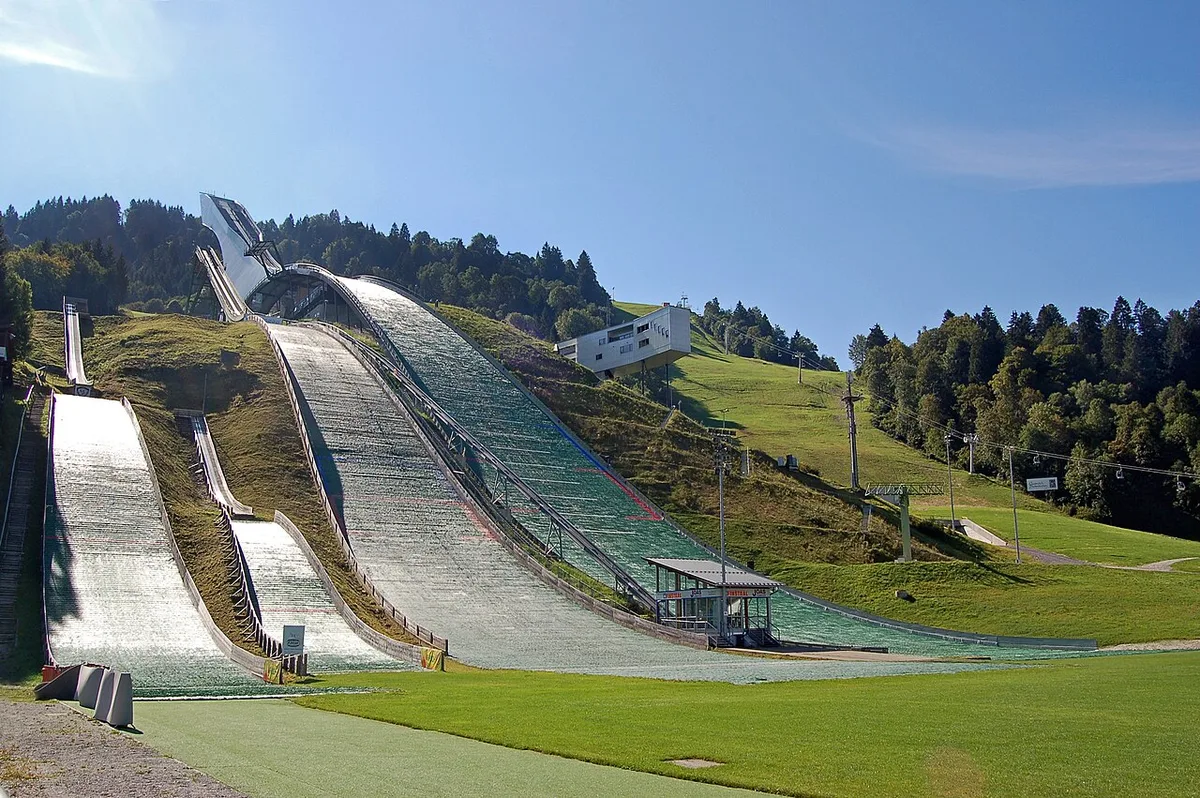
The hill carries a historic name, but the apparatus has been rebuilt and upgraded over the decades. The archive records that the Olympiaschanze has matting, which allows jumping outside the snow season. The result is a venue that works both as an Olympic heritage stop and as a working sports facility, which is why the atmosphere changes with the calendar rather than staying fixed.
Hill Sizes and Names Explained
Hill size, written HS, is the modern measure used in ski jumping, while the calculation point, or R, is the older mark tied to the steepest part of the landing slope. The archive gives the Große Olympiaschanze an HS of 142 and an R of 145.5 m, the Mittlere an HS of 89, and the Kleine Olympiaschanzen an HS of 47. When coverage refers to the Garmisch hill, it is almost always the big one described by those figures.
What You Can See on a Casual Visit
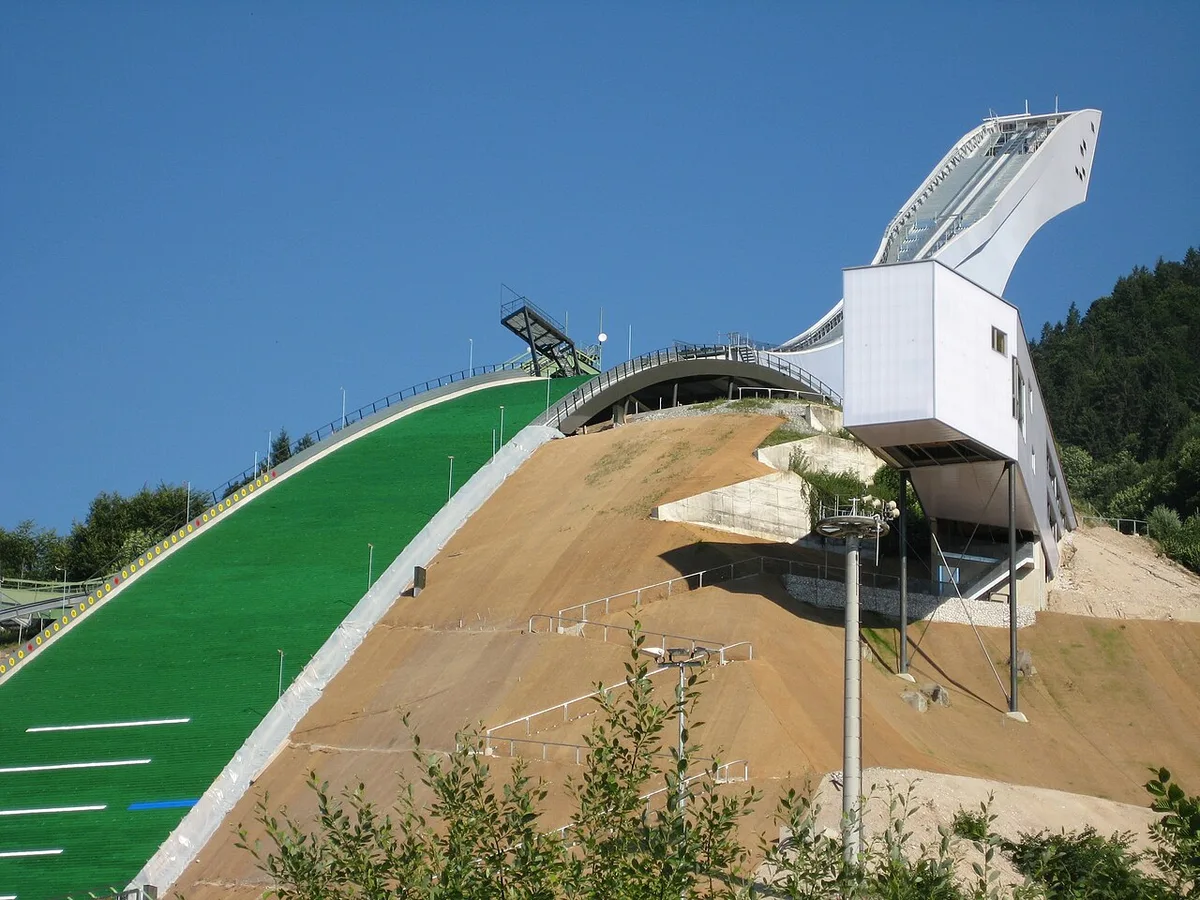
From the stadium level the inrun tower rises above the bowl, and the outrun falls away toward the valley. The scale only becomes clear from below, which is one reason the site works as a short stop rather than a full-day attraction. The open ground and the view of the apparatus are the reliable part of a visit; anything beyond that, such as a lift, an interior display, or a stadium restaurant, should be confirmed with the operator before you travel.
Public events and other uses take place at the stadium through the year, so it is not a museum case. If you are planning around a competition, check the official event website rather than assuming a date or ticket arrangement. For the everyday visitor, the stadium bowl, the tower and the mountain backdrop are the main draws.
The Route to the Partnachklamm and the Stadium Corner
The jump sits just outside the town centre, and the approach to the Partnachklamm passes the stadium area. TripTins notes that visitors heading to the Partnach Gorge pass right by the Olympic ski jump area on the way. The gorge itself is a narrow boardwalk cut into the rock above the Partnach river, and it is one of the area's most popular short outings.
Because the gorge route is linear, the simplest sequence is stadium first and gorge second, with a return along the same path or a longer loop if you have time. The Partnachklamm Visitor Guide is the right place to check current conditions before committing, since boardwalk routes can close after heavy rain or snow-melt.
The 1936 Olympic Story Behind the Name
The 1936 Winter Olympics gave Garmisch-Partenkirchen its Olympic identity and the hill its name. TripTins records that the towns of Garmisch and Partenkirchen were combined into one municipality so the area could host the 1936 Winter Games. The Games were notable for including alpine skiing for the first time, but for a visitor the point is simpler: the ski jump is one of the visible pieces of that period that still functions as a sports venue.
Because the hill has been rebuilt since the 1930s, the Olympic connection is carried by the site and the name more than by original fabric. That framing keeps expectations reasonable: this is a working ski jumping hill with a historic identity, not a preserved 1936 set piece.
Getting Your Bearings in the Valley
Garmisch-Partenkirchen sits among the Wetterstein Alps, the Bavarian Pre-Alps and the Ammergau Alps, with the Zugspitze rising in the Wetterstein range. The ski stadium and the hills sit above the built-up area on the eastern side of the valley, below the walking routes. Once you know you are heading for the Olympia Skistadion rather than the shopping streets, the approach is straightforward from the town side.
GaPa Tourismus runs a livecam at the Olympiaschanze at the Olympia Skistadion, along with webcams at the Kongresshaus and the Rathaus. Checking the ski jump webcam before you leave is a practical way to judge cloud, snow and visibility, since the hill and the gorge sit in the same valley corner. GaPa Tourismus is the local tourist board, so its visitor guidance is the appropriate place to confirm anything the hill archive does not cover.
How Long to Spend, as a Suggestion Only
As a rough suggestion rather than an official figure, a look at the stadium and the jump from below takes about twenty to thirty minutes. Pairing the jump with the Partnachklamm and the walk back puts you closer to a half day once you allow for the gorge and the return leg. These are planning shapes, not official timings, and they lengthen quickly with photo stops, children or a break.
Seasons, Surfaces and Event Days
Matting on the Olympiaschanze means the hill can operate without snow cover, and the surrounding slopes turn into a snow sports area in winter. In the colder months the stadium becomes the setting for competition and public events, while in summer the same ground is a quiet viewpoint stop. If your interest is atmosphere rather than architecture, winter is when the venue feels most alive, but paths can be icy and daylight is short.
The New Year's ski jumping competition at this hill is a long-running fixture, but dates and ticket details change year to year. Check the official event website for the next edition rather than assuming tickets are on sale for a date you have not verified.
Where the Ski Jump Fits in a Wider Garmisch Trip
The Olympia Skistadion, the Eckbauerbahn and the Partnachklamm all sit in the same valley corner, so a single outing can cover Olympic heritage and a gorge walk without crossing town. Alternatively, the AlpspiX viewing platform at Osterfelderkopf and the Zugspitze summit give contrasting high-altitude views on clear days, and the town's Lüftlmalerei murals and the Michael-Ende-Kurpark fill a quieter afternoon. For a wider spread of vantage points, the Garmisch-Partenkirchen Viewpoints Guide is a useful companion piece.
Use Garmisch-Partenkirchen: Landmark Visitor Guides when you are deciding how to split your time, and Garmisch-Partenkirchen: Itineraries and City Travel Guides when you want a structured day. Both help you judge whether the jump is a short add-on or the anchor of a morning.
Practical Framing: Treat It as a Viewpoint Stop
The jump is best understood as a viewpoint and heritage stop rather than a headline attraction with a full programme. That framing avoids disappointment if the hill is quiet or the interior is closed, and it lets you fold the stop into a walk without planning your whole day around it. Take in the view from the bowl, read any interpretive panels you find, and move on to the gorge or back into town.
Plan Your Visit
The Olympia-Skisprungschanze works as an easy stop in Garmisch-Partenkirchen because it does not demand a whole day. Walk up to the stadium, look at the hill from below, and use the same outing to reach the Partnachklamm. Check the operator webcam, the event website and the local tourist board pages before you set off, since admission and detailed access arrangements are not set out in the sources consulted for this guide.
If your plans lean toward longer walks or mountains, save the jump for a short morning and spend the rest of the day on valley trails, at the Eckbauerbahn, or on a higher viewpoint.
Frequently Asked Questions
Can you visit the Olympia-Skisprungschanze without a ticket?
The stadium and the hill can be viewed from the surrounding open ground, which is the reliable part of a visit. The operator and tourist board publish guidance on current conditions, but the sources consulted for this guide do not set out an admission price, opening hours or visitor-centre access. Anything beyond looking at the stadium from outside should be confirmed with the operator before you travel.
Is the ski jump on the way to the Partnachklamm?
Yes. The Olympic ski jump area is passed on the way to the Partnach Gorge when you approach from the town side, so the two stops belong in one outing. The gorge walk is linear, so the natural sequence is stadium first and gorge second, with a return along the same path or a longer loop if you have the time.
How long should you spend at the Olympic ski jump?
As a suggested stop rather than an official timing, allow about twenty to thirty minutes for the stadium and the view up to the hill. If you combine the jump with the Partnachklamm and the walk back, plan closer to a half day. These are planning shapes, not published timings, and they lengthen with photo stops or a break.


