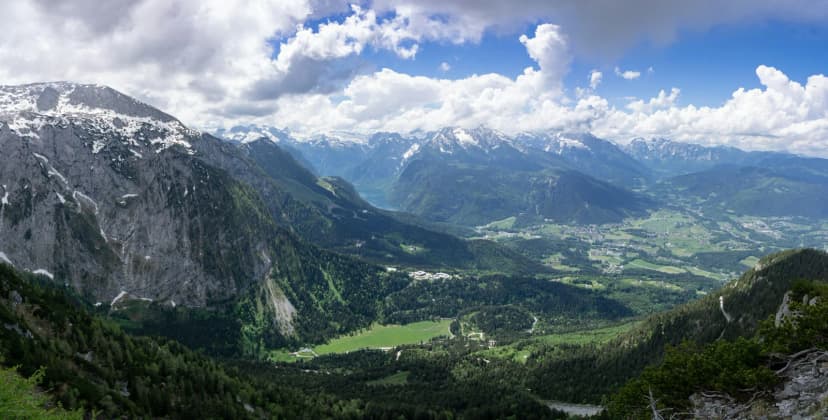
The Kehlsteinhaus, widely known in English as the Eagle's Nest, sits at 1,834 m on a rocky ridge above Berchtesgaden. The operator states that the building was completed in 1938 and was not a birthday gift to Hitler, contradicting a claim repeated by some tour operators. It has served as a mountain restaurant since 1952, and the operator asks visitors to plan around two hours for the visit including the bus journey up and back.
Nearly everything about a visit follows from one constraint: the Kehlsteinstrasse is closed to private traffic, so the ascent runs through the Kehlsteinlinie bus 849 from the Obersalzberg car park at Salzbergstrasse 45. Buses reach a turning plate below the summit, where a 124 m tunnel and a brass-clad lift carry you the remaining height into the building. Walking up is possible on marked routes, but the tourism board lists the route from the Dokumentation Obersalzberg at about five and a half hours, so it is a serious mountain outing rather than a substitute for the bus on a tight schedule.
This guide covers the bus and lift, what the ticket includes, the weather-dependent season, a realistic time budget and the limits of accessibility. Volatile details such as fares, first and last departures and exact opening dates change, so confirm them with the operator and the Berchtesgaden tourism board before you travel rather than relying on figures from an older article.
What the Kehlsteinhaus Is Today
The building functions as a Berggaststaette, a staffed mountain restaurant, with a sun terrace and a panoramic outlook toward the Berchtesgaden mountains and the Salzburg basin. The operator states that guided tours are not permitted in the area of the mountain restaurant, so the visit is self-directed: you walk through the rooms open to guests, step out onto the terrace and take in the view. That framing matters, because anyone expecting a museum-style circuit will find a social, working restaurant instead.
A terrace exhibition uses 14 information panels with historical photographs to trace the mountain's story, from the transformation of the Obersalzberg into a restricted zone through the 1937-38 construction of the road and house to its post-1945 tourist use. The operator is explicit that this display is not a short version of the Dokumentation Obersalzberg, but a prompt to visit the main museum on the mountainside. Treat it as an orientation rather than the substance of the history.
To go deeper, build the day around the Dokumentation Obersalzberg, whose permanent exhibition presents around 350 objects, documents and photographs, with the historic bunker complex as its largest exhibit. The operator notes that admission to that documentation site is included in the bus ticket, which is a strong argument for pairing the two in one trip. Start at the museum for context, then ride up to the summit; doing it in reverse tends to leave the exhibition feeling like an afterthought.
Why You Cannot Drive Yourself
The Kehlsteinstrasse is closed to public traffic as well as to cyclists and pedestrians, so the only motorised access is the special Kehlsteinlinie bus, line 849, which departs from the Obersalzberg car park at Salzbergstrasse 45. If you are coming from Berchtesgaden town, take RVO bus 838 from the train and bus station up to the Obersalzberg, then change to the 849. Drivers park at the paid car parks at the departure point and leave the car there for the duration.
The tourism board states that the bus fleet on the mountain has been electric since June 2023, when eight e-buses with 41 seats each took over the route. That detail is worth knowing if you are sensitive to diesel fumes on a steep, winding climb, and it also means the vehicles are modern low-floor buses. Because the road is the only way up by vehicle, any closure of the line closes the summit for everyone without a hiking plan.
Arriving by public transport from Salzburg is feasible: bus 840 runs from the city to Berchtesgaden's train and bus station, where you switch to the 838 toward the Dokumentation Obersalzberg stop. The bus departure point sits across the street from that stop, under the blue and white flags, according to a tour operator's arrival instructions. Allow generous buffer time, because missing your slot at the departure point means waiting for space on a later bus.
Tickets: What the Bus and Lift Fare Covers
The single fare for the Kehlsteinlinie covers the bus ride up and down and the lift into the building; there is no separate entrance fee for the Kehlsteinhaus. That is the key distinction to hold on to, because third-party tours are a different product with their own inclusions and prices rather than a reflection of official admission. If a seller implies that the house charges extra entry on top of the bus, the operator's own FAQ contradicts that.
Cash-free payment is possible at the ticket desk at the departure point, where Girocard and major credit cards such as Mastercard and Visa are accepted alongside cash. Buying the online ticket in advance spares you the queue at the desk, which matters most on Saturdays, when the line is at its busiest. Seasonal fares and any guest-card reductions are published by the operator and the tourism board, so confirm the current figure there rather than relying on a cached number.
Individual travellers do not need to register in advance and can buy at the desk, but groups of 20 paying people or more qualify for a group rate and must be registered at least two weeks ahead by phone or email so the whole party can board one bus. Larger parties above roughly 42 people are split across several buses that normally depart together. A guided tour sold by an outside operator bundles transport, guiding and sometimes other stops, so compare what is inside the price before judging it against the plain bus fare; one Salzburg operator, for instance, advertises tour prices that are separate from official admission.
Step by Step at the Summit
The bus ends at the turning plate on the plateau below the house, 124 m under the summit building. From there you walk into the 124 m tunnel bored through the rock, which is paved and leads to the lift. The brass-clad lift rises directly into the interior of the Kehlsteinhaus, so you arrive inside the building rather than at its front door.
If you would rather skip the lift, walk a short way back along the service road and take the narrow path branching up to the left; sturdy footwear is advised and temporary path closures can apply. Once inside, the rooms, restaurant and terrace connect on foot, and a few steps are needed to reach the large chimney room. For most visitors the whole sequence from bus to terrace takes only a few minutes, which is why the two-hour figure is realistic rather than optimistic.
How Long to Allow, and the Fixed Return Time
The operator asks visitors to plan about two hours for the visit including the journey up and back, which is a planning figure rather than a rule enforced at the gate. The important mechanical detail is that the return trip is automatically booked for two hours after your ascent and printed on the ticket. If the weather turns or you simply want longer on the terrace, the return time can be rebooked at the terminal in the Kehlsteinhaus or at the turning plate.
That automatic slot is the reason a short visit can feel rushed and a long one can feel stuck, so decide before boarding whether you want a quick panorama or a slow lunch. Guided group tours often include around an hour of free time at the building, and guides can help adjust return tickets on the day. If photography and the restaurant both matter to you, aim for longer than two hours and rebook upward at the terminal.
If you plan to combine the summit with other stops, treat the Kehlsteinhaus as a half-day anchor rather than a two-hour errand. A one day in Berchtesgaden itinerary that attempts the Eagle's Nest, a lake cruise and a salt mine on the same day tends to collapse at the first weather delay. Put the mountain first, then add lower-altitude options only if time and conditions allow.
Season, Weather Closures and How to Check
The Kehlsteinsaison is weather-dependent: the tourism board states that it typically starts in early to mid-May and ends in late October or early November, and the exact opening date is not fixed until around mid-April, once conditions on the road are clear. A tour operator states that the official closing date is always October 31, but also notes that the mountain can be forced to close earlier by weather. Rather than trusting any single date, verify the season status close to your travel day.
Unpredictable events such as heavy snowfall, rockfall or storms can shut the bus line and the house at short notice even in summer, and the tourism board says it posts current-day information on its channels when that happens. The operator's own Webcam page lets you see conditions at the summit before you commit to the drive. During a closure, the Obersalzberg documentation remains the sensible fallback and keeps the historical part of the day intact.
Bad weather does not automatically cancel a visit: rain, cloud, cold or heat will not stop the buses, and a tour operator notes that only heavy snowfall on the peak can make shuttle operation unsafe. Cloud can, however, erase the panorama that most people come for, so check the live camera and decide whether a summit trip still earns its slot in your day. Many travellers find a misty terrace atmospheric; others should redirect the hours to the museum or a valley walk.
What You See at the Top
The terrace opens onto a wide panorama over the Berchtesgadener Land, with the Koenigssee visible in the distance on clear days. The restaurant and terrace let you sit with the view rather than photograph and leave. The summit cross stands a few minutes' walk above the building, and from it the Kehlstein Rundweg begins, a short loop with the tourism board listing it at 1.6 km and 108 m of ascent that gives close-up views of the rocky Hoher Goell landscape.
The exhibition panels on the sun terrace frame the view historically, moving from the mountain's role as part of the restricted Fuehrersperrgebiet through the road and house construction in 1937 and 1938 to its tourist reuse after 1945. Because the displays are outdoors and compact, they fit naturally into a terrace stop rather than demanding a separate room. Read them before you settle at a table; the narrative lands better before the view seduces you.
Eating at 1,834 Metres
The restaurant serves mountain fare and cakes, and the tourism board promotes breakfast at the summit as a way to start the day at eye level with the peaks. Menus are published by the house each season, so check the current offering rather than assuming a specific dish or service window. Because the building is a working restaurant rather than a museum, food and drink are the practical way to slow a short visit down.
Seating on the terrace fills quickly when a bus load arrives, so early ascents give you a better chance at a table with the view. Dogs are permitted on the buses and in the building, including the restaurant, but the tourism board asks that they wear a muzzle. Accessibility inside the restaurant, and on parts of the garden terrace, is described as step-free, though a companion is recommended.
Accessibility: What Works and Where It Stops
Access is partially step-free: low-floor buses with designated wheelchair spaces run the restricted road, and the tunnel from the bus turning plate to the lift is paved and can be used with a wheelchair. Designated accessible toilets are available at the RVO bus stops at Hintereck and the Kehlsteinhaus car park, and at the restaurant. That chain works only if the bus line is running, so a weather closure removes the accessible route entirely.
Two limits are worth planning around: a few steps must be negotiated to enter the large chimney room, and the summit cross cannot be reached with a wheelchair, according to the operator. The restaurant and parts of the garden terrace are accessible, and the operator advises visiting with a companion. If the summit cross or the full interior circuit is essential to you, plan the trip as a partial rather than a fully accessible visit.
Walking Up Instead of Riding
Walkers can approach the mountain on foot from the Obersalzberg or from Ofnerboden on the Rossfeld panoramic road, following a marked trail through the forest to a road closed to public traffic. The route bends through a cirque between the Kehlriedel and the Hochfeld on the north side of the Kehlstein, and the signed alpine trail 40 finishes at the bus turning plate 124 m below the house. From there the paved path switchbacks up to the summit; beyond the building the Kehlstein Rundweg continues.
The tourism board lists the walk from the Dokumentation Obersalzberg at around five and a half hours over roughly 15 km with 859 m of ascent, and the route from the Dalsenwinklstrasse side at about four hours. Those are substantial mountain days, so carry water, check the weather and start early; a late start plus a long ascent is the usual way people end up on the last bus down. Walkers must also respect the road closure, which applies to pedestrians and cyclists on the Kehlsteinstrasse itself.
Nearby Attractions Worth Pairing
The Koenigssee, the Jenner and the Salzbergwerk are the classic add-ons in the valley, and each offers something the summit cannot: a boat trip into a glacial lake, a cable car to a different panorama, and a working salt mine with underground slides. Anyone building a Berchtesgaden itinerary around the Eagle's Nest should pick one of these, not all three, because each consumes at least half a day on its own. The Jennerbahn cable car and summit guide is a useful reference if a second high viewpoint appeals.
For a gentler counterpoint on the same day or the next, the Hintersee and Ramsau Zauberwald guide covers an easy lake-and-forest walk in the Ramsau valley, well below the altitude where weather closures bite. It pairs neatly with a morning on the Obersalzberg, and the terrain is far more forgiving than a summit trail. If your trip hinges on the Kehlsteinhaus, keep the Ramsau walk as the flexible option for a day when the bus line stops.
Practical Decisions for the Day
Take the first buses of the morning if you can: the tourism board itself recommends it, and the summit is calmer before the mid-morning wave arrives. Buy the online ticket to bypass the desk, but keep in mind that the return time is fixed at ascent plus two hours unless you rebook, so a spontaneous long lunch needs a stop at the terminal. Saturdays see the heaviest load on the Kehlsteinlinie, which makes an early weekday start the better trade if your schedule allows it.
The historical context is best assembled in two parts: the museum on the Obersalzberg, which is included in the bus ticket, and the terrace exhibition at the summit, which points back to it. Budget more time below than you first expect, because the documentation's objects and bunker take longer than the panels upstairs. For visitors combining town and mountain logistics, the Berchtesgaden city travel guides cover transport and multi-day sequencing in more depth.
Finally, decide in advance what would make you cancel: heavy snowfall that stops the shuttle, a cloud base sitting on the ridge, or a bus line down for rockfall. Having a substitute plan, whether the museum, the Ramsau valley or the salt mine, turns a weather closure from a wasted day into a slightly different one. Check the live camera and the operator's channels on the morning itself, since conditions on the mountain can differ sharply from the valley.
Plan Your Kehlsteinhaus Visit
The Kehlsteinhaus rewards planning more than most mountain viewpoints because the access chain is fixed: bus from Salzbergstrasse 45, tunnel, lift, and a return time printed two hours after you ascend. Confirm the season window, current fares and departure details with the operator or the Berchtesgaden tourism board before you travel, since the mountain closes on short notice for weather and the season shifts each year. Building the day around the Dokumentation Obersalzberg as well turns a scenic outing into a more complete historical visit.
Frequently Asked Questions
Do I need a separate entrance ticket for the Kehlsteinhaus?
No. The bus fare covers the ride up and down as well as the lift, and there is no separate charge to enter the building itself. Admission to the Dokumentation Obersalzberg is also included in the bus ticket, which makes pairing the museum with the summit a sensible plan. Guided tours sold by outside operators are separate products with their own inclusions, so compare what is in the price before booking one.
How long should I plan for a Kehlsteinhaus visit?
The operator asks visitors to allow about two hours including the trip up and back, which is guidance rather than a fixed rule. Your return trip is automatically reserved for two hours after your ascent and shown on the ticket, and it can be changed at the rebooking terminal in the house or at the bus turning plate. If you want a meal on the terrace plus a walk to the summit cross, plan for longer and rebook upward.
Can I walk up to the Kehlsteinhaus instead of taking the bus?
Yes, but it is a proper mountain walk. Marked routes start from the Obersalzberg and from Ofnerboden, joining a forest road closed to public traffic and finishing at the bus turning plate below the house. The tourism board lists the ascent from the Dokumentation Obersalzberg at roughly five and a half hours, so carry water, check conditions and start early. The Kehlsteinstrasse itself is closed to pedestrians and cyclists.
Is the Kehlsteinhaus worth visiting in bad weather?
Rain, cloud, cold or heat will not stop the buses; only heavy snowfall that makes shuttle operation unsafe closes the summit. Cloud can hide the panorama entirely, which is the main reason most people go, so check the live webcam before committing. If the view is the priority, redirect the day to the Obersalzberg documentation or a valley walk and keep the mountain for clearer conditions.
When is the Kehlsteinhaus open?
The season depends on the weather and usually runs from early or mid-May to late October or early November, with the exact opening date often not settled until around mid-April. Storms, snowfall or rockfall can suspend the bus line, and therefore the house, at short notice even in summer. The operator and the Berchtesgaden tourism board publish current-day status and webcam views, so check those rather than relying on a fixed date.