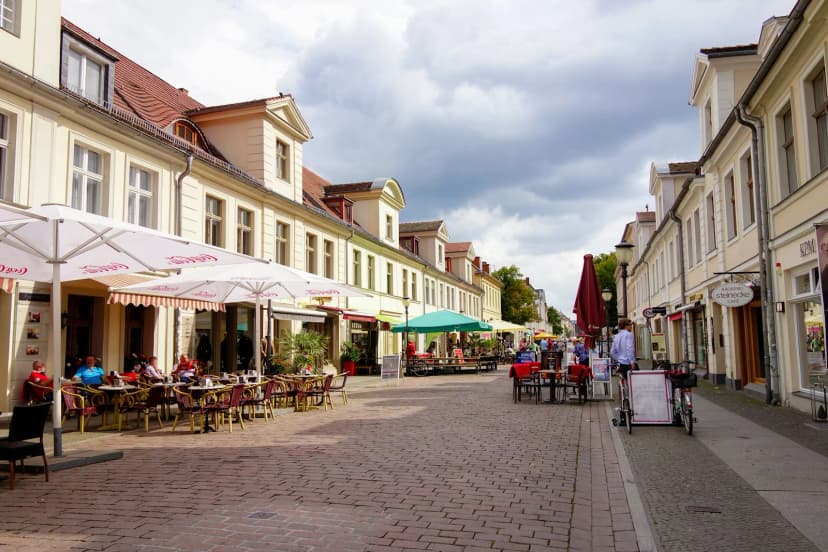
Potsdam packs palaces, gardens, water and playgrounds into a compact city a short ride from Berlin, which is exactly why it suits families better than a single big sight. The one planning rule worth memorising before anything else is that the park grounds and the palaces standing inside them are separate propositions, so "free park" never means "free palace". Decide in advance whether any interior is worth the ticket and the time slot, because that single choice shapes the whole day.
The gardens and palaces of Potsdam have held UNESCO World Heritage status since 1990, and the city counts eighteen palaces visitors can explore on foot, by bike or from the water. That scale is a warning as much as an invitation: three small stops usually beat one ambitious palace marathon with tired legs in tow.
Free Grounds, Ticketed Interiors: The Rule That Shapes Your Day
Sanssouci Park covers nearly 300 hectares, is cut by an east-west axis more than two kilometres long, and contains over a thousand sculptures, so the operator explicitly asks visitors to plan ample time for a leisurely walk. Entry to the park itself is free, while the palaces and buildings inside it are separate sites with their own admissions and hours. Families who understand that split can spend a whole morning outdoors without spending anything, then choose one paid interior if the children still have patience left.
The park opens daily from 8 am until dark, according to the foundation that manages it, and a free volunteer-run shuttle has historically linked the Green Grille entrance with the New Palace from April to October, daily from 11 am to 5.30 pm. Because that shuttle depends on volunteer drivers and is cancelled in heavy rain, treat it as a bonus rather than a plan. Also check the park's own notices before setting out: the foundation warns that drought-damaged trees drop branches, asks visitors to stay on paths and avoid resting under old trees, and advises against entering the parks during severe weather warnings.
Sanssouci Palace or Neues Palais: Matching Palace to Child
Sanssouci Palace is the smaller, more intimate building on the vineyard terraces, and its rococo interiors are densely decorated, which suits shorter attention spans and parents who want the famous rooms without a long walk-through. The New Palace at the far end of the park's main avenue is Potsdam's largest palace and the stronger draw for older children, with lavishly decorated halls and a grotto room lined with shells and stones. A guided tour can be added at the New Palace visitor centres on the day, so the practical question is not which palace is better but how much queueing and walking your group will tolerate.
The foundation's visitor centres keep separate opening patterns, with the Historic Windmill centre closed on Mondays and the New Palace centre closed on Tuesdays, and some palace interiors close for restoration work. Two visitor centres also mean two different places to ask about combination tickets, which bundle several sites rather than covering everything in the park. Check the operator's site for the current version before you build a day around one building.
If the weather is good and the children are young, skipping interiors entirely is a legitimate strategy rather than a compromise. The grounds give you lawns, fountains, terraces and space to run, and the park's own app includes a free children's rally aimed at roughly six- to ten-year-olds for those who want some structure. Another reason to hold off on tickets: one published family guide notes that a single Sanssouci Palace ticket has historically been sold on site rather than online, while combination tickets were the online product, so the purchase route itself can influence what you buy.
The Sicilian Garden and the Historic Mill: Short Stops Inside the Park
Inside Sanssouci Park, the Sicilian Garden is the part children tend to remember, because its hedge-lined paths and fountains turn a formal garden into a maze for hide-and-seek. It sits close to the Historic Mill, a decorative showpiece beside the palace that offers a short, self-contained stop rather than another long gallery. Both work well as a mid-morning break between the terraces and the main avenue.
A visit to the mill is best with a guided explanation, since the machinery is the point and a walk-through without context loses most of its interest. Rather than quoting a price that will age, check the foundation's site for the current ticket scope before promising children a working mill. If your group is already fading, the garden alone is a perfectly good substitute.
Filmpark Babelsberg: A Full-Day Theme Park, Not a Palace Add-On
Filmpark Babelsberg is a film and television theme park in the Babelsberg district with more than twenty film-related attractions, several shows and a 4D cinema, and one family guide puts its best age range at roughly three and up. It is not something you combine with a serious palace visit in the same afternoon. Treat it as the day's single headline: arrive early to beat the queues, then let the park set the pace.
Younger children are catered for with dedicated areas and raft-style rides rather than only stunt shows, which is what makes the park usable for mixed-age families. Whether the park is operating on your travel dates is a seasonal question, and ticket prices change, so check the park's own website before committing a whole day to it. The trade-off is simple: one big paid attraction means fewer, calmer stops elsewhere.
Biosphäre Potsdam: The Tropical Greenhouse That Saves a Wet Day
Biosphäre Potsdam sits in the Volkspark and houses roughly 20,000 tropical plants across more than 350 species, along with animals and interactive exhibits, which makes it a nature experience rather than a classic botanical garden. The butterfly house and the jungle trail do most of the work for children, and a tropical café inside gives you somewhere to sit when legs give out. One published guide rates it suitable from about age two upward, which makes it one of the few attractions that works for toddlers and older siblings at once.
Families should also know what the Biosphäre is not: it is not a covered playground, and its value on a wet day is that it is indoors, warm and walkable with a buggy. Timed entry, booking routes and current pricing vary, so confirm the operational details on the operator's page before you travel rather than relying on an old listing. Pairing a Biosphäre visit with a short loop of the surrounding Volkspark works well if the rain eases.
Animals Without a Big Ticket: Krongut Bornstedt
Krongut Bornstedt is a historic estate in the Bornstedt area with animal enclosures, and for children the draw is a tucked-away peacock and bird enclosure where the birds can be watched at close range. There is a small playground and a café on site, which turns the estate into a compact stop rather than a full outing. The wider grounds are free to enter, with a modest charge only for the main building, so this is the low-cost animal option in the city.
Weekend events are common at the estate, and one guide reports that the playground and peacock enclosure usually stay open during them, but that is exactly the sort of detail worth rechecking before you go. Bornstedt village also has a church and cemetery that the writer Theodor Fontane described in his nineteenth-century walking accounts, which gives older children something to read up on beforehand. Confirm event days and enclosure access locally, since these are not fixed year-round.
Playground Strategy: Where to Schedule the Running-Around Break
The Volkspark is the strongest playground anchor in Potsdam, with several play areas rather than one, a café with snacks and ice cream, and restrooms on site. It is also a paid park, so budget it as an entry cost rather than a free stop, and check the operator's page for current admission before you set off. Slotting it into the mid-afternoon, when attention is gone, is far more effective than saving it as a reward at the end of a long day.
Freundschaftsinsel is the city-centre alternative: a small Havel island linked to the old town by a bridge, with a large playground of climbing structures, slides and swings at one end and sculptures along the paths. Because it sits next to the Alter Markt, it works as a break inserted between palace blocks rather than a separate trip. Boat rental on the island has historically been available for a change of pace, subject to season and weather.
Alter Markt and the Old Town Hall: A Compact City-Centre Loop
The Alter Markt was laid out in the mid-eighteenth century under Frederick the Great as an Italian-style square near the Havel, and the marble obelisk raised in 1753 still stands as its focal point. The Old Town Hall on the square was built around 1755 to designs by Jan Bouman and Christian Ludwig Hildebrandt, inspired by a Palladio design for a palazzo near Vicenza, and its domed drum once served as a prison. For families this is a flat, short, stroller-friendly loop rather than a sight that needs half a day.
Damage in April 1945 left only four buildings of the historic ensemble standing, the City Palace ruins were demolished in 1959 and 1960, and the Old Town Hall burned out the same year before being rebuilt as a cultural centre between 1960 and 1966. After restoration between 2010 and 2012, the Potsdam Museum returned to its founding home in the Old Town Hall with exhibits on the city's history. That makes the building a sensible indoor half hour when a shower interrupts the walk.
Rainy-Day Picks: Science, Animals and Sweets
Potsdam's rainy-day answer is a cluster of small, indoor attractions rather than one big museum. An interactive science museum where children run experiments and a compact natural history museum focused on animals both suit short attention spans, and the natural history option is deliberately small enough not to overwhelm young children. A candy factory visit offers a free behind-the-scenes look with samples, but one guide notes there is no production at weekends, so weekday timing matters.
Because indoor capacity is finite and school groups fill the popular slots, reversing the usual order works better on wet days: start indoors in the morning and move outside if the sky clears. Entry arrangements, opening days and prices for these smaller museums change, so verify each one on its own website the day before. On a genuinely washed-out day, choose two indoor stops close together instead of crisscrossing the city.
Getting Around and Pacing the Day With Tired Legs
Potsdam is broadly manageable with a stroller, and the one honest caveat from a local family guide is that some older trams with steps have remained in service, so vehicle type can matter more than distance. Schedules and fleets change over time, so check current service information rather than assuming every tram is step-free. If a route looks awkward, a shorter walk plus a taxi is often better than a heroic tram change with a sleeping toddler.
The bigger risk in Potsdam is ambition. One large paid attraction such as Filmpark Babelsberg consumes a full day, whereas three smaller stops such as a park, a playground and one indoor site fit comfortably into daylight hours. Plan one anchor, one outdoor block and one break, then let the children set the finish line. If you want more ideas for shaping a day, browse the Potsdam: Itineraries and City Travel Guides collection before you commit to a route.
A Realistic One-Day Family Shape
On a dry day, the shape that works best is park in the morning while everyone is fresh, one paid attraction in the afternoon, and a playground as the final stop before dinner. That order puts the walking and the queuing early and the running-around late, when patience is thinnest. Keep the paid element to a single site and the day will stay manageable even with a buggy and a five-year-old.
On a wet day, flip it: start with an indoor science or museum visit before the school groups arrive, add a warm greenhouse or a covered attraction second, and treat any dry spell as a bonus park loop. Before travelling, confirm opening days, ticket scope and any restoration closures directly with the operator, since those details shift between seasons. You can compare more Potsdam options in the Potsdam: Landmark Visitor Guides hub if you want to swap one stop for another.
Frequently Asked Questions
Is Sanssouci Park free to enter with children?
Yes. The operator lists free admission for Sanssouci Park itself, which covers the grounds, lawns, paths and fountains, and the park opens daily from 8 am until dark. The palaces and other buildings inside the park are separate sites with their own admission and opening arrangements, so a free park visit and a palace visit are two different decisions. Plan for the fact that the park is extremely large and the operator advises allowing ample time to walk between its sights.
Do you need separate tickets for Sanssouci Palace and the New Palace?
They are separate ticketed buildings rather than one admission covering everything in the park. Combination tickets exist as a distinct product that bundles several sites, and palace visits can involve time slots, so check the current scope of each ticket with the operator before buying. Visitor centres have different closing days, so confirm which centre handles the building you want and whether it is open on your travel date.
What is the best age for Filmpark Babelsberg?
One family guide rates the park from around age three upward, largely because younger children have dedicated areas and gentler rides alongside the stunt shows and 4D cinema. The park is a full-day commitment rather than something to combine with a palace visit, so it works best with children who can handle a long day with a fair amount of walking. Because the park is seasonal, confirm operating dates and current ticket details on its own website before planning around it.
What can you do in Potsdam with kids when it rains?
The strongest indoor options are a tropical greenhouse with animals and a jungle trail, an interactive science museum, a small natural history museum, and a free candy factory visit that is best attempted on a weekday. Because these are individually ticketed and their opening days vary, verify each one separately the day before you go. If the weather clears, the park and playgrounds become viable again quickly, so keep the plan flexible.
Is Potsdam doable with a stroller?
Mostly yes. A local family guide reports that Potsdam is generally manageable with a buggy, with the caveat that some older trams with steps can still appear on a route, so vehicle type matters as much as distance. Check current service information rather than assuming every tram is step-free, and treat the Alter Markt, Freundschaftsinsel and the main park avenues as the easiest walking areas. For hillier or looser-surfaced ground, plan shorter stretches and build in sitting breaks.