Leipzig's old centre is small enough to cross on foot in an afternoon, yet it holds the church where Bach worked for 27 years, the hall that gave the Gewandhaus Orchestra its name, and a museum on the site of his family home. That density is what makes a self-guided music walk work here: you are rarely far from the next stop, and you set your own pace rather than following a group. The city signs the whole route, so the main challenge is deciding how much of it to attempt.
The official route is the Leipziger Notenspur, a 5.3 km walking trail with 23 numbered stations and an average gap of 225 m between them, according to the operator's route page. Those figures describe the signed path itself, not a ticket or a schedule; the same page lists stations in its own numbering from the New Gewandhaus through to the MDR Cube. Treat the numbering as the operator's sequence, not a required order of march.
One planning caveat shapes everything below: the operator page publishes route, station and audio information but no prices, opening hours or booking rules for individual stops. Any interior you want to enter, whether a museum, a church tower or a concert hall, needs checking separately with that venue. The sections that follow keep the free act of walking separate from the paid decisions along the way.
The Route at a Glance: What the Notenspur Actually Is
The Notenspur is the pedestrian trail, and it is distinct from two companion products the same organisation runs: the Leipzig Music Bike Trail, called Notenrad, and the Leipzig Music Arc, or Notenbogen. Choosing the wrong one is an easy mistake, because all three carry the Notenspur branding and appear together in navigation menus. If you are on foot in the centre, you want the 5.3 km trail.
Distances matter less than interiors. With stations averaging 225 m apart, the full trail is a gentle walk in terms of ground covered, but a single museum can absorb two hours on its own, so the limiting factor is how long you linger, not how far you walk.
The route is waymarked, and the operator also publishes downloadable station descriptions, GPS data, a flyer and a map, plus audio samples for the stations. Downloading the map before you leave removes any dependence on mobile signal in narrow streets, and headphones are worth packing.
Suggested Duration and Pacing
This is our suggestion, not an official figure: allow roughly three to four hours for a Bach-focused core covering the Gewandhaus area, the Thomaskirche quarter and the Bach Museum, and a full day if you want to work through all 23 stations with interior visits. The walking itself is short while the looking is not.
Group the stops geographically instead of chasing the numbers in strict order. The Thomaskirche quarter alone holds St. Thomas Church, the Bach Museum, the site of Clara Wieck's birthplace, the site of the Old Conservatoire and the site of the first Gewandhaus, so you can clear several stations without doubling back. That clustering is the single biggest time saver on the trail.
If you only have half a day, cut rather than hurry. Pick one interior to do properly and treat the rest as exterior stops with a photograph and a minute of context. Walkers who try to enter everything tend to remember none of it clearly.
Leg 1: New Gewandhaus and the Mendelssohn Thread
Station 1 is the New Gewandhaus, the modern concert hall carrying a name that dates back to a cloth traders' hall where the orchestra once performed. The orchestras and choirs of the MDR close the numbering at station 23, so orchestral Leipzig bookends the trail. As a visitor you can walk around the exterior freely; whether you can go inside depends on the hall's own programme and access arrangements, which the Notenspur page does not cover.
From there the route runs to Mendelssohn House at station 2, then the Grieg Memorial Centre and the former Peters Music Library. This stretch threads Mendelssohn through the city rather than isolating him in one building, which is worth knowing if you assumed the trail was Bach-only. Budget extra time at Mendelssohn House only if the interior is part of your plan; verify its arrangements directly.
A commercially guided three-hour city walk covering Bach and Mendelssohn landmarks plus St. Nicholas Church exists as a separate product from a tour operator. It is an alternative to the self-guided trail, not the trail itself, and its inclusions, exclusions and access notes are set by that operator rather than by the Notenspur. Use it only if you would rather have a guide than a map.
Leg 2: Instruments, Publishers and the Graphic Quarter
Stations 5 to 8 move from the Museum of Musical Instruments through the Old St. John Cemetery, Schumann House and into the Graphic Quarter, which the operator labels for music publishers. This is where Leipzig's identity as a printing and publishing city shows through, and it rewards readers who care about how scores actually reached the public. The museum is an interior and needs its own access check.
Further along, stations 9 to 10 bring in the Wagner Memorial and the Leipzig Opera, then 11 to 12 lead to the Old St. Nicholas School and St. Nicholas Church. The cemetery at station 6 is the kind of stop people skip and later regret, because it explains the city's musical dead ends as well as its successes. It is an outdoor site, which makes it easy to fold into a walking stretch.
Do not treat this leg as a shopping detour. The Graphic Quarter's value on the trail is historical context about music publishing, and the courtyard arcades around the centre are part of the walking experience itself. Keep moving unless a specific building interests you enough to investigate its opening arrangements.
Leg 3: St. Nicholas Church, the Old City Hall and Toward the Thomaskirche
St. Nicholas Church, station 12, is where the trail touches modern history as well as musical history, since the operator's guided alternative notes how it became a symbol of peaceful political change. Immediately after comes the Old City Hall at station 13, then the Museum of Fine Arts with the Beethoven sound installation at Kretschmanns Hof. This is a dense, flat stretch through the market area, so it suits a slow amble rather than a march.
Stations 15 and 16, the Arabian Coffee Tree and the Hôtel de Saxe, are historic locations rather than visitor attractions in the usual sense, so do not expect a lobby to wander into. The value here is in reading the station description and picturing the city's coffeehouse and hotel culture. Then the trail arrives at St. Thomas Church at 17, followed by the Bach Museum at 18.
A visitor account from a trip in October 2025 describes arriving at St. Thomas Church during an organ rehearsal and finding Bach's tomb near the altar decorated with flowers. That kind of moment is a personal observation from one visit, not a programme you can plan around, and it should not be read as evidence of current opening times or events. Treat interiors as possibilities to verify rather than fixtures.
Leg 4: St. Thomas Church, Bach's Grave and the Tower Decision
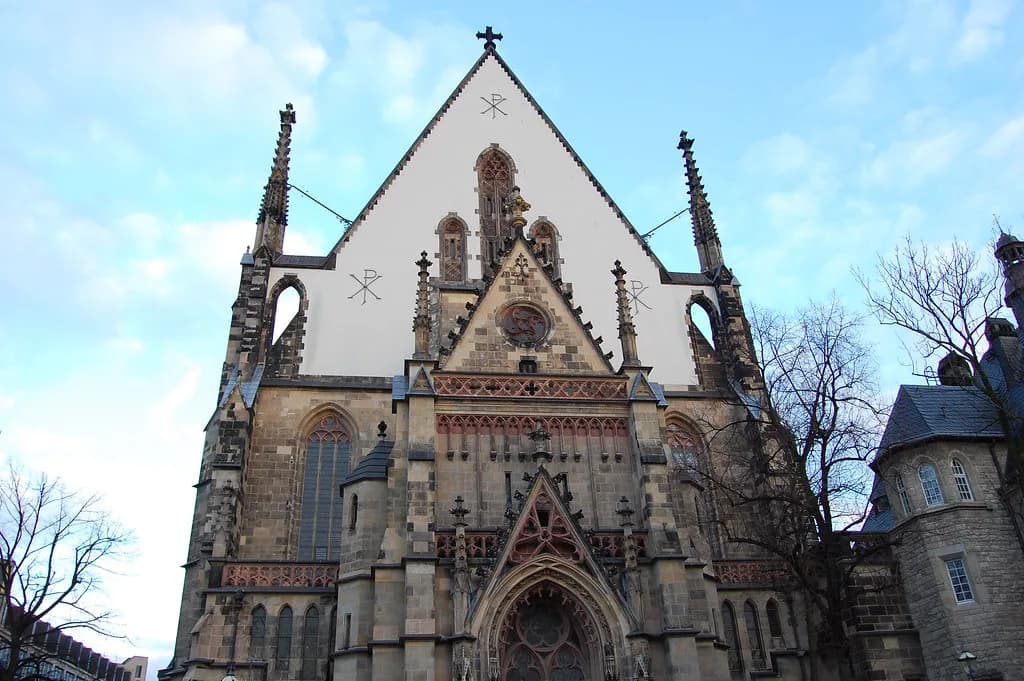
The Thomaskirche is the emotional centre of the walk for most visitors, and its interior contains the rib-vaulted ceiling, the stained-glass windows and Bach's tomb described in the 2025 visitor account. Whether you can enter at a given moment is a question for the church itself, since the Notenspur page does not publish opening times. Plan on the assumption that you may need to return if a service is in progress.
The tower climb is a separate decision from visiting the church, and the same travel account describes a narrow wooden staircase, a small entrance that was easy to miss, and a guide leading the way on that occasion. None of that establishes a current access rule, a fee or a schedule, so check the arrangements at the church before counting on a climb. If stairs and confined spaces are not for you, the church floor alone justifies the stop.
Outside the church, the Bach statue and the surrounding square make a natural resting point between two interior visits. Because the Bach Museum sits only a short step away in the same quarter, this is the best place on the trail to pause before committing to another ticket. Sequence the two carefully so you do not spend the same hour twice.
Leg 5: Bach Museum and the St. Thomas School Site
Station 18 is the Bach Museum, which stands on the site where Bach's home and the old St. Thomas School once were, according to the visitor account from that trip. The displays described there include period instruments, manuscript copies and family portraits, with music playing through the rooms. A family tree handwritten by Bach himself was the detail that stayed with that particular visitor.
Stations 19 to 21 continue the same theme: the site of Clara Wieck's birthplace, the site of the Old Conservatoire and the site of the first Gewandhaus. These are locations marked rather than preserved buildings, so they read as waypoints on a walk rather than destinations requiring an entrance fee. That distinction matters when you are deciding where to spend the limited paid stops in your day.
Because the museum, the church and the birth-place sites sit so close together, the final cluster is where a short Bach-only loop makes the most sense. Walk it, note what you want to come back for, and save the rest for a second pass rather than trying to absorb it all at once. Leipzig rewards a return visit more than a forced marathon.
Choosing Your Version: Short Loop, Full Trail or Bike Route
Three reasonable versions exist. A short Bach-only loop covers the Gewandhaus, St. Nicholas Church, the Old City Hall and the Thomaskirche quarter with the Bach Museum, and can be done in a relaxed half day. The full 23-station trail takes in the whole signed route from the New Gewandhaus to the MDR Cube and wants a full day or more. A third option swaps walking for cycling on the Notenrad, which covers the same musical territory at a different pace.
The Notenbogen, or Music Arc, is a distinct third route rather than a variant of the trail, so read the operator's descriptions before picking. If your interest is specifically the city centre's composers and publishers, the on-foot trail is the direct answer. If you want a wider sweep of the region, that is a different product with different logistics.
Families with children can look at the operator's own family materials, which include a children's version of the trail and a family app. Those exist precisely because the full route's interior-heavy stops are hard work for young walkers. Choosing the family variant is a legitimate decision, not a compromise.
Free Grounds Versus Paid Interiors
Walking the signed route costs nothing, and that is the part the operator describes. Interiors are another matter entirely, and there is no basis for assuming that St. Thomas Church, the Bach Museum and the Gewandhaus operate on one shared ticket. Each is a separate institution with its own arrangements, and the Notenspur page does not publish prices for any of them.
Nor should you assume every station on the trail can be entered freely. Some are marked sites, some are working churches, some are concert halls with programme-dependent access, and some are simply locations with a plaque. Build your budget and your expectations around the two or three interiors you genuinely want, and check each one's own information before travelling.
If you want a starting point for comparing the ticketed stops, the city's landmark guides cover individual venues in more detail than the trail page does. Use them to shortlist, then confirm current arrangements at source. That two-step approach keeps you from planning around stale information.
Practical Planning: Signage, Downloads and What to Verify
The signage and acoustic guidance system on the trail was realised by the City of Leipzig in cooperation with the Notenspur association and funded by the Free State of Saxony, according to the operator. That makes the waymarking a civic installation rather than a commercial tour, and it should be present on the ground. Downloadable station descriptions, GPS data, a flyer and a map sit alongside it.
What the operator page does not give you is the practical layer: no prices, no opening hours, no booking requirements and no accessibility information for the stations. Those gaps are not oversights to work around; they are the reason you should check each venue you plan to enter directly. The operator also publishes an app, which is the sensible place to start for audio and navigation.
If you want a fuller city context around the walk, a broader Leipzig guide pairs well with a single-day music route because it covers what to do with the rest of your time. The trail covers music well and almost nothing else, so plan your non-musical hours separately. If you have more than one day, Leipzig itineraries that run across three days let you spread the interiors out instead of stacking them.
Common Mistakes and Where to Break
The most common error is over-scheduling: treating 23 stations as an achievable checklist and then rushing past the two or three places that deserved an hour each. The second is treating a personal travel account as a rulebook; a blog describing one October 2025 visit tells you what one person saw, not what is open now or what it costs. The third is expecting every station to have a door you can walk through.
For a break, the Mädler-Passage area near the centre is a natural pause point, with the arcade passages offering shelter whatever the weather. The visitor account mentions stopping at a café inside those passages after several hours on foot, which is the right instinct for this trail. Confirm current venues and menus on arrival rather than planning around a specific establishment.
To end the walk, Leipzig Central Station is a short walk from the old centre and works as a finishing point whether you are catching a train or not. The same account describes the station as a grand gateway with shops and food inside, which makes it a practical place to decompress. Finish there rather than retracing the trail backwards.
Plan Your Visit
The Leipzig music trail walk works best as a set of decisions rather than a fixed itinerary: choose a short Bach-only loop or the full 23 stations, group the Thomaskirche quarter stops together, and decide in advance which one or two interiors you will actually pay to enter. The operator's route page gives you the 5.3 km line and the station list; everything else comes from the venues themselves.
Before you go, download the map and audio, and check current arrangements for the church, the Bach Museum and any concert hall you hope to enter. Do not rely on a single visit report or an old blog post for hours, prices or access rules, because none of those are published on the trail page. Walking is free and flexible; the interiors are where the planning earns its keep.
Frequently Asked Questions
How long does the Leipzig Music Trail take to walk?
The signed trail is 5.3 km with 23 numbered stations and an average gap of 225 m, so the walking alone is short. The time goes into the interiors, which the operator does not schedule. As our own suggestion rather than an official figure, allow a relaxed half day for a Bach-focused core and a full day if you want to work through all the stations with interior visits.
Is the Leipzig Music Trail free to walk?
Walking the signed route is free, and the operator describes the trail, the station list and the audio guidance rather than a ticket. Interiors along the way are separate, and you should not assume one ticket covers the Gewandhaus, St. Thomas Church and the Bach Museum. Check each venue directly for its own current arrangements.
Can you see Bach's grave and the Bach Museum on the same walk?
Yes, and they sit in the same quarter. St. Thomas Church is station 17 and the Bach Museum is station 18, a short step apart, with the site of Clara Wieck's birthplace and the site of the first Gewandhaus following close behind. Entering the church depends on services and the church's own arrangements, so check before you count on it.
Do you need a guide for the Leipzig Music Trail?
No. The trail is waymarked, and the operator publishes downloadable station descriptions, GPS data, a flyer, a map and audio samples. A commercially guided city walk covering Bach and Mendelssohn landmarks does exist as a separate product, but it is an alternative rather than the trail itself.
Can every station on the Leipzig Music Trail be entered?
No, and you should not assume free entry anywhere. Some stations are marked sites or historic locations rather than buildings open to the public, and others are working institutions with their own rules. The operator page lists the stops but does not publish opening times, access conditions or prices, so verify anything you specifically want to go inside.
What is the difference between the Leipzig Music Trail and the Music Bike Trail?
They are separate routes from the same organisation. The Leipzig Music Trail is the 5.3 km pedestrian route through the centre with 23 stations. The Leipzig Music Bike Trail, called Notenrad, is a cycling route, and the Leipzig Music Arc, or Notenbogen, is a third distinct product. Pick the one that matches how you want to travel.