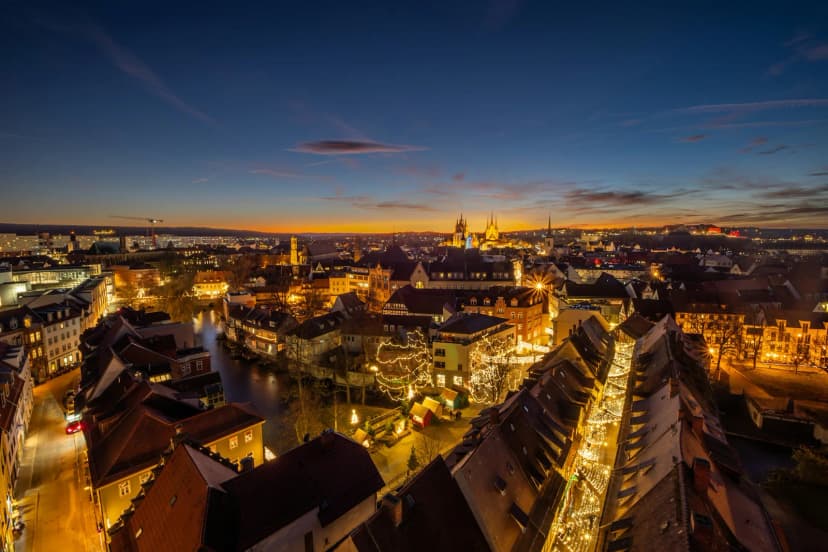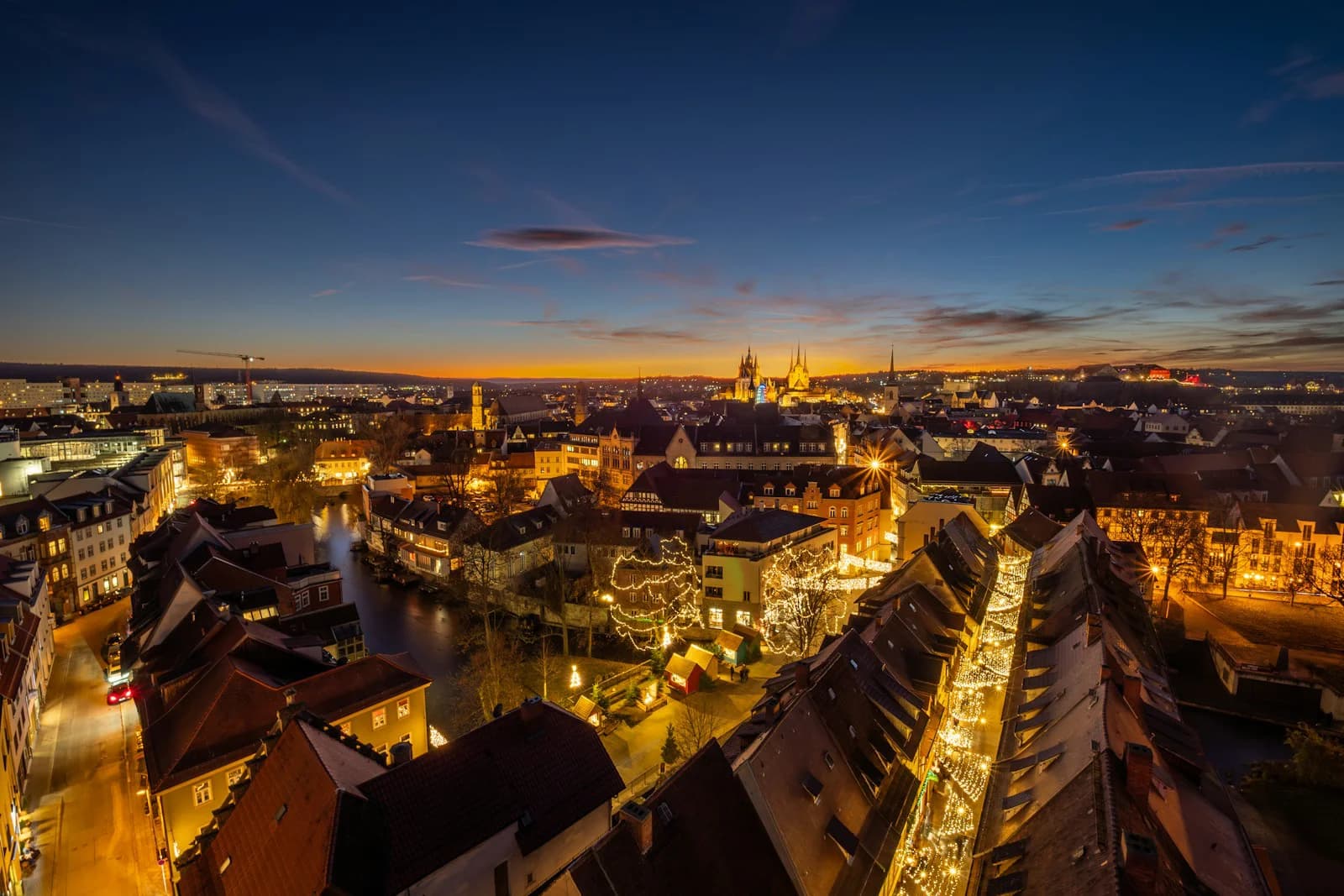
Erfurt's skyline is dominated by the cathedral and St. Severus on the Domberg, the two buildings almost every visitor photographs from Domplatz. Yet the old town holds a much larger medieval religious landscape, with monastery churches and one wartime ruin tucked into ordinary side streets. Seeing them requires a different pace: fewer stops, more looking, and a plan that survives a closed door.
This guide focuses on the Barfusserkirche, whose roofless Franciscan nave stands open to the sky, and the Predigerkirche, a 13th-century Gothic monastery church that today serves as Erfurt's main Protestant church. Both are in the old town and can be reached on foot. Everything here is a suggestion for structuring your own walk, not an official programme, and access can change.
What Makes a Church 'Hidden' in Erfurt
Hidden here does not mean secret or undiscovered. It means a church that sits off the main visitor circuit: down a lane, behind a row of houses, or in the form of a ruin that no longer functions as a parish church. Erfurt's old town is compact enough that you will pass several of these buildings without realising what they are, which is precisely why they feel calmer than the cathedral steps.
The city's official tourism service groups its major sights around the Cathedral of St. Mary, the Church of St. Severus, the Merchants' Bridge and the Old Synagogue, which gives you a sense of what the standard route covers. The churches in this guide rarely appear at the top of that list, so treating them as secondary stops rather than headline monuments is what makes them rewarding.
Barfusserkirche: A Franciscan Ruin Left Open to the Sky
The Barfusserkirche began as a Franciscan church, with construction starting in 1291 and the choir consecrated in 1316; the nave was only completed in 1430. The monastery was dissolved at the Reformation, and the monastic buildings were destroyed between 1641 and 1648. On 26 November 1944 a bomb hit the church, and unlike most damaged German churches it was never rebuilt. Since 1977 it has housed a museum.
What you see today is the consequence of that decision. The Gothic nave, completed in 1430, stands open to the sky, its vault missing and its south wall destroyed, while the north wall and aisle survive to full height. That survival is the real attraction for anyone interested in architecture, because it exposes the structure of a Gothic nave in a way an intact interior cannot.
The restored choir, completed in 1316, holds the church's original 13th-century stained glass depicting St. Francis along with a small collection of medieval religious art. Because the nave is a ruin and the choir is a restored interior, the two halves of the building give very different experiences within a few metres of each other. Budget time for both rather than walking past the shell.
Access details for the choir and its collection are the part of a Barfusserkirche visit most likely to change. Rather than relying on a printed guidebook or an old web page, check the current position with the city's tourism service or the site itself shortly before you travel. If the choir is closed, the roofless nave is still visible from the street and still worth the walk.
Predigerkirche: Plain Gothic and Erfurt's Main Protestant Church
The Predigerkirche was built in the 13th century as a stone Gothic monastery church and today serves as Erfurt's main Protestant church. It stands in the city centre on Predigerstrasse, close enough to the main squares that you can fold it into a walk without a special detour. Its stone exterior and tower make it easy to identify from a distance even if you have not marked it on a map.
The interior is deliberately plain, and that is the point. Visitors who have just come from the richly furnished cathedral often describe the Predigerkirche as a contrast rather than a lesser version of it, with a simple, quiet character. If you are choosing between churches on a short visit, this one rewards people who prefer restrained architecture to spectacle.
Because the Predigerkirche is an active congregation rather than a monument with fixed visitor hours, its opening depends on the community that uses it. Do not assume it will be unlocked simply because it is on a sightseeing list. If the doors are shut, note the exterior and the position, and come back rather than treating the stop as wasted.
Erfurt also has a strong Reformation connection through the Augustinian Monastery, where Martin Luther lived, which is why the city's Protestant heritage is more than a footnote. Pairing the Predigerkirche with that context turns a single church stop into a coherent half-hour of history.
Reading a Ruin: What the Barfusserkirche Walls Tell You
At the Barfusserkirche, the intact north wall and aisle let you trace how a Gothic nave was actually put together, from the arcade up to the clerestory. Guidebooks rarely explain this well, but standing in the open shell makes the logic visible: the missing vault and south wall show you what usually sits above and beside you in an intact church. It is a rare chance to see the skeleton rather than the finished room.
For visitors with an interest in the Second World War's effect on German cities, the site also functions as a document. The decision not to rebuild distinguishes it from churches that were restored to their pre-war appearance. Read it as evidence of a choice, not simply as damage.
Keeping the Walk Short in a Dense Old Town
Erfurt's medieval core is small enough that church-hopping on foot makes more sense than planning a long route. Clustering two or three stops around the Altstadt, rather than crossing the whole city, leaves room for the unplanned pauses that make a quiet visit work. An Erfurt Altstadt walk is the natural spine for this, because it keeps you inside the lanes where these buildings actually sit.
The Fischmarkt and the lanes around it make a practical midpoint, with the Krämerbrücke and its church tower a short step away. If you want more smaller-scale stops between the churches, the city's courtyards and lesser-known corners fill the gaps without adding transport. Combining a church-focused morning with one of the city's Hidden Gems keeps the day varied rather than repetitive.
A Suggested Half-Day for Slower Church Visits
Our own suggestion, not an official schedule, is to allow roughly three hours for a church-focused half-day: about an hour around the Barfusserkirche if the choir collection is open, forty minutes at the Predigerkirche, and the rest for walking between them and stopping when something catches your eye. Add time if you linger over architecture, and cut stops without guilt if a door is closed.
Start earlier rather than later if your priority is a calm visit, but do not build the day around a promise of empty interiors. Churches host services, rehearsals, funerals and private events, and none of that appears on a sightseeing list. A flexible order, with the ruin as your anchor because its exterior cannot close, is more robust than a fixed timetable.
For anyone stretching the visit across more than one day, a multi-day structure works better than cramming every church into an afternoon. A flexible 3-day Erfurt itinerary gives you room to reattempt a closed church the following morning instead of losing the stop entirely.
Access Reality Check: Verify Before You Go
The most useful planning step is to accept that church interiors in Erfurt may be closed, open only for services, or run on donation-based entry with no published hours. Do not treat any schedule you find online as guaranteed. Confirm with the site or the city's tourism service in the days before your visit.
Erfurt Tourismus & Marketing maintains the city's official visitor information, including sights and museums, and is the sensible first place to check what is currently open. The EVE Tourist-Information in Erfurt also handles enquiries and guided tour bookings if you want a person to confirm details. Use these rather than an old blog post, because access arrangements at small churches change quietly.
Do not plan around tower climbs, crypt access or guided tours of these churches unless you have confirmed them directly. There is no published schedule for such access at the quieter churches, and assuming it exists is the most common way a church visit disappoints. Ask specifically what is open on your dates, and treat any answer as valid only for that period.
Pairing a Church Visit With a Municipal Museum
Erfurt's municipal museums are a useful complement to a church walk, especially on a wet day, and they run their own ticketing rather than sharing one pass with the churches. The Stadtmuseum 'Haus zum Stockfisch' covers the city from its early history through the Reformation period, which gives context to the religious buildings you have just seen. Its published hours run Tuesday to Sunday, and the museum lists a first-Tuesday-of-the-month free admission arrangement.
The Museum fur Thuringer Volkskunde is another option in the same municipal group, with its own exhibitions, ticket prices and the same monthly free-entry day; its seasonal special exhibitions change through the year, so check what is on rather than assuming a permanent display. Note that the free day applies to the municipal museums as a group, not to church interiors or their collections.
Combining a church stop with one museum keeps the day indoors-and-outdoors rather than a single long walk. Decide in advance which museum matters more to you, since trying to cover both plus two churches in one day tends to flatten the experience. A museum visit also gives you a dry fallback if a church turns out to be closed.
Where the Quieter Churches Fit in a Wider Erfurt Visit
If you are building a broader picture of the city, the cathedral and St. Severus remain the essential first stop, and the Old Synagogue and medieval mikveh add a different religious dimension that is part of Erfurt's UNESCO-listed heritage. The lesser-known churches work best as a second layer on top of that, not as a replacement. This is a city where the layers reward a return visit rather than a rushed one.
Erfurt's compact centre means you can move between the Domberg, the old town lanes and the monastery church on foot in a single morning. That density is the main reason a quiet church walk is feasible at all without transport planning. Keep the route loose, and let the buildings you find open set the pace.
Plan Your Visit
Erfurt's quieter churches reward visitors who accept uncertainty and verify before travelling. The Barfusserkirche offers something you cannot see elsewhere in the city, and the Predigerkirche gives a counterpoint of plain, active Gothic architecture. Neither needs a long detour, and both fit naturally into a morning in the Altstadt.
Before you go, confirm current access with Erfurt Tourismus or the sites themselves, decide which municipal museum you actually want, and keep the schedule loose enough to return to a church that was closed. That approach turns an unpredictable stop into a reliable part of the day.
Frequently Asked Questions
Which churches in Erfurt are worth visiting beyond the cathedral?
The Barfusserkirche and the Predigerkirche are the two most rewarding lesser-known churches for most visitors. The Barfusserkirche is a ruined Franciscan church with a roofless nave and a restored choir, while the Predigerkirche is a 13th-century Gothic monastery church that serves as Erfurt's main Protestant church. Both sit in or near the old town and can be combined on foot.
What happened to the Barfusserkirche in Erfurt?
The church was built as a Franciscan foundation, with construction starting in 1291 and the choir consecrated in 1316. The monastery was dissolved at the Reformation, and in November 1944 the church was hit by a bomb. Unlike many damaged German churches it was never rebuilt, so the nave remains a ruin open to the sky while the choir has been restored. Since 1977 it has housed a museum.
Is the Predigerkirche in Erfurt Protestant or Catholic?
The Predigerkirche is Erfurt's main Protestant church today, though it began as a 13th-century Gothic monastery church. Its interior is notably plain compared with the richly decorated cathedral, which is part of what makes it interesting for visitors who prefer restrained architecture.
Do you need tickets for Erfurt's smaller churches?
Church access in Erfurt is not standardised. Some interiors may be free, some may ask for a donation, and some may be closed to visitors at any given time. Because these arrangements change, check with the site or the city's tourism service shortly before you travel rather than relying on an old listing.
How long should you allow for a quiet church-focused walk in Erfurt's old town?
Our own suggestion, not an official figure, is to allow around three hours for two churches plus walking time in the Altstadt. If the Barfusserkirche choir and its collection are open, that stop alone can take an hour. Build in slack so a closed church does not derail the whole plan.
Are Erfurt's church interiors usually open during the day?
There is no single reliable answer. Churches that are active congregations may be open only around services, and buildings used for events can be shut at short notice. Check the city's official tourism service or contact the site directly for your dates instead of assuming daytime access.
Which Erfurt museums can you combine with a church visit?
The Stadtmuseum 'Haus zum Stockfisch' and the Museum fur Thuringer Volkskunde are both municipal museums with their own hours and ticketing. They are useful companions to a church walk and give historical context, but they do not share one ticket with the churches. Check current opening times and any free-entry arrangements before you go.