The Spanish Steps are free to visit and open to the public 24 hours a day — no ticket, no booking, and no admission fee, at any time of year. That surprises a lot of travelers who search "Spanish Steps tickets" expecting a museum-style entry fee, especially with nearby sights like the Colosseum charging for entry and even the Trevi Fountain now selling a €2 ticket for its inner basin.
What does cost you something is sitting down. Since a 2019 city ordinance, perching on the steps to rest, eat, or people-watch carries a fine of up to €250 — rising to €400 if you dirty or damage the travertine — and officers patrol the piazza to enforce it. This guide covers what actually costs money in the area, when to go to dodge the worst crowds, how long to plan, and how to get there from wherever you're staying in Rome.
What Is the Spanish Steps?
The Spanish Steps (Scalinata di Trinità dei Monti) are a monumental flight of 135 travertine steps connecting Piazza di Spagna at the bottom with Piazza Trinità dei Monti and its twin-towered church at the top. Architect Francesco De Sanctis designed and built the staircase between 1723 and 1726, funded by a bequest from French diplomat Étienne Gueffier and commissioned under Cardinal Pierre Guérin de Tencin. Pope Benedict XIII inaugurated it during the 1725 Jubilee.
The name is a small historical irony: French money paid for the staircase, but it takes its name from the Spanish Embassy to the Holy See, which once stood on the piazza at its foot. Roughly from mid-April to mid-May each year, around 450 pots of Capitoline azaleas in white and lilac line the ramps, a tradition dating to the 1950s. The staircase underwent a full restoration in 1995 and again in 2016, the latter funded by Bvlgari, which is part of why the travertine still looks this clean today.
Spanish Steps Tickets & Prices 2026
There's no fee to walk the Spanish Steps at any time in 2026, and there's no ticket to buy, book, or print — the staircase and the piazzas at both its base and its summit are open public space maintained by the City of Rome. That makes it one of the few genuinely free landmarks left in the historic center, alongside the Pantheon's exterior and the Trevi Fountain's piazza view (though not the fountain's fenced inner basin, which has charged €2 since February 2026).
Two paid sites sit right at the foot of the staircase if you want to add a stop. The Keats-Shelley House — the apartment where poet John Keats died in 1821 — charges roughly €6-7 for adults, with reduced rates for students and free entry for children under 6; it's about a minute's walk from Spagna metro station. Check current pricing before you go on the official Keats-Shelley House site. At the top of the steps, the Trinità dei Monti church is free to enter, though it closes during services, and its own posted hours (roughly 10:15am–7:45pm most days) run far shorter than the staircase's round-the-clock access.
Opening Hours & Best Time to Visit
The Spanish Steps have no official opening or closing time — the staircase is public street-level space, lit and accessible 24 hours a day, every day of the year, including holidays. There's no gate and nothing to check before you go, which is unusual for a Rome landmark this famous.
That said, "open 24 hours" doesn't mean "pleasant at all hours." From late morning through early evening, especially April through September, the steps and the piazza below fill with tour groups, street vendors, and photographers — moving through the staircase in peak season can mean genuine crowding rather than just a busy view. Early morning, before about 9am, is the quietest window and gives the best light for photos of the empty staircase. Mid-April to mid-May, when the Capitoline azaleas are in bloom, is worth timing a visit around if flowers matter to you, but that window also coincides with some of the year's heaviest tourist traffic.
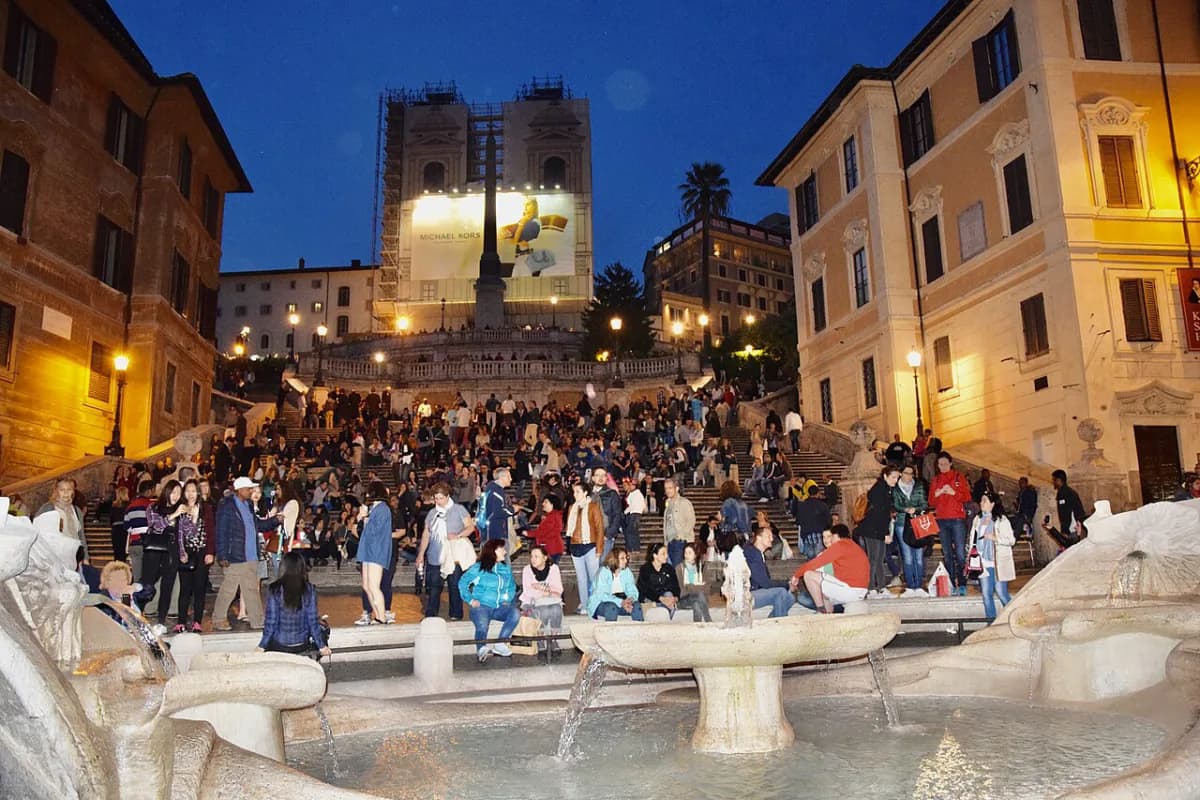
In the evening, the piazza turns into more of a local hangout than a tour stop — it's one of the better spots in central Rome for an after-dark walk through the historic center, with the staircase lit and Via Condotti's shop windows glowing on the approach.
How Long to Plan for Your Visit
Most visitors spend 20–30 minutes at the Spanish Steps: enough time to walk up or down, take photos from a few vantage points, and browse the Via Condotti shopping street that runs off the piazza. If you add the Keats-Shelley House or the Trinità dei Monti church, budget another 30–45 minutes combined.
Because there's a single main sight and no ticketed entry to plan around, the Spanish Steps work best as one stop within a longer walk through the Tridente and historic center rather than a dedicated outing on their own.
How to Get to the Spanish Steps
The nearest metro station is Spagna on Line A (the red line), which lets you out directly onto Piazza Trinità dei Monti at the top of the staircase — you'll be standing at the summit within a minute of leaving the station. This is the simplest approach from almost anywhere else on the Line A route, including the Vatican area and Termini station.
From the bottom of the steps, the closest major landmark is the Trevi Fountain, about a 10-minute walk east through Via Condotti and Via del Corso. Several bus lines run along Via del Corso and Via del Tritone a short walk from the piazza — check Rome's ATAC transit app for current routes, since lines shift periodically. There's no dedicated parking near the piazza, and the surrounding historic center is a restricted traffic zone (ZTL) for non-resident vehicles, so walking or the metro is the practical option regardless of where you're staying.
Visit Tips: Queues, Booking & Common Mistakes
The rule that catches the most visitors off guard: sitting or lying on the steps is illegal. Since the 2019 city ordinance, officers patrol the piazza and can fine anyone caught sitting €250, rising to €400 if you're seen eating, drinking, or otherwise dirtying or damaging the travertine. This applies to tourists and residents alike — the staircase is legally classified as a protected monument, not a public bench.
The other common mistake is searching "Spanish Steps tickets" and assuming there's an admission fee to budget for — there isn't. If a third-party site is selling a "ticket" to the Spanish Steps themselves, it's either a guided walking tour bundling several sights together, or it isn't what it claims to be. The only genuinely ticketed venue in the immediate area is the Keats-Shelley House at the base of the staircase.
Crowding, not cost, is the real planning problem here. Pickpocketing is a known issue in dense tourist piazzas like this one — keep bags zipped and in front of you, particularly on the crowded lower steps where everyone's attention is on their phone. If you're visiting during the mid-April to mid-May azalea season or a Roman holiday weekend, arrive before 9am or plan your visit for after dinner instead.
Nearby Attractions
The Trevi Fountain is the natural pairing, about a 10-minute walk east — both sit inside the same compact, walkable stretch of Rome's historic center, and most visitors cover both in a single morning or evening loop. The Pantheon is a further 10 minutes south of the fountain, easily folded into the same walk if you have a few hours to spare.
For a longer outing in the other direction, the Vatican Museums are about 25–30 minutes away by metro or taxi and are worth planning as a separate half-day rather than squeezing in alongside the Spanish Steps. To see how the steps fit into a broader trip and which paid sights are actually worth bundling, our guide to whether the Rome city pass is worth it covers the calculation — useful context, since the Spanish Steps themselves need no pass at all. For the full lay of the city, start with the Rome attractions hub.
Frequently Asked Questions
Do I need a ticket to visit the Spanish Steps?
No. The Spanish Steps are free to visit at any time, with no ticket, booking, or admission fee required. The only paid site in the immediate area is the Keats-Shelley House museum at the foot of the staircase, which is a separate attraction with its own admission fee.
What are the Spanish Steps' opening hours?
The Spanish Steps have no set opening or closing time — the staircase is open public space, accessible 24 hours a day, every day of the year. Early morning, before about 9am, is the quietest and best-lit time to visit if you want to avoid crowds.
Can you sit on the Spanish Steps?
No. Since a 2019 city ordinance, sitting or lying on the Spanish Steps is illegal and enforced by patrolling officers, with fines of €250, rising to €400 for dirtying or damaging the travertine. The staircase is classified as a protected monument, not a public seating area.
How long should you spend at the Spanish Steps?
Most visitors spend 20–30 minutes at the Spanish Steps — enough time to walk the staircase, take photos, and browse the Via Condotti shops nearby. Add another 30–45 minutes if you're also visiting the Keats-Shelley House or the Trinità dei Monti church at the top.
What is the nearest metro station to the Spanish Steps?
Spagna station on Metro Line A is the nearest stop, exiting directly onto Piazza Trinità dei Monti at the top of the staircase. It's the simplest way to reach the Spanish Steps from most other points along the Line A route.
The Spanish Steps are a rare thing in central Rome: a headline landmark that costs nothing and needs no advance planning beyond deciding when to go. The one rule worth remembering is the no-sitting policy — it's strictly enforced and the fine is real — and the one timing decision worth making is arriving early or after dark if you want the staircase without the crowds.
Pair the visit with the Trevi Fountain and the Pantheon for a single walkable loop through Rome's historic core, and you'll cover several of the city's best free, or nearly free, sights in a single morning or evening.
For the latest official information, see the Spanish Steps on the official Turismo Roma site.