As of mid-2026, a full-price ticket to the Basilica of Santa Croce costs €10 at the ticket office (a €1 booking fee applies if you reserve online), with a €6 reduced rate for ages 12–17, university students, and groups of 15+. The basilica is open Monday through Saturday, 9:30 a.m. to 5:30 p.m. (last admission 5:00 p.m.), and Sunday and religious holidays from 2:00 p.m. to 5:30 p.m. — closed December 25.
Santa Croce sits on the eastern edge of central Florence, a short walk from the Duomo, and it's easy to underrate on paper — it's "just a church" the way the Uffizi is "just a museum." Inside, though, are the tombs of Michelangelo, Galileo, and Machiavelli, Giotto's frescoes, Brunelleschi's Pazzi Chapel, and a working leather school founded by Franciscan friars. This guide covers exactly what a Santa Croce ticket buys you, when to go, how long to realistically plan, and how to avoid the two most common mistakes: skipping it as a "minor" church, and showing up after the ticket office closes.
What Is the Basilica of Santa Croce?
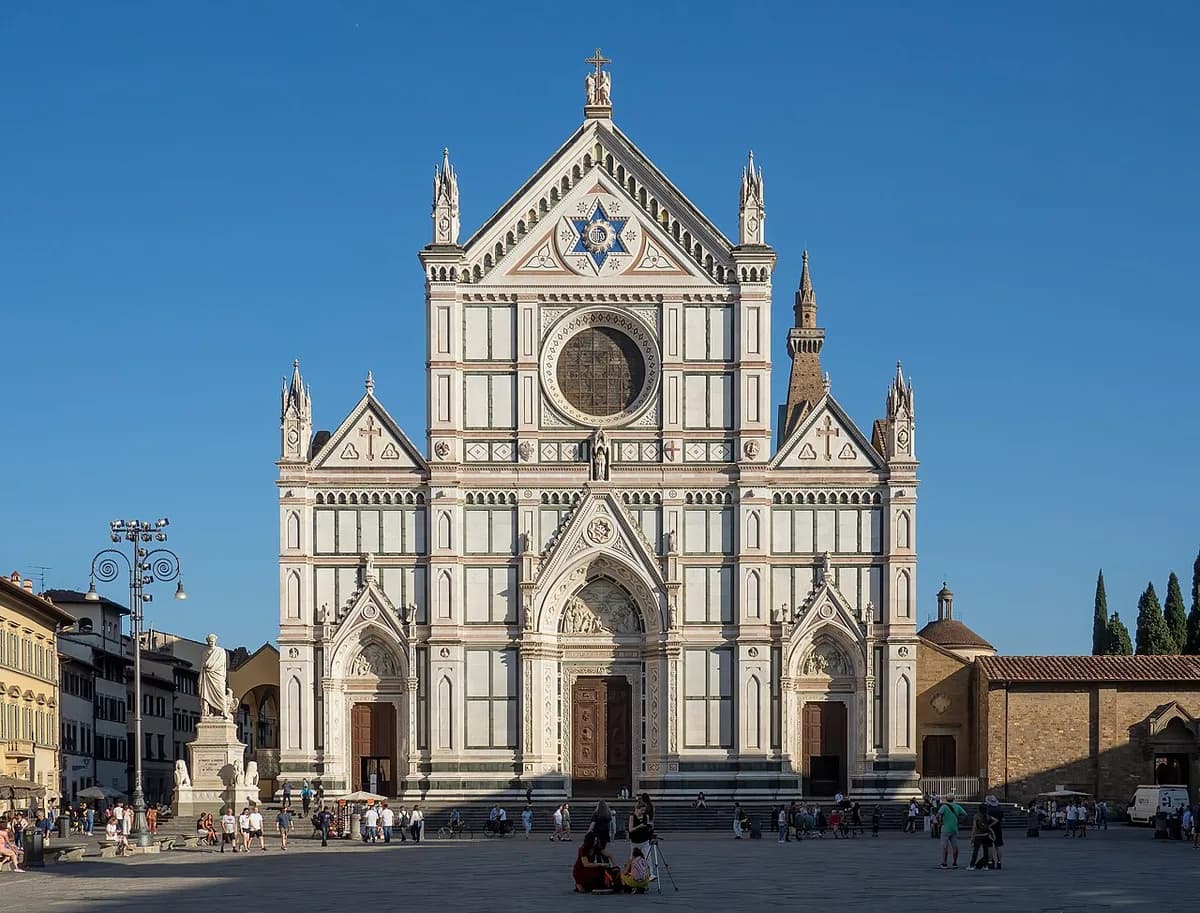
The Basilica of Santa Croce is Florence's principal Franciscan church, begun in 1294 on the site of an earlier Franciscan oratory and largely built up through the 14th century, with its neo-Gothic marble facade added much later, in the 19th century. For centuries it served as a burial site for Florence's most prominent citizens, which is why it's sometimes called the "Temple of the Italian Glories" — the floor and side aisles are packed with tomb slabs and monuments to the city's leading artists, scientists, and statesmen.
Inside, the monumental tomb of Michelangelo Buonarroti (completed 1564–1576) sits along the south aisle, along with the tomb of Galileo Galilei — who was initially denied a prominent burial because of his condemnation by the Inquisition, and only reinterred in the main body of the church in 1737, nearly a century after his death. Niccolò Machiavelli and composer Gioachino Rossini are buried here too, and a cenotaph (an empty memorial tomb; Dante is actually buried in Ravenna) honors Dante Alighieri. The Bardi Chapel holds Giotto's "Stories of Saint Francis" frescoes (1317–1325), and the complex also includes Agnolo Gaddi's "Legend of the True Cross" cycle, works by Donatello, and the Pazzi Chapel — a small Renaissance masterpiece designed by Filippo Brunelleschi in the first cloister. As of mid-2026, some fresco cycles have been affected by ongoing restoration work; confirm current visibility on the official Santa Croce site before you go.
Santa Croce Tickets & Prices 2026
Full admission to the Basilica of Santa Croce is €10, whether you buy at the ticket office or online (online purchases carry a €1 per-ticket booking fee, so plan for about €11 if you reserve ahead). A reduced ticket at €6 applies to visitors aged 12–17, university students, and groups of 15 or more. Children under 11, Florence residents, people with disabilities, and holders of certain museum cards enter free. An audio guide adds €4 if booked online in advance or €6 rented on site.
Santa Croce is included on the Firenze Card, with skip-the-line access through a reserved entrance and no advance reservation required — useful if you're already covering the Uffizi and Accademia on the same pass. A handful of religious holidays throughout the year (New Year's Day, Easter, the Feast of St. Francis on October 4, and European Heritage Days in late September, among others) offer free admission, though the ticket office closes earlier on those dates, with no entry after 4:30 p.m. rather than the usual 5:00 p.m. cutoff. Ticket prices and free-entry dates are set by the Opera di Santa Croce and can shift year to year — confirm current 2026 rates on the official ticket page before booking.
Opening Hours & Best Time to Visit
Santa Croce is open Monday through Saturday, 9:30 a.m. to 5:30 p.m., with last admission at 5:00 p.m. On Sundays and religious holidays, hours shift to 2:00 p.m. through 5:30 p.m., also with last admission at 5:00 p.m. — plan a Sunday visit for the afternoon only. The basilica closes entirely on December 25.
Arriving right at 9:30 a.m. opening, or after 3:30 p.m. on weekdays, gives you the calmest visit; Santa Croce draws real but noticeably thinner crowds than the Uffizi or the Duomo, so queues are rarely severe, though tour groups do cluster mid-morning. Note that the piazza hosts Calcio Storico Fiorentino, Florence's historic costume football tournament, each June — in 2026 the semifinals run June 13–14 and the final on June 24 — with a temporary sand pitch set up in the square around those dates.
How Long to Plan for Your Visit
Santa Croce's own visitor guidance puts a focused walk-through of the basilica itself at around 50 minutes. Realistically, most visitors who also want the two cloisters, the Pazzi Chapel, the Opera Museum, and a stop at the adjacent Leather School should budget 90 minutes to 2 hours. If you're short on time, prioritize the basilica's south aisle (Michelangelo, Galileo, and Machiavelli's tombs) and the Pazzi Chapel — that pairing captures the two things most visitors come for without needing the full complex ticket.
An audio guide or the official Santa Croce app helps make sense of the tomb inscriptions and chapel frescoes, which have minimal on-site English signage in places. If you're combining Santa Croce with a longer day in the historic center, treat it as a 1.5-to-2-hour stop rather than a quick 20-minute detour between bigger sights.
How to Get to Santa Croce
The basilica sits on Piazza di Santa Croce, on the eastern edge of Florence's historic center, roughly a 10-minute walk from the Duomo and about 10–15 minutes on foot from the river crossing near the Uffizi. Florence's center is largely closed to private traffic (Zona a Traffico Limitato), so walking from anywhere within the old city is the practical option; city buses serving the area stop within a few minutes' walk of the piazza if you're coming from farther out.
Flying in, Florence Airport (Peretola) is about 20–30 minutes from the center by taxi or the Vola in Bus shuttle to Santa Maria Novella station. Pisa Airport, roughly 90 minutes away by train, is the busier long-haul alternative many travelers use instead. From Santa Maria Novella train station, Santa Croce is a walkable but longer 20–25 minute cross-town route through the historic center — most visitors combine it with a stop at one of the other major sights along the way rather than walking there directly.
Visit Tips: Queues, Booking & Mistakes to Avoid
Booking online isn't essential outside peak season — Santa Croce rarely sells out the way the Uffizi or Accademia do — but the €1 fee is cheap insurance during Easter week, Golden Week-adjacent spring dates, or any summer weekend. Dress appropriately: shoulders and legs need to be covered to enter, and free disposable ponchos are available at the ticket office if your outfit doesn't meet that standard, so you won't be turned away entirely.
Personal photography is allowed without a tripod or flash, for private use only; a left-luggage facility is available near the entrance on Largo Bargellini if you're arriving with bags. The most common mistake is treating Santa Croce as a five-minute photo stop because "it's just a church" — the tomb complex, frescoes, and cloisters genuinely reward the full 90 minutes. The second is arriving after 5:00 p.m. expecting to get in; the ticket office cuts off admission a full half-hour before the doors actually close at 5:30 p.m.
Nearby Attractions
The Florence Duomo is about a 10-minute walk northwest, and most visitors pair the two in the same morning or afternoon. Continuing toward the river, the Ponte Vecchio is roughly 10–15 minutes on foot, and the Accademia Gallery — home to Michelangelo's David — sits about 15 minutes away on the north side of the center, a natural pairing given how much of Santa Croce's own draw is Michelangelo's tomb. Right outside the basilica, the Leather School (Scuola del Cuoio) is free to enter and worth a short stop even if you're not buying anything.
For the full spread of what else the city offers, see our Florence attractions hub, or sequence Santa Croce against the city's other major sights with our 2-day Florence itinerary so you're not backtracking across town. If you'd rather build a day around lesser-known stops, our guide to hidden gems in Florence has suggestions within easy reach of the basilica.
Frequently Asked Questions
How much are tickets to Santa Croce in Florence?
A full-price ticket is €10, whether purchased at the ticket office or online (online purchases add a €1 booking fee). A reduced ticket is €6 for ages 12–17, university students, and groups of 15+. Children under 11, Florence residents, and people with disabilities enter free.
What are Santa Croce's opening hours?
Monday through Saturday, Santa Croce is open 9:30 a.m. to 5:30 p.m., with last admission at 5:00 p.m. On Sundays and religious holidays, it's open 2:00 p.m. to 5:30 p.m., also with last admission at 5:00 p.m. It's closed on December 25.
Is Santa Croce included with the Firenze Card?
Yes. The Firenze Card covers admission to Santa Croce with skip-the-line access through a reserved entrance, and no advance reservation is required — you can visit during any available time slot on the card.
How long should I spend at Santa Croce?
A focused walk-through of the basilica alone takes about 50 minutes. Most visitors who also see both cloisters, the Pazzi Chapel, the Opera Museum, and the adjacent Leather School should budget 90 minutes to 2 hours.
Who is buried in Santa Croce?
Michelangelo, Galileo Galilei, Niccolò Machiavelli, and composer Gioachino Rossini are all buried inside Santa Croce, along with a cenotaph (empty memorial tomb) to Dante Alighieri, whose actual grave is in Ravenna. Galileo was only reinterred in the main church in 1737, nearly a century after his death, once the Church lifted its objection tied to his condemnation by the Inquisition.
Santa Croce is the rare Florence sight that's genuinely undersold by its own name — "a church" undersells a building holding the tombs of Michelangelo and Galileo, a Brunelleschi chapel, and Giotto frescoes, all a short walk from the Duomo.
Book online if you're visiting in peak season, dress with shoulders and legs covered, and build in the full 90 minutes rather than treating it as a quick stop — do that, and Santa Croce fits cleanly into a 2026 Florence itinerary as more than a footnote next to the bigger-name museums.
For the latest official information, see the Santa Croce official visitor information page and the Santa Croce entry on Wikipedia.