Ponte Vecchio itself is free — the bridge is open to pedestrians 24 hours a day, every day, and its roughly 40 jewelry and goldsmith shops keep their own hours, typically around 9:00 a.m. to 7:30 p.m. There is no ticket, no booking, and no admission fee for the bridge. The "tickets" people are actually searching for almost always mean the Vasari Corridor, the elevated passage that runs directly above the shops: as of 2026 that's a separate, reservation-only product bundled with Uffizi Gallery admission, priced from €43 (bought the day of, at the ticket office) to €47 (booked online in advance).
This guide separates the two clearly — what costs nothing on Ponte Vecchio itself, what the Vasari Corridor actually costs and how to book it, when to go to avoid the crowds, and what's within walking distance. It's part of our full Florence attractions guide.
What Is Ponte Vecchio?
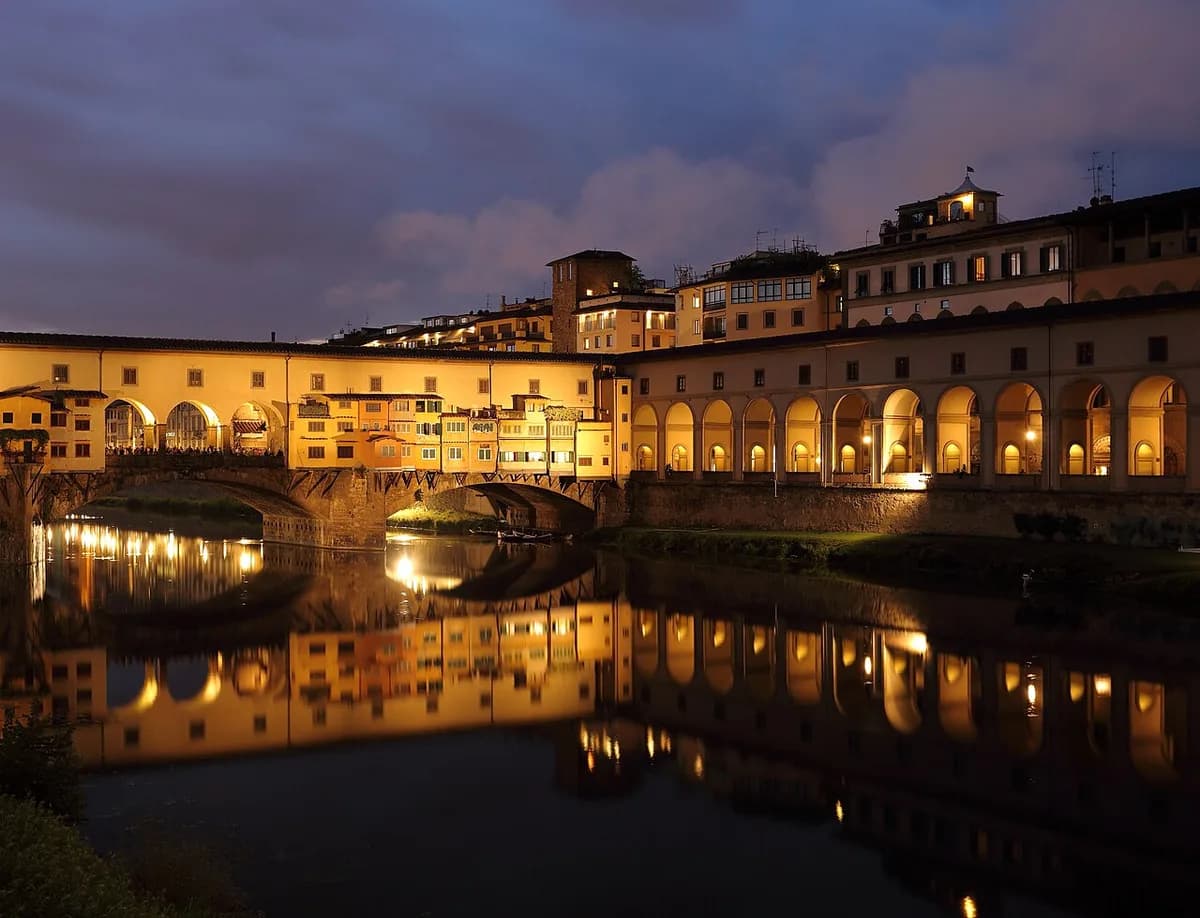
Ponte Vecchio ("Old Bridge") is Florence's medieval bridge over the Arno River, built in 1345 at the river's narrowest point — its design is usually attributed to either Taddeo Gaddi or Neri di Fioravanti. It replaced earlier bridges lost to floods, and it's the only bridge in Florence to survive World War II intact: when German forces retreating in August 1944 destroyed every other bridge across the Arno, Ponte Vecchio was spared, though the medieval buildings at both ends were demolished to block it just as effectively.
The shops lining both sides weren't always jewelers. Butchers, tanners, and other trades originally occupied the bridge, until Grand Duke Ferdinando I de' Medici banned them in 1593 to cut down on the smell drifting up to the Vasari Corridor above — the covered, elevated passageway Giorgio Vasari built in 1565 so the Medici family could walk between Palazzo Vecchio and Palazzo Pitti without descending into the street. Only goldsmiths and jewelers were allowed to stay, a rule that still shapes the bridge today. A bronze bust of Benvenuto Cellini, Florence's most famous Renaissance goldsmith, was added at the bridge's midpoint overlook in 1900 and remains the bridge's one landmark beyond the shops and the view.
Tickets & Prices 2026
Crossing Ponte Vecchio, browsing the jewelry shops, and photographing the bridge and the Arno are all free — there's no ticket, turnstile, or booking involved at any point. If a site or tour operator is charging you to "visit" the bridge itself, that's a paid walking tour bundling in commentary, not an admission fee for the bridge.
The genuine paid product is the Vasari Corridor, which runs directly above the shops and is only sold combined with an Uffizi Gallery ticket. As of mid-2026: the combined Uffizi + Vasari Corridor ticket is €43 full price purchased the day of your visit, or €47 booked online in advance; a reduced rate of around €2 applies to EU citizens aged 18–25, and admission is free for eligible categories including EU citizens under 18. From July 3 to November 20, 2026, the corridor also opens on Friday evenings, 7:00 p.m. to 11:00 p.m. (last admission 9:50 p.m.), with a separate evening ticket priced €20 (day-of) to €24 (online). Reservations are mandatory for the corridor and should be made through the official Uffizi ticketing site — resellers near the bridge and piazza are known to charge well above face value for the same slot. If you're weighing several paid Florence sights against each other, our breakdown of whether the Florence Pass is worth it covers whether a bundle makes sense for your specific itinerary.
Opening Hours & Best Time to Go
Ponte Vecchio has no opening or closing time — it's a public street, accessible around the clock. The jewelry shops set their own schedules, but most run roughly 9:00 a.m. to 7:30 p.m., with some opening a little later or closing for a midday break outside peak summer months; a handful stay shut on Sundays or Mondays. The Vasari Corridor runs on its own separate 2026 schedule: standard visits Tuesday through Sunday, with the first group entering at 10:15 a.m. and the last leaving at 4:35 p.m., plus the Friday evening slot (7:00–11:00 p.m.) from July 3 through November 20, 2026.
For the bridge itself, early morning — before 9:00 a.m., ahead of the shops opening and the day's tour groups — is the calmest window, and it's also when the light on the Arno is best for photos. Sunset draws the biggest crowds of the day, since the view from Ponte Vecchio (and of it, from the next bridge over) is one of the classic Florence images; if you want that shot without a wall of phones in the frame, arrive 20–30 minutes before sunset rather than at peak. The best angle to photograph the bridge itself, rather than from it, is from Ponte Santa Trinita or Ponte alle Grazie, both a short walk along the river.
How Long to Plan
Simply crossing the bridge and stopping for photos takes 10–15 minutes. Add browsing time at the jewelry shops and the visit stretches to 30–45 minutes, longer if you're shopping seriously rather than looking. If you're adding the Vasari Corridor, budget closer to half a day: entry to the Uffizi Gallery is required two hours ahead of your corridor time slot, the corridor walk itself runs 45–75 minutes depending on the tour pace, and it exits through the Boboli Gardens, which are worth another 45–60 minutes if you have the time. Doing Ponte Vecchio on its own, without the corridor, comfortably fits into a short stop on a walk between the Uffizi and the Oltrarno side of the river. If you're mapping out where it fits alongside the Duomo, the Uffizi, and the rest of the historic center, our 2-day Florence itinerary sequences it into a walkable loop.
How to Get There
Ponte Vecchio sits in the heart of central Florence, spanning the Arno at its narrowest point and connecting the historic center near Piazza della Signoria to the Oltrarno neighborhood on the south bank. It's about a 5-minute walk from the Uffizi Gallery, 10–15 minutes from the Duomo, and roughly 20 minutes on foot from Santa Maria Novella train station. Florence's historic center is largely pedestrianized and restricted to resident traffic (ZTL), so there's no practical parking near the bridge — walking, or a taxi to the edge of the ZTL, is the realistic option for most visitors.
Visit Tips: Queues, Booking & Common Mistakes
There's no queue for the bridge itself, but it gets genuinely crowded — shoulder-to-shoulder in places — at midday and sunset from June through September. Early morning is the reliable way around that. If you're booking the Vasari Corridor, do it weeks ahead in peak season; it sells out, reservations are mandatory, and you have to enter the Uffizi two hours before your corridor slot, so plan the rest of your morning around that fixed window rather than the other way around.
The most common mistake is assuming Ponte Vecchio itself requires a ticket — it never has and it never will; the paid product people are actually thinking of is almost always the Vasari Corridor or a separately booked walking tour. Buy corridor tickets only through the official Uffizi site or a clearly licensed operator; resale markups near the piazza offer no guarantee the slot is genuine. Watch your belongings in the dense evening crowd, a known spot for pickpockets in any heavily touristed European city center. And treat the jewelry shops as browsing, not obligation — prices are marked, bargaining isn't the norm the way it is at Florence's leather markets, and no shop expects a purchase just because you stopped to look.
Nearby Attractions
Ponte Vecchio sits within a few minutes of several of central Florence's major sights. The Uffizi Gallery is a 5-minute walk north, and the Palazzo Vecchio and Piazza della Signoria sit just beyond it on the same side of the river. Crossing to the Oltrarno bank puts you a short walk from the Pitti Palace, the Medici's later residence and the terminus of the Vasari Corridor itself — a natural pairing if you're spending a morning on this stretch of the river.
Frequently Asked Questions
Frequently Asked Questions
Do you need a ticket to visit Ponte Vecchio?
No. Ponte Vecchio is a public bridge and street, open 24 hours a day with no ticket, booking, or admission fee at any point. The only paid, ticketed product connected to the bridge is the Vasari Corridor, the elevated passage running above the shops, which is sold separately and combined with Uffizi Gallery admission.
What is the Vasari Corridor and is it part of Ponte Vecchio?
The Vasari Corridor is a covered, elevated passageway built in 1565 that runs directly above the jewelry shops on Ponte Vecchio, connecting the Uffizi to the Pitti Palace. It's physically part of the same structure but a completely separate visitor experience, requiring its own reservation and a combined Uffizi + Vasari Corridor ticket priced €43–47 in 2026.
What are Ponte Vecchio's opening hours?
The bridge itself never closes — it's accessible around the clock, every day of the year. The jewelry shops that line it keep their own hours, generally around 9:00 a.m. to 7:30 p.m., with some variation shop to shop and outside peak season.
What's the best time to visit Ponte Vecchio to avoid crowds?
Before 9:00 a.m. is the quietest window, ahead of the shops opening and the day's tour groups arriving. Sunset is the most crowded time, since it's the classic photo moment for the bridge and the Arno — if you want that view with fewer people, arrive 20–30 minutes before peak sunset rather than right at it.
Ponte Vecchio is one of the few Florence sights where the honest answer to "what does it cost" is genuinely nothing — the confusion almost always traces back to the Vasari Corridor, a distinct paid experience that happens to run directly overhead. Treat the bridge itself as a free stop on any walk through central Florence, and treat the corridor as a separate booking decision tied to your Uffizi visit.
Go early for a quiet crossing and good light, or embrace the sunset crowd for the classic photo — either way, budget the Vasari Corridor's mandatory two-hour Uffizi lead time separately if you're adding it to your 2026 itinerary.
For current official information, see the Uffizi Galleries — Vasari Corridor official page and the FeelFlorence official Florence tourism site.