
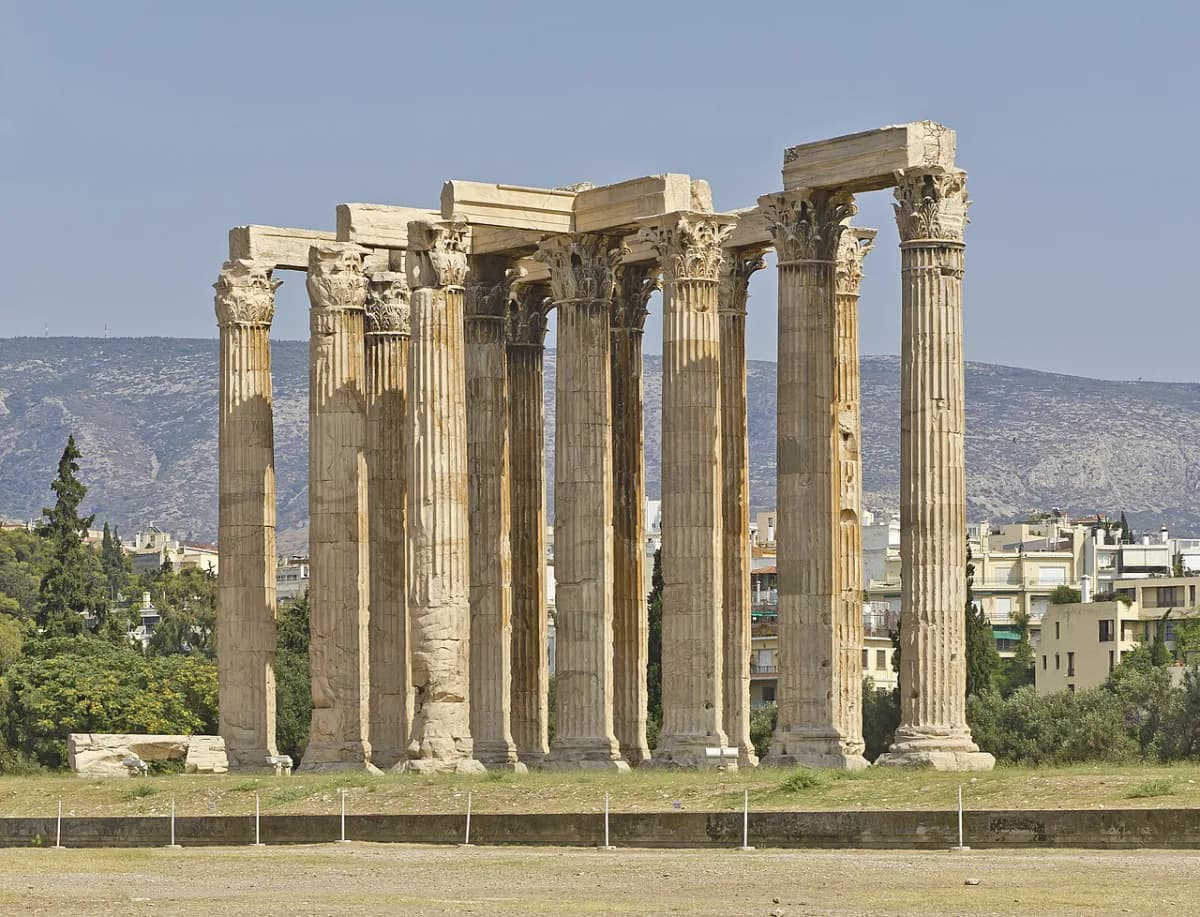
Standalone admission to the Temple of Olympian Zeus costs €6 in 2026, or €3 at the reduced rate — one of the cheapest tickets of any major site in central Athens. In summer (April 1–October 31) the site opens at 8 a.m. and stays open until roughly 7 p.m.; winter hours (November 1–March 31) run shorter, closing mid-afternoon. A five-day combined ticket covering the Acropolis and several other archaeological sites is also available for €30 full / €15 reduced, which is worth checking before you buy single tickets separately.
This guide covers exactly what a 2026 ticket costs, current opening hours by season, how long to realistically budget for a site that most visitors clear in under an hour, and how to get there from the Acropolis or Plaka. For the rest of the city's sights, see our Athens attractions guide.
What Is the Temple of Olympian Zeus?
The Temple of Olympian Zeus — also known as the Olympieion — was once the largest temple in Greece. Construction began under the tyrant Peisistratos around the 6th century BCE, then stalled for centuries through changes of ruler and political upheaval, leaving the project unfinished for roughly 650 years. It was finally completed in 131/132 CE under the Roman Emperor Hadrian, who marked the occasion by dedicating a colossal chryselephantine (gold-and-ivory) statue of Zeus inside, alongside a statue of himself.
At full scale the temple carried 104 towering Corinthian columns, each around 17 meters tall. Today only 15 remain standing; a 16th toppled during a storm in 1852 and still lies where it fell, giving visitors a rare close-up look at how the column drums were assembled. Hadrian's Arch, built the same year the temple was completed, stands just outside the enclosure and once marked the boundary between the old city of Theseus and "Hadrian's new Athens." The whole site sits southeast of the Acropolis, in a green, sunken plaza between Vasilissis Olgas Avenue and the edge of the National Garden.
Temple of Olympian Zeus Tickets & Prices 2026
As of mid-2026, standalone admission is €6 for a full ticket and €3 for the reduced rate. Reduced and free-entry eligibility follows the same categories used across Greece's state-run archaeological sites — among them EU citizens under 25 with valid ID, children, and people with disabilities — with the complete, current list published on the site's official ticket page, since the Ministry of Culture and Sports sets and occasionally revises eligibility criteria.
A five-day combined ticket covers the Temple of Olympian Zeus alongside the Acropolis, the Ancient Agora, the Roman Agora, the Theatre of Dionysus, Kerameikos, and several other archaeological sites across the city, priced at €30 full / €15 reduced. If you're already planning to visit the Acropolis and one or two of the other included sites, the combo pays for itself quickly rather than buying separate tickets at each gate. If you're weighing a multi-attraction city pass instead, check whether the Athens Pass is worth it for the specific sights on your list, since passes don't always line up with the Ministry's own combined ticket.
Book directly through the official Hellenic Heritage e-ticket portal rather than a third-party reseller — official tickets are the same price and skip the markup some resale sites add for a ticket that doesn't require any priority-access engineering to book. Confirm exact current pricing there before you travel, since Greek state museum and site fees are reviewed periodically.
Opening Hours & Best Time to Visit
The site runs a seasonal schedule similar to the Acropolis nearby. In summer (April 1–October 31), it's open daily from 8 a.m. to roughly 7 p.m., with last entry around 30 minutes before closing. In winter (November 1–March 31), hours shorten to 8 a.m.–3 p.m. The temple is closed to the public on January 1, March 25 (Greek Independence Day), Orthodox Easter Sunday, May 1, and December 25–26 — confirm exact current hours on the official site before locking in a visit, since the Orthodox Easter date shifts every year and Greek sites occasionally adjust hours for heat advisories in midsummer.
Because admission is inexpensive and the site is small, it doesn't build the timed-entry queues that the Acropolis does — most visitors move through in a steady, unhurried stream rather than waiting at a gate. Early morning, right after opening, and the last hour before closing are still the quietest and coolest windows, particularly from June through August when the open, shade-free plaza gets hot by midday.
How Long to Plan for Your Visit
Most visitors spend 20 to 40 minutes at the site — enough time to walk the perimeter of the surviving columns, see the fallen 16th column up close, look at Hadrian's Arch just outside the enclosure, and take photos from the elevated viewing path. It's rarely a half-day destination on its own; most itineraries treat it as a short add-on between the Acropolis and a walk through the old town. For a fuller schedule that fits it in alongside the rest of the city, see our 2-day Athens itinerary.
How to Get to the Temple of Olympian Zeus
The temple sits between Syngrou Avenue and Vasilissis Olgas Avenue, just southeast of the Acropolis and directly across from the entrance to the National Garden. The nearest metro stop is Akropoli on Line 2 (the red line), roughly a 10-minute walk to the site entrance near Hadrian's Arch. Syntagma station (Lines 2 and 3) is a similar distance in the other direction, making the temple an easy stop whether you're walking from Plaka or from the Syntagma Square area.
There is no dedicated on-site parking, and central Athens' one-way streets make driving impractical for what is, for most visitors, a short stop. Walking from the Acropolis takes about 15 minutes downhill through the Plaka and Makrygianni neighborhoods, and walking from Plaka itself takes well under 10 minutes — this is why most people fold the temple into a longer walking loop rather than treating it as a standalone trip.
Visit Tips: Queues, Booking & Common Mistakes
Queues are rarely the issue here — the more common mistake is the opposite problem, rushing through in five minutes because the site looks small from the entrance. Slow down at the fallen column near the eastern corner; it's one of the few places anywhere in Greece where you can see the individual stacked drums that made up a classical-era column up close, rather than viewing a column only from the ground looking up.
If you're planning to see three or more archaeological sites in the same trip, buy the combined ticket online before you arrive rather than at the gate — it saves a second transaction and works across all the included sites for five days. There's little shade on the plaza, so bring water and sunscreen even for a short visit in summer. Tripods and drone flights require special permits, the same rule that applies across Greece's state-run archaeological sites.
Nearby Attractions
The Acropolis of Athens is about a 15-minute walk uphill and, on the days it's included, shares nothing on its own ticket with the temple — but the two are the natural backbone of a single day out. The Acropolis Museum, a little closer to the Acropolis itself, is worth pairing with the temple if you're spending a half-day in this part of the city. Plaka, Athens' old neighborhood of narrow lanes and neoclassical houses, borders the temple grounds directly and is the obvious spot for lunch or coffee afterward.
Frequently Asked Questions
How much are Temple of Olympian Zeus tickets in 2026?
Standalone admission is €6 for a full ticket and €3 for the reduced rate as of mid-2026. A five-day combined ticket covering the Acropolis, Ancient Agora, Roman Agora, Theatre of Dionysus, Kerameikos, and other sites costs €30 full / €15 reduced. Confirm current pricing on the official ticket portal before you travel, since fees are reviewed periodically.
What are the Temple of Olympian Zeus's opening hours?
In summer (April 1–October 31), the site is open daily from 8 a.m. to roughly 7 p.m., with last entry about 30 minutes before closing. In winter (November 1–March 31), hours shorten to 8 a.m.–3 p.m. The temple is closed on January 1, March 25, Orthodox Easter Sunday, May 1, and December 25–26.
Is the Temple of Olympian Zeus included in the Acropolis combined ticket?
Yes. The Ministry of Culture and Sports' five-day combined ticket (€30 full / €15 reduced) includes the Temple of Olympian Zeus alongside the Acropolis, Ancient Agora, Roman Agora, Theatre of Dionysus, Kerameikos, and several other sites. If you're visiting three or more of the included sites, it's cheaper than buying separate single tickets.
How long does it take to visit the Temple of Olympian Zeus?
Most visitors spend 20 to 40 minutes at the site, enough time to walk around the surviving columns, see the fallen 16th column, and view Hadrian's Arch just outside the enclosure. It's usually paired with a longer visit to the Acropolis or a walk through Plaka rather than treated as a standalone half-day stop.
Is the Temple of Olympian Zeus worth visiting?
Yes, especially given the low admission price and its location directly between the Acropolis and Plaka. The site rewards a short, unhurried look rather than a rushed pass-through — the fallen column and the sheer original scale of the temple (once the largest in Greece) are easy to miss if you don't slow down at the entrance.
The Temple of Olympian Zeus is an easy site to underrate: at €6 for standalone admission, it's one of the least expensive stops in central Athens, and its 15 surviving columns are a genuine link to a building project that spanned roughly 650 years and two empires. The honest caveat is that it rewards a slower look — the fallen column and Hadrian's Arch are easy to walk past if you treat the visit as a five-minute photo stop.
Buy the €6 standalone ticket, or the €30 combined ticket if you're also doing the Acropolis and Ancient Agora, aim for early morning or the last hour before closing in summer, and budget 20 to 40 minutes on-site. Pair it with a walk through Plaka afterward, and it fits comfortably into an afternoon alongside the Acropolis in 2026.
For the latest official information, see the Hellenic Ministry of Culture's Temple of Olympian Zeus page.