
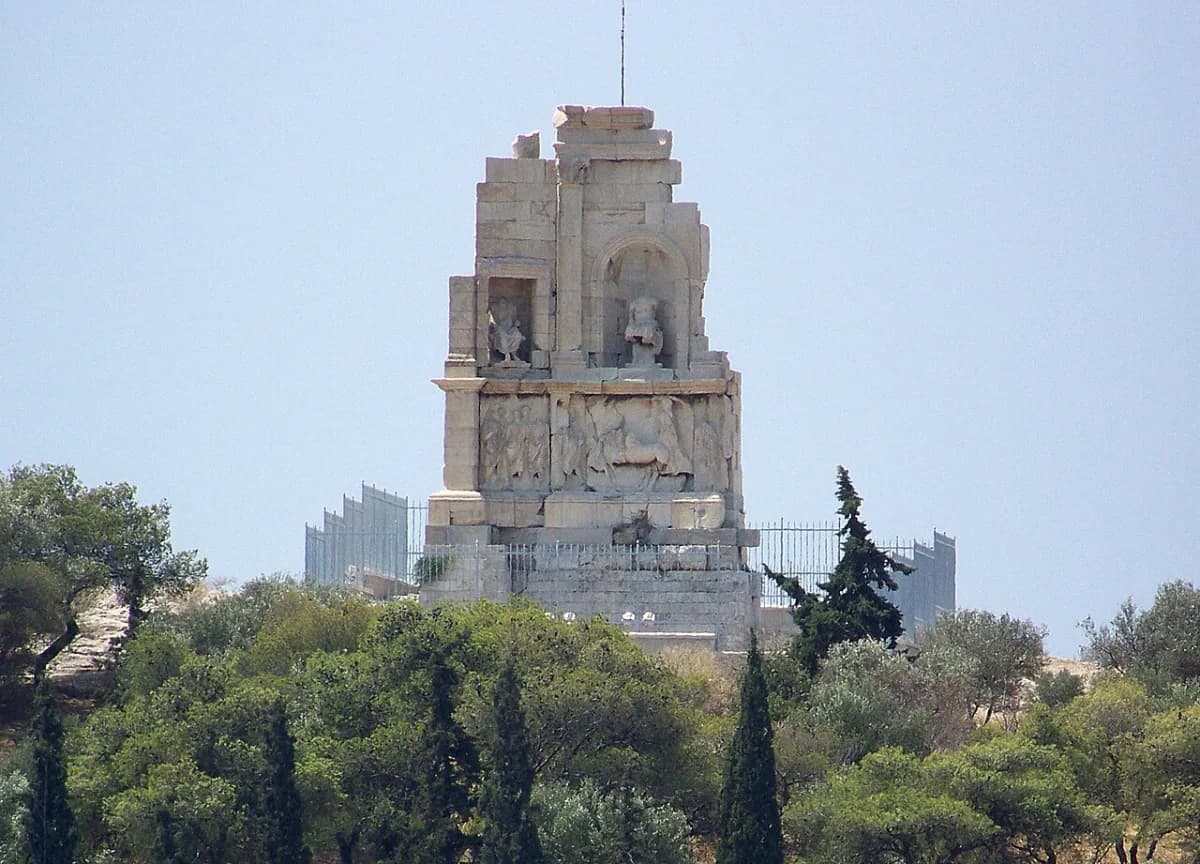
There's no ticket to buy for Philopappos Hill, because it doesn't sell any: admission is free and the park is open 24 hours a day, every day of the year, with no gate, no turnstile, and no posted closing time. That single fact is the most useful thing anyone searching "Philopappos Hill tickets" needs to know — unlike the paid Acropolis a few hundred meters away, this is an open public archaeological park, and the only real cost of visiting is the walk up.
This guide covers what's actually on the hill (a 2nd-century marble monument, the Pnyx, and the rock-cut chambers known as Socrates' Prison), when to go for the best light and fewest crowds, how long to realistically budget, and how to get there on foot from the Acropolis or by metro. For the rest of the city's sights, see our Athens attractions guide.
What Is Philopappos Hill?
Philopappos Hill — also called the Hill of the Muses, or Mouseion Hill — is a 147-meter rocky rise southwest of the Acropolis, crowned by a two-story marble monument built around 114–116 CE. The tomb honors Gaius Julius Antiochus Epiphanes Philopappos, an exiled prince of the Kingdom of Commagene who became a Roman consul and, later, an honorary Athenian citizen popular enough with the city that it erected this monument after his death. His sister, Julia Balbilla, is thought to have commissioned it alongside the Athenians themselves.
The structure is built from white Pentelic marble, roughly 9.8 by 9.3 meters at the base. Its lower frieze depicts Philopappos as a Roman consul riding in a chariot procession; the upper level holds three seated statues of his ancestors, framed by Greek and Latin inscriptions recording his lineage and titles. Long before the monument existed, the hill already carried legendary weight — ancient tradition held it as the burial place of Musaeus, a mythical seer and poet, which is where the "Hill of the Muses" name comes from.
The hill sits within a wider green space, the Filopappou archaeological park, which also contains the Pnyx (the open-air meeting place where the Athenian assembly voted from the 6th century BCE onward — one of the earliest physical sites of democratic government anywhere) and the Hill of the Nymphs. The stone-paved paths connecting them were laid out in the 1950s by architect Dimitris Pikionis, a project now studied as a landmark of modern Greek landscape design in its own right.
Philopappos Hill Tickets & Prices 2026
As of mid-2026, admission to Philopappos Hill costs nothing. There is no ticket window, no online booking step, and no scanned code at any entrance to the park. That covers the summit monument, the Pnyx, the Hill of the Nymphs, and Socrates' Prison alike — none of it falls under the Ministry of Culture's paid combined ticket that covers the enclosed Acropolis, Ancient Agora, and other fenced archaeological sites nearby.
The only cost some visitors do pay is optional: a handful of tour operators sell guided walking tours of the hill, usually bundled with a wider Acropolis or Plaka walk, priced for the guide's time rather than any site admission. If you're weighing a multi-attraction city pass before your trip, check whether the Athens Pass is worth it for the sights you actually plan to visit — Philopappos Hill doesn't require or benefit from any pass, since there's nothing to unlock here that isn't already open to everyone.
Opening Hours & Best Time to Go
Philopappos Hill has no posted opening or closing hours because the park never closes — the paths, viewpoints, and monument grounds are accessible around the clock, including on public holidays when the ticketed Acropolis and nearby museums are shut. That makes it a rare fallback in Athens: if you land at odd hours or need a view outside normal museum hours, the hill is always an option.
"Open 24/7" is not the same as "well-lit 24/7," though. After dark the upper paths have limited lighting, and most visitor guides recommend going with company rather than alone once the sun is down. For photography, sunset is the single most popular window — as light hits the Parthenon's western face across the valley, the marble shifts from gold to pink to a deep amber, and the hill's eye-level angle makes it one of the best vantage points in the city for that view. Early morning is a quieter alternative with similarly strong light and far fewer people. Conditions and any temporary path closures can change, so it's worth a quick check before a night visit.
How Long to Plan for Your Visit
Budget 20 to 30 minutes if you're only climbing to the summit monument for the Parthenon view and photos — the paved path from the base takes roughly 15 minutes at an easy pace. Add the Pnyx and Socrates' Prison, both just steps off the main path, and a fuller loop of the whole archaeological park runs closer to 1 to 2 hours. Neither extension requires backtracking far, so it's easy to fold in without derailing the rest of a day built around the Acropolis.
How to Get to Philopappos Hill
The nearest metro stop is Akropoli on Line 2 (the red line), about a 5-minute walk to the base of the hill along Dionysiou Areopagitou Street, Athens' pedestrianized promenade that skirts the south side of the Acropolis. From the Acropolis itself, it's roughly a 15-minute walk continuing west along the same street and then Apostolou Pavlou Street, which curves around toward the hill's main entrances.
There's no dedicated on-site parking, and central Athens' one-way streets and pedestrian zones make driving impractical for what is, for most visitors, a short walk-up stop. The climb itself starts on paved, gentle paths near the base and transitions to a packed dirt trail closer to the summit — manageable for most fitness levels, but not stroller- or wheelchair-friendly on the upper stretches.
Visit Tips: What to Know & Common Mistakes
There are no queues to plan around here — no ticket booth means no line, at any hour. The more common mistake is treating the hill purely as a Parthenon photo stop and skipping the Pnyx and Socrates' Prison, both of which sit just off the main path and cost nothing extra to see. The Pnyx in particular is easy to walk past without realizing it's the physical spot where the Athenian assembly met and voted more than two thousand years ago.
Wear proper walking shoes rather than sandals — the dirt sections near the summit get uneven and can be slippery after rain. There's little shade once you're above the treeline, so bring water in summer, when midday heat on the exposed upper paths can be uncomfortable; the golden-hour and early-morning windows are cooler as well as better lit. If you're visiting for sunset, bring a phone flashlight for the walk back down, since the upper paths lose light quickly once the sun sets and lighting along the route is limited.
Note that "Socrates' Prison" — the set of rock-cut chambers near the base of the hill — is a traditional association rather than a confirmed historical fact; treat it as local legend worth seeing rather than a verified archaeological claim.
Nearby Attractions
The Acropolis of Athens is the obvious pairing — Philopappos Hill exists largely because of the view across the valley to it, and the two make a natural single outing on foot. The Ancient Agora, the commercial and civic heart of classical Athens, sits a short walk to the north and pairs well with the Pnyx if you're interested in the mechanics of Athenian democracy. Plaka, the city's old neighborhood of narrow lanes and neoclassical houses, borders the base of the hill and is the natural spot for a meal or coffee afterward. If you're after more low-key, less crowded stops like this one, our hidden gems in Athens guide has several in the same spirit.
Frequently Asked Questions
Do you need a ticket for Philopappos Hill?
No. Philopappos Hill is free to enter at every access point, with no ticket booth, online booking, or scanned code anywhere on the paths. This covers the summit monument, the Pnyx, the Hill of the Nymphs, and Socrates' Prison — none of it is part of the paid Acropolis-area ticket.
What are Philopappos Hill's opening hours?
The park has no posted opening or closing hours and is accessible 24 hours a day, including public holidays when the ticketed Acropolis and nearby museums are closed. Lighting on the upper paths is limited after dark, so most visitors go during daylight or for sunset rather than late at night.
How long does it take to visit Philopappos Hill?
Plan 20 to 30 minutes for just the summit monument and Parthenon view. Adding the Pnyx and Socrates' Prison, both just off the main path, brings a fuller loop of the archaeological park to roughly 1 to 2 hours.
Is Philopappos Hill worth visiting?
Yes. It offers one of the best eye-level views of the Parthenon in Athens, it's free, and it's noticeably less crowded than paid viewpoints like the Acropolis itself or Lycabettus Hill. Sunset is the standout time to go for photography.
How do you get to Philopappos Hill?
The nearest metro stop is Akropoli on Line 2, about a 5-minute walk to the base along Dionysiou Areopagitou Street. From the Acropolis itself, it's roughly a 15-minute walk continuing along the same pedestrianized street and then Apostolou Pavlou Street.
Philopappos Hill is an easy site to underrate precisely because it costs nothing: with no ticket to buy and no closing time, it's simple to treat as an afterthought rather than plan around. That undersells it — the eye-level Parthenon view, the Pnyx's direct link to the origins of Athenian democracy, and the quieter pace relative to the paid sites nearby make it one of the better free stops in central Athens.
Go for sunset if photography is the priority, or early morning for a cooler, quieter climb. Either way, budget at least an hour if you want to see the Pnyx and Socrates' Prison alongside the monument, wear real walking shoes for the dirt sections near the top, and pair the visit with the Acropolis or a walk through Plaka to fill out the rest of the day in 2026.
For background on the monument and site history, see the Philopappos Hill entry on Wikipedia.