
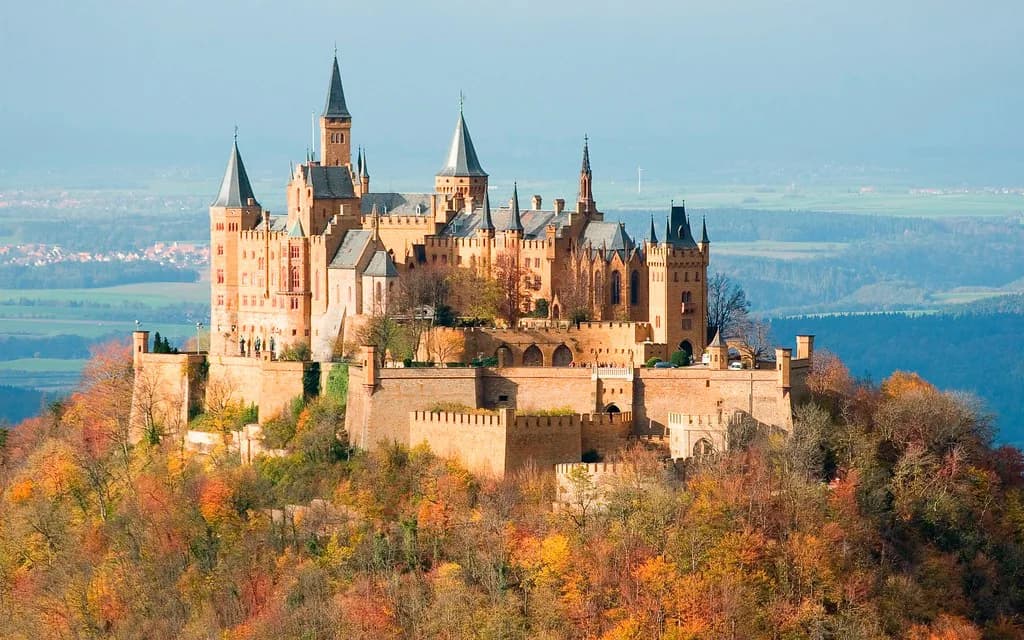
The detail that changes every budget on a Hohenzollern Castle day trip is the ticket scope: the admission price already includes the parking fee for cars and motorbikes as well as the shuttle bus between the visitor car park and the Eagle's Gate, the castle's entrance gate. You are not paying a car-park charge and a shuttle fare on top of admission.
The castle is still privately owned by the Hohenzollern family and looks back on around 1,000 years of building and family history; today's structure is the third fortress on the Zoller Mountain, rebuilt between 1850 and 1867 after its two predecessors were destroyed or decayed. That private ownership is why upkeep is financed through admissions rather than government support.
This guide separates the castle complex from the ticketed showrooms, explains the shuttle and the final uphill walk, flags the closures that fall inside the 2026 season, and sets the outing against a Ludwigsburg Residential Palace day trip from Stuttgart, which moves at a very different pace.
What your Hohenzollern admission ticket actually includes
The castle complex and the showrooms run on different hours inside the same season, and the ticket page is the only reliable place to check current inclusions and prices, because both change between seasons. What is documented is the structure: admission prices include the shuttle bus between the visitor car park and the Eagle's Gate, plus parking for cars and motorbikes. Motorhome parking is priced separately and must be paid via the online ticket shop or the terminal in the parking shop.
Two scope traps catch people out. First, the castle restaurant sits inside the museum grounds, which are subject to admission, so a meal there is not a stand-alone hillside stop unless you hold a valid castle ticket. Second, the showrooms and the Treasury are ticketed interiors with their own rules; the grounds and outdoor areas follow a different scope. Do not assume one purchase opens every part of the site.
Tickets can be bought on-site at the parking-lot shop if any remain, but the castle states that on busy days tickets may no longer be available on-site and recommends buying online. Tickets cannot be cancelled or rebooked. If your travel dates are fixed, buying ahead removes the risk of reaching the hill with nothing to do but turn around.
Getting there from Stuttgart: car, train and the shuttle handover
The most-quoted shorthand, that Hohenzollern is about an hour from Stuttgart, comes from a personal blog's day-trip roundup and is explicitly a driving estimate, not a rail time. No source checked here gives train routes, operators or journey times from Stuttgart to the castle, so treat any specific rail figure as unverified until a transport operator confirms it.
By car the picture is clear: two car parks and one coach park sit halfway up the castle hill, with the upper lot P1 as the main parking area holding a shop and restrooms, and P2 opened when needed. The same blog that lists Hohenzollern among six day trips from Stuttgart frames it as the most elaborate castle within driving distance of the city, which is a fair description for a car-based outing.
If you intend to arrive by public transport, verify the final leg before committing, because the castle's arrival information is written in terms of the car parks and the shuttle rather than rail connections. Confirm with the local transport authority which station serves the castle area, then confirm with the castle information desk how to reach the shuttle from there. Do not assume a station-to-gate connection exists simply because the castle is well known.
Parking, the shuttle and the last 350 metres
The shuttle runs between the visitor car park and the Eagle's Gate roughly every fifteen minutes. It is not the end of the climb: from the gate it is about 350 metres uphill to the castle courtyard, partly over cobblestones. Alternatively, an elevator a few metres from the Eagle's Gate rises to the Schnarrwacht bastion, which sits about 50 metres from the courtyard. That lift is the difference between a short walk and a sustained slope for many visitors.
Facilities support a car-based day: there are spacious toilets in the upper car park P1 and inside the castle, both described as accessible, and payment on site is by debit card, major credit cards or cash. Motorhomes have five designated spaces in P1 without water connections or waste disposal, though the P1 toilets can be used.
Build in slack for the shuttle and the walk, particularly on busy weekends and during the castle's events. The shuttle interval is published, but demand is not, and a missed bus at a hilltop site costs more time than a missed bus in a city centre.
Accessibility: what works and what does not
The shuttle between the visitor car park and the Eagle's Gate is wheelchair accessible and also suitable for a baby carriage, and the elevator near the gate removes most of the ascent to the courtyard. Wheelchair users may use their chair in the museum rooms, the Treasury is reachable from the courtyard without stairs, and the castle grants free admission to two people accompanying a wheelchair user.
The hard constraint is the staircase of 25 steps that must be climbed to reach the museum rooms. The castle states plainly that it cannot provide suitable staff to assist and asks visitors to assess the feasibility themselves, with help from their own relatives if needed. That is a personal judgement no ticket desk can make for you.
Walking aids such as a rollator, crutch or cane are permitted in the museum rooms provided they are rubberised and will not damage floors or furniture; long and sharp objects such as walking sticks or umbrellas are not allowed in the showrooms. Baby carriages and buggies are not permitted in the museum rooms. Accessible toilets are available in the P1 parking lot and on the castle grounds a few metres below the courtyard.
Interior showrooms: is the paid core worth it?
The castle's own pages do not describe the interior visit as a compulsory guided tour, so treat claims that a tour is mandatory with caution. The showrooms are the paid heart of a visit, presented by the castle as a glimpse into its magnificent chambers; a personal day-trip blog describes chandeliers, gold ceilings, opulent art and antiques across dozens of spacious rooms, which is an impression rather than an official description.
Because the showrooms and the Treasury are ticketed interiors while the grounds and outdoor areas follow a different scope, decide before you climb which version of the day you want: a shorter visit built around the courtyards, the Treasury and the views, or the longer interior circuit through the museum rooms.
Two practical points shape that experience. Photography and filming are permitted in the outdoor area and in the museum rooms without flash or tripod for private use, but not in the Treasury. In cold months the museum rooms are not heated and the castle advises dressing warmly, which changes how long the interiors stay comfortable.
If you are weighing whether to spend the interior hours here or elsewhere in the city, the Stuttgart: Museum Comparison is a useful cross-check before you commit a whole day to one hill.
2026 season dates and the closures that matter
For the 2026 season the castle lists the period from 28 March to 1 November, with the castle complex open daily from 10:00 to 18:30 and the showrooms from 10:00 to 18:00, last admission to the showrooms at 17:30 and the shop closing at 18:30. Those hours belong to the stated season and should not be read as year-round opening. The castle also notes that on Sunday 11 October 2026 it does not open until 13:00.
After the main season there is a distinct window from 2 November to 15 November 2026 when the museum rooms are closed but the castle grounds, shop and restaurant remain open from 11:00 to 17:30, with last admission at 16:30. That is a materially different visit: the hill, the views and the walk without the interiors. The castle was then fully closed from 16 to 19 November 2026 ahead of Royal Winter Magic, which ran from 20 November 2026 to 10 January 2027; on the date of this review that winter event has already finished.
One long-running closure affects planning well beyond this season: the Protestant Christ Chapel has been closed for restoration work since 10 August 2026, with the closure stated to run through 31 December 2027. A chapel visit should not be part of your plan for a trip in that period. Check the castle's information and events pages close to your travel date, since these dates are the castle's own and can change.
Cold months, lighting and what to pack
The castle is open almost every day during the cold months, but the museum rooms are not heated, so the interiors reward warm layers and shoes that cope with a 350-metre cobbled climb. Evening illumination is another timing detail: from the first Advent to Candlemas the castle is lit daily, and from Candlemas to the first Advent it is lit on Fridays and Saturdays, with the lighting switching off at 22:30.
With the Christ Chapel out of action and the interiors unheated, the shoulder season suits visitors who care more about the silhouette on the hill and the Swabian Alb views than about room-by-room interior time. If the showrooms are the priority, target the main season window instead. Whatever you choose, the castle publishes a live webcam, which is a more honest weather check than any forecast for a hilltop site.
If your trip is built around winter travel more broadly, the Stuttgart on a Rainy Day guide covers indoor fallbacks for the days when the hill is better seen from a distance.
Bags, photography, dogs and drones: the house rules
To protect the historic interior, hiking rucksacks, walking sticks and umbrellas are not permitted in the museum rooms; rucksacks can be left at the visitor information desk and there are bins for hiking poles and umbrellas at the museum entrance. Smaller rucksacks may be taken in but must be worn on the chest.
Dogs on a lead of no more than two metres may access the castle grounds but not the museum rooms, chapels or cellar rooms, regardless of type, size or how they are carried. Dogs may ride the shuttle and enter the castle restaurant provided they do not impair the safety and well-being of other guests. A certified assistance dog with the appropriate ID or proof of training and a visible badge may accompany its user inside the museum.
Drones and other remote-controlled model aircraft are prohibited on and above the entire castle grounds and castle hill, including the parking lots, under both statutory and private-law rules, and the castle administration states it will report violations to the police. Outside the castle hill, launching a drone on public or permitted land is allowed only while maintaining a minimum distance of 500 metres from the castle, with no closer approaches or overflights.
Hohenzollern versus Ludwigsburg: how to choose
The honest comparison is a difference in shape, not a ranking. Hohenzollern is a privately owned mountaintop fortress reached by shuttle and a final uphill walk, with a compact set of ticketed interiors and an unusually dramatic setting. Ludwigsburg Residential Palace is the other obvious axis from Stuttgart: a large palace complex with gardens that supports a slower, flatter day on foot. Choose on the axes you can control, such as how much uphill walking suits your group and whether step-free access is required.
Reliable side-by-side data on ticket scope, room counts or tour formats for the two sites is not available in the sources checked here, so no definitive verdict is offered. If your group includes someone with limited mobility, the 25-step staircase to the Hohenzollern museum rooms is a genuine constraint even though the shuttle and lift cover much of the ascent; if gardens and grounds matter more than a summit, Ludwigsburg is likely to fit the day better.
For a fuller picture of what the palace day involves, the Ludwigsburg Residential Palace guide sets out the complex in detail, and the Stuttgart: Parks and Gardens guide covers green alternatives if both castles feel like too much structure for one day.
If you would rather skip Hohenzollern
The same shortlist that includes Hohenzollern also names Lichtenstein Castle, Wiblingen Abbey, Urach Waterfall, Heidelberg and Tübingen. Lichtenstein is a smaller castle on a cliff perch, Wiblingen an abbey in Ulm with a celebrated Rococo library, Urach a moderate waterfall hike with a restaurant at the top, while Heidelberg and Tübingen are town days rather than single-site visits. The driving times in that list come from a personal blog, not an operator, so treat them as rough planning aids.
If you would rather stay in the city, the Stuttgart: Landmark Visitor Guides hub shows what the alternatives look like at the same level of practical detail.
A suggested visiting duration
The castle publishes no recommended visit length, so this is our suggestion rather than official guidance. For a half-day, allow roughly three hours on the hill: the shuttle up, the courtyard, the Treasury and the walk back down. That covers the setting and one ticketed interior without rushing.
For a fuller day, allow four to five hours and include the museum rooms alongside the outdoor areas, with time for the restaurant inside the museum grounds. In the 2 to 15 November 2026 window the timetable compresses sharply: grounds, shop and restaurant close at 17:30 with last admission at 16:30, so a late start leaves very little margin. Build the day around the last-admission time rather than the closing time.
Plan Your Visit
Make three checks before you commit. Confirm the season dates and any closures on the castle website, because the showrooms and the grounds follow different calendars and the long-running Christ Chapel restoration continues into 2027. Confirm whether tickets are still available on-site, since busy days can sell out, the castle recommends buying online, and tickets cannot be cancelled or rebooked.
Then plan your own mobility honestly. The shuttle and the elevator remove most of the climb, but the 25-step staircase to the museum rooms has to be climbed to see those rooms, and only your group can judge whether that works. If it does not, the Treasury and the grounds still justify the trip.
If you need the wider city picture, the Stuttgart: Itineraries and City Travel Guides hub is the place to compare this outing against other ways to spend the day.
Frequently Asked Questions
Is Hohenzollern Castle worth visiting as a day trip from Stuttgart?
It is worth it if you want a dramatic hilltop setting and are prepared for a shuttle plus a short uphill walk. The castle is still privately owned by the Hohenzollern family, and the current building is the third fortress on the site, rebuilt between 1850 and 1867. The trade-off is that the interior experience is compact and partly stair-limited, so decide in advance whether you want the showrooms or mainly the grounds and views.
How do you get to Hohenzollern Castle from Stuttgart?
Driving is the best-documented option, with two car parks and a coach park halfway up the hill and the main lot P1 holding the shop and restrooms. The admission price includes parking for cars and motorbikes and the shuttle bus to the Eagle's Gate. The widely repeated one-hour figure is a driving estimate from a personal blog, not a rail journey time, and no train route or journey time is published in the sources checked here, so confirm any public transport connection with the local transport authority before relying on it.
What does the Hohenzollern Castle admission ticket include?
The admission price includes the parking fee for cars and motorbikes and the shuttle bus between the visitor car park and the Eagle's Gate. Motorhome parking is priced separately. The showrooms and the Treasury are ticketed interiors with their own access rules, while the grounds and outdoor areas follow a different scope. The restaurant sits inside the museum grounds and is therefore subject to admission, and the castle shop is not part of the museum interior.
How long should you spend at Hohenzollern Castle?
The castle publishes no official recommended duration. As an editorial suggestion, allow about three hours for a half-day focused on the shuttle, courtyard, Treasury and the walk down, or four to five hours if you add the museum rooms and a meal at the restaurant inside the museum grounds. In the November window, when grounds, shop and restaurant close earlier and last admission falls earlier still, plan around the last-admission time rather than the closing time.
Can you visit Hohenzollern Castle without the interior tour?
Yes. The castle complex and the showrooms have separate opening times within the season, and the grounds and outdoor areas can be visited without entering every ticketed interior. The official pages do not describe the interior visit as a compulsory guided tour, so that framing should not be treated as a castle rule. If you skip the interiors, the Treasury remains reachable from the courtyard without stairs.
Is Hohenzollern Castle accessible for wheelchair users?
Partly. The shuttle between the visitor car park and the Eagle's Gate is wheelchair accessible, and an elevator a few metres from the gate leads to the Schnarrwacht bastion, roughly 50 metres from the courtyard. The Treasury is reachable from the courtyard without stairs, and free admission is granted to two people accompanying a wheelchair user. However, a staircase of 25 steps must be climbed to reach the museum rooms, and the castle states it cannot provide staff to assist, so wheelchair users should assess that step themselves, with help from their own companions if needed.


