
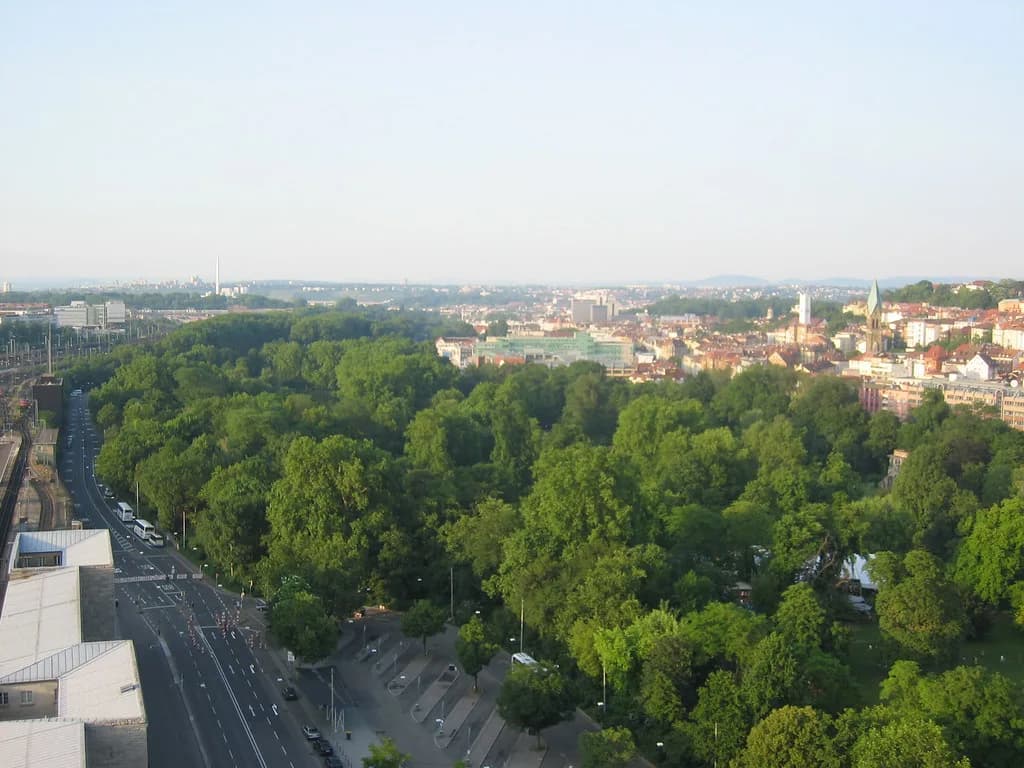
Stuttgart's name usually travels with Porsche and Mercedes-Benz, yet the everyday city is unusually green. This guide is organised around a single decision: what you can walk into freely and around the clock, and what needs a ticket, a queue or a fixed time slot. That split matters more in Stuttgart than in most cities, because two of its best-known green spaces sit side by side but work completely differently. You can start with the Stuttgart: Itineraries and City Travel Guides hub if you want to see how a green half-day fits into a longer stay.
A good example of the free-versus-paid distinction is Killesberg Hill Park, whose grounds Stuttgart's tourist office lists as open from midnight to midnight every day of the week, with no closing day. The same page describes a 40-metre tower, children's play areas, a petting zoo and an outdoor pool, but all-hours grounds access does not automatically extend to those individual facilities. Treat each one as a separate check rather than assuming one opening time covers the whole hill.
Killesberg Hill Park: Free Grounds, Optional Extras
Killesberg is the easiest green space to recommend to a first-time visitor because the entry decision is already made for you: the park itself is free and open around the clock. Stuttgart's official tourism site lists the grounds as accessible from 00:00 to 24:00 daily and describes them as a family destination close to the centre. That combination of no ticket, no closing time and a central location makes it the lowest-risk option when your schedule shifts. The managed attractions on the hill are a different matter, so budget them as optional rather than included.
The 40-metre tower is the one feature worth deciding on in advance, because it changes how much time you spend on the hill. The same listing confirms the tower exists and gives its height, along with play areas, a petting zoo, a narrow-gauge railway and an outdoor pool as park facilities. What it does not publish is a current tower admission charge, so treat any figure you find quoted online as unverified until you confirm it on site or through the city's own pages. If paying to climb is not something you want to decide on the spot, plan your route so the tower is a bonus rather than the reason you came.
The narrow-gauge railway is the single most variable element of a Killesberg day, because it is a seasonal, staffed attraction rather than permanent infrastructure. Our sources confirm the park contains a narrow-gauge railway but say nothing about which days it runs or what traction is in use. Check the operating status shortly before you travel instead of building a family plan around a train ride. For a wider picture of the hill's layout and facilities, the Killesberg Park in Stuttgart page is a useful companion read before you go.
Rosenstein Park: The English Landscape Garden
Rosenstein Park feels different from Killesberg in almost every way: flatter, shadier and more obviously a designed landscape than an event ground. Baden-Württemberg's tourism board describes it as a setting that combines culture, experience and relaxation, and names two separate natural history museum locations associated with it. That phrasing is the key planning point — the park is the frame, and the museums are their own visits with their own arrangements. You can enjoy the grounds thoroughly without setting foot indoors, which is exactly why it works as a low-commitment stop.
The park contains two distinct museum sites, the Museum am Löwentor and the museum at Schloss Rosenstein, and they are generally treated as separately accessible rather than covered by one combined park ticket. Stuttgart's tourist listings show both as individual museum entries with separate exhibition information, which is why you should confirm opening days and any admission separately for each. If you only want a walk under old trees with a palace view, none of that matters and the park remains a straightforward, free outdoor stop. For a closer look at what sits where, use the Rosenstein Park Stuttgart visit planning page.
Rosenstein is also the park to choose when you want to pair greenery with a second, indoor stop without crossing the city. The tourism board's description explicitly frames it as a combination of culture and relaxation, which is a fair summary of how a half-day there tends to work. Build in a buffer if you plan to see a museum as well, because exhibition visits run to a different rhythm than a loop of the grounds. The museum fee, not the park, is what you should verify in advance.
Wilhelma: A Zoological and Botanical Garden on Paid Grounds
Wilhelma is the one entry in this guide that is not a city park you simply stroll into. Stuttgart's official tourism site lists it as Wilhelma – Zoo & Botanical Gardens, a single ticketed attraction that combines animal enclosures with historic botanical collections on the same site. That means your decision is binary: you buy admission and commit a substantial block of time, or you save Wilhelma for a dedicated trip and use a free park for a shorter outing. Mixing casual park time with a Wilhelma visit rarely works well, because the grounds reward slow walking rather than a quick pass-through.
Because Wilhelma is a paid attraction, all of its current commercial details — admission, opening times, seasonal variations and any combined offers — should be checked against the operator's own information close to your travel date. This guide deliberately does not quote a figure, because ticket values change and a stale number is worse than none. If you want to weigh the visit against the city's other ticketed sights, the Wilhelma Stuttgart tickets and visit planning page sets out the decision in more detail. Plan Wilhelma as a half-day minimum rather than a filler between two other stops.
Schlossgarten and the Green U: The Downtown Lawn Chain
The Schlossgarten is the green spine that most visitors cross without noticing, running from the centre outwards and connecting to the larger parks. Stuttgart's city administration handles the city's green spaces through its Garden, Cemetery and Forestry Office, the department behind the municipal park and forest network. That administrative link is a useful reminder that the parks you walk through are maintained public infrastructure, not commercial attractions. If you need to ask about a specific site, that office is the correct point of contact rather than a tourism desk.
In practice the Schlossgarten works as a connector: you can walk central lawns, then continue towards the eastern parks and Rosenstein without arranging transport. That is what makes the Green U concept useful for planning, because it turns several separate green spaces into one continuous low-cost day. Plan the route by direction rather than by attraction, starting in the middle of the city and moving east. Two green spaces in one day is realistic here; three is optimistic unless you keep each stop short.
Vineyards and Forest Walks: Verify Before You Plan
Stuttgart sits in a wine-growing region, and vineyard slopes are part of the city's landscape, but published detail on walkable routes, signage, gradients and accessibility is inconsistent. Treat any specific vineyard trail, its start point or its surface as something to confirm locally or through the city's green-space department before you build a day around it. The same caution applies to forest and lake walks: the terrain is real, but route information does not survive well online. Ask a tourist information desk in Stuttgart for a current printed route rather than relying on an older blog post.
Forest areas on the city's edge are a genuine alternative to the central parks when you want quiet rather than facilities, and they reward comfortable shoes and a checked route. Note that distance and duration figures circulating for lakeside and wildlife-park loops come from personal accounts rather than official measurement, so use them as rough scale only. If mobility, gradients or waymarking matter to your group, verify those points in advance instead of discovering them at the trailhead. For an itinerary that balances indoor sights with outdoor time, the 3-Day Stuttgart Itinerary is a practical starting point.
How to Choose: Free Grounds, Paid Interiors, Timing
Start by separating free grounds from ticketed interiors, because that one distinction resolves most planning questions in Stuttgart. Killesberg's grounds and Rosenstein Park are outdoor spaces you can enter without buying anything; Wilhelma and the two natural history museum sites are ticketed, and each has its own conditions. If your day is short or the weather is uncertain, default to a free park and treat anything indoors as a swap rather than an addition. That way a closed exhibition or a full car park does not derail the whole outing.
Second, match terrain to the people you are travelling with. Killesberg's hill and tower suit children who need play areas and a landmark to aim for, while Rosenstein's flatter landscape suits strollers, slower walkers and anyone who wants distance without climbing. Forest and vineyard routes sit at the other end of the spectrum and need more preparation. Be honest about which of those three profiles fits your group before you commit to a route.
Third, time your visit around crowds rather than around a checklist. Mid-morning on a weekend tends to concentrate families at the popular play areas, while weekday mornings leave the same grounds much emptier. Spring and autumn give you the most comfortable walking conditions without the summer heat, and autumn colour is a genuine reason to prioritise the larger landscape parks. If you want to see how these green spaces slot into a wider sightseeing plan, the Stuttgart: Landmark Visitor Guides hub covers the city's major ticketed attractions.
Plan Your Green Day in Stuttgart
The simplest way to plan Stuttgart's parks is to decide first whether you want free outdoor time or a ticketed half-day, then pick the space that matches. Killesberg gives you all-hours grounds and the most facilities; Rosenstein gives you a quieter landscape garden plus museum options you book separately; Wilhelma is a paid zoological and botanical visit that deserves its own slot. The Schlossgarten links the centre to the eastern parks, which makes it the natural connector if you want two spaces in one day.
Because opening times, railway operation, tower access and admission are the details most likely to change, confirm them with the operator or the city's green-space department shortly before you travel rather than trusting older write-ups. Build in slack: a free park absorbs a change of plan gracefully, while a timed ticket does not. Keep your list short, walk between neighbouring spaces where you can, and leave the rest for a return visit.
Frequently Asked Questions
Is entry to Killesberg Hill Park free?
The park grounds are listed by Stuttgart's official tourism site as open around the clock every day, and walking into the park itself does not require a ticket. Individual facilities on the hill, such as the tower, the outdoor pool and the petting zoo, are separate and may have their own conditions or charges. Check the current status of each facility before you rely on it, because operating patterns for staffed attractions change by season.
Is Wilhelma a park or a zoo?
Wilhelma is presented as a combined zoo and botanical garden on one ticketed site, not as a public park you can wander into freely. That changes how you plan the day: you commit to a paid visit and a longer block of time rather than treating it as a green shortcut between other stops. Admission, opening times and any seasonal variations should be checked directly with the operator close to your travel date, since those details are the ones most likely to change.
Can you visit Rosenstein Park and the natural history museums on one ticket?
No. The park is an outdoor space, while the two natural history museum sites associated with the area are separate indoor attractions with their own arrangements. Museum listings for the Löwentor site and the Schloss Rosenstein site appear individually, so treat park access and museum admission as two different decisions. If museums are the priority, confirm each site's current opening days and admission before you go, and check whether either has a closure period.
How much time should I allow for Killesberg compared with Rosenstein Park?
As a suggestion rather than official guidance, allow roughly two to three hours for Killesberg if you want the tower, a walk and time in the play areas, and around ninety minutes to two hours for a relaxed loop of Rosenstein. Rosenstein is flatter and easier to cover quickly, while Killesberg's hill and spread-out facilities reward a slower pace. Add time if you plan to visit a museum at Rosenstein, since an exhibition visit runs on its own schedule.


