
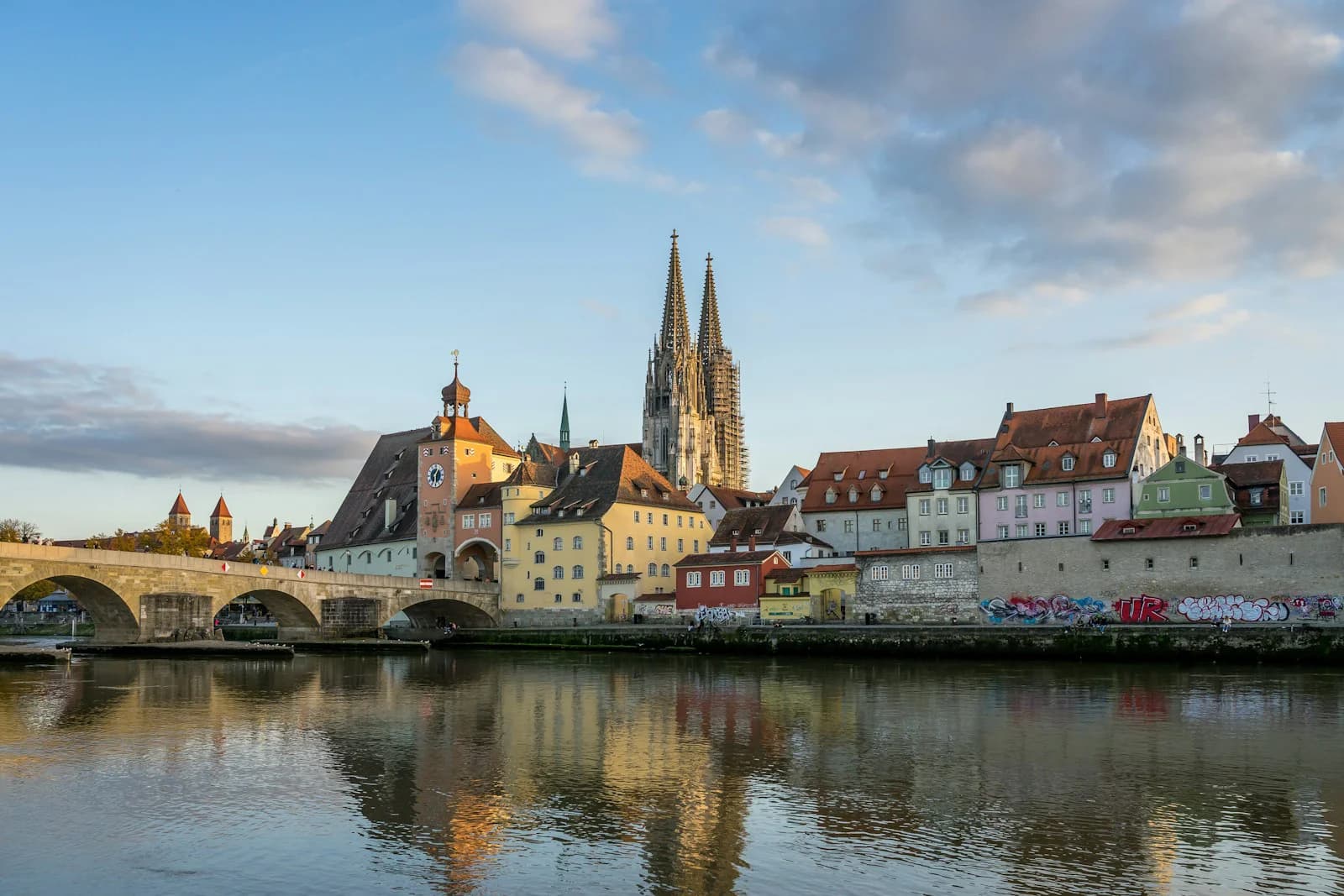
Regensburg's Altes Rathaus is visible from a distance thanks to the 55-metre council tower rising above Rathausplatz, and the city's tourism pages call it foremost among Regensburg's secular buildings. It is really a complex of three buildings raised at different times, which is why the facade reads as a patchwork of medieval and Baroque rather than a single design. A suggested visit of roughly twenty minutes covers the exterior, the Schutz and Trutz figures and the courtyard; that is editorial advice, not an official duration, and the guided interiors take longer.
The complex sits on Rathausplatz in the old town, and the Tourist Information desk occupies the ground floor of the Reichssaal building at Rathausplatz 4. That desk is the one place on site with published hours, so it doubles as the practical starting point for questions about tours. Around the corner on Zieroldsplatz you can see the statue of Don Juan de Austria, and directly opposite the town hall stands one of Germany's earliest coffee houses, which opened in 1686.
This guide treats the Altes Rathaus as a layered site rather than a single ticket, and it deliberately avoids quoting admission prices or tour departure times because those details are not published in the sources available here. Instead, it explains what each part is, which parts you can see on your own, and how to plan around the guided-tour model that governs the historic rooms.
What the Altes Rathaus Is and Where It Sits
The Altes Rathaus was built as Regensburg's status changed: the city was elevated to Free Imperial City in 1245, and the town hall complex grew from that point. The oldest element is the tower, while the hall building and the connecting portal wing came later, each reflecting a different era of civic ambition. That layered construction is the reason the complex looks mismatched, because it was never designed as a single unified building.
Rathausplatz itself has served as Regensburg's administrative hub for roughly eight centuries, according to the city's own online magazine, which puts the square's role in long perspective. For visitors, that means the town hall is embedded in the working old town rather than set apart as a monument. You will pass ordinary shops, cafes and offices on the way in, and the square's everyday function is part of its character.
The free, always-visible layer is the exterior: the tower, the late-Gothic portal with its Schutz and Trutz figures, and the courtyard spaces you can walk through. The guided layer covers the historic interiors, including the Reichssaal, the Reichstagsmuseum rooms and the Fragstatt in the cellar. Separating those two layers in your head prevents the common mistake of assuming one ticket or one tour covers everything.
The 55-Metre Council Tower and the Free Imperial City of 1245
The council tower, known as the Ratsturm, is the oldest part of the complex and stands around 55 metres high as an eight-storey structure. It was raised when Regensburg's new status as a Free Imperial City gave the council both wealth and a reason to advertise its authority on the skyline. The tower was not decorative: height carried political meaning in a medieval city competing with its peers.
From the square below, the tower is the easiest element to read without entering anything, and it frames the whole complex in photographs. There is no evidence in the sources here about climbing the tower or about step counts, so treat any claim of a tower ascent with caution and verify on site. What you can rely on is the tower's role as the anchor of the complex.
The Reichssaal: From Dance Hall to Perpetual Diet
The Reichssaal building went up around 1320 to 1330, and the great hall on its upper floor was originally intended as a dance hall, not a parliamentary chamber. Its importance came later: from 1663 the Perpetual Diet of the Holy Roman Empire met in Regensburg's Altes Rathaus for almost 150 years. That single fact explains why a city of Regensburg's size carries such outsized political history.
The city's tourism pages describe the Reichssaal as a forerunner of later parliaments, and even of the European Union and the United Nations, which is a bold framing but a useful one for understanding why the room matters. The hall retains a wooden ceiling and historic decoration that give a sense of the scale of those assemblies. Whether that framing convinces you is a matter of taste, but the room's political function over roughly a century and a half is not in dispute.
The Reichssaal is part of the guided interior experience rather than something you can simply walk into off the street. If the hall is the reason you are visiting, plan around a guided tour and confirm with the operator what the current route includes before you commit your day. The city's tourism pages frame the historic rooms as something to visit on a guided tour, which is the model to assume.
The 1408 Portalbau and the Schutz and Trutz Figures
The portal wing, or Portalbau, was added around 1408 and later modified, and it links the tower and the hall building while carrying a staircase to the upper floors. Its late-Gothic pointed-arch portal is flanked by carved city keys and two armoured half-figures known as Schutz and Trutz, meaning protection and defiance. The figures symbolised the city's readiness to defend itself, and they became one of Regensburg's recognised landmarks early on.
This is the part of the complex you can study closely without a ticket, and it rewards a few minutes of looking rather than a passing glance. The portal's carved details and the armoured figures are the most photographed elements of the facade for good reason. Look for the city keys, which tie the entrance to Regensburg's civic identity rather than to any royal or ecclesiastical patron.
Inside the Reichstagsmuseum: The Ticketed Interior Layer
The Reichstagsmuseum was established in 1963 and is dedicated to the history of the Imperial Diets that met in Regensburg. Its rooms include the Kurfürstenkollegium, the advisory chamber of the electors, and the Fürstliches Kollegium, the consultation room of the princes. Those two rooms matter because they show how the Diet actually worked: separate colleges negotiating before anything reached the full assembly.
The museum also holds a document collection, which is where the political history becomes tangible rather than abstract. Crucially, this is the ticketed interior layer, distinct from the free facade and courtyard. The sources here do not state admission prices or museum hours, so check with the operator rather than assuming a figure or a schedule.
Do not assume that a single ticket covers every part of the complex, including the Baroque wing, because no source here supports that claim. Treat the museum, the hall and any guided route as items to confirm individually when you plan. If you are travelling on a tight schedule, the Reichstagsmuseum and the Reichssaal are the two priorities worth building the visit around.
The Fragstatt: The Original Torture Chamber
In the cellar of the Altes Rathaus survives the Fragstatt, the medieval torture chamber complete with instruments, and it is described as original surviving fabric rather than a reconstruction. That distinction is the reason it is tied to guided visits: it is a fragile historic space, not a display you wander through at will. The tourism pages state plainly that it can be visited with guided tours.
Descriptions of the cellar also mention prison cells with stone walls and iron bars, which give a stark counterpoint to the grandeur of the hall above. The combination of council chamber and dungeon in one building is a reminder that civic power and civic punishment were administered from the same address. There is no reliable information here about accessibility, group sizes or how long the cellar section takes, so ask before booking if those points matter to you.
If the Fragstatt is a priority, say so when you enquire about a tour, because not every route may include the same rooms. The tourism pages list the Fragstatt alongside the Reichssaal and the museum as things to see on a guided visit, but they do not detail individual tour contents. Confirmation has to come from the operator.
Baroque Additions: The Neptune Courtyard and the South Wing
The complex was extended in the Baroque period, and the eastern side includes the Neptunhof, a courtyard named after its Neptune Fountain. The most notable addition is the South Wing, built between 1721 and 1723 on the site of the old Market Tower, which had burned down in 1706. Its grand portal is framed by Tuscan columns and adorned with allegorical figures representing virtues such as Faith, Peace, Justice and Prudence.
These additions explain why the Altes Rathaus does not read as a single-period monument: medieval tower, Gothic portal and Baroque wing sit within metres of each other. The courtyard and the South Wing's exterior can be appreciated without a ticket, so they are a sensible inclusion even on a short stop. The contrast between the medieval defence symbolism and the Baroque allegories of civic virtue is one of the more interesting things to notice on site.
Tours and How to Plan Around Them
The practical rule is simple: judge the Altes Rathaus by how much time you have. With twenty minutes, the facade, the Schutz and Trutz figures and the courtyard are a coherent stop. With an hour or more, a guided visit opens the Reichssaal, the Reichstagsmuseum rooms and the Fragstatt, which is where the building's political and judicial history actually lives.
The Tourist Information desk at Rathausplatz 4 sits in the ground floor of the complex and publishes desk hours of Monday to Saturday 9.30 to 18.00 and Sunday and holidays 9.30 to 16.00, per Regensburg Tourismus. Those are desk hours, not museum or tour hours, and the distinction matters when you are planning. Use them as the moment you can walk in and ask about current tours rather than as a guarantee of interior access.
Because tour times, prices and booking requirements are not published in the sources here, the correct move is to confirm directly with the operator before you travel. Ask specifically what the current tour includes, whether the Fragstatt is on the route, and whether you need to reserve in advance. That single enquiry removes most of the uncertainty from a visit.
If your timing is flexible, building the Altes Rathaus into a broader old-town walk works well, and a one day in Regensburg itinerary can help you sequence it alongside the cathedral and the Stone Bridge. On wet days, the indoor historic rooms make the town hall a stronger choice than an outdoor-only plan, which is worth remembering if you are weighing options for a rainy day.
Pairing the Altes Rathaus with the Rest of the Old Town
The Altes Rathaus sits inside the UNESCO World Heritage old town, and Regensburg holds two World Heritage titles: the medieval city listed in 2006 and the Danube Limes added in 2021. That context is why the town hall is worth seeing as part of a wider walk rather than in isolation. Nearby, the cathedral of St Peter and the Stone Bridge are the other anchors most visitors pair with it.
The Regensburg Cathedral visitor guide covers the Gothic cathedral a short walk away, which makes a natural pairing if you are building a half-day route. For something further afield, the Befreiungshalle Kelheim day trip from Regensburg sits outside the city and suits a separate outing rather than a combined town-centre walk. Keep the town hall morning for the compact old town and leave longer excursions for another day. Related guide: Regensburg Cathedral Tower Climb: Is It Worth It?.
Plan Your Visit
The Altes Rathaus rewards a little preparation more than most city landmarks, because the interesting parts are split between what you can see freely and what only opens on a guided visit. Decide first whether you want a facade-and-courtyard stop or the full interior experience, then plan the rest of your day around that choice. Either way, the tower, the portal figures and the courtyard make the square worth the detour.
Before you go, use the Tourism Regensburg and city pages to check what the operator currently publishes about tours, and ask the Tourist Information desk at Rathausplatz 4 about current arrangements during its published desk hours. Treat any price, departure time or booking rule you see elsewhere as unconfirmed until the operator says otherwise. If you want to widen the trip, the Regensburg: Landmark Visitor Guides collection and the Regensburg: Itineraries and City Travel Guides hub cover other sights and route ideas.
Frequently Asked Questions
Is the Altes Rathaus in Regensburg free to visit?
The exterior layer is free to look at: the tower, the late-Gothic portal with the Schutz and Trutz figures, and the courtyard spaces. The historic interiors, including the Reichssaal, the Reichstagsmuseum rooms and the Fragstatt, are reached on guided visits, and no source consulted here states admission charges. Confirm current arrangements and any fees directly with the operator before you travel.
Do you need a guided tour to see the Reichssaal?
Yes, the guided-tour model is how the historic rooms are presented. Regensburg's tourism pages list the Reichssaal, the Reichstagsmuseum and the Fragstatt as things to see on a guided visit, rather than as rooms you can enter independently. Check what the current tour includes before booking, because routes and inclusions can change.
What is the Fragstatt and can you visit it?
The Fragstatt is the medieval torture chamber in the cellar of the Altes Rathaus, and it survives in original form with its instruments rather than being a reconstruction. It can be visited as part of a guided tour according to the tourism pages. There is no reliable information here on accessibility, group size or timing, so ask the operator if those details matter for your visit.
How long should you spend at the Altes Rathaus?
That depends on which layer you choose. A facade-and-courtyard stop can be done in about twenty minutes, while a guided interior visit covering the Reichssaal, the museum rooms and the Fragstatt takes longer. No official duration is published, so treat any figures as suggestions and plan around your own pace and what the tour actually includes.
What is the difference between the Altes Rathaus and the Reichstagsmuseum?
The Altes Rathaus is the whole complex: three buildings from different periods, plus a Baroque courtyard and wing. The Reichstagsmuseum, established in 1963, is the museum inside that complex devoted to the history of the Imperial Diets, with rooms such as the electors' advisory chamber and the princes' consultation room. The museum is one part of the complex, not a separate building.
Where is the Tourist Information office at the Altes Rathaus?
It is on the ground floor of the complex at Rathausplatz 4 in Regensburg, which makes it the natural first stop for questions about tours. Regensburg Tourismus publishes desk hours of Monday to Saturday 9.30 to 18.00 and Sunday and holidays 9.30 to 16.00. Those are desk hours only, so use them to ask about current tour arrangements rather than as museum opening times.


