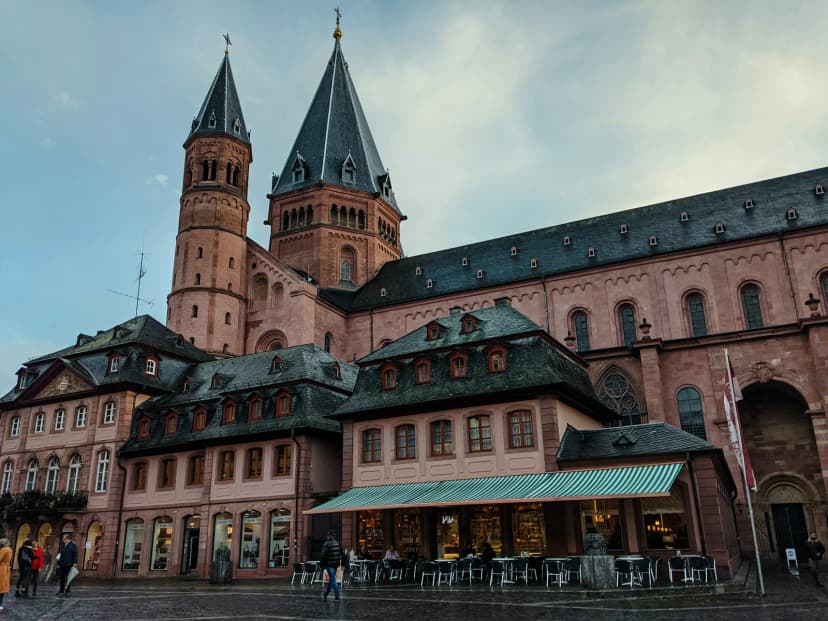
The City Museum at Fembo House occupies a late-Renaissance merchant's house at Burgstrasse 15, roughly halfway up the climb between the city hall and the Imperial Castle. The operator notes it is the only merchant's residence of its scale in Nuremberg to have survived the centuries intact, and since 1953 it has housed the city museum.
For orientation, the museum's Krone - Macht - Geschichte room presents the most important chapters of Nuremberg's history in about 30 minutes, with a multimedia guide in nine languages. That makes it a realistic first stop if you are short on time. Check the operator's visitor information page before you go, since hours, holiday exceptions and prices are published there and can change.
What the Fembohaus City Museum actually is
The Fembo House was built between 1591 and 1596 for the Dutch silk trader Philipp van Oyrl, in a prominent spot between the city hall and the Imperial Castle. It takes its name from a later owner, the art dealer Georg Christoph Franz Fembo, who played a key role in preserving the building. Since 1953 it has housed the city museum.
Quartiere Nürnberg describes the Fembo House as the last remaining trader and patrician family home in Nuremberg from the Renaissance and Baroque era, and notes that admission is free with the NÜRNBERG CARD. The museum sits within the network of Nuremberg Municipal Museums, which also includes Albrecht Dürer's House, the Toy Museum and the Museum for Industrial Culture.
Opening hours and 2026 holiday exceptions
Standard opening hours are Tuesday to Friday 10:00-17:00, and Saturday and Sunday 10:00-18:00. During the Christmas market the museum also opens on Mondays 10:00-17:00, but that Monday opening is seasonal and should not be treated as a permanent schedule. It is closed on Mondays outside that period.
The operator publishes a short list of 2026 public holidays that follow different hours: 1 November 10:00-18:00, 24 December closed, 25 December closed, 26 December 10:00-18:00 and 31 December 10:00-18:00. Do not extend or generalise this list to other holidays, because the source does not. If your visit falls on any other public holiday, check the museum's own visitor information before travelling.
Because the hours page is published by the operator, it is the right place to confirm your date. Treat third-party listing sites with caution, since some recycle stale times and even wrong country details.
Tickets, reduced rates and the day-ticket upgrade
The museum's published admission includes the Krone - Macht - Geschichte exhibition room. The operator lists an adult ticket, reduced tickets, a per-student rate for school classes, a group rate for parties of 15 or more, and a small-group ticket covering one adult with up to three children under 18. Because these figures are volatile, confirm them on the operator's visitor information page when you plan.
The decision worth understanding is the day-ticket upgrade. For a modest supplement, the operator lets you convert your admission into a day ticket that gives same-day free entry to the other municipal museums. That only pays off if you can realistically fit a second municipal museum into the same day; if you are already short on time, the upgrade is money spent rather than saved.
The day ticket does not cover everything. Special tours, including the costume tours at Albrecht Dürer's House and Tucherschloss, as well as the medieval Lochgefängnisse, the Historischer Kunstbunker and educational programmes, are excluded from the museum's regular admission pricing. Read the exclusion list before assuming a single ticket opens every Nuremberg museum door.
Guided tours and languages
Groups can book guided tours in German, English, French, Italian, Spanish and Japanese, with a maximum of 25 people per group. The pricing structure is two-part: the tour fee is charged per group, and admission is charged per person on top. Couples and small parties should do the arithmetic before booking a private guide, because the group fee does not shrink with party size.
Tour fees vary according to duration, so the operator does not publish one flat figure for all formats. The museum does not list fixed public tour times or booking windows, so do not plan around an assumed daily tour. Contact the museum directly via the details on its visitor information page if a guided visit matters to your group.
Accessibility and getting to Burgstrasse 15
For step-free entry, the operator directs visitors to a wheelchair-usable level entrance on the right side of the building on Burgstrasse, about two metres from the main entrance. Inside, a ramp on the left side of the foyer leads to a lift that serves all floors of the building. This is the wording the museum publishes, so check the page again if you need confirmation for a specific need.
The address is Burgstrasse 15, 90403 Nuremberg, between the city hall and the Imperial Castle. Plan arrival by that address rather than by any specific tram, U-Bahn or bus line, which the museum does not publish on this page. Allow extra time for the uphill walk through the Castle District if you are coming from the main market square.
If the weather turns, the museum is a sensible indoor option in the old town, and you can pair it with other sheltered stops in the district. See more ideas for a Nuremberg rainy day if you want to build a wet-weather plan around this part of the city.
What to see inside
The condensed overview room, Krone - Macht - Geschichte, places faithful reproductions of the imperial regalia at the centre of a 30-minute tour through the city's key historical chapters. The multimedia guide is available in nine languages, which makes it a practical orientation point if you have limited time or prefer to self-navigate.
Surviving historic rooms carry much of the atmosphere: the dance hall, the Baroque vestibule and the Beautiful Room from the Pellerhaus are the spaces the castle-district pages highlight. These are the interiors to look for if you care about patrician-era architecture rather than museum displays alone. Note that room access can shift with the ongoing exhibition work, so check at the desk.
The museum traces 950 years of city history, from Nuremberg's first documentary mention in 1050 to the present day. If you also plan to visit the Germanisches Nationalmuseum, keep the two separate in your mind: that is a different institution with its own admission and collection scope. Pairing city history here with the national museum elsewhere in the old town works well across a full day.
Redesign status and why older descriptions may be wrong
The museum has been in a multi-phase redesign. The operator states that both the fourth and third floors closed for a time to allow the first phase of a complete renovation, with reopening planned for early 2024. That date is now in the past, and the page should be read as the operator's own account of a remodelling programme rather than a current status report.
During the work, important exhibits stayed on view: the large city model moved to the first floor above the ground floor, joining a model of the former Great Synagogue, and selected third-floor items were shown in a ground-floor presentation from 9 May to 1 October 2023. Those dates are historical and should not be treated as current display dates. The redesign was led by the Berlin design studio tecton GmbH and funded in part by the Theo and Friedl Schöller Foundation.
The consequence for visitors is straightforward: older room-by-room descriptions and old floor plans may not match what is on display. The operator's own house and permanent-exhibition pages are the reliable check before you travel. Expect the permanent exhibition as it stands now to differ from pre-remodelling guides.
Nuremberg Card and combined-ticket logic
The NÜRNBERG CARD gives free admission to the city museum at Fembo House, according to the castle-district listing. That makes the card worth comparing against the day-ticket upgrade if you plan to see several municipal museums. If you only intend to visit this one, paying standard admission is usually the simpler route.
The municipal day ticket and the Nürnberg Card are not identical products: the day ticket is an upgrade bought on top of one museum's admission and covers same-day municipal museums, while the card is a separate pass. Neither of these necessarily covers special or costume tours. Confirm the current inclusions on the operator's pages before you pay.
For a broader view of what to do in Nuremberg beyond this museum, explore the city's itineraries and city travel guides and build a route around your ticket strategy. If you want to stay in the quarter, nearby sights keep the walking distances short.
Plan Your Visit
Build your Fembohaus visit around the current operator details, not around old listings. Check the visitor information page for hours, holiday exceptions and admission, and check the house page for how the redesign affects floors and displays. That takes about five minutes and prevents most wasted trips.
If you have only an hour, start with Krone - Macht - Geschichte and the historic rooms, then decide whether the day-ticket upgrade is worth it. If you have a full day, the upgrade can make sense when a second municipal museum fits comfortably into your afternoon.
For a fuller old-town plan, pair the museum with the Nuremberg landmarks hub and keep an indoor alternative ready if the weather shifts.
Frequently Asked Questions
Is there a toy museum in Nuremberg?
Yes. The Toy Museum is one of Nuremberg's municipal museums alongside the City Museum at Fembo House, Albrecht Dürer's House and the Museum for Industrial Culture. It is a separate building with its own admission. If you buy the city museum's day-ticket upgrade, check whether the Toy Museum is included for your date, because the upgrade covers other municipal museums on the same day under the operator's conditions. The Toy Museum's own pages give its current hours and admission.
How much does the Fembohaus City Museum cost in Nuremberg?
The operator publishes adult, reduced, school-class, group and small-group rates on its visitor information page, and those are the figures to trust. Because admission prices are volatile, confirm the current amounts there rather than relying on listing sites or older guides. A same-day day-ticket upgrade is also available for an extra supplement, which lets you visit other municipal museums on the same day. Special tours are not included in the standard pricing.
What are the opening hours of the Fembohaus City Museum?
The museum is normally open Tuesday to Friday 10:00-17:00 and Saturday and Sunday 10:00-18:00. During the Christmas market it also opens on Mondays 10:00-17:00, but that is seasonal rather than a year-round Monday opening. The operator lists a short set of 2026 public-holiday exceptions, including closures on 24 and 25 December. Check the visitor information page for your exact date.
Does the Nuremberg Card cover the Fembohaus City Museum?
The NÜRNBERG CARD gives free admission to the City Museum at Fembo House according to the castle-district listing, so it can replace a standard ticket. It is a separate product from the museum's own day-ticket upgrade, which covers same-day municipal museums bought at the museum. Neither product automatically includes special or costume tours, which the operator lists as excluded. Verify current inclusions before buying.
How long should I spend at the Fembohaus City Museum?
There is no official duration published by the operator. The museum itself notes that the Krone - Macht - Geschichte room covers the city's key history chapters in about 30 minutes with a multimedia guide. As a suggestion rather than an official estimate, allow around 30 minutes for that overview if you are short on time, and closer to 90 minutes to two hours if you also want the historic rooms and the wider exhibition. Add time for the media guide in your language.
Is the Fembohaus City Museum wheelchair accessible?
The operator publishes a specific route: a wheelchair-usable level entrance on the right side of the building on Burgstrasse about two metres from the main entrance, then a ramp on the left of the foyer leading to a lift that serves all floors. That covers the building's floors, but the museum does not claim every area is accessible, and no cafe is documented. If you have a specific requirement, contact the museum using the details on its visitor information page.