Lübeck's Town Hall, the Rathaus, stands on Breite Straße in the middle of the historic Old Town, and the city's tourism board describes it as one of the most famous brick Gothic buildings, with a façade that mixes architectural styles from three centuries. The exterior is free to admire from the Markt; the interior, by contrast, opens mainly through guided tours. A suggested allowance of about 15 to 20 minutes on the square is enough to read the façade before you decide whether to book a tour.
Because the building still functions as an administrative headquarters and a venue for the city parliament, it is not a museum you can wander through at will. Plan your visit around two distinct experiences: the free public exterior and, if your dates allow, a guided look inside.
1. Why the Rathaus Matters
Lübeck was the leading city of the Hanseatic League, and the Rathaus was the hub of that power. According to the city's tourism board, the Hanse was a group of merchants who traded together and enjoyed privileges abroad, its members met annually, and 43 of the 67 Hanseatic Days took place in Lübeck because of its favourable position. That concentration of decision-making explains why the building received such ambitious architectural treatment.
Today the Rathaus anchors the Old Town alongside the Markt and nearby churches, and the Hanseatic idea lives on in the modern Hanseatic League, whose foreman is traditionally the mayor of Lübeck. For a broader orientation to the city's landmarks, see the Lübeck: Itineraries and City Travel Guides page, which places the Rathaus in a wider itinerary context.
2. Reading the Façade as a Timeline
The building's shape was defined over three centuries. The tourism board notes that from 1226 a succession of new elements were added, with conversions and extensions including the sandstone arcade, the raising of the striking façade with its distinctive circular openings for improved wind resistance, and the bay window and impressive grand staircase. Rather than a single construction date, the façade records layers, each belonging to a different phase of the town hall's growth.
The city's tourism board says the façade, with its mix of styles, is reminiscent of a fairytale castle. Stories about the black glazed bricks sometimes cited as a status symbol are not confirmed by the sources reviewed here, so treat such claims as folklore unless a specialist source verifies them. For architectural comparison, the Marienkirche Lübeck visitor guide explains another Brick Gothic masterpiece nearby.
3. Odd Details: Wind Openings, Bay Window, and Staircase
The circular holes in the upper façade are often mistaken for decorative windows. According to the tourism board, they were left for improved wind resistance. The bay window and the grand staircase are later additions that gave the building its imposing, asymmetric silhouette. These features are best viewed from the Markt, where you can step back and see how the sections fit together.
Because the Rathaus is a working building, its exterior is what most visitors see without joining a tour. The Markt itself is a public square, so you can walk around the building and study the stonework at no cost. If you want to understand the interior, you will need to join a guided city or town hall tour when one is available.
4. Free Exterior vs. Guided Interior Access
The square and the exterior are freely accessible, but the interior is not a self-guided museum. The tourism board states that the premises of the historic Town Hall can be discovered as part of a city tour, and that a guided tour will reveal this historical jewel in all its beauty. There is no indication in the sources reviewed that you can simply walk in and wander the halls on your own.
Tour schedules, ticket prices, and booking availability change and are not published consistently in the sources reviewed, so ask at the Lübeck Tourist Information on Holstentorplatz. They can confirm current options, including whether a town hall tour is running during your dates. This is also the place to check whether any spaces are available on short notice.
5. Inside the Rococo Audience Hall
The Audience Hall, converted in 1755, is the showpiece of the interior and glows in red velvet Rococo style. It served as a conference room for the Council until the beginning of the 20th century. The walls carry ten paintings by the Italian artist Stefano Torelli, together embodying the virtues of good government: vigilance, diligence, unity, wisdom, freedom, mercy, justice, caution, moderation and discretion.
All these virtues are portrayed by women with the exception of discretion, which is represented by a man — a detail the tourism board highlights with a wry question about expectations. The hall is only viewable on a guided tour, so your interior experience depends on the guide. Listen for the explanation of why virtue was usually female in 18th-century allegory.
6. The Renaissance Portal and Unequal Doors
The portal of the Audience Hall is part of the former Renaissance features from 1573. Its motifs point to the hall's use as a courtroom. The centrepiece is the depiction of the Solomonic Judgement with an inscription above it in Low German saying that a judge should hear both parties and then issue a judgement. The door itself reveals an anomaly: the leaves are of different heights.
According to the tourism board, acquitted defendants were allowed to leave the hall via the right-hand door, with head held high and wearing their hat, while convicted defendants had to remove their hats and leave via the low door, so that citizens waiting outside could see immediately what the verdict had been. The threshold of the lower door is much more heavily worn. This is one of the most vivid stories a guide will tell inside the Rathaus.
7. The Mayor Portrait Gallery
Lübeck has had 229 mayors in total, and 65 of them had their portraits painted; to this day the oil paintings can be admired in the long corridors of the Town Hall. The tourism board notes that they are painted in a special style — whatever angle you look at them from, the gentlemen follow you with their eyes. During the Middle Ages, up to four mayors were in office at the same time, usually experienced long-distance traders guiding the fate of the trading metropolis.
Mayors were elected by the Town Council from its own midst, served for life, and also lived dangerously as they frequently accompanied their fleets into battle. Seeing the portraits requires interior access, which again means joining a guided tour. If you are interested in Lübeck's civic history, this corridor is the payoff.
8. Separate Stop: The Ratskeller Cellars
The Ratskeller restaurant in the vaulted cellars of the Town Hall serves as a place for social gatherings, separate from the Audience Hall. The tourism board describes it that way and does not indicate that it shares a ticket with any town hall tour. Do not assume that buying a meal or drink there grants access to the historic interiors above.
Because the Ratskeller is a restaurant, its hours and menu are commercial matters that change; check directly before planning a meal around it. It is best treated as a distinct stop in the same building rather than part of a Rathaus visit. This separation is a common source of confusion for first-time visitors, and the sources reviewed do not confirm claims that it is one of the oldest in North Germany.
9. Fitting the Rathaus into an Old Town Day
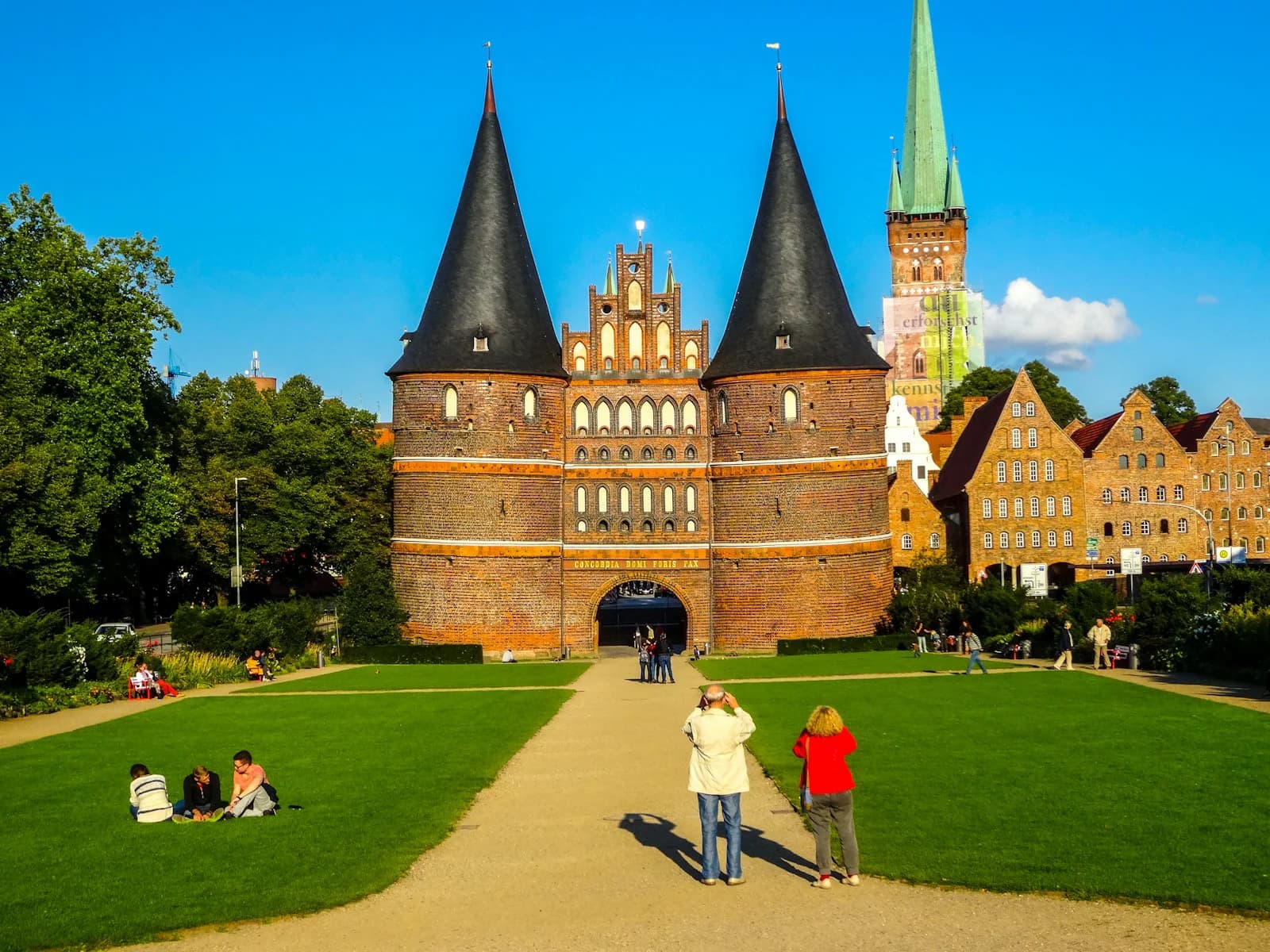
The Rathaus sits on Breite Straße at the Markt, within walking distance of the Marienkirche and the Holstentor. A logical sequence is to start at the Holstentor, covered in the Holstentor Lübeck visitor guide, walk up to the Markt to see the Rathaus exterior, then visit the Marienkirche. Allow extra time if you have booked a guided tour of the town hall.
If you want to go beyond the headline sights, the hidden gems in Lübeck page lists quieter courtyards and alleys that reward a slower walk. The Rathaus is a fixed point, but the surrounding streets are where the city's medieval layout becomes legible. Wear comfortable shoes, as the Old Town is best explored on foot.
10. Etiquette and Common Mistakes
The most common mistake is treating the Rathaus as a museum with open doors. It is a working city hall and a venue for meetings of Lübeck's city parliament, so public access is restricted and guided tours exist precisely because the building is in active use. If you arrive without a tour booking, enjoy the exterior and the Markt rather than trying to slip inside.
Another error is assuming that a single ticket covers everything in the building. The Ratskeller is a restaurant, the Audience Hall is on guided tours, and other parts of the building are administrative. Check each element separately rather than expecting one admission to cover all.
11. Suggested Time Budget
For the exterior alone, a suggested allowance of about 15 to 20 minutes on the Markt is enough to study the façade and the circular wind openings. If you join a guided town hall tour, budget roughly an hour for the interior, though the actual length depends on the operator. This is a suggested duration, not an official figure.
If you are combining the Rathaus with the Marienkirche and the Holstentor, set aside a half day for the Old Town core. The Rathaus is compact, but the surrounding streets and squares invite lingering. Build slack into your schedule for spontaneous detours.
Plan Your Visit
The Rathaus rewards a two-part approach: study the façade from the Markt for free, then book a guided tour if you want to see the Audience Hall, the Torelli paintings, the Renaissance portal, and the mayor portrait gallery. Confirm current tour availability and any fees through Lübeck Tourist Information, since those details change and are not published consistently online.
Treat the Ratskeller as a separate restaurant stop and the building as a working city hall rather than a museum. With those distinctions clear, the Rathaus becomes one of the most rewarding stops in Lübeck's UNESCO-listed Old Town.
Frequently Asked Questions
Can you go inside Lübeck Town Hall without a tour?
The interior is mainly accessible through guided town hall or city tours, according to the city tourism board, which describes discovering the premises as part of a city tour. The building is a working city hall and a venue for the city parliament, so it is not set up for independent wandering. Check with Lübeck Tourist Information about current tour options and booking requirements.
Is Lübeck Town Hall free to visit?
The exterior and the Markt are free to view. Interior access is generally tied to a guided tour, and any fees for those tours are set by the operator. Because prices and schedules change, confirm current details with the tourist information office rather than relying on older online figures.
What is there to see inside the Lübeck Town Hall?
The highlights are the Rococo Audience Hall with ten paintings by Stefano Torelli, the Renaissance portal with the Solomonic Judgement and its unequal doors, and the gallery of mayoral portraits, all described by the city tourism board. These are viewed as part of a guided tour. The Ratskeller restaurant in the vaulted cellars is a separate stop and does not share a ticket with the historic interiors.