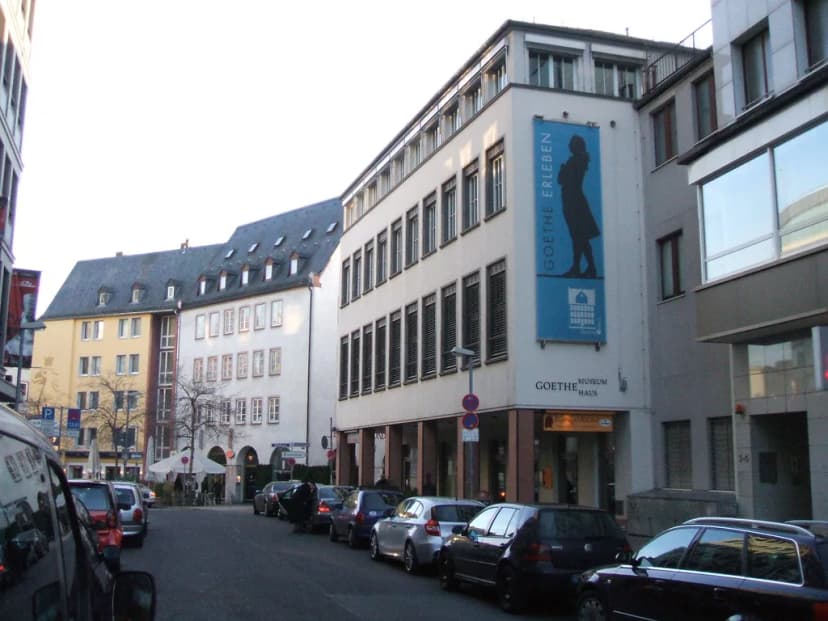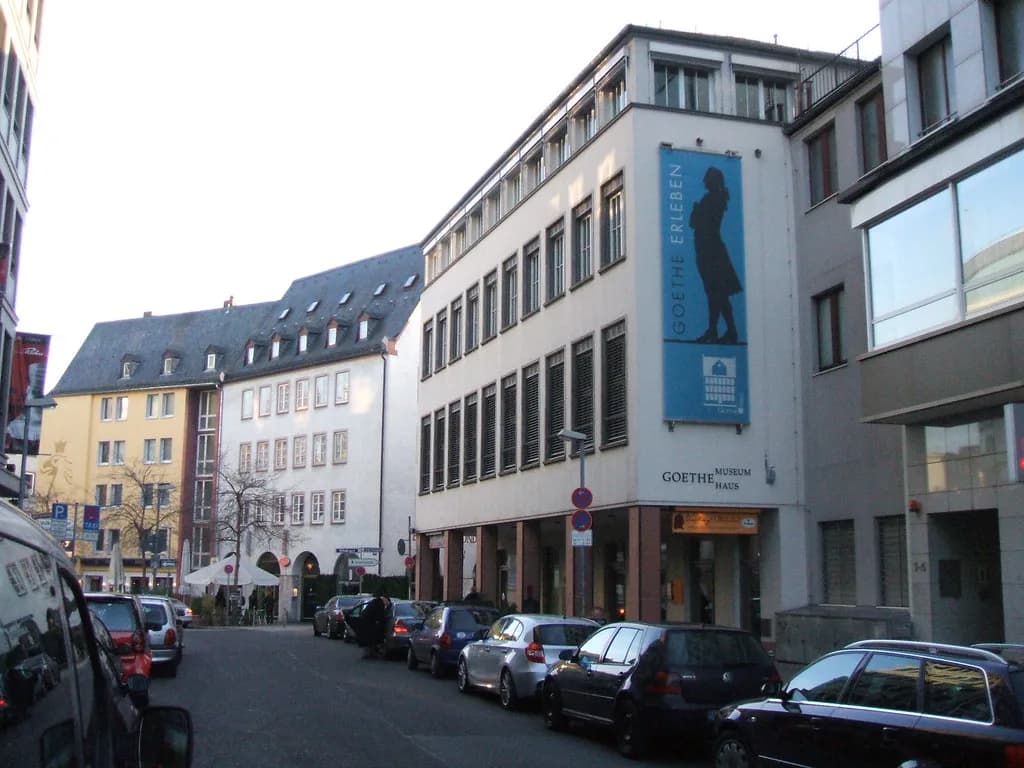
The Frankfurter Goethe-Haus at Großer Hirschgraben 21 is the townhouse where Johann Wolfgang von Goethe was born in 1749 and spent his childhood and youth until he left for Weimar in 1775. In these rooms he wrote his early work, including Götz von Berlichingen, the original version of Faust and The Sorrows of Young Werther. The house was destroyed in the war and faithfully reconstructed, so the interior you walk through today is a rebuilt and period-furnished home rather than untouched original fabric.
One practical detail shapes the whole visit. The operator states that tickets are sold at the museum box office on site and that online reservation is not possible. You cannot lock in a time slot in advance, so arriving earlier in the day gives you the most flexibility if a queue forms.
This guide helps you decide whether the Goethe House deserves a slot in a short Frankfurt stay, and how to combine it with the city's other central sights. It covers the combined ticket with the Deutsches Romantik-Museum, opening hours including Thursday evenings, guided tour formats, accessibility limits and who the house suits best.
Where the Goethe House Sits in Frankfurt
The address is Großer Hirschgraben 21 in the 60311 postal district, a short walk from the commercial core of central Frankfurt. The operator lists S-Bahn lines 1 through 9 and U-Bahn lines 1, 2, 3, 6, 7, 8 and 9 stopping at Hauptwache. U-Bahn lines 4 and 5 stop at Dom/Römer, and tram lines 11, 12 and 14 stop at Karmeliterkloster. Those are the stops the museum itself recommends, so treat them as the reliable set.
If you are driving, the operator names three nearby garages: Parkhaus Hauptwache on Kornmarkt, Parkhaus am Goetheplatz and Parkhaus am Kaiserplatz on Bethmannstraße. Central Frankfurt traffic is dense and the old town streets are largely pedestrian, so parking is a fallback rather than the easy option. Using the S-Bahn or U-Bahn to Hauptwache removes that problem entirely.
The location makes the Goethe House easy to pair with the surrounding old town rather than treating it as a separate trip. The Römerberg and the rebuilt old town lanes sit within a short walk, so a single afternoon can cover both without transport. If you are mapping a broader city day, the Frankfurt am Main landmark guides give you the wider set of sights to sequence around it.
What You Actually See Inside
The tour walks you through domestic rooms including the kitchen, dining room and music room, then up to the bel étage where the family lived and received guests. Because the interior is furnished in the style of the Goethe family's household, the appeal is atmosphere and context rather than a conventional object-by-object museum display. You are looking at how an affluent Frankfurt family lived in the eighteenth century.
Two exhibits give the house its emotional weight, according to the city's tourism board. The puppet theatre that Goethe's grandmother gave him when he was four is on display, the same toy linked to his childhood play. A draft of Dichtung und Wahrheit is also exhibited, and in it Goethe claimed he was born at noon exactly. A standing desk in his room illustrates how he preferred to work.
Do not expect a manuscript treasury on the scale of a dedicated literature archive. The house is small and domestic, and its reconstructed status means the value lies in the arrangement of rooms and the objects tied to Goethe's youth. If you want the wider manuscript and Romantic-era collection, the Deutsches Romantik-Museum next door is where that material sits.
Tickets and Admission Tiers
Admission comes in three structures: a combined ticket that covers the Goethe House, the Deutsches Romantik-Museum and any special exhibition, a regular ticket for the Goethe House alone, and a ticket for a special exhibition alone. The operator publishes current figures in a table on its visit page, and rates can change between seasons. Check that page before you travel rather than relying on older listings or third-party summaries.
Reduced categories are broad. Students and trainees, severely disabled visitors with a GdB of 50 or above, unemployed people, those in compulsory military or voluntary service, Frankfurt Pass holders and pupils all pay less than the standard rate. Children aged six and under, Museumsufer Card and Museumsufer-Ticket holders, ICOM Card and hessische Ehrenamts-Card holders and members of the Freies Deutsches Hochstift enter free.
Group admission applies from fifteen people upward and is charged per person. Note the scope carefully: the combined ticket covers the Goethe House plus the Deutsches Romantik-Museum and a special exhibition, not every museum in a wider complex. For anyone comparing Frankfurt's museums before deciding, the Frankfurt museum decision: which museum should you choose sets out how the larger institutions differ.
Frankfurt Card, Satourday and Reduced Entry
The city tourism board states that the Frankfurt Card gives holders 50 percent off the admission price at the Goethe House. The card is sold as a one-day or two-day ticket that also covers travel in Frankfurt including the airport, and it carries discounts at other museums and attractions. Because the discount applies on top of one of several admission tiers, confirm the exact rate for your category at the box office rather than assuming a single figure.
Satourday is a separate arrangement. The tourism board lists the museum as participating in Satourday at regular admission, with children and families exploring free on the last Saturday of every month through guided tours, workshops and other activities. That is a family-programme benefit, not a blanket free-entry day for all visitors, so read the participation terms before planning a trip around it.
The operator also runs Feierabend im Museum on the first Thursday of each month from 18:00 to 21:00, when admission is one euro. Treat it as a specific recurring event rather than a general Thursday-evening rate. The regular Thursday opening until 21:00 is a different thing and applies without that special pricing.
Opening Hours and Dated Exceptions
The Goethe House and the Deutsches Romantik-Museum share opening hours: Monday, Tuesday, Wednesday, Friday, Saturday, Sunday and public holidays from 10:00 to 18:00, with Thursday extended to 21:00. The two venues run on one timetable because they are operated together by the Freies Deutsches Hochstift. If you only have an evening free, Thursday is the day that works.
The operator publishes a list of dated exceptions where hours differ from the standard week. Rather than repeating them here, where a wrong date would send you to a closed door, check the differing opening hours table on the visit page for your travel dates. It covers holiday periods across the year, including reduced hours on some days and full closures on others.
The museum library keeps separate hours from the exhibition, opening Monday to Friday in two blocks across the middle of the day and extending later by appointment after registration. If you want to consult holdings rather than tour the house, that is a different booking process and a different contact. Tourists should not confuse the two.
Guided Tours and Group Bookings
Public guided tours run in German from Tuesday to Sunday and on public holidays at 14:00 and 16:00, with an additional 10:30 tour on Saturdays, Sundays and public holidays. The operator gives the duration as approximately 50 minutes. Tours run with a minimum of three and a maximum of 25 participants, so a quiet afternoon slot can be cancelled if too few people turn up.
A family guided tour takes place on the second and fourth Saturday of each month at 14:00. Participation is included in museum admission rather than charged separately, and participants up to 18 years old have free admission. There is no registration, and seats are subject to availability, which means arriving early is the only way to improve your chances.
Group tours must be requested in advance, with a maximum of 25 people per tour, and the capacities differ between the two venues. The operator charges a guide fee on top of admission, and the fee level depends on whether the group is a regular adult group, a school or student group, or a foreign-language tour. English, French, Italian and other languages are available only as requested foreign-language group tours, so independent travellers who want a tour in English need to arrange one as a group.
Pairing the Goethe House with the Deutsches Romantik-Museum
The combined ticket is the main reason to treat the two buildings as one visit. It covers the Goethe House, the Deutsches Romantik-Museum and any special exhibition, so you pay once and move between a reconstructed eighteenth-century family home and a collection devoted to the Romantic era as a whole. The Deutsches Romantik-Museum presents original material through exhibition formats designed to make the period legible rather than purely decorative.
Plan the order deliberately. The Goethe House is small and atmospheric and rewards attention to rooms and objects, while the Romantik-Museum is object-led and takes longer if you read labels. Doing the house first while you are fresh, then the museum, avoids the common mistake of rushing the smaller building at the end.
Special exhibitions rotate and the programme changes through the year, so a combined ticket bought in one season may give access to different temporary material than in another. Check the current exhibition listing before you go if a specific show is your reason for visiting. The Freies Deutsches Hochstift runs both venues and publishes the programme.
Accessibility and Practical Limits
The operator states plainly that the Goethe House is not accessible for wheelchairs and baby carriages, although a handicapped toilet is available. This is a historic townhouse with stairs. Visitors who use a wheelchair, or who plan to bring a pram, should treat the Goethe House as a building they cannot tour and plan accordingly.
The practical consequence is a split visit. If part of your group cannot enter the house, the Deutsches Romantik-Museum is the half of the combined ticket to check in advance, and the nearby old town gives the rest of the party something to do. Confirm current access arrangements with the museum before you commit, since accessibility details can change with building work.
The operator also publishes a house rule document, which is worth reading if you are visiting with a school class or a large group. Beyond the stated limits, do not assume lift access, storage for bags or cloakroom capacity that the operator has not published. Contact the museum directly for anything the visit page does not answer.
Does the Goethe House Suit You?
Literature-minded visitors get the most from the house, because the rooms only mean something if you know the early work written in them. If you have read Werther or Faust, the standing desk and the family rooms land differently than for a visitor arriving cold. Goethe's own account of his childhood, drawn on in Dichtung und Wahrheit, is the thread that ties the displays together. For wider planning, see Römerberg and Frankfurt's Old Town.
Families should weigh the stairs and the no-pram rule before committing. The family guided tour and the Satourday programme are the two structured options aimed at children, and the puppet theatre is the exhibit most likely to hold a young visitor's attention. A short visit works better than a long one with children in a house this size.
Short-stay visitors with one free afternoon should consider whether the house or a larger museum better matches their interests, since the Goethe House is compact and the big Frankfurt collections are a different kind of day. Travellers planning a family-oriented science stop instead may prefer the Frankfurt with kids guide. For most first-time visitors, the house works best as a stop woven into an old-town walk rather than a standalone destination.
Suggested Time and How to Sequence the Visit
As an editorial suggestion rather than an official figure, allow roughly 45 to 60 minutes for the Goethe House on its own and up to two hours if you add the Deutsches Romantik-Museum and read the displays properly. Public guided tours run approximately 50 minutes, which gives you a useful benchmark for the house alone.
Build the visit around the box office constraint. Because tickets are only sold on site, arrive with time to queue rather than slotting the house into a tight schedule between timed reservations elsewhere. Morning entry, close to opening, is the simplest way to reduce that risk.
Combine the house with the surrounding old town and the riverbank rather than crossing the city twice. The Frankfurt am Main itineraries and city travel guides give you day structures that put the Goethe House alongside other central sights. If churches and civic history interest you, the St Paul's Church Frankfurt visitor guide covers another landmark within walking distance of the old town.
Plan Your Visit
The Goethe House rewards a decision made before you arrive: buy on site, check the operator's visit page for current prices and the dated exception hours, and decide in advance whether the combined ticket with the Deutsches Romantik-Museum matches your interests. Anyone who needs step-free or pram access should plan around the house rather than for it.
Thursday evenings, the monthly Feierabend im Museum window and the family tour on the second and fourth Saturday are the three timing choices worth knowing about. Each has different terms, so match the one you pick to your group and your reason for going. Book nothing in advance, because the operator does not offer online reservation.
Frequently Asked Questions
Can you buy Goethe House tickets online?
No. The operator states that tickets are sold at the museum box office on site and that online reservation is not possible. Plan to buy on arrival and allow for a possible queue, especially around midday and on weekends. Groups and guided tours are handled differently: they must be requested in advance by contacting the museum directly.
What is included in the Goethe House combined ticket?
The combined ticket covers the Frankfurter Goethe-Haus, the Deutsches Romantik-Museum and any special exhibition. It does not cover every museum in a wider complex, so do not treat it as an all-museums pass. There are also separate regular tickets for the Goethe House alone and tickets for a special exhibition on its own.
Is the Goethe House wheelchair accessible?
The operator states that the Goethe House is not accessible for wheelchairs and baby carriages. A handicapped toilet is available, but the historic house itself involves stairs and cannot be toured in a wheelchair or with a pram. Check current access arrangements with the museum before travelling if accessibility is a deciding factor.
Are guided tours of the Goethe House in English?
The scheduled public guided tours are in German and run Tuesday to Sunday and on public holidays at 14:00 and 16:00, with an extra 10:30 tour at weekends and on holidays, lasting approximately 50 minutes. English, French, Italian and other languages are available as requested foreign-language group tours, which carry a different guide fee to regular and student groups.
How much does the Goethe House cost with a Frankfurt Card?
The city tourism board states that the Frankfurt Card gives holders 50 percent off the admission price at the Goethe House, and the operator lists a Frankfurt Card rate within its admission table. The card is available as a one-day or two-day ticket that also covers travel in Frankfurt including the airport. Because several admission tiers exist, confirm your exact discounted rate at the box office rather than assuming one figure.
Is Satourday free at the Goethe House?
The tourism board lists the museum as participating in Satourday at regular admission, with children and families exploring free through special guided tours, workshops and activities on the last Saturday of every month. It is a family-programme benefit, not general free entry for everyone, so check the participation terms before planning your trip around that date.
How long do you need at the Goethe House and Deutsches Romantik-Museum?
As a suggestion rather than an official figure, allow roughly 45 to 60 minutes for the Goethe House alone and up to two hours if you add the Deutsches Romantik-Museum and read the displays. Public guided tours last approximately 50 minutes, which is a useful benchmark for the house on its own.
Is the Goethe House suitable for children?
It can work for families, but the stairs and the ban on baby carriages mean prams stay outside. The family guided tour on the second and fourth Saturday of the month includes participation in the admission price and gives under-18s free entry, with no registration and seats subject to availability. The puppet theatre is the exhibit most likely to engage a young visitor.