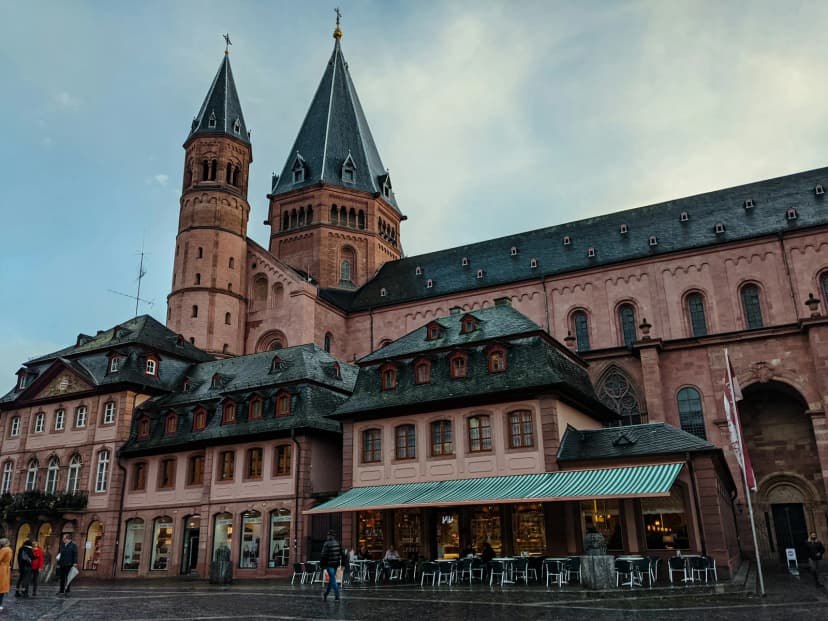
St. Lambertus is the landmark most people photograph without knowing its name: a dark brick church whose spire visibly leans, sitting at the edge of Düsseldorf's Old Town. The official tourism listing places it at Stiftsplatz 7, 40213 Düsseldorf, a small square near Burgplatz and the Schlossturm, so anyone walking between the Rhine promenade and the shopping streets passes directly in front of it. A visit is short, free-standing and easy to combine with the rest of the district.
Three things carry the visit: the twist of the tower, the medieval brick interior, and the layers added after 1945. As a planning suggestion, allow around 20 to 30 minutes inside — that is an editorial estimate, not an official duration — and let the surrounding Altstadt fill out the rest of the walk. Approach from the Rhine side first so the leaning spire registers against the sky before you look at the facade.
Where St. Lambertus Stands in the Old Town
The official tourism address is Stiftsplatz 7, 40213 Düsseldorf, placing the church on a small square a short walk from Burgplatz and the Schlossturm. Some third-party listings give a different house number on the same square, so use the tourism address when you are navigating and rely on the square name rather than the number if your map looks inconsistent. The location is the point: this is the oldest settled corner of the Altstadt.
Because it sits between the Rhine embankment and the bar streets, St. Lambertus works best as a fixed point in a self-guided loop rather than a destination you travel across town for. A dedicated Düsseldorf old town walking tour can sequence Burgplatz, the Schlossturm and the church into one continuous route. Keep the order loose and let the weather decide the pace.
The Building: Lower Rhine Brick Gothic
St. Lambertus is a three-aisled hall church built in the Lower Rhine brick Gothic style, and the city tourism board dates its foundation to 1288, the year Düsseldorf received its town charter. That makes it part of the original settlement core rather than a later addition to a grown city. The brick fabric, rather than carved stone, is what gives the exterior its tight, dark character.
A hall church means the nave and side aisles rise to a similar height, creating a broad, unified interior rather than the tall central shaft of a cathedral. In practice this makes the inside feel wide and comparatively light, and it explains why the modern stained glass reads so clearly across the space. Look up at the aisle ceilings and the arcade piers before heading toward the choir.
The church appears in the city's own list of notable churches, where it is described as first built in the 13th century and as part of the Old Town's original core alongside the Schlossturm and the river Düssel. That same listing is a useful reminder that other significant churches — St. Andreas and St. Maximilian among them — sit within walking distance if you want to compare styles.
The 1815 Fire and the Twisted Spire
The tower you see today is not medieval. The city tourism board states that a fire in 1815 destroyed the spire and that the present appearance of the church is the consequence of that rebuilding. In other words, the most photographed feature of the building is a nineteenth-century replacement, not an original Gothic construction.
The most commonly repeated explanation for the twist is that unseasoned or damp timber was used in the rebuild, and that green wood can deform as it matures — a process that can run for decades. That account is described in a local expat guide to the church, which also mentions the weight of the lead roofing and the timing of structural cross-bracing as possible contributing factors. None of these should be presented as a settled engineering verdict.
Separately, the devil story — that the twist was the devil's rage at being unable to tear the church out of the ground — is legend, and so is the claim that the tower will straighten when a virgin marries inside the church. The same guide labels both as urban legend, and the tourism board's own page also frames the devil's role explicitly as a legend rather than historical fact.
What is verifiable is the affection: the twist survived post-war rebuilding because locals asked for it to be reproduced, which is why a structural accident reads today as a piece of civic identity. A third-party attraction summary likewise highlights the leaning steeple and the collection of light-coloured modern stained glass as reasons visitors rate the church highly. Use that as a prompt to look up and to look through, not just at.
What to Look For Inside
The interior is where the building stops being a silhouette and becomes a space. Visitors consistently point to the modern stained glass in light tones, which is one of the reasons the nave reads brighter than the heavy brick exterior would suggest. Give your eyes a moment to adjust after coming in from the square.
The parish altar holds a shrine containing relics of Saint Apollinaris, the city's patron, which the city tourism board identifies as one of the church's notable features. A local guide also notes a large organ and the shrine among the elements worth seeking out. Both are part of the working liturgical furniture, so treat them with the quiet you would use in any active church.
On the west front, the portal is a piece of the 1950s commissioned from the sculptor Ewald Mataré, which the city tourism board identifies as a work from that decade. Rather than reading it as a mismatch, treat it as the third layer of the building: medieval brick, nineteenth-century tower, twentieth-century doorway. It is the clearest single place to see how the church absorbed each era without erasing the last.
Basilica Status and Parish Life
St. Lambertus has carried the title Basilica minor since July 1974, according to the city tourism board. The designation is an honour granted by the Vatican rather than a change in function: the church remains a parish church, not a cathedral, and its daily rhythm belongs to the congregation. That distinction matters if you arrive expecting cathedral-scale visiting arrangements.
The city tourism board notes that the church's Kirchweihfest forms the spiritual backdrop to the Größte Kirmes am Rhein, the large Rhine funfair. That link is a genuinely local piece of context: the fair and the parish anniversary belong to the same tradition, which is why locals treat the church as more than a photo stop. There is no need to plan around a specific date — the point is the relationship, not a schedule.
Because it is an active place of worship, opening depends on services, funerals and rehearsals rather than a tourist timetable. Confirm before you travel through the parish, which publishes contact details and its own website, or through the city's tourist information. Do not rely on a listing site's cached hours for the interior.
Practical Visiting Notes
For the current visiting window, services and any entrance arrangements, check the parish directly or the city tourist information rather than assuming. The parish phone number and website are published on the city tourism page for the church, which is the cleanest starting point. Verify on the day you plan to go, since weekday access can vary with parish use.
Treat the exterior and the interior as two separate assets. The lean of the spire and the brick mass are visible at any hour from the square and from the Rhine bank, so a late-evening pass still delivers the signature view. The interior is the part that depends on the parish being open, which is why the order of your visit matters.
Do not plan on climbing the tower. Public sources describe the spire as a landmark to look at, not an observation point, and there is no indication that the tower is open for visitors. If a tower view is what you want, look instead toward a purpose-built observation structure such as the Rheinturm Düsseldorf visitor guide, which is designed for exactly that.
Accessibility, facilities and security arrangements are not published in the sources used here, so plan around the assumption that this is a historic building entered from a paved square. If you have specific requirements, ask the parish before travelling rather than arriving and hoping. That single phone call or email removes the main uncertainty from the visit.
Building It Into an Altstadt Walk
St. Lambertus sits naturally on the northern edge of the Altstadt, so a sensible route runs from Burgplatz and the Schlossturm to the church, then down toward the Rhine. The Rhine promenade Düsseldorf visitor guide gives you the riverside half of that walk and explains how the embankment stages connect. Put the church in the middle rather than at the end, so the interior stop breaks up the walking.
If you are travelling with children or want a weather-proof alternative, the Aquazoo Löbbecke Museum visitor guide covers an indoor option in the same city and works as a swap on a wet afternoon. The Altstadt itself is compact enough that you do not need transport between these stops. Keep the plan loose and let the weather decide.
For a full day, combine the church with one of the longer city itineraries and with the Old Town route rather than treating them as competing plans. The Old Town route is oriented around walking and squares; the church is a short insertion into it. That combination gives you architecture, river and street life without retracing steps.
Plan Your Visit
St. Lambertus rewards a focused visit: look at the leaning spire from the square and from the Rhine bank, then step inside for the light-toned stained glass, the organ and the Apollinaris shrine. The twist is the headline, but the layered building behind it is the reason the stop is worth more than a photograph.
Before you go, confirm current visiting conditions with the parish and use the official tourism page for the address and contact details rather than relying on aggregator hours. Then fold the church into a wider walk through the Altstadt and along the Rhine promenade, and let the rest of the Old Town fill the time around it.
Frequently Asked Questions
Is St. Lambertus in Düsseldorf free to enter?
The church is an active Catholic parish, and the sources used for this guide do not publish a current admission price or state that entry is free at all times. Rather than assume, check with the parish or with Düsseldorf's official tourist information before you go. Any arrangement can also vary with services and parish use on the day.
Can visitors climb the twisted tower of St. Lambertus?
There is nothing in the sources consulted that indicates the tower is open to visitors or that a climb is offered. It is consistently described as a landmark to view rather than an observation point. If a high viewpoint is on your list, look at a structure built for that purpose instead of planning around tower access here.
Why is the tower of St. Lambertus twisted?
The rebuilding after the 1815 fire is the starting point, and the explanation most often given is that unseasoned or damp timber was used and deformed as it dried, possibly combined with the weight of the lead roofing. The devil story is legend, not an explanation, and the tale that the tower will straighten when a virgin marries in the church is folklore as well. Treat the timber account as the leading theory rather than a settled finding.
How long does a visit to St. Lambertus take?
A reasonable suggestion is around 20 to 30 minutes for the interior once you are inside, plus a few minutes outside for the tower and facade. That is a planning estimate, not an official duration. If you linger over the stained glass, the organ and the shrine, allow closer to 45 minutes.
When is St. Lambertus open for visitors?
Current opening times and service schedules are not published in the sources used here, and they depend on parish life rather than a fixed tourist timetable. Check the parish website or contact the parish directly, or ask at Düsseldorf's tourist information, before you travel. Confirm again on the day, since access can change with services and events.