Düsseldorf's Altstadt is compact enough that a walking tour here is less about covering distance and more about choosing where to slow down. The old town sits against the Rhine, with the Königsallee, the Carlsplatz market square and the brewery lanes all within comfortable strolling range of one another. A commercially guided walk through this same ground is advertised by GuruWalk as 1 hour 45 minutes with five stops covering Königsallee, Carlsplatz, the Altstadt, the breweries and the Rhine. That figure is the operator's stated tour length, not a rule for your own pace.
This guide keeps two things separate that are easy to blur: the free, public streets and squares you walk through, and the paid interiors — museum collections, church interiors with restricted access and brewery buildings with their own rules — that sit along the way. Plan the walk as an outdoor sequence and decide separately, on the day, whether any interior is worth adding.
The route below follows the main themes that guided walks in the city use to frame the Altstadt: the Königsallee, the Carlsplatz market, the historic lanes, the brewery tradition and the river. A suggested self-guided version, including pauses, is two to three hours at a relaxed pace — that is an editorial allowance, not an official figure. For wider planning, see Düsseldorf landmark visitor guides.
Why the Altstadt Rewards a Walk, Not a Checklist
The Altstadt is the historic core on the east bank of the Rhine, and its reputation as a dense concentration of pubs reflects a genuinely walkable street pattern rather than a single sight. Streets are short, the river is always close, and the main anchors — Carlsplatz, Burgplatz, the St. Lambertus church and the town hall area — sit within a few minutes of one another on foot. The practical consequence is that you rarely need to plan transport inside the old town; you need to plan pauses.
Brewery culture is part of the urban fabric rather than a separate evening activity. Guided tours routinely build breweries into the daytime route, explaining the history of the local Altbier alongside the streets. Walking past them in daylight, when the architecture and signage are visible, gives you context you would miss in a crowded evening visit.
Because the area is compact, a checklist approach — racing to tick off every landmark — usually produces a blur. Choosing two or three things to look at properly, and letting the rest be scenery between them, tends to yield a more memorable walk. That is the principle behind the sequence that follows.
Route Logic: Start on Königsallee, Cross to Carlsplatz, Finish at the Rhine
A west-to-east line works well here: begin on the Königsallee, move to the Carlsplatz market square, enter the old lanes, then walk through to the Rhine promenade as the finale. This ordering means you finish at the river rather than doubling back through shopping streets, and it places the market at a natural mid-walk pause. It also matches how guided operators structure their own routes, which list the boulevard, the market, the Altstadt, the breweries and the Rhine in that general direction, as seen on GuruWalk.
The whole line is short enough to walk without a fixed schedule, which is the main advantage of self-guiding. A suggested plan is to allow two to three hours including a market stop and a brewery pause — that is an editorial estimate, not an official time. If you only have a single day in the city, this walk slots in as the anchor of the morning or afternoon rather than the whole day, as outlined in a one-day Düsseldorf itinerary.
If you are staying longer, the walk can be split across two days, with the boulevard and market in one session and the old town and river in another. A two days in Düsseldorf itinerary gives you room to add a museum or the media harbour without rushing the lanes.
Stop 1 – Königsallee: Boulevard as Orientation Warm-Up
The Königsallee is the wide, tree-lined boulevard that most guided walks use as their starting point, partly because it is easy to find and partly because it frames the city's present before you step into its past. Walking its length gives you a sense of the scale of central Düsseldorf and a straightforward line towards the old town. Guidebooks and tour descriptions treat it as a shopping boulevard, so expect banks, boutiques and a canal rather than medieval architecture.
The GuruWalk tour places its meeting point at the eastern end of the Königsallee bridge, opposite a Cartier shop — a useful illustration of how central the boulevard is as a gathering spot. Do not treat that specific spot as fixed policy for any tour you might join; if you book a guided walk, confirm the current meeting point with the operator directly. For a self-guided start, the bridge and canal area is simply a convenient, easy-to-describe beginning.
Keep this first stretch short. The boulevard's job is to orient you and point you east, not to consume an hour of the walk. Fifteen to twenty minutes of strolling is usually plenty before you turn towards the market.
Stop 2 – Carlsplatz: Market Square and Everyday Düsseldorf
Carlsplatz functions as the working market square of the centre, which makes it a good mid-morning pause and a counterweight to the historic lanes. Guided routes list it as a stop between the boulevard and the old town, and it is where you see the city going about ordinary business rather than performing for visitors. Approach it as a place to look, smell and rest, not as a ticketed attraction.
Market squares live on their own rhythm, and the stalls you find on a weekday morning generally differ from those on a weekend. Rather than assuming a fixed set of vendors, check the market's own notices or the city's tourism information for the days and hours that suit your trip. If the market is quiet on the day you visit, the square still works as a five-minute orientation point before the old lanes.
This is the natural place to break the walk in two if you are pacing yourself or travelling with people who tire quickly. Cafes and seating around the square let one half of the group wait while the other explores the lanes, and you can rejoin without retracing the whole route.
Stop 3 – The Altstadt Core: Lanes, St. Lambertus and Burgplatz
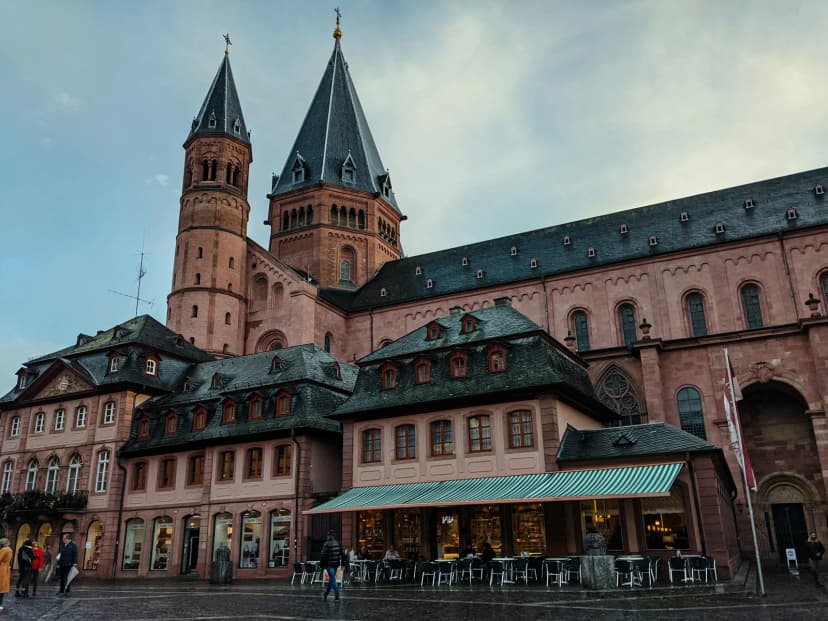
Once you leave the market, the streets narrow and the route becomes deliberately loose. The towers of St. Lambertus and the Burgplatz area act as anchors rather than fixed waypoints, and the pleasure of the walk lies in threading between them rather than marching directly to either. Let the church spire pull you east and you will pass through the lanes that give the Altstadt its character.
The twisted spire of the basilica is the most recognisable silhouette in the old town, and it is visible from several streets, which makes it a reliable compass if you lose your bearings. Note that churches are working buildings with their own access arrangements; whether you can go inside, and when, is something to check at the door or on the parish's own information rather than assume from a guidebook. Treat the interior as a separate decision from the street-level walk. For wider planning, see St. Lambertus in Düsseldorf.
Around Burgplatz you also find the town hall complex and the old castle tower, which together mark the historic centre of civic power. Because the lanes here are short and interconnected, there is no single correct order — pick a direction, allow yourself one detour, and accept that you will pass some streets twice. That redundancy is normal in a district this size.
Stop 4 – Breweries as History, Not Just Drinks
Altbier is a top-fermented dark beer associated with Düsseldorf, and the old town's brewery houses are as much architectural and social history as they are places to drink. Guided tours explicitly use breweries to explain the city's identity, pairing the buildings with stories about the beer style and the local drinking culture, as noted on GuruWalk. Walking past them in daylight, reading the facades and signage, gives you the cultural context even if you never sit down.
If you do want to stop, treat each establishment individually: opening hours, whether food is served, and whether a reservation is expected all vary between houses and change with the season. Check directly with the brewery you plan to visit rather than relying on a general guide. Allow one proper pause — roughly forty-five minutes — and keep the rest of the walk moving, or the afternoon will disappear into a single room.
For a longer stay in the city, breweries can be spread across an evening rather than folded into the daytime walk. A two days in Düsseldorf itinerary gives you room to visit one or two houses properly instead of squeezing them into a single route.
Stop 5 – Rhine Promenade: Ending Where the City Opens Up
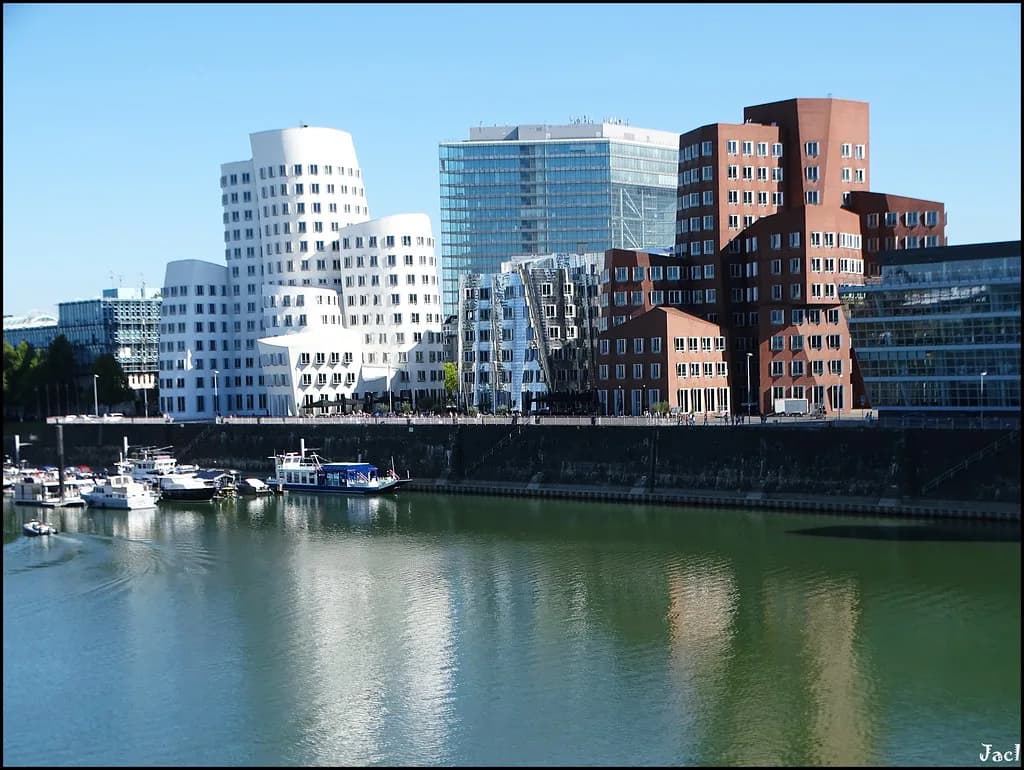
The Rhine promenade is the natural end point: the streets give way to a long riverside terrace with views across the water and back towards the bridge. Tour routes list the river as their final stop, and it works as a release after the enclosed lanes — the space, light and horizon all change at once. Arriving on foot from the old town, rather than by transport, makes that shift obvious.
Plan on spending twenty to thirty minutes here if the weather is kind, walking either direction along the bank before deciding where to eat. If it is raining or windy, the promenade loses much of its appeal — the river is exposed, so it is the section of the route most worth cutting short. Weather is the one variable that should genuinely change your plan on the day.
Because the promenade runs along the edge of the old town, it also gives you an easy exit: you can continue north or south along the river, or turn back into the lanes for dinner. Ending here rather than at a museum means you are never trapped indoors or dependent on a closing time.
History Threads to Carry With You
Three stories recur in guided descriptions of the city, and knowing them in advance makes the streets richer. The first is Altbier and the brewery tradition that shaped the old town's social life. The second is the Napoleonic era, which reshaped the city's administration and layout. The third is Düsseldorf's modern cultural identity, including its association with punk music and with the artist Joseph Beuys.
You do not need to research these deeply before walking; a couple of sentences of context per theme is enough to make the buildings legible. If you want detail, the city's tourism information and reputable local histories are better starting points than single tour listings. Avoid treating a guide's anecdote as settled history — the streets are the reliable part.
How Long to Allow, and Pacing Self-Guided vs Guided
Commercial walks through the Altstadt are typically pitched at around one and three-quarter to two hours, which tells you the core route is short. A self-guided version of the same ground, including a market pause and one brewery stop, is likely to take two to three hours at a relaxed pace — that is a suggested allowance, not an official figure. Walking it quickly without stops would take far less.
The real difference between guided and self-guided is attention, not distance. A guide supplies interpretation, keeps a group moving and handles navigation; self-guiding trades that for the freedom to stop for ten minutes at a doorway, or to skip a stretch entirely. If you value context over flexibility, book a guide; if you value flexibility, walk it yourself and read up beforehand.
Guided availability, group sizes and booking requirements are set by each operator and change over time, so confirm details on the operator's own page rather than assuming a walk runs on any given day. Free-tour models in Germany generally mean no upfront cost with a tip at the end, but the specifics are the operator's to state.
Practical Choices: Weekdays, Weekends, Group Size and Splitting the Walk
Weekdays are generally calmer in the lanes, while weekends bring market crowds and busier brewery rooms. If your priority is looking at architecture and reading the streets, aim for a weekday morning and use the Carlsplatz pause as your mid-point. If your priority is atmosphere and people-watching, a weekend visit delivers more of both, at the cost of slower movement.
Larger groups move more slowly through narrow lanes and struggle to hear commentary without a guide, which is one argument for splitting up. Two or three people can cover the route in one pass; six or more will spend more time regrouping than looking. If you are travelling as a big party, consider walking the core independently and meeting afterwards on the promenade.
The walk splits naturally at the market: boulevard and market in one session, old town and river in another. That works well if you are in the city for two days, or if you want to spend the middle of the day indoors and return to the lanes in the late afternoon when the light is better.
Accessibility, Weather and Comfort on an Outdoor Route
This is an outdoor route over paving, cobbles and riverside surfaces, and the old lanes are narrow with occasional steps at doorways. Surfaces vary from smooth boulevard paving to rougher stone in the historic streets, so footwear matters more than distance. Anyone with limited mobility should plan to use the broader sections — the boulevard, the market square and the promenade — and treat the narrow lanes as optional.
Some free walking tours advertise themselves as suitable for people with reduced mobility, but accessibility policy belongs to each operator and can change with route and guide. Treat any such statement on a booking page as the operator's claim to verify rather than a guarantee about the streets themselves. If you need step-free access, confirm the specific route before you commit.
Weather is the biggest single factor on this route: the promenade is exposed, the lanes are shaded and occasionally damp, and rain makes cobbles slippery. Carry a light layer and check a local forecast the morning of your walk, keeping the river stretch as the part you drop if conditions turn. Packing an umbrella costs little and salvages an otherwise grey afternoon.
Self-Guided Alternatives: Game and Audio Formats
Several self-guided products cover the Altstadt, including app-based exploration games that turn the walk into a sequence of puzzles at historic locations. FREETOUR.com lists a self-guided exploration game covering 12 historic locations in Düsseldorf's old town, provided by Questo, which changes the experience in a specific way: it adds a task to each stop, which slows you down and directs your attention to details you would otherwise pass. That can suit families or groups who want a structure, and it can feel restrictive if you want to choose your own route.
Durations for such products are stated by their providers and vary, so treat any quoted length as the provider's estimate rather than a verified time. They also require a charged phone and, in most cases, a purchase before you start, which is a different commitment from simply walking the streets. Check the product page for the current format, length and requirements before relying on it.
A plain audio guide or a written route is the middle ground: structured information without a puzzle layer. For most first-time visitors, the simplest option is still a map, this article's sequence, and a willingness to wander.
What the Altstadt Is Not: Free Streets vs Paid Interiors
Everything described in this route — the boulevard, the market square, the lanes, the churchyard and the promenade — is public space you can walk for free. What is not included is anything behind a door: museum collections, paid exhibitions, church interiors with restricted access and any ticketed attraction. Those are separate visits with their own prices and hours.
Düsseldorf has substantial museums and galleries, and it is tempting to assume one ticket covers several of them. It usually does not: institutions inside a complex, or even in the same building, can run separate admissions. Check each museum's own page for what its entry actually includes, and decide which one, if any, is worth building into your day.
The same logic applies to breweries: walking past them is free, while sitting down involves whatever the house charges that day. Do not budget from a tour description or an old review; use current information from the venue before you go.
Making the Walk Your Own
The strength of this route is that it needs no permit, ticket or timetable: you can start on the Königsallee, drift through the market, lose yourself briefly in the lanes and end at the river on your own terms. The only fixed points are the anchors — St. Lambertus, Burgplatz and the promenade — and even those are suggestions.
Decide in advance how much time you have, whether you want a brewery stop, and where you plan to eat afterwards, then let the streets fill in the rest. If you are staying longer, use the wider city guides to build the old town walk into a larger itinerary rather than treating it as a standalone attraction.
Frequently Asked Questions
Is Düsseldorf walkable for a first visit?
Yes. The historic centre, the Königsallee, the market square and the Rhine promenade all sit close together, so a first-time visitor can cover the main sights on foot without using transport inside the district. The lanes are narrow and cobbled in places, so comfortable shoes help, and the riverside is exposed if the weather turns.
How long does a Düsseldorf old town walking tour take?
Guided walks through the Altstadt are commonly advertised at roughly 1 hour 45 minutes to two hours, while a self-guided version that includes a market pause and one brewery stop is likely to take two to three hours at a relaxed pace. That is a suggested allowance rather than an official figure. Walking the same streets quickly, without stops, would take considerably less time.
Should I do a self-guided or guided old town walk?
Choose guided if you want interpretation, stories and someone else handling navigation, and book through the operator so you get current details on meeting points and times. Choose self-guided if you prefer flexibility, want to linger at specific buildings, or are travelling with people who move at different speeds. Both cover broadly the same compact area.