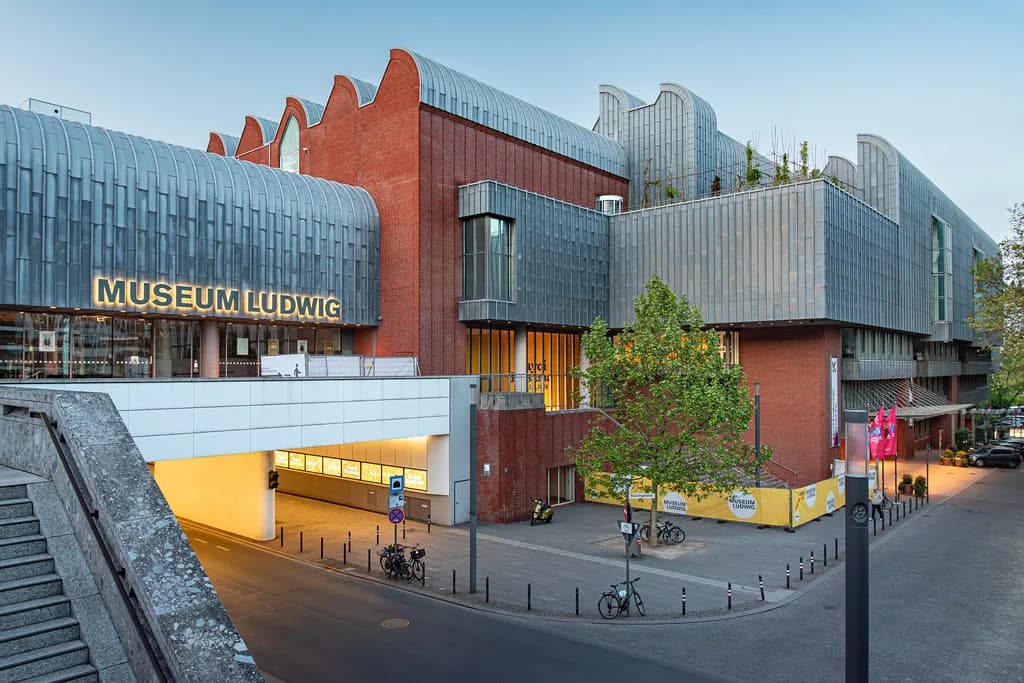
Museum Ludwig occupies a position few art museums in Europe can match: directly beside Cologne Cathedral, the central station, and the Rhine. The museum describes itself as holding one of the most important collections of 20th- and 21st-century art worldwide, which means its location makes it unusually easy to fold into a short Cologne visit even though the collection itself is far larger than a quick cathedral-adjacent stop suggests.
This guide covers what the collection is actually strong in, how two private donations shaped that strength, and how to weigh highlights against a fuller visit. It also flags practical details you should confirm with the operator before travelling, since admission, hours, and exhibition programming change and are not fixed here. For orientation across the city, the Cologne: Landmark Visitor Guides collection sets out how the main sights relate to each other.
What Museum Ludwig Is and Where It Sits
Museum Ludwig is Cologne's major museum for modern and contemporary art, standing in a cultural complex shared with the Cologne Philharmonie at Heinrich-Böll-Platz. That location is the single most useful fact for planning, because the museum competes for your time with the cathedral next door, not with a cross-city journey. The cathedral and the main railway station are immediately adjacent, and the Rhine promenade and old town are a short walk away.
If you are building a day around central Cologne, this cluster is where you will spend most of it anyway, so the museum does not require a separate half-day of transport. For the wider city context, including how the main sights relate to one another, start with the Cologne: Itineraries and City Travel Guides hub.
Founding, Donors, and the Building
The museum opened in 1976 after the collectors Peter and Irene Ludwig donated major works to the city, and that donation is the reason the collection is unusually deep in 20th-century art for a municipal museum. The Ludwig gift built on Cologne's existing Haubrich collection, which covers art from roughly 1914 to 1939 and brings in German Expressionist and modernist works by artists such as Kirchner, Heckel, Chagall, and Dix. One early account notes that the Ludwigs donated 350 works of Pop Art to the city at the outset.
The current building, designed by Peter Busmann and Godfrid Haberer, opened in 1986 and shares its complex with the Cologne Philharmonie. Galleries are large and many areas are flooded with light, which suits the scale of the Pop Art and large-format works but also means the museum feels bigger on foot than its footprint suggests. Expect to do real walking between sections rather than a single loop through a few rooms.
What the Collection Is Actually Strong In
Pop Art is the headline strength, and the museum's holdings in this movement are among the most acclaimed outside the United States. Works by Andy Warhol and Roy Lichtenstein anchor that section, and third-party travel listings describe pieces such as Lichtenstein's "Maybe" and Warhol's "Brillo Boxes" as part of the collection. If Pop Art is your reason for coming, this is the part of the collection to prioritise rather than treat as a passing room.
Picasso is the other core draw, with paintings, sculptures, ceramics, and prints represented. The museum publishes that it holds a complete set of Picasso's three major print series, and travel listings describe paintings, sculptures, ceramics, and prints among its Picasso holdings. One independent travel account calls it the third largest Picasso collection in the world, while a mapping reference describes independent references as pointing to one of Europe's largest Picasso holdings. Because what is on view rotates, if you want the print series specifically, check the current presentation before you go.
Beyond those two pillars, the collection traces a broad modern trajectory through German Expressionism, New Objectivity, Surrealism, Russian avant-garde, and abstraction, with the Haubrich holdings adding earlier modernist works. An independent photography collection runs into the tens of thousands of items, covering the medium from its early years to the present. That range is why a highlights-only visit and a fuller visit feel like two different museums.
Deciding How Long to Stay
As a suggestion rather than an official figure, allow roughly 60 to 90 minutes if you want highlights only, concentrating on the Pop Art galleries and the Picasso rooms. That is enough to see the works most visitors come for without rushing past them. It is a reasonable fit if the museum is one stop in a packed day.
For a fuller visit that includes German Expressionism, the Russian avant-garde, Surrealism, and the photography collection, plan on about two hours, again as a recommendation rather than a published duration. One mapping reference puts a highlights visit at 60 to 90 minutes and a fuller visit at about two hours, while a travel booking listing suggests a recommended sightseeing time of 2 to 4 hours. Because the galleries are large and spread out, the upper end is more realistic if you prefer not to rush. Add time if a temporary exhibition is running, because those are usually in addition to the permanent displays rather than replacing them.
The honest trade-off is that the museum's scale makes it a serious stop rather than a quick side room attached to the cathedral. If your Cologne time is measured in hours, choosing highlights only is a legitimate strategy, not a compromised one. If you have a full day, the museum can absorb half of it without repetition.
Does It Fit a Short Cologne Trip?
The location makes the museum unusually easy to combine with the cathedral, the main station, and the Rhine, so the practical question is not whether you can reach it but whether you want to spend an hour or two indoors. A sequence that works well for many visitors is the cathedral first and the museum second, because the contrast between medieval pilgrimage art and Gothic architecture and the museum's Picasso, Pop Art, and postwar experimentation is sharper when taken in that order. Treat that as a suggestion, not a rule.
One planning point that trips people up: the museum is a separate institution from its neighbours, so do not assume a single ticket covers the cathedral or the neighbouring museums in the same area. Budget your time and tickets per institution. For alternatives if you decide the museum is not the right fit, Great St. Martin Church in Cologne is a short walk into the old town and pairs well with a Rhine-side wander.
If you want a view of the city rather than another interior, the Cologne Cable Car crosses the Rhine near the zoo and gives a different perspective on the river and the bridges. Combining a museum visit with a river crossing makes for a varied day without long transfers. It is best treated as an alternative to a second museum rather than an add-on to an already full itinerary.
Tickets, Hours, and Practical Checks
Admission prices, reduced rates, and any age-based free entry are set by the museum and change over time, so confirm them on the official Museum Ludwig site before you travel rather than relying on third-party listings. The same applies to opening hours, any extended evening opening, and the weekly closure day. Third-party ticket pages are useful for orientation but are not the authority for current conditions; the museum's own site is the appropriate source for current visitor information.
Temporary exhibitions change the experience, so check what is on before you commit to a long visit. The museum's site currently lists exhibitions with specific run dates, which makes it a practical place to confirm what will actually be on the walls during your trip. A rotating presentation means that the specific Picasso prints or photographic works you read about may not be displayed during your dates. Build your expectations around the permanent strengths rather than a single famous object.
Since the museum sits in a shared cultural complex, treat its ticket as covering the museum only and verify access rules, booking requirements, and accessibility directly with the operator. Those details are exactly the kind that change and cannot be assumed. A quick check a day or two before your visit avoids most surprises.
How Museum Ludwig Compares with Other Cologne Museums
Cologne spreads its museums across several clusters rather than concentrating them, so the sensible approach is to pick one or two per area instead of trying to cover the city's institutions in a single day. Museum Ludwig is the strongest choice for 20th- and 21st-century art and for Pop Art and Picasso specifically. Other museums in the city serve different interests, and a comparison of the main options is covered in the best museums in Cologne worth visiting guide.
If you are limited to one museum and your interests lean modern, Museum Ludwig is difficult to argue against given its location alone. If your interests lean medieval or Roman, a different institution will serve you better. Deciding that before you arrive saves you from defaulting to the most convenient option.
Plan Your Visit
Museum Ludwig rewards a decision made in advance: highlights only for an hour or so, or a fuller two-hour visit that takes in the Expressionist, Russian avant-garde, Surrealist, and photography holdings. Its position beside the cathedral, the main station, and the Rhine means it slots into almost any central Cologne day without extra travel. The one thing you cannot skip is checking current admission, hours, and exhibition programming on the official site before you go.
Once your museum time is set, build the rest of the day around the cathedral, the old town, and the Rhine promenade, all within walking distance. That cluster is what makes a short Cologne trip work without transit planning. For the wider picture of what to see and how to sequence it, start with the city's landmark guides and itineraries.
Frequently Asked Questions
How much does Museum Ludwig cost to enter?
Admission is set by the museum and changes over time, so the reliable approach is to check the official Museum Ludwig website for current prices, reduced rates, and any free-entry conditions before your visit. Third-party ticket listings can be out of date, and reduced eligibility rules are not always described accurately on resale pages. If you are travelling with children or on a concession, confirm the specific conditions directly with the museum.
What is a must-see inside Museum Ludwig?
Prioritise the Pop Art galleries, where works by Andy Warhol and Roy Lichtenstein anchor the collection, and the Picasso holdings, which the museum describes as including a complete set of Picasso's three major print series. Beyond those, the German Expressionism and Russian avant-garde sections and the separate photography collection are the areas that give the museum its range. Because displays rotate, check the current presentation before assuming a particular work or print series is on view.
Is Museum Ludwig worth visiting on a short Cologne trip?
Yes, if modern and contemporary art interests you, because the museum sits directly beside Cologne Cathedral, the main station, and the Rhine, so it costs you almost no travel time. The trade-off is scale: it is a serious museum rather than a quick side room, so a short trip means choosing either a focused highlights visit or accepting that you will see only part of it. If you have limited time, pair it with the cathedral rather than adding a second museum.
How long should you spend at Museum Ludwig?
As a rough suggestion rather than an official figure, allow around 60 to 90 minutes for the highlights, concentrating on Pop Art and Picasso, or about two hours if you also want the Expressionist, Russian avant-garde, Surrealist, and photography sections. Some travel listings suggest a broader 2 to 4 hour sightseeing window. Add time if a temporary exhibition is running. Because the galleries are large and spread out, the upper end is more realistic than the lower end if you prefer not to rush.
When is Museum Ludwig closed?
Closure days and opening hours are set by the museum and can change, including for public holidays, so confirm the current schedule on the official website before planning your day around it. Do not rely on older travel articles or third-party listings for this. If your Cologne trip is short, check the schedule first and build the rest of your itinerary around the days the museum is open.
Does one ticket cover the neighbouring museums or the cathedral?
No. Museum Ludwig is a separate institution from Cologne Cathedral and from the other museums in the area, so its ticket covers its own displays and does not extend to neighbouring sites. Budget separately for the cathedral and any other museums you want to visit. If you are comparing options, the city's best museums guide explains how the main institutions differ.