The Hohenzollern Bridge does two jobs at once: it carries one of Germany's busiest rail corridors across the Rhine and gives pedestrians a free, open-air viewing platform pointed at Cologne Cathedral. Cologne's tourism office describes the footpath as beginning directly behind the Museum Ludwig and the Philharmonic Hall, with the walk from Cologne Central Station taking about three minutes. That makes it one of the easiest major sights in the city to reach on foot.
Two details shape the visit before you arrive. Rail traffic is the reason the bridge exists today, and the tourism office says roughly 1,500 train crossings a day make the structure vibrate impressively underfoot. Love locks hang by the thousands on the railings, and attaching one remains a permitted Cologne tradition. Both realities are worth knowing before you decide how long to stay.
Why the Hohenzollern Bridge Matters
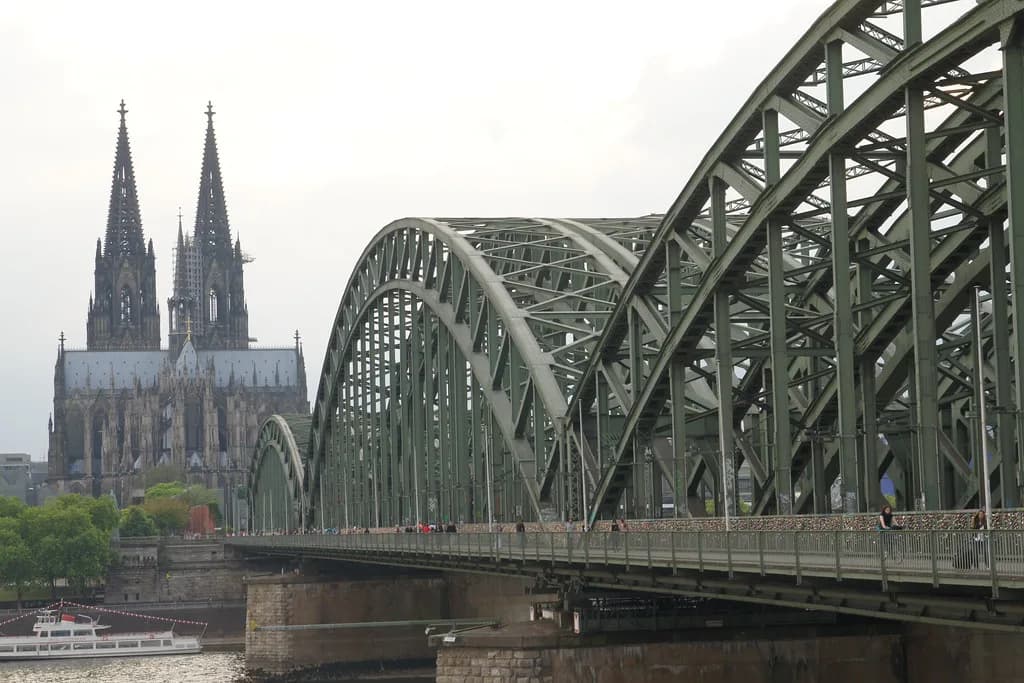
Walkers get a panorama that few riverside promenades match, because the bridge places the cathedral, the Old Town spires and the Rhine in a single sweep. Look one way for the cathedral facade and the main station, the other way for the Deutz bank and the river's curve. The bridge is working infrastructure rather than a monument set aside for tourists, and that contrast is what makes it memorable.
The bridge was built between 1907 and 1911 and inaugurated by Emperor Wilhelm II, and it replaced an earlier rail crossing known as the Cathedral Bridge. Equestrian statues of Prussian kings and emperors still flank the access ramps, not the deck itself. The original portal structures and towers are gone and were never replaced.
Orientation: Where the Pedestrian Path Begins
On the city side, the footpath starts directly behind the Museum Ludwig and the Philharmonic Hall, near Heinrich-Böll-Platz. From Cologne Central Station the walk to the bridge takes about three minutes, which makes it one of the easiest major sights in the city to reach on foot. If you are arriving by train, you can leave the station and be on the bridge almost immediately.
The route is shared by pedestrians and cyclists, so keep an eye out on the ramp where the two streams of traffic merge. The path is broad enough for a comfortable stroll, but it is not a quiet park promenade. Expect crowds at the cathedral end and thinning numbers as you move toward mid-span.
The bridge sits between the cathedral quarter and the Deutz bank, so it slots naturally into a walking day. If you are building a wider itinerary, the Cologne: Itineraries and City Travel Guides hub collects routes that use the bridge as a link rather than a detour.
Entering from the Deutz Side
From the right bank you reach the bridge from Cologne Deutz Messe station, and the tourism office gives the distance from there to the bridge as 450 metres. That entry gives you a head-on view of the city centre, with the cathedral rising behind the bridge arches and the Old Town off to the left. Many visitors find this the more dramatic approach because the whole skyline sits in front of you.
Deutz is the trade-fair district, so your experience depends heavily on whether an exhibition is running. On event days the station and surrounding streets fill up quickly and the walk across becomes a busier affair. On quiet days the eastern ramp is calm and the view back at the cathedral feels almost private.
Love Locks: How the Custom Works
Couples, friends and families attach padlocks to the bridge railings, often engraved with initials, dates or short messages, and then throw the key into the Rhine to mark the promise. Locks have been appearing on the Hohenzollern Bridge since 2008, and the practice continues in Cologne because Deutsche Bahn does not currently regard them as a danger to the bridge's statics. A statement from 2018 suggesting all locks would have to be removed was retracted.
If you want to take part, shops in the city centre near the main station sell locks and will engrave them for you. Nothing on the bridge is provided, so bring or buy a lock before you start walking. Do not attach anything to the structural cables or the railway equipment, and only use the railing sections where locks already cluster.
The custom is not universally tolerated in Europe. The Pont des Arts railing in Paris collapsed under the weight of locks in 2014, and attaching a lock to the Rialto Bridge in Venice can carry a fine of up to €3,000. Cologne is unusual in still allowing the practice, which is worth remembering before you assume every European bridge works the same way.
How Many Locks Are There?
Nobody has an exact current count. Cologne's tourism office reports that estimates in 2011 put the figure at around 40,000 locks, that a physicist calculated a range of between 50,000 and 200,000 in 2015 based on lock density per metre, and that the total probably exceeds several hundred thousand today. Treat these as estimates from different years rather than a measured fact.
Weight estimates circulate too, with roughly 45 tonnes reported, but that figure should be read as an estimate rather than a verified load calculation. The count changes daily as visitors add and occasionally remove locks. If the number matters for an article or school project, cite the range and the year it came from.
The Rumble Factor: Trains Underfoot
KölnTourismus describes the Hohenzollern Bridge as Germany's busiest railway bridge, with around 1,500 train crossings a day, and says the structure vibrates noticeably as a result. A separate non-official source gives a lower figure of roughly 1,200 daily trains, so treat the higher number as the tourism office's characterisation rather than a timetable statistic. Either way, you will feel and hear trains passing while you walk.
The rail traffic is not background noise you can tune out; it is a rolling, rhythmic vibration that travels through the deck. Some visitors find it thrilling and others find it unsettling, especially with children or if you are unsteady on your feet. If you want a calmer crossing, watch the flow of trains for a minute before stepping onto the path and pick a gap.
Because the bridge is a six-track rail crossing with a pedestrian and cycle path, there are no benches, cafés or shelters along the deck. Plan your stop for either end of the bridge. This matters in rain or cold, when the exposed walk feels considerably longer than it looks.
Looking Closer at the Locks
Many locks have nothing to do with romance. Along the railings you will find memorials to people who have died, declarations of friendship, thanks for a child's birth and locks marking a family milestone. Reading a few inscriptions changes the walk from a photo stop into something closer to an open-air archive of small personal stories.
Engravings range from simple initials scratched by hand to professionally cut lettering with dates and symbols. Some locks carry photographs or painted motifs, and a few are clearly mass-produced souvenirs. If you plan to add one, decide in advance what you want on it, because engraving at a city-centre shop takes time you may not want to spend on the day.
Photo Angles That Work
The classic shot places the cathedral behind the bridge arches, and the evening illumination makes the steel structure glow against the dark sky. Cologne's tourism office names the illuminated bridge with the cathedral behind it as one of the city's best-known photo motifs. It does not name a best hour, so plan around the light you want rather than a published schedule.
For a wide skyline frame, stand on the Deutz side and look back across the river toward the city centre and the Old Town. For a tighter composition, use the lock-covered railings as a foreground layer with the cathedral behind. Both angles depend on where you stand rather than on any special access.
If you want elevated river views beyond the bridge deck, the Cologne Cable Car crosses the Rhine nearby and offers a different perspective on the same skyline. It is a separate attraction with its own operating arrangements, which you should confirm before building a day around it.
History in Brief
The current bridge opened in 1911 and originally carried four railway tracks plus a road, with monumental neo-Roman portal towers at each end. Its predecessor, the Cathedral Bridge of 1859, had become too small for growing rail traffic. The older crossing was nicknamed the Mousetrap because of its cage-like lattice structure and lockable gates.
The Hohenzollern Bridge was the only Cologne bridge not destroyed by bombing in the Second World War, but on 6 March 1945 the retreating German army blew it up. One rail span was rebuilt and reopened in 1948, and further spans were added between 1956 and 1959 and again in the mid-1980s. The imposing portal entrances were demolished in the late 1950s and never replaced.
Look for the old tracks embedded in the cobblestones on the Deutz side, a remnant of the era when cars and trams crossed here. They are easy to miss if you are focused on the river. They are also a reminder that the bridge's role has changed more than once.
A Practical Walk-Through
Start at the cathedral forecourt, walk past the Museum Ludwig and across Heinrich-Böll-Platz to pick up the footpath. Cross to the Deutz bank, turn around and walk back, which gives you both panoramas without any extra planning. As a suggested duration rather than an official timing, allow 45 to 60 minutes for the round trip if you want to read inscriptions and stop for photographs; the crossing alone takes far less.
The bridge is a public thoroughfare with no stated opening hours, and the tourism office lists entrance as free. That means there is no ticket to buy and no gate to check, which is why it works well as a flexible stop before or after a ticketed attraction. The tourism office labels the bridge as suitable for pushchairs and families, but it does not publish detailed accessibility specifications, so if you need step-free routes or specific measurements, check with the operator before you go.
Wear shoes you can walk in and keep a hand free for the railing on windy days. Photography stops on a narrow shared path block cyclists, so step to the side rather than stopping mid-lane. Small habits like these keep the crossing pleasant for everyone using it.
What to Do at Either End
On the cathedral side you have the Dom itself, the Romano-Germanic Museum area and the main station, all within a few minutes of the bridge ramp. The Cologne Cathedral visitor guide explains how to plan time inside the building separately from your bridge walk. Allow more time here than you expect, because the cathedral forecourt is usually busy.
Walk south along the Rhine from the cathedral and you reach the Old Town and Great St. Martin Church Cologne, whose tower is another classic skyline element. The Chocolate Museum sits further down the same bank, on its own peninsula, and is a separate ticketed attraction with its own entry arrangements. Pick one or two of these rather than trying to combine everything in a single afternoon.
On the Deutz side the main draws are the trade-fair grounds and the riverside paths, plus the station that puts you back on the rail network. There is less sightseeing here, which is precisely why the view back toward the cathedral works so well. It also makes Deutz a sensible place to start if you want to end your walk in the busy city centre.
Plan Your Visit
The Hohenzollern Bridge rewards a simple plan: approach from the cathedral side, walk the full span to Deutz, and turn around for the view you missed the first time. Budget a relaxed hour as a suggested duration if you want to read locks and take photographs, less if you are simply crossing. Combine it with the cathedral or the Old Town rather than treating it as a standalone destination.
Check practical details on the day, since rail works, major trade fairs in Deutz and river events can all change how the area feels. The bridge itself has no ticket and no published opening hours, so the main variables are weather, crowds and light. Bring a lock if you intend to leave one, and confirm any attraction times separately before you set out.
Frequently Asked Questions
Can you still attach a love lock on the Hohenzollern Bridge?
Yes. Cologne's tourism office states that locks can still be attached, and that Deutsche Bahn does not currently regard them as a danger to the bridge's statics. A 2018 statement suggesting all locks would have to be removed was retracted. Bring a lock with you or buy one from a shop near the main station, and attach it to a railing section where locks already cluster.
Is the Hohenzollern Bridge free to walk across?
Yes. The bridge is a public thoroughfare and the pedestrian and cycle path is free to use; the tourism office lists entrance as free. There is no ticket, no gate and no published opening hours. Paid attractions at either end, such as the cathedral's towers or nearby museums, are separate and priced individually.
How do you get to the Hohenzollern Bridge from Cologne Central Station?
The tourism office says the walk from Cologne Central Station to the bridge takes about three minutes. Leave the station toward the cathedral, pass the Museum Ludwig and cross Heinrich-Böll-Platz to reach the footpath. From the other bank, Cologne Deutz Messe station is 450 metres from the bridge.
How many love locks are on the Hohenzollern Bridge?
There is no exact current figure. Cologne's tourism office reports an estimate of around 40,000 locks in 2011, a 2015 calculation of between 50,000 and 200,000, and says the total probably exceeds several hundred thousand. Read these as estimates from different years rather than a live count.
Why does the bridge vibrate?
It is a working railway bridge. KölnTourismus describes it as Germany's busiest railway bridge, with around 1,500 train crossings a day, and notes that the structure vibrates noticeably as trains pass. A separate non-official source gives a lower figure, so treat the crossing number as the tourism office's characterisation. The vibration is normal and part of the experience.
Where do the equestrian statues stand?
The statues are not on the bridge deck. They flank the access ramps, with Emperor Frederick III and Emperor William II on the Cologne side and King Frederick William IV and Emperor William I on the Deutz side. Look for them as you approach rather than while you are crossing.