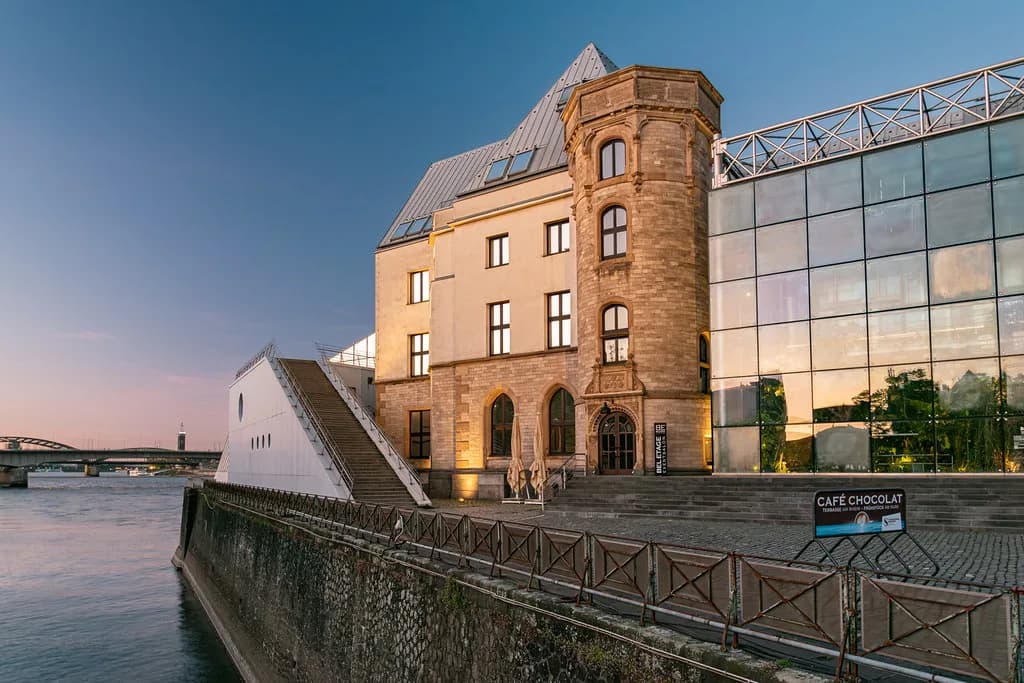
The Schokoladenmuseum is Cologne's chocolate attraction, at Am Schokoladenmuseum 1a in the Rheinauhafen harbour district on the Rhine. Its route begins at a large cocoa bean model, passes through a ten-metre tropical house, and continues to a glass chocolate factory, according to the operator. For planning, a focused walk of the exhibition, fountain and factory is often enough for about sixty to ninety minutes — our suggested estimate, not an official duration. Confirm prices, hours and event programming on the operator's pages close to your travel date.
The museum suits two very different visits: a brisk walk-through of the exhibition and factory, or a slower half-day that adds tastings, a guided format and a café stop overlooking the river. Deciding which you want before you book shapes the day. The sections below separate what the operator and tourism sources publish from what you still need to verify.
Quick Planning Snapshot
The operator lists opening hours as 10:00–18:00 Monday through Friday, 10:00–18:00 on Saturday and 10:00–18:00 on Sunday, but those times can change for holidays and special programmes. Re-check the official opening-hours page in the days before you travel. The museum's address is Am Schokoladenmuseum 1a, 50678 Cologne, and the published contact number is +49 221 931888-0.
Entry fees are published on the operator's entry-fees page, and the museum sells tickets through its own webshop alongside guided tours, courses and tastings. Because prices and reductions are revised periodically, check the fee page yourself before committing. Online tickets are recommended to reduce queueing at the counter, but nothing published states advance booking is compulsory for general admission.
The Exhibition Route: Cocoa Bean to Glass Factory
The route is sequenced rather than a set of unrelated rooms. You begin at a large cocoa bean model, then walk through the ten-metre tropical house where cocoa trees grow in a warm, humid climate, before continuing past displays on harvest, world trade and transport. The operator describes following the path of cocoa from harvest through the major exchanges of world trade and transport to the chocolate factory.
The collection is substantial: the museum presents the cultural history of chocolate across more than 4,000 square metres, covering roughly 5,000 years from early Central American cultures to industrial production, according to the NRW tourism listing. Displays include pre-Columbian exhibits, porcelain and silver from the Baroque period, and machines from the industrial era, alongside digital and interactive stations such as a multi-touch table and a large LED globe. The glass chocolate factory is the working finale, where small bars, hollow figures and pralines are made.
Budget your attention here: the factory section rewards standing still for a full production cycle, while the historical galleries can be skimmed if your group is flagging. A useful tactic is to move briskly through the early galleries and slow down from the tropical house onward. If the factory is busy, loop back after the café rather than queueing twice in the same spot.
The Chocolate Fountain and Tasting Moments
The fountain is the museum's signature feature: a three-metre structure formed from a golden cocoa bean, with chocolate flowing continuously for tasting, according to the NRW tourism listing. Visitors encounter tasting moments along the route rather than in one dedicated room. A robot also dispenses freshly produced Nappos from the production line at the touch of a button, the same source states.
The NRW tourism page describes the fountain as having 200 kilograms of chocolate flowing continuously for tasting. Treat any such figure as illustrative rather than a guaranteed quantity on the day you visit. What matters for planning is that tasting is built into the standard route, so you do not need to buy a separate tasting to experience it. Paid tastings, courses and guided formats are a different product with their own booking and content.
If tasting is the main reason for your visit, build slack into your schedule instead of racing toward it. Avoid arriving in the final hour before closing, when you may feel rushed through the later rooms. If you have dietary restrictions or allergies, raise them with staff before sampling rather than assuming ingredient information is displayed at every station.
Guided Tours, Courses and Tastings
Beyond general admission, the museum operates an experience programme that includes guided tours, chocolate and praline courses, and tastings, all bookable through the operator's own webshop. Named formats include a tour branded as 100% Chocolate and a Little Chocolate School aimed at younger visitors, both described as including samples. Combination tastings pairing chocolate with craft beer, wine or whiskey are also offered for adults, according to the NRW tourism listing.
These add-ons change the shape of a visit considerably: a course can turn a ninety-minute walk-through into a multi-hour commitment, so decide before you buy your admission. Courses and tours sell in fixed slots and are best reserved as early as you can commit, especially around school holidays and weekends. Whether a guided format includes general admission or requires a separate ticket is a detail to confirm at the point of purchase, since ticket scope is not always obvious.
For groups, families and school parties, the operator maintains separate family, school and holiday-programme pages that explain what is available in each case. The Maître Chocolatier at the museum is Aiga Müller, whose confectionery work features in the museum's own content, and her production demonstrations sit within the same building rather than at an off-site facility. If you are choosing between a course and a plain visit, ask yourself whether you want to make something yourself or simply watch and taste.
Chocolat Grand Café and the Rhine View
The Chocolat Grand Café is inside the museum and the operator advertises a view over the Rhine from it, with an offering that includes chocolate fondue, drinking chocolate, chocolate cakes, waffles and breakfast items. That makes it a genuine pacing decision rather than a footnote: a mid-visit break lets you reset before finishing the exhibition or the factory section. Because it sits within the attraction, you can break the visit without leaving the building.
The Rhineauhafen location means the waterfront itself is part of the experience. The harbour district is a modern redevelopment with promenades along the water, and walking a short stretch before or after your slot adds context to the riverside setting. If the weather is good, treating the terrace and harbour walk as the relaxed half of your day works better than trying to compress everything into the museum interior.
The Chocolat Shop adjoins the café and carries gift lines, including seasonal items and the museum's own bar releases featured in its blog. Expect it to be busiest at the end of a visit, when most people exit through it, so shop first if you have a timed onward booking. Gift vouchers are also sold directly by the museum for people who want to give the experience rather than a physical item.
Visiting with Children
Children tend to engage most with the working parts of the museum: the warm tropical house, the glass factory where bars and figures take shape, the robot dispensing Nappos, and the fountain. The museum runs a dedicated children's programme and holiday activities, with a separate family outing page, so it is worth checking what is running during your travel window. To plan the wider day, our guide to Cologne with kids covers the city's family-oriented options beyond the museum.
A reasonable suggested duration for a family visit is about one and a half to two hours inside the exhibition, plus thirty to forty-five minutes if you stop at the café; this is our planning estimate, not an official figure. Younger children usually run out of patience in the historical galleries before the factory, so reversing priorities by heading straight for the production areas can work better. Pushchair and accessibility arrangements vary, so contact the operator directly before travelling rather than assuming step-free access throughout.
Timing matters more than stamina here. Late afternoons are often calmer than mid-morning, and school holidays bring their own surge in family bookings. If your child has a particular interest in making chocolate rather than watching it, a course is the better spend than a longer general visit.
How Long Does a Visit Take?
For a focused visit, allow roughly sixty to ninety minutes to walk the exhibition route and stop at the fountain and factory. Add a café break and that becomes closer to two hours, and adding a guided tour or course pushes it well beyond that. These are suggested durations for planning, not published timings, and how busy the museum is will shift them.
Three things reliably extend a visit: a slow group, a long café stop, and a course or tasting with a fixed start and end time. Conversely, if you arrive knowing you only want the factory and fountain, you can move quickly past the historical galleries without missing the headline experiences. Check the day's programme before you arrive, since special events and holiday activities can change what is accessible and when.
Tickets, Booking and Practical Checks
The museum sells admission and experience tickets online through its own shop, and the operator advises buying in advance to avoid waiting at the ticket desk. Nothing published says advance purchase is mandatory for standard entry, so treat it as a convenience rather than a rule. If you want a specific tour, course or tasting slot, book early because those have limited capacity and fixed times.
Confirm the scope of whatever you buy: whether a guided format includes admission, whether family or group reductions apply in your case, and whether any sub-area requires a separate ticket. These are exactly the details that change, and the operator's questions-and-answers page and entry-fees page are the right places to look. If you need certainty on accessibility, cloakroom rules or what you may bring inside, ask the museum directly by phone or email before your visit.
Seasonal programming is worth checking because it can shape your day: the museum has run holiday activities and participated in Cologne's museum night in autumn 2026. The museum first opened in 1993 and marked its 33rd anniversary in its own communications, so it is an established attraction rather than a new venue. Beyond that, current and upcoming events are best read from the operator's news and blog sections rather than assumed.
Getting There and the Rheinauhafen Setting
The museum stands at Am Schokoladenmuseum 1a, 50678 Cologne, in the Rheinauhafen district on the Rhine. The harbour is a redeveloped dock area with modern architecture and waterfront walkways, and the museum sits within walking distance of the river frontage. Because the location is on the water rather than in the old town, plan it as a separate stop rather than something you pass through en route to the cathedral.
Public transport in Cologne is extensive and the museum's own travel page lists the recommended approach for car, train and bicycle, so check that page for current directions instead of relying on an out-of-date route description. If you are combining several sights, allow real transfer time between the harbour area and the city centre. Cycling along the Rhine is a popular way to reach the district in good weather.
Pairing the Museum with the Rest of Cologne
The Rheinauhafen sits south of the old town, which makes a natural pairing with the Altstadt and its riverside promenades on the same day. If you want more river-level sightseeing after the museum, the Cologne Cable Car crosses the Rhine and gives a very different view of the water and the city. Our Cologne Old Town walk outlines a compact route for the historic core if you would rather anchor the day there.
Cologne Cathedral is the city's other headline sight and works well as a separate half-day rather than something to squeeze in after the museum. If you are building a multi-day trip, our Cologne overview collects the landmark guides in one place, while the separate Cologne itineraries and city travel guides hub is better for shaping a full day or weekend. Both are useful depending on whether you need one attraction or a whole plan.
One practical warning: museum fatigue is real, and chocolate does not cure it. If you are doing the cathedral, the old town and the museum on the same day, put the museum either first or last rather than in the middle. Whichever order you choose, check opening hours for each site independently, since they do not run in parallel.
Decide Based on Your Group and Appetite
The Chocolate Museum works for a wide range of visitors because it can be a quick, high-impact indoor stop or a longer, tasting-led experience, and the difference between those two days is entirely in what you book. Families should prioritise the tropical house, factory and fountain and consider a course if children want to make something themselves. Anyone treating it as the centrepiece of a day should add the Rhine-side café and the harbour walk to make the most of the setting.
Before you go, do three things: verify opening hours and entry fees on the operator's own pages, decide whether you want a standard visit or a guided format with samples, and check whether your travel date overlaps with holiday programming or a special event. Beyond that, the museum is straightforward to enjoy. Plan around your group's patience and appetite rather than an idealised checklist.
Frequently Asked Questions
How long does a visit to the Cologne Chocolate Museum take?
Allow roughly sixty to ninety minutes for a focused walk through the exhibition, the fountain and the factory, or about two hours if you add a café stop. Adding a guided tour, course or tasting extends the visit further, since those run in fixed slots. These are planning estimates, not published timings, and busy periods can stretch them.
Does the Cologne Chocolate Museum have a chocolate fountain with tastings?
Yes. The museum's signature feature is a three-metre fountain, described in the NRW tourism listing as formed from a golden cocoa bean, with chocolate flowing for tasting. Tasting moments are built into the standard route, including freshly produced Nappos dispensed from the production line by a robot. Separate paid tastings and courses are a different product with their own booking.
Do I need to book Cologne Chocolate Museum tickets in advance?
Advance booking is not published as compulsory for general admission, but the operator recommends buying online to avoid waiting at the ticket desk. Guided tours, courses and tastings have limited capacity and fixed times, so those are worth reserving as early as you can commit. Check the operator's own ticket pages for the current position before your trip.
What can families do at the Cologne Chocolate Museum with children?
Children usually engage most with the ten-metre tropical house, the glass chocolate factory, the robot dispensing Nappos and the fountain. The museum runs dedicated family, school and holiday programmes, including formats aimed at younger visitors, so check what is scheduled during your dates. Pushchair and accessibility arrangements should be confirmed with the operator in advance rather than assumed.
Is the Cologne Chocolate Museum worth visiting?
It depends on what you want from a museum. If you enjoy food, industrial processes or family-friendly attractions, the combination of a working factory, a large-scale exhibition and tastings along the route makes it a strong choice. If you prefer art or history museums, the cocoa-focused content may feel narrow. The Rhine-side setting and café also make it a reasonable half-day in its own right.