
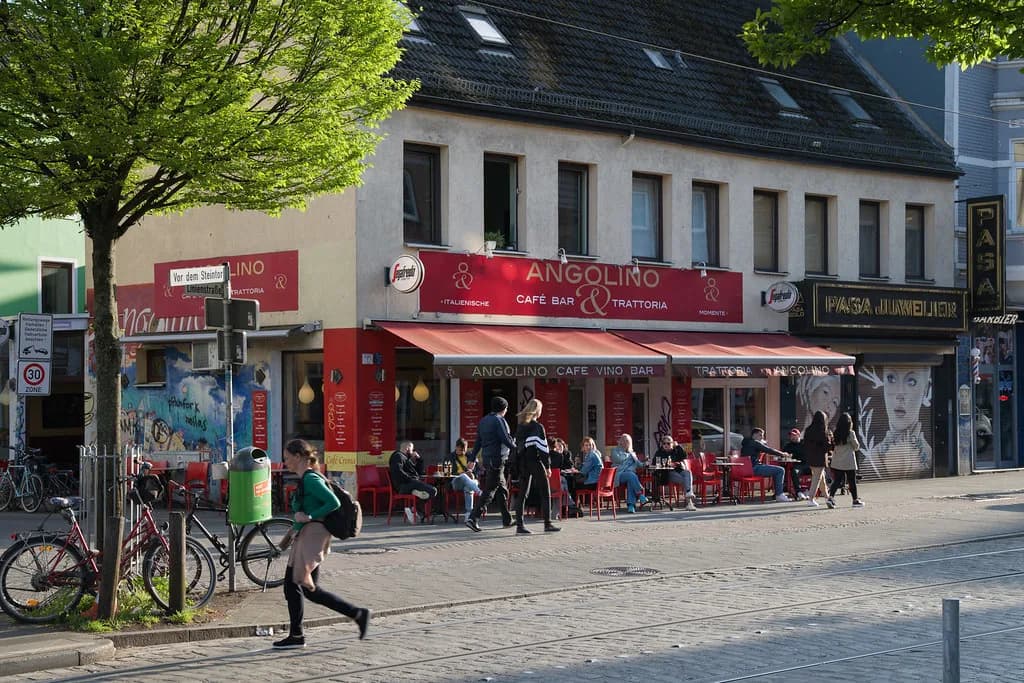
Bremen's Viertel, usually called das Viertel, sits on the far side of the Weser dike from the historic centre. You enter it from Ostertorsteinweg, the spine street that carries most of its shops, cafes and foot traffic. The Discover Germany guide notes that a colourful spray-painted chameleon on a house front near the Bremen Theater announces the neighbourhood's character, a useful landmark if you arrive without a map.
The Viertel is not organised around a single paid attraction. Its identity comes from what fills the street level: individual shops, cafes, vegan restaurants, second-hand stores, cultural centres and art-house cinemas. Street art appears throughout rather than on one curated wall. Because most of what you see is public space, the core experience is free, and there is no ticket to buy, book or collect at the entrance.
This guide is about orientation and pacing. A suggested walk of roughly two hours gives a first impression of Ostertorsteinweg and a side street or two, while a full afternoon into evening lets you browse, eat and see the bar cluster after dark. Those durations are suggestions, not official timings. Exact opening hours, event dates and transport details change through the year and are best confirmed locally.
What and Where the Viertel Is
The quarter begins behind the Weser dike, which is why arriving feels like crossing a threshold rather than turning a corner. From Ostertorsteinweg, the long spine street, the neighbourhood opens outward into a lived-in residential and commercial district. It sits within comfortable walking distance of Marktplatz, so many visitors combine the two areas on the same day.
That geography shapes the atmosphere. The old town is compact, heavily visited and architecturally grand, while the Viertel fills its streets with everyday city life, individual businesses, cultural venues and street art. Come here for colour, cafes and independent shops rather than monumental architecture.
The honest trade-off is that the Viertel has no headline monument of its own. If you are in Bremen for the Gothic town hall, the Roland statue and the bronze Town Musicians, stay in the centre and use a Bremen Marktplatz visitor guide to plan that. The Viertel works best as a complement to the old town, not a replacement.
Bremen as a whole is compact and easily walkable, which makes this pairing practical. If you want a broader orientation before deciding how to split your time, the Bremen City travel guides cover the centre and its surrounding districts.
A Suggested Half-Day Wander
Start on Ostertorsteinweg and walk its length without a shopping list. Treat this as a suggestion rather than a prescribed trail, because the quarter rewards drift and the side streets off the spine hold much of the character. Roughly half a day is enough to browse, stop for coffee and eat without rushing, and that duration is an editorial suggestion rather than an official figure.
From the spine, turn into the smaller streets and look up. Street art appears across the neighbourhood, and the sprayed chameleon near the Bremen Theater is the clearest single landmark that you have reached the colourful part of town, as the Discover Germany guide describes.
Finish toward the river for a pause, then decide whether to loop back along a parallel street or head west into the centre. If you want the old town in the same outing, the Bremen walking tour itinerary pairs naturally with a Viertel afternoon, since the two areas sit within walking distance of each other.
What You Actually Find on the Streets
The mix is the draw: individual shops, cafes, vegan restaurants, second-hand stores, cultural centres and art-house cinemas cluster across the quarter, according to the Discover Germany guide. Because these are small independent operations rather than chains, opening days and hours vary widely. Check individual listings or shopfront signage on the day instead of relying on a printed schedule.
Food is where the neighbourhood's personality shows most clearly. Vegan kitchens sit alongside traditional cafe culture, so a group with mixed diets can eat within the same short stretch of street. If a specific place matters to your trip, look it up before you travel, because small kitchens in the quarter open and close with little public notice and details change frequently.
For shopping, the second-hand and independent offerings suit unhurried browsing rather than targeted buying. Stock turns over constantly, so arriving with a fixed list tends to lead to disappointment. Budget time rather than money: the pleasure here is in looking, comparing and stopping for coffee between shops.
Street Art and the Quarter's Visual Character
Street art is part of the fabric rather than a curated attraction, appearing on house fronts, shutters and side walls across the district. The sprayed chameleon near the Bremen Theater is the best-known marker of that colour, and it works well as a mental anchor when you are orienting yourself.
The quarter is more rewarding for atmosphere than for single set-piece shots, so wide street frames and facade details tend to work better than monument portraits. If you want to build a route around picture-making, a collection of photo spots in Bremen is worth reading before you set out, since it covers the centre as well as the surrounding streets.
Keep expectations calibrated: this is a working neighbourhood, not an open-air gallery with labels and opening times. The reward is the density of small visual surprises along a single walk, not one headline mural. Walk slowly and look above shop level, where much of the paintwork sits.
The Bermuda Triangle After Dark
In the evening, attention shifts to the Bermuda Triangle, the cluster of Fehrfeld, Römerstraße and Humboldtstraße. The Discover Germany guide describes it as one of the top nightlife areas, with an enormous density of pubs and drink variations. It is best understood as a street cluster rather than a list of specific venues, and that framing is deliberate: individual businesses change hands too often for any named recommendation to stay accurate.
Pace an evening rather than chasing a venue. Pick one street, settle somewhere that looks busy with locals, and let the night develop on foot, since the three streets sit close enough to move between without planning transport. Arriving early gives you a quieter choice of seats; arriving late gives you the crowd.
Two practical points matter here. First, treat drink prices and closing times as things you check at the door, not on a planning page. Second, keep the walk home in mind before the evening starts, since the quarter sits a comfortable walk from the centre.
Second-Hand and Independent Shopping
The quarter suits browsing over ticking off. Second-hand stores, small design shops and one-off retailers sit close together, which means a single street can cover several different interests in twenty minutes. Because inventory is unpredictable, a loose list of categories works better than named stores.
If you enjoy the independent-retail side of a city more than its landmarks, this district will probably be your favourite part of Bremen. The same logic applies elsewhere, and a guide to hidden gems in Bremen is a useful companion for finding the smaller, less signposted corners that mirror the Viertel's character.
Plan around opening days rather than hours. Small independent shops in this part of Bremen often keep shorter schedules than city-centre retail, so a weekday afternoon is generally a safer bet than a Sunday. If one particular shop is the reason for your visit, check its own listing first.
Where the Viertel Fits in a Wider Bremen Trip
The quarter's greatest practical advantage is its walkable relationship to the centre. Marktplatz, with the town hall, Roland statue, cathedral and the Town Musicians sculpture, sits within easy walking distance, and the Schnoor quarter and Böttcherstrasse are close to each other on the same side of the centre. As the Love Travelling Blog describes, Bremen is a compact and easily walkable city to enjoy a weekend break, which makes a natural split practical: old town in the morning, Viertel in the afternoon and evening.
The Wallanlagen park route is the connective tissue between the two halves of a day. The green belt runs between the centre and the central station. Walking it from the old mill area toward the quarter gives you a calm, shaded transition instead of a straight run along busy streets.
For the centre itself, Marktplatz is the logical starting point because it gathers the city's headline sights in one square, with the Town Musicians sculpture west of the town hall and the cathedral alongside. Pair that with the Viertel for a full day that covers both sides of Bremen. For wider planning, see Bremen City: Landmark Visitor Guides.
Two-Hour Wander Versus a Full Afternoon and Evening
With two hours, stay on and immediately around Ostertorsteinweg. Walk the spine once in each direction, take one or two side streets, find the chameleon, and stop for a single coffee or snack. This version is about impressions: colour, shopfronts and street life, with no attempt to see everything the quarter offers.
With an afternoon and evening, the shape changes rather than the stops repeating. Spend daylight hours on browsing, street art and a proper meal, then let the day taper into the Bermuda Triangle streets as the bars open. The difference is energy allocation, not a longer list: you are trading coverage for depth, and depth is what this neighbourhood rewards.
Both versions work without booking anything, because the core Viertel experience is wandering, looking and eating. If you prefer a structured day, build it around the city's own orientation material and confirm current details before you travel through the official tourism source.
Practical Decisions That Shape the Visit
Time of day changes the quarter more than the day of the week does. Mornings are quiet and shop-focused, afternoons are the busiest for browsing, and evenings belong to the bars around the Bermuda Triangle cluster. If you want to see the neighbourhood as a place where people live and work, aim for a weekday afternoon.
Weekends bring a different crowd, with more visitors mixing into local routines and more people lingering over long cafe meals. That suits browsing but can slow a fast walk-through, so build in slack if you have a fixed departure. If your only free slot is an evening, accept that you will see the nightlife side and very little of the shopping side.
Whatever you plan, verify the moving parts shortly before you go. Bremen's official tourism sources are the right places to check current opening hours, exhibitions, events and transport arrangements rather than relying on older write-ups. The Viertel rewards flexibility as much as planning.
Plan Your Visit
The Viertel is the part of Bremen that shows you the city rather than its monuments. Enter from Ostertorsteinweg, look up for the chameleon near the Bremen Theater, browse without a fixed list, and let the evening drift toward the Fehrfeld, Römerstraße and Humboldtstraße cluster if you have the energy.
Treat it as a half-day at minimum, ideally afternoon into evening, and pair it with an old town morning around Marktplatz and the riverfront. That combination gives you both halves of Bremen: the Hanseatic showpiece and the neighbourhood where the city actually lives.
Before travelling, confirm opening hours, current exhibitions, events and transport details through Bremen's official tourism channels, since these details change through the year. Everything else about the quarter, from the street art to the shop windows, is free to enjoy on foot.
Frequently Asked Questions
Is the Viertel district in Bremen worth visiting?
Yes, if you want to see how Bremen lives rather than only how it presents itself to visitors. The quarter is entered from Ostertorsteinweg behind the Weser dike and is known for street art, independent shops, cafes, vegan restaurants, second-hand stores, cultural centres and art-house cinemas. The trade-off is that it has few headline monuments, so come for atmosphere and everyday texture rather than tick-box sightseeing.
How do you get to the Viertel in Bremen?
The most straightforward approach is on foot from the city centre, since the quarter sits a walkable distance from the old town and Marktplatz. You enter it from Ostertorsteinweg, which acts as the main spine street. Because transport services, routes and ticketing change over time, check current public transport information from Bremen's official tourism and transport sources before you travel rather than relying on older descriptions.
Is the Viertel the same as Schnoor?
No, they are separate neighbourhoods with different characters. Schnoor is Bremen's oldest quarter, a tight maze of small historic houses close to the market square, while the Viertel is the alternative quarter on the far side of the Weser dike, known for street art, independent retail and its bar streets. Visiting both in one day works well because they sit within walking distance of the centre.
What can you do in the Viertel in the evening?
Evenings centre on the Bermuda Triangle, the cluster of Fehrfeld, Römerstraße and Humboldtstraße, which has an enormous density of pubs and bars. Rather than chasing a specific venue, pick one street, settle somewhere busy and move on foot between the three. Individual businesses change over time, so check what is currently open on the night rather than planning around named venues.
How long do you need in the Viertel?
Two hours is enough for a first impression along Ostertorsteinweg with one or two side streets and a coffee stop. An afternoon into evening gives you a much better sense of the quarter, covering browsing, street art, a proper meal and the bar streets after dark. Both plans are suggestions rather than official routes, and neither requires booking anything in advance.
When is the best time of day to walk the Viertel?
A weekday afternoon suits browsing, with shops open and the streets busy but not overwhelmed. Evenings belong to the bar cluster around the Bermuda Triangle, while mornings are quieter and more residential. Weekend visits bring a larger mixed crowd, which is pleasant for lingering but slower if you are short on time.


