A self-guided visit to the Opera Garnier costs €15-25 for adults in 2026 depending on residency, and the building is open to visitors daily from 10am to 3:30pm (extended to 4:30pm in August). Booking is online-only through the official Paris Opera site — there's no ticket desk to walk up to on the day.
Officially called the Palais Garnier, this is the ornate 19th-century opera house that most visitors mean when they say "Opera Garnier" — as opposed to the modern Opéra Bastille across the city. This guide covers exactly what a 2026 ticket costs, when the building is open, how long to budget, and how to avoid the two mistakes that catch first-time visitors: turning up without a booking, and confusing this building with the other Paris opera house. It's part of our full Paris attractions guide.
What Is the Opera Garnier?
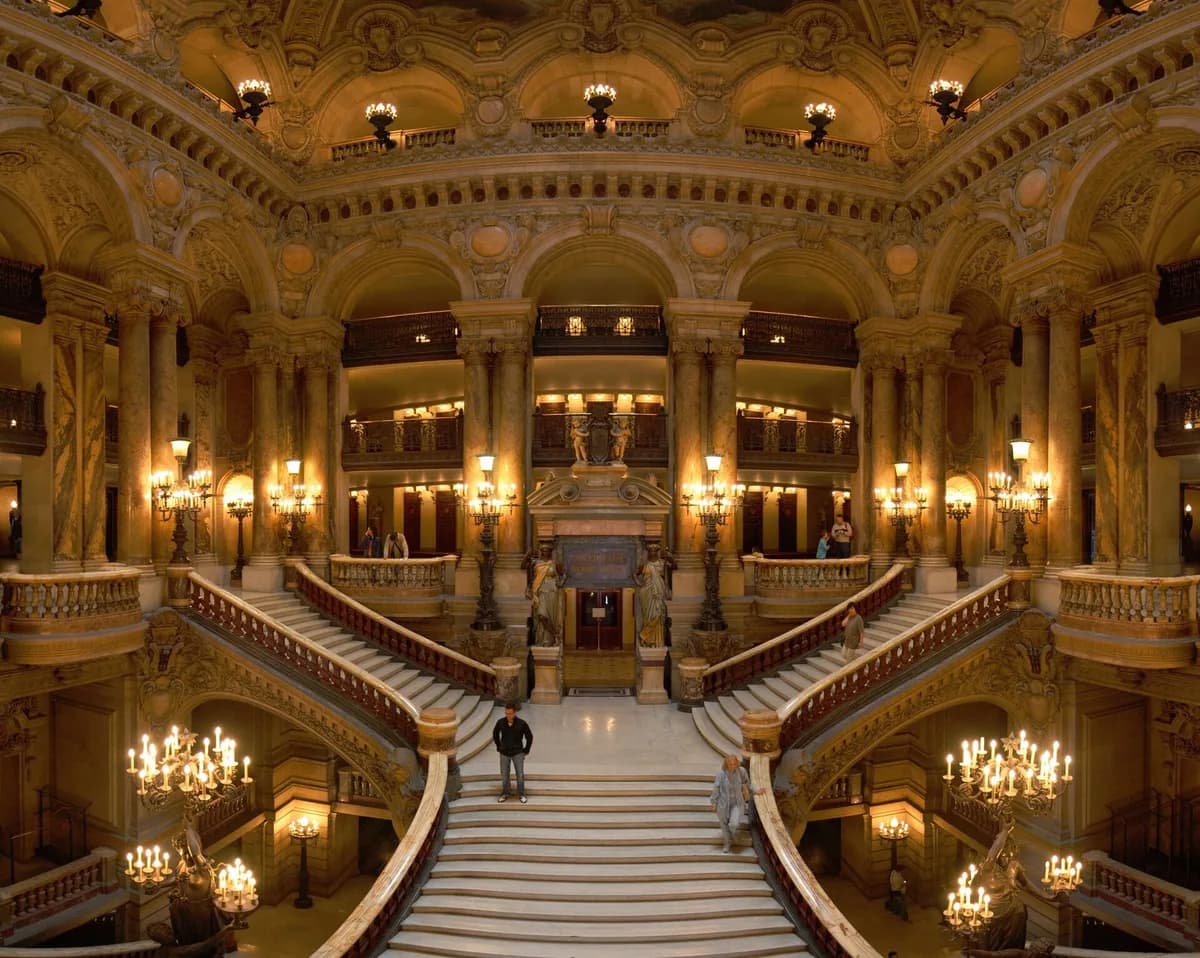
The Opera Garnier — its official name is the Palais Garnier — was built between 1861 and 1875 to a design by architect Charles Garnier, commissioned by Napoleon III as the new home of the Paris Opera. It's one of the defining examples of Beaux-Arts architecture in Europe: a marble Grand Staircase, a foyer covered in gilding and mirrors modeled on the Hall of Mirrors at Versailles, and an auditorium ceiling painted by Marc Chagall in 1964, installed above the original 19th-century decor rather than replacing it.
It sits at the northern end of the Avenue de l'Opéra in the 9th arrondissement, a short walk from the Louvre and the Grands Boulevards shopping district around Galeries Lafayette. Since the Opéra Bastille opened in 1989 to take over most full-scale opera productions, the Palais Garnier has functioned primarily as the home of the Paris Opera Ballet, alongside a reduced opera and concert program — which is worth knowing before you book a performance ticket expecting a full opera here specifically.
Opera Garnier Tickets & Prices 2026
As of mid-2026, the official self-guided visit ticket is priced by residency: €25 for adults outside the European Economic Area, €15 for adults resident in France or the EEA, €20 for ages 13-25 from outside the EEA, and €10 for ages 13-25 resident in France/EEA. Season subscribers pay €10. Entry is free for children under 13, visitors with disabilities plus one companion, jobseekers, and architecture students — bring proof at the door.
A guided tour costs more: €35 full rate (adults outside the EEA) or €25 reduced rate (France/EEA adults), with a further reduced rate of €28 for ages 13-25, students, seniors 65+, jobseekers, and disabled visitors outside the EEA. After-hours guided tours run €32-42, and shorter 45-minute "flash" tours are €15-25. A multimedia handheld tablet guide can be added to a self-guided ticket for an extra fee and covers roughly an hour of content.
Every ticket type must be booked online in advance on the official Opéra national de Paris website — the site is explicit that visit tickets are not sold on site. Third-party resale and tour sites also list Palais Garnier tickets, often at a markup; there's no advantage to using them over booking direct unless you specifically want a bundled guided experience they offer that the official site doesn't. If you're weighing whether a multi-attraction pass covers this stop, see our breakdown of whether the Paris Pass is worth it — most city passes do not include the Palais Garnier visit.
Opening Hours & Best Time to Go
The Palais Garnier is open for self-guided visits every day from 10am to 3:30pm, extended to 4:30pm during August. Last entry is one hour before closing. The building is closed on January 1st and May 1st, and — as of mid-2026 — check the official booking calendar before you travel, since exact hours can shift for exceptional closures.
The one detail that catches visitors off guard: rehearsals cause frequent, unpredictable closures of parts of the auditorium, and the official site is upfront that no visit ticket guarantees access to the performance hall itself on a given day. If seeing the auditorium specifically matters to you, there's no way to confirm access in advance — it's simply a possibility, not a guarantee, with any ticket type.
Arriving close to the 10am opening is the most reliable way to beat both the crowds and the risk of rehearsal-related access changes building up over the day. Weekday mornings outside French school holidays are the quietest window; weekend afternoons and the first two weeks of August are the busiest.
How Long to Plan for Your Visit
A self-guided visit covering the Grand Staircase, the main foyers, and the auditorium (when open) takes most visitors about 1 to 1.5 hours. Adding the optional multimedia tablet guide extends that by roughly an hour, since it walks you through a more detailed self-paced route. A guided tour runs about 90 minutes and covers similar ground with a live commentary, so it's not significantly longer than a self-guided visit with the tablet — the tradeoff is flexibility versus expert narration.
Budget extra buffer time before your slot: online booking is mandatory, so arrive with your ticket already on your phone or printed, and expect a security check at the entrance (see visit tips below). If you're combining the Palais Garnier with a nearby stop on the same morning, plan for roughly 2 hours total including the walk over and the visit itself.
How to Get to the Opera Garnier
The Palais Garnier sits directly on Place de l'Opéra in the 9th arrondissement. The closest Métro station is Opéra, served by lines 3, 7, and 8, with an exit that opens almost onto the building's front steps. Chaussée d'Antin-La Fayette, on lines 7 and 9, is a short walk away and convenient if you're coming from the Galeries Lafayette shopping district next door.
On foot, it's about a 15-20 minute walk south down the Avenue de l'Opéra toward the Louvre — an easy pairing for one morning (see Nearby Attractions below). Taxis and rideshares can drop off directly on Place de l'Opéra, though the surrounding streets get congested during rush hour and on weekend afternoons.
Visit Tips: Queues, Booking & Common Mistakes
Book online before you travel — this is the single most important tip. Visit tickets are not sold at the building, and turning up without a reservation means you won't get in regardless of how quiet it looks. Booking also lets you pick a specific entry slot, which spaces out arrivals and keeps the queue at the door manageable.
Don't confuse this building with the Opéra Bastille. Both venues host the Paris Opera's program, but they're on opposite sides of the city, and a ticket for a performance at one won't get you into the other. If you booked a show expecting the gilded 19th-century interior of the Palais Garnier, double-check the venue listed on your confirmation before you leave your hotel.
Security is airport-style: large suitcases and travel bags are not permitted inside under the current Vigipirate security plan, and there's no cloakroom available during visiting hours to store them. Travel light, or leave luggage at your accommodation before you come. Because rehearsals can close parts of the building without notice, treat the Grand Staircase and main foyers — which stay accessible far more reliably than the auditorium — as the core of the visit, and the auditorium as a bonus if it happens to be open that day.
Nearby Attractions
The Louvre Museum is the natural pairing, roughly 15-20 minutes on foot down the Avenue de l'Opéra, and easily fills the rest of a morning. Heading north instead, the Sacré-Cœur in Montmartre is a short Métro ride away and works well as an afternoon contrast — white-domed basilica and hilltop views after the gilded opera interior.
West along the Grands Boulevards, the Arc de Triomphe is reachable by Métro in under 20 minutes and pairs naturally with an Opera Garnier morning if you're building a one-day central Paris loop. For evening plans after your visit, our guide to things to do in Paris at night covers the area's theater and nightlife options around the Grands Boulevards.
Frequently Asked Questions
Frequently Asked Questions
How much are Opera Garnier tickets in 2026?
A self-guided visit costs €25 for adults from outside the EEA, or €15 for adults resident in France/EEA, as of mid-2026. Ages 13-25 pay €20 (outside EEA) or €10 (France/EEA). Children under 13, disabled visitors with a companion, jobseekers, and architecture students enter free. Guided tours cost more, from €25-35 depending on residency.
What are the Opera Garnier opening hours?
The Palais Garnier is open for self-guided visits daily from 10am to 3:30pm, extended to 4:30pm in August. Last entry is one hour before closing. The building is closed on January 1st and May 1st, and rehearsals can close parts of the auditorium on any given day without notice.
How long does a Palais Garnier visit take?
A self-guided visit of the Grand Staircase, foyers, and auditorium (when accessible) takes about 1 to 1.5 hours. A guided tour runs roughly 90 minutes. Adding the optional multimedia tablet guide extends a self-guided visit by about an hour.
Is the Opera Garnier the same as the Opera Bastille?
No. The Opera Garnier — officially the Palais Garnier — is the 19th-century opera house on Place de l'Opéra and is now home mainly to the Paris Opera Ballet. The Opéra Bastille is a separate, modern venue on the other side of the city that hosts most full opera productions. Check your booking confirmation carefully, since both are run by the same Paris Opera company.
Do I need to book Opera Garnier tickets in advance?
Yes. Visit tickets are sold online only through the official Opéra national de Paris website and are not available for purchase on site. Booking ahead also secures a specific entry time slot rather than an open queue.
The Opera Garnier rewards planning more than most Paris landmarks: the ticket is inexpensive if you book direct, the visit itself is short enough to slot into a half-day, and the interior — the Grand Staircase and Chagall ceiling especially — holds up against any of the city's better-known museums. The one real risk is booking blind, either by skipping the online reservation or by mixing this venue up with the Opéra Bastille across town.
Book your self-guided slot for the first hour after opening, confirm the venue on your ticket if you're going for a performance rather than a daytime visit, and pair it with the Louvre or a Métro ride to Montmartre to make the most of the trip in 2026.
For current official information, see the official Palais Garnier visit page and Palais Garnier on Wikipedia.