
Last updated October 2026. Stockholm metro art is public art inside working stations, so you can see it on an ordinary SL ticket. This guide groups stations by line, builds a short route around a single ticket window, and flags what to check on sl.se before you go.
Stockholm Metro Art: What You Are Actually Visiting
Stockholm's Tunnelbana is often called the world's longest art gallery. Sources describe a network about 110 km long, with 90+ stations and work by over 150 artists. Treat those figures as round numbers rather than an exact count.
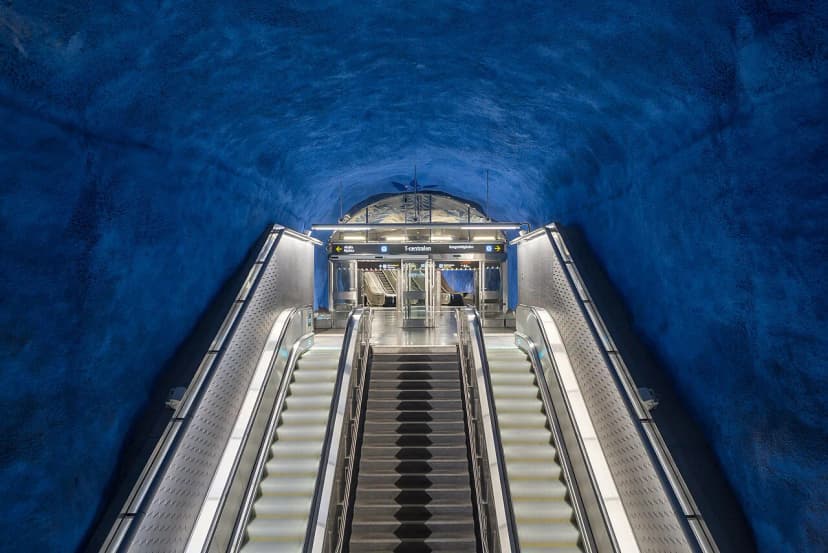
Most of this art sits in the open, on platforms and concourses. You are not entering a museum. You are riding a commuter system that happens to be decorated. Some stations are carved straight into bedrock, with raw rock ceilings left exposed. Others use tiles, paint, neon or LED lighting.
About 1957 is the date usually given for when T-Centralen introduced art to the system. Older stations built without any art were later retrofitted. That mix is why a short visit works best when you choose a few contrasting stations rather than trying to see everything. For background on the city, Visit Stockholm's official guide is a reasonable starting point.
Tickets, the SL App and the Stay-Inside Rule
A standard SL single ticket costs about 45 kr and is valid for 75 minutes. Prices change, so confirm the current fare on SL's English-language pages before you travel. You can pay in the SL app or by tapping a contactless bank card at the gates.
The key rule is simple: stay behind the ticket gates. Platforms and many concourses are inside the paid area, so you can ride between stations and look at the art without paying again. If you exit to see a station's street-level entrance, you may need a new ticket to re-enter. Plan your exits deliberately.
| Line Numbers | Best For | Visual Style |
|---|---|---|
| Blue: 10, 11 | Cave rock drama | Painted motifs, forest imagery |
| Red: 13, 14 | Modern & contrast | Rainbow, science symbols, color shifts |
| Green: 17, 18, 19 | Retro tiles & LED light | 1950s–2008s tile work with modern additions |
A 24-hour pass can make sense if you want to leave stations freely, for example to walk between a station and a nearby sight. Compare the current pass price with two or three single tickets on SL's site. For a tight route that never leaves the gates, one single ticket is usually the cheaper choice.
Use the SL app or its journey planner for live departures. Line numbers matter here. Blue line trains run as 10 and 11, red line trains as 13 and 14, and green line trains as 17, 18 and 19.
- Fare reference: about 45 kr for a single ticket, valid 75 minutes (verify on sl.se)
- Payment: SL app or contactless card tap
- Best for short routes: one ticket, no exits through the gates
- Best for flexible days: compare a 24-hour pass with several singles
Blue Line Stations: Bedrock Caves and Big Gestures
The blue line (10 and 11) is the best place to start because its stations feel most like caves. Four stops show the range.
Exploring four blue-line stations costs just 45 kr on a single ticket, delivering cave art that rivals museum visits but requires only transit fare.
T-Centralen is the system's hub. Its platform is painted largely in blue, with vine and flower motifs meant to calm commuters. It is busy, so expect to share the view.
Kungsträdgården is a few minutes from the city centre by train. Its design nods to the Makalös Palace and the formal gardens once above it, and the station holds replicas of palace exterior art. Reports also mention a rare cave spider, Lessertia dentichelis, living there. Do not count on seeing it.
Solna Centrum is the dramatic one. Green forest and a fiery red sunset cover the rock, and the 1970s themes include deforestation and rural depopulation. Per the brief, Anders Åberg is linked to this station's art.
Rådhuset has raw rock in earthy tones and leaf motifs. It suits travelers who prefer a quieter, more industrial look.
- T-Centralen: blue vine motifs, hub station, heavy foot traffic
- Kungsträdgården: Makalös Palace references and a royal-garden theme
- Solna Centrum: red sunset over painted forest, political backstory
- Rådhuset: exposed bedrock and leaf motifs
Red Line Stations: Science, Nature and Pride
The red line (13 and 14) is the second-best line for art-hopping. Its three standouts are very different from the blue line caves.
Stadion is near the Olympic Stadium used for the 1912 Games. A rainbow arcs across blue cave walls, which links the station to Stockholm Pride as well as to sport. It is a strong photo stop.
Tekniska Högskolan sits near the Royal Institute of Technology. Its imagery draws on science, with formulas and technological symbols. Tiles by Per Olof Ultvedt are credited at this station.
Mörby Centrum is the subtle one. Its walls appear to shift from light pink to a greenish tone as you move, so your position changes what you see. Walk the platform slowly and look from both ends.
- Stadion: rainbow over blue rock, 1912 Olympic link
- Tekniska Högskolan: science motifs near the technical university
- Mörby Centrum: colour-shifting walls, best seen by walking the platform
Green Line and Citybanan: Retro Tiles and Modern Light
The green line (17, 18 and 19) has more traditional tiled stations and a few installations. Hötorget keeps its 1950s tile work and original wastebaskets. A 1998 neon ceiling by Gun Gordillo adds a modern layer on top.
Thorildsplan was built in 1952, and its 2008 tile work by Lars Arrhenius uses pixelated clouds, mushrooms and projectiles in a video-game style. It is a surface-level station, so natural light changes how it looks.
Odenplan on Citybanan is a separate commuter-rail station rather than a Tunnelbana stop. Its Life Line installation by David Svensson uses about 400 m of LED lighting, described as a heartbeat. Check on SL's site that your ticket covers the rail leg you plan to ride.
If you are staying near Södermalm, Södermalm side streets and viewpoints pair well with a station stop there, such as Mariatorget.
Short Station-Art Itineraries Using One Ticket
Pick three or four stations that contrast rather than repeat. Cave rock, rainbow colour and retro tile look different enough to keep the visit interesting.
Within your 75 minutes, plan routes avoiding peak commute hours (07:30 to 09:00 and 16:00 to 18:00) for clearer views and better photos.
A first-time route can fit inside one 75-minute ticket window if you do not exit. Start the clock when you tap in. Check live timetables, because waits change by time of day. If you reach 60 minutes with stations left, stop and plan a second ticket.
On a wet day, the metro works as an indoor activity. Stockholm rainy day plans show how to combine it with museums. A longer blue-and-red tour fits that mood, and you can buy a 24-hour pass if you want to step out between stations.
- 1-Hour Express: T-Centralen, then Kungsträdgården, then Solna Centrum (all blue line; stay inside the gates)
- Contrast Route: T-Centralen for blue motifs, a red-line stop at Stadion for the rainbow, and a green-line stop at Hötorget for retro tiles
- Rainy-Day Deep Dive: work through the blue and red lines, with a 24-hour pass if you plan to exit
- Suburban Add-On: Tensta or Bagarmossen for quieter art away from the central stations
Public Art Is Not a Guided Tour
Most station art is free to see with transit access, but it is not a ticketed attraction. There is no guarantee of a guide, signage in English at every station, or an audio tour. You are visiting working infrastructure.
SL has been reported to run "Art Walk" tours in summer, sometimes free. Do not assume one will run on your dates. Check the schedule on sl.se, and book only through official channels if a tour is offered. Private operators sell walking tours that include stations, but those are separate products with their own prices.
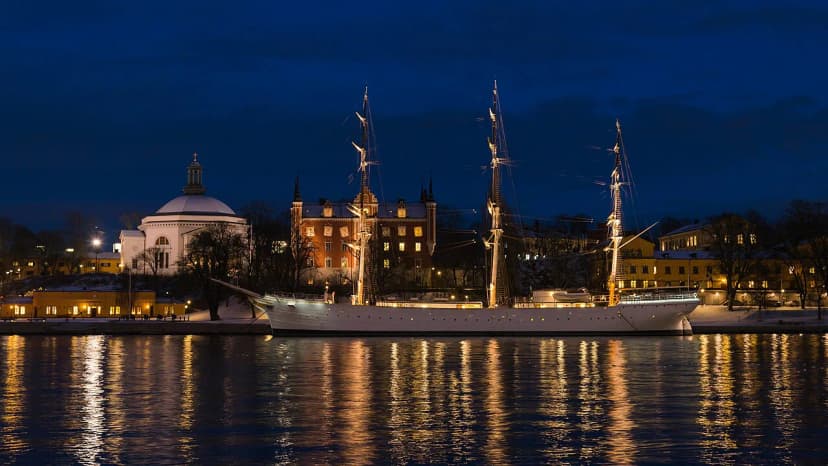
If you want more neighbourhood color after your stations, a Skeppsholmen walking route is a good next step. For quieter suburban stations, lesser-known Stockholm stops like Tensta are worth adding.
Photography, Crowds and Etiquette
Avoid rush hour, roughly 07:30 to 09:00 and 16:00 to 18:00. Late mornings and late evenings usually give cleaner shots, but check the last trains on SL.
Cave stations use warm orange and yellow lighting. Set your white balance manually or shoot RAW to keep colors accurate. A phone's auto mode often over-warms the rock.
Do not stop on escalators or block platform edges for photos. Step aside, keep a clear path, and avoid using flash close to passing trains. Tripods can obstruct commuters, so they are best skipped.
Most stations are reported to have elevators, which makes a route workable with a stroller or wheelchair. Confirm elevator status for each station on SL's site before you go, since lifts can be out of service.
Frequently Asked Questions
How much does a Stockholm metro art tour cost?
You only need transit fare. A single SL ticket costs about 45 kr and is valid for 75 minutes. Confirm the current price on sl.se.
Can I see several stations on one ticket?
Yes, if you stay behind the gates and finish within the validity window. Exiting a station may mean buying a new ticket to re-enter.
Which stations are best for first-timers?
Start with T-Centralen, Kungsträdgården and Solna Centrum on the blue line. Add Stadion on the red line for contrast. Hötorget adds retro tiles on the green line.
Is there an official guided tour of the station art?
Do not assume one. SL has been reported to offer summer Art Walk tours at times. Check sl.se for current schedules before planning around one.
Is the metro art accessible with a stroller or wheelchair?
Most stations have elevators, which makes many routes workable. Check live elevator status on SL's site before each trip.