Stuttgart sits in a basin ringed by vineyards and wooded hills, and that geography shapes the evening more than any single venue does. The centre is compact enough to walk, but the moment you climb towards the terraces and viewpoints you feel the slopes, so a night here is really a choice between staying low and central or heading uphill for the panorama. This guide organises the evening by that decision, then covers bar quarters, free public space, match nights and how to plan the trip home.
One useful anchor detail: the Killesberg Hill Park, north of the centre, combines a 40-metre tower, play areas, a petting zoo, a narrow-gauge railway and an open-air pool in one green destination, which makes it a plausible late-afternoon start that rolls into an evening. The park's own listing shows opening hours around the clock, but seasonal attractions inside it and food and drink outlets keep their own times, so confirm those before you build an evening around them.
Why Stuttgart Works Well After Dark
The city's press material describes Stuttgart as a place for big celebrations and long nights, with the pub quarter around the Hans-im-Glück fountain, the old city centre and the Leonhardsviertel drawing visitors from across Germany to clubs, bars and lounges. That concentration is the point: several distinct areas sit within a short walk of each other, so you can drift between them instead of committing to one address. The hills add a second layer, because the slopes that make the city awkward to cross on foot also produce the viewpoints that make an evening memorable.
Stuttgart is also wine country inside its own limits, and vineyard trails and terraces sit within the built-up area rather than beyond it. That gives you an unusual option for a European city break: a glass of local wine on a slope above the rooftops, without leaving the transport network. Bear in mind that terraces and vineyard stops are seasonal and weather-dependent, so treat any specific terrace as something to confirm on the day.
The Illuminated City Core: Schlossplatz and the New Palace
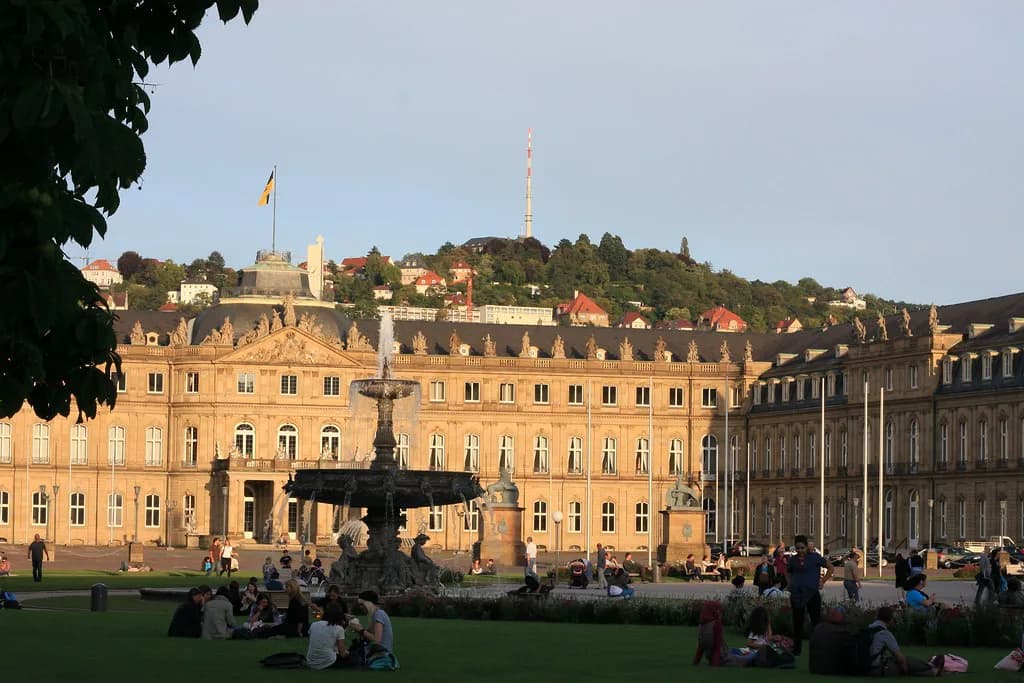
Schlossplatz is the natural starting point for an evening, and it costs nothing to walk through. The square began as a private garden before it was opened to the public as parkland used for open-air concerts and events, and it sits a few steps from the Kunstgebäude, the state parliament and the Königstrasse shopping street. After dark the appeal is the lit facade of the New Palace behind it and the general hum of people doing very little in particular.
The New Palace itself is a Baroque building from the eighteenth century that served as the royal seat of the kings of Württemberg, and it is still used for government offices. That is why you cannot simply wander through the state rooms: the interior is normally seen only on a special public tour, while the exterior and the square around it are open to anyone. Separating those two things keeps your evening budget honest.
The Kunstmuseum's glass cube is the other piece of the picture, and it changes character after dark. By day the reflective cube throws back the city; at night the interior limestone walls light up and illuminate the street around it. Inside, the galleries hold modern and contemporary art, and there is a museum restaurant, so the cube can be either a quick look or the whole evening depending on your appetite.
For a closer look at how the square fits into a full day and evening, it helps to see it in context rather than as an isolated stop. Schillerplatz, the old town lanes and the Markthalle all sit within a short walk, which is why the centre rewards slow wandering rather than a checklist.
Bar Quarters Compared: Old Centre, Leonhardsviertel and the Fountain Quarter
The historic cluster is the safest bet for a first evening because it is compact and flat. The quarter around the Hans-im-Glück fountain mixes old pubs, cocktail bars and cafés, and the adjacent old centre keeps the same density without long walks between stops. If your priority is choice within a few minutes of each other, this is where to base yourself.
The Leonhardsviertel has developed a different flavour, with bars that deliberately hide behind unremarkable facades. Some venues there are described as speakeasy in style, and at least one is written up as admitting only guests who know a secret password, but entry rules change and a password should never be assumed. Treat the hidden-bar aesthetic as a genre and check the rules with the venue directly rather than arriving with an expectation.
The Hospitalviertel adds another option and a good talking point: one well-known bar there occupies a former bank strongroom, which is exactly the kind of detail that makes an evening feel specific to a city rather than generic. The same press material also notes a bar in the Leonhardsviertel that combines a bar with a delicatessen, so a single stop can serve as both drink and late snack.
Wherever you settle, one honest caveat applies to all of these districts: opening days, door policies and whether a place is busy on a Tuesday rather than a Saturday vary widely, and no single list can guarantee a given venue is open on a given night. Pick two or three addresses per district and keep a fallback.
South of the Centre: Hauptstätter Strasse, Wilhelmsplatz and Marienplatz
On the edge of the old town, bordering the Hauptstätter Strasse area, a newer nightlife axis has grown up that feels distinct from the historic core. The Wilhelmsplatz area sits nearby and the two together form a natural extension of an evening that starts centrally, rewarding a longer walk with a different crowd and a different style of bar. That is the trade-off to weigh: more walking, less density, but a less familiar side of the city.
Tübinger Strasse leads from the centre towards Marienplatz, an area known for vintage shops, cafés and bars, including a wine bar and shop where guests pour their own from a large selection. That self-pour format suits groups with mixed preferences, since nobody is locked into a single bottle. It also means the pace of the evening is entirely yours.
If you want to combine this axis with the classic sights, it fits best into a longer stay rather than a single rushed night. Pairing a central evening with a slower day that covers the museums and the hills keeps the walking realistic.
Free Public Space Versus Paid Interiors
A large share of a Stuttgart evening can be free if you separate public space from interiors. The squares, the illuminated facades, the church steps and the park grounds cost nothing to walk through, and the lit New Palace seen from Kleiner Schlossplatz is exactly the kind of thing visitors pay nothing for. Budget your money for what happens indoors.
Where tickets apply, they apply per institution and often per exhibition, not across a whole complex. At the Stuttgart Museum of Art, admission is reported to vary by exhibition, with tours charged separately from entry, and that is a useful reminder that museum pricing in Stuttgart is not uniform. For any specific collection, check the institution's own page rather than assuming a shared ticket.
The city's own visitor portal lists a long roster of sights, from the Württemberg State Museum and the Staatsgalerie to the Porsche and Mercedes-Benz museums, and a StuttCard covering many partners is sold in 24, 48 and 72-hour versions. Whether that card pays off depends on how many of those paid interiors you genuinely plan to enter, and on current prices, which you should confirm with the operator before buying.
Architecture fans should also know that the Weissenhofsiedlung on the Killesberg is a listed estate whose Le Corbusier house has been a museum since 2006 and joined the UNESCO World Heritage List in 2016. The city publishes the site's background and contact details. It is a daytime rather than an evening proposition, but it pairs neatly with an evening on the northern hills.
Beer Gardens, Stairs and Hillside Viewpoints
Stuttgart's hills are stitched together by hundreds of public stairs, and residents use them for exercise as much as for getting anywhere. One account of the city counts around 400 sets of public stairs covering more than 20 kilometres, and notes a beer garden with views across the city discovered along the way. The practical consequence for an evening is that a viewpoint is rarely far away, but the climb changes what you wear and how much you want to drink.
Killesberg Hill Park is the easiest introduction to that idea because it combines a tower, play areas and food and drink options in one place, so a mixed group with children and adults can all find something. Smaller, steeper viewpoints reward more effort with wider sweeps over the basin. Aim to reach your chosen terrace before dark if you want to watch the lights come on, and carry a light for the stairs back down.
Vineyard Evenings Inside the City Limits
Stuttgart is unusual in having vineyards within the city, and the wine hiking trails that run through them combine landscape views with the chance to taste local wine along the way. One route described by a long-form guide runs from Uhlbach to Rotenberg and is suggested for spring or autumn. Evenings on the vines are therefore a shoulder-season pleasure rather than a year-round certainty.
If you want the vineyard experience without committing to a long hike, a bar that specialises in regional wines gives you the flavour in the centre. Several of the bars in the old core and along the newer axis keep regional wines on the list alongside beer and cocktails. Either way, decide in advance whether you are walking home or taking transport, because the slopes make a tipsy descent less forgiving than a flat city stroll.
Family and Couples Evenings
Not every Stuttgart evening needs to end in a bar. The floodlit square, the illuminated cube and the park grounds give families a genuinely free, low-stress evening, and the central pedestrian zone means you are never far from food or a tram stop. An early dinner followed by a slow loop of the centre works well with children because you can leave whenever energy runs out.
For couples, the strongest combination is usually a viewpoint plus a quiet bar rather than a single big night out. Climb to a terrace for the sunset, then descend to one of the smaller bars in the old centre or the Hospitalviertel for a slow drink. The city's compactness makes that two-part evening realistic without a car.
Cultural evenings are another option worth checking: the state opera and the city's theatres and concert venues publish their own programmes. Availability and timing shift constantly, so look at the venue's own calendar for the night you are in town rather than relying on a general guide.
Match Nights at the MHP Arena
When VfB Stuttgart play at home, the evening belongs to Bad Cannstatt rather than the centre. The arena sits in the NeckarPark area on the east bank of the Neckar, roughly 4.5 kilometres from Stuttgart's city centre and main rail station, and crowds move in a single direction before and after kick-off. If your visit coincides with a fixture, either embrace it or deliberately plan your night somewhere else. Further visitor details appear in Mercedes-Benz Arena - Stuttgart - The Stadium Guide.
Transport pressure is the main practical issue, which is why the club and the regional transport authority publish matchday guidance rather than a fixed timetable you can memorise. The VfB site carries fixtures, tickets and arena service information, and the transport operator publishes the live timetable for the specific evening. Build in slack, and expect stations near the ground to be busy for a period after the final whistle.
Arena tours run on non-match days in several formats, including family, children's and accessible options, and the operator warns that group booking dates can be released gradually while competition scheduling is still being confirmed. That means a tour you want may not be bookable far ahead. Check the operator's booking page for the dates actually on offer.
Seasonal Realities: Summer Terraces and Winter Interiors
Stuttgart's beach and rooftop venues are genuinely seasonal: the press material describes a Palast der Republik operating from spring to autumn and a Sky Beach opening from March to October on the roof of a multi-storey car park, with 100 tonnes of white sand. A Stadtstrand urban beach sits further out on the banks of the Neckar. These are weather-dependent additions to your list, never the anchor of the night, and dates shift from year to year.
Winter shifts the evening indoors, towards the bars, the museum restaurants and the cultural venues, and the Christmas market period brings its own crowds to the centre. November and December evenings in the old town are busy but atmospheric, and the illuminated squares still work when it is cold, provided you keep the walking segments short. Layer up and plan fewer, closer stops.
Getting Home: Transit Planning After Dark
Stuttgart's S-Bahn and Stadtbahn network runs late, and the main station is the hub most visitors will use, but frequencies and last connections vary by day and by disruption. The regional transport association publishes timetable information for exactly this purpose, and the city's visitor portal links to it, so check the live timetable for your specific evening and note the last connection before you go out.
For a broader picture of how the city's sights fit together across a stay, so you are not criss-crossing the basin after dark, the city hub is a useful reference before you finalise your evenings.
Three Evening Plans by Duration
If you have two hours, stay in the centre: walk the illuminated Schlossplatz, look at the glowing museum cube, and take one drink in the old centre or the fountain quarter. Everything is flat and within a few minutes of each other, so you can leave on the next tram without a long walk. This is also the best option if you are changing trains and treating the city as a stopover. This two-hour figure is a suggested duration, not an official visiting time.
With a full evening, add a bar district beyond the core, choosing between the Leonhardsviertel for hidden-bar atmosphere and the Hauptstätter Strasse and Wilhelmsplatz axis for a newer crowd. Pick one direction and accept the walk, because trying to cover both leaves you spending the night in transit. Dinner somewhere in the middle keeps the energy up.
With a long evening and good weather, start on the hills: a viewpoint or a beer garden before dark, then descend into the centre for the lit square and a final stop near your accommodation. This version gives you both the landscape and the city, and it works best in the shoulder seasons when the slopes are comfortable.
Plan Your Stuttgart Evening
Stuttgart rewards a night that matches its shape: stay low and central for a compact, walkable evening, or accept the climb and trade easy walking for a view over the illuminated basin. Decide that first and the rest, from which bar quarter to which connection home, follows naturally.
The city's tourist information office publishes sight listings, seasonal events and transport links, and it is the right place to confirm what is actually open on your dates rather than trusting a fixed schedule. Check it alongside the individual venue pages before you set out.
Frequently Asked Questions
Does Stuttgart have nightlife?
Yes. Stuttgart has several distinct nightlife areas rather than one strip: the pub quarter around the Hans-im-Glück fountain, the old city centre and the Leonhardsviertel form the classic cluster, while a newer axis has developed around Hauptstätter Strasse, Wilhelmsplatz and Marienplatz south of the centre. The choice is essentially between the compact historic cluster and the newer spots, which require a longer walk.
What are the best free things to do in Stuttgart at night?
The illuminated Schlossplatz and the floodlit New Palace are free to walk past, and the Kunstmuseum's glass cube lights up the surrounding street at night at no cost to view from outside. Park grounds such as Killesberg also cost nothing to enter, though rides, the tower and any paid interiors are separate. Going inside museums, bars and tours is where money changes hands.
How do I get back from Stuttgart city centre late at night?
The S-Bahn and Stadtbahn network serves the centre and the main station late into the evening, but frequencies and last connections vary by day and by disruption. Check the regional transport association's live timetable for your specific evening before you go out, note the last connection back to your accommodation, and allow extra time on match nights when stations near the arena are unusually busy.
What can couples do in Stuttgart in the evening?
A two-part evening works well: climb to a hillside viewpoint or terrace for sunset, then descend to one of the smaller bars in the old centre, the Hospitalviertel or the Leonhardsviertel for a slow drink. Alternatively, check the state opera and other venues for performances. The centre is compact enough that you do not need a car to combine both.
Is Stuttgart good for families after dark?
Yes, within limits. The lit central squares, the illuminated museum cube and the park grounds are free, low-stress and easy to leave when children tire, and the central pedestrian zone keeps food and transport close by. Killesberg Hill Park offers a tower, play areas and food in one place. Schedule an early dinner and keep the walking short.
Are Stuttgart's beach bars and terraces open all year?
No. Press material describes the city's beach and rooftop venues as spring-to-autumn operations tied to warm weather, and names March to October for one rooftop beach, so they should be treated as a bonus rather than a guaranteed part of your evening. Dates shift from year to year. In colder months, plan around indoor bars, museum restaurants and cultural venues instead, and confirm any seasonal venue directly.
Sources
- Visit Stuttgart - discover the home of Porsche and Mercedes-Benz
- Stuttgart by Night - Freizeit - Stuttgart Press Portal
- Best Things to Do in Stuttgart, Germany in 2026 - My Germany Vacation
- Things to do in Stuttgart, Germany - a city guide (2026)
- Weissenhofsiedlung | Landeshauptstadt Stuttgart
- VfB Stuttgart | Offizielle Webseite des VfB Stuttgart
- VfB Stuttgart | Experiences
- Mercedes-Benz Arena - Stuttgart - The Stadium Guide
- Höhenpark Killesberg in Stuttgart - a green destination for the whole family